Shared Information Bias

aka Common Information Bias · Collective Information Sampling Bias · Hidden Profile Problem

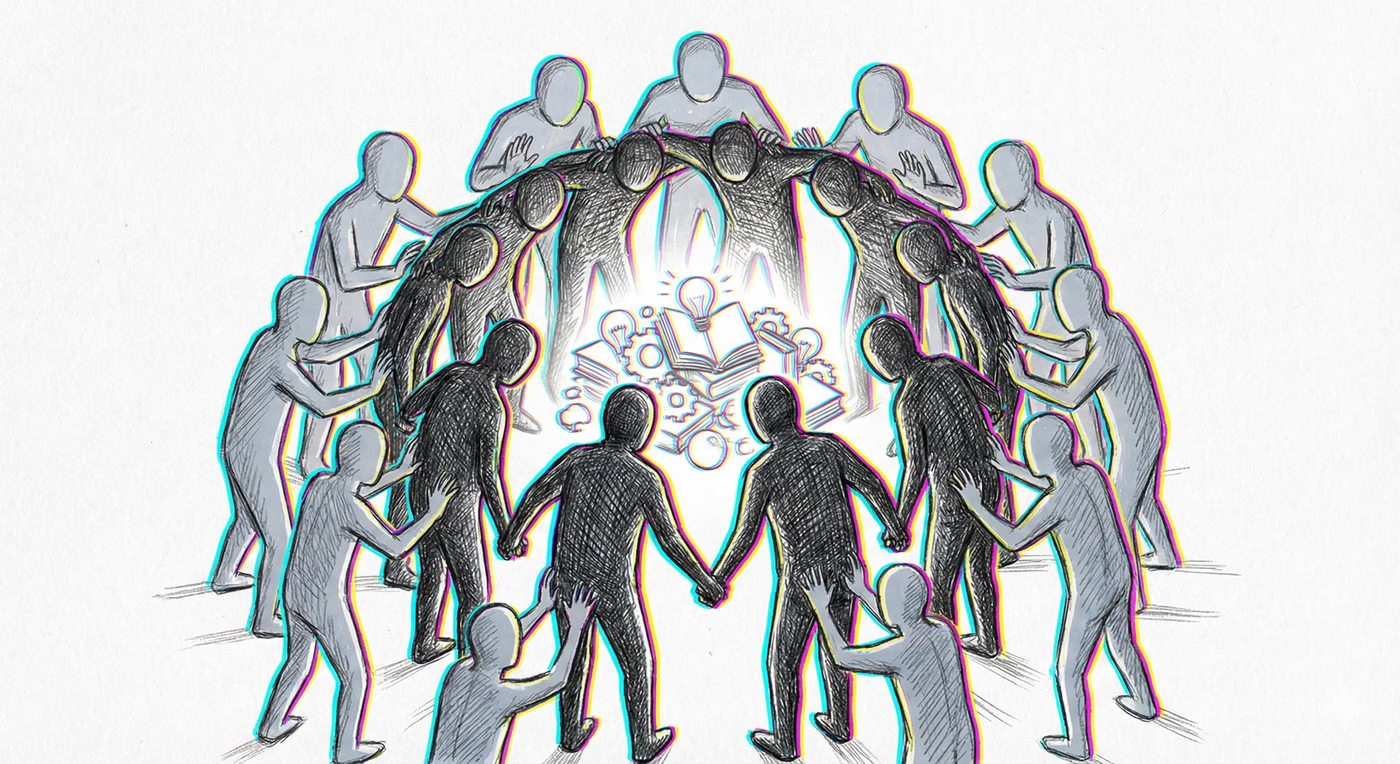
Groups spending most of their discussion time on information everyone already knows, while neglecting unique insights held by individuals.

WHAT IT IS

The glitch, explained plainly.

Imagine your family is trying to pick a restaurant. Everyone keeps talking about the pizza place they've all been to, because it's easy to agree on. But your little brother went to an amazing new taco place last week that nobody else has tried. He tries to mention it, but everyone keeps going back to talking about the pizza place because that's what they all know. So you end up at the pizza place again, even though the taco place might have been better.

When groups convene to make decisions, they systematically over-discuss information that all members already possess while under-discussing unique insights held by individual members. This creates a paradox: the very reason groups are assembled—to pool diverse knowledge—is undermined by a collective gravitational pull toward the familiar and already-known. The bias is amplified when groups face time pressure, seek consensus, or work on ambiguous judgment tasks rather than problems with demonstrably correct answers. As a result, groups often arrive at inferior decisions that any single well-informed member could have improved upon, because critical unshared information never surfaces or is dismissed when it does.

SOUND FAMILIAR?

Where it shows up.

  1. 01 A hospital diagnostic team meets to discuss a patient with puzzling symptoms. The three doctors spend 40 minutes debating the lab results they all reviewed, while the nurse who noticed an unusual medication interaction in the patient's history tries twice to bring it up but is talked over. The team settles on a diagnosis consistent with the shared lab data, missing the correct diagnosis that the nurse's unique observation would have revealed.
  2. 02 A startup's leadership team gathers to choose between three potential office locations. Each executive visited all three sites, but each also gathered unique local intelligence—one learned about upcoming construction, another about a tax incentive, a third about transit changes. The meeting is dominated by debate over rent prices and square footage that everyone already knows, and the team picks a location without ever surfacing the construction disruption that would have changed their decision.
  3. 03 A hiring committee reviews five candidates. Each committee member interviewed different candidates in addition to two they all interviewed. During deliberation, 80% of the discussion centers on the two commonly interviewed candidates, with rich anecdotes and comparisons. The uniquely interviewed candidates receive only brief, surface-level mentions, and the committee selects from the commonly seen pool despite one uniquely interviewed candidate being objectively stronger.
  4. 04 A product team at a tech company holds a retrospective after a failed launch. The engineers, designers, and marketers each have distinct insights about what went wrong in their domains, but the meeting keeps circling back to the server outage everyone witnessed. The design flaws and market misread that individual members uniquely understood are barely mentioned, so the team's action plan addresses only the infrastructure issue.
  5. 05 A jury deliberates on a fraud case. Eleven jurors fixate on the defendant's suspicious financial records that were central to the prosecution's closing argument—evidence everyone remembers clearly. One juror, who paid close attention to a brief expert testimony about industry-standard accounting practices, tries to contextualize the records but is dismissed because no one else recalls that testimony. The jury convicts based on the collectively salient evidence alone.
IN DIFFERENT DOMAINS

Where it shows up at work.

The same glitch looks different depending on the terrain. Finance, medicine, a relationship, a team — same mechanism, different costume.

Finance & investing

Investment committees tend to anchor discussions on market data and analyst reports available to all members, while overlooking unique sector intelligence or contrarian data points held by individual analysts. This leads to herding behavior and missed opportunities that would have been caught by properly surfacing unshared information.
Medicine & diagnosis

Diagnostic teams and clinical case conferences disproportionately discuss symptoms and test results available in the shared patient chart, while unique bedside observations or patient history details known to individual clinicians are underweighted or never mentioned, contributing to diagnostic errors.

Education & grading

Curriculum committees and academic review boards spend most of their time discussing widely known student performance metrics while neglecting unique qualitative insights from individual teachers about specific students' circumstances or learning needs.

Relationships

When couples or families make major decisions—moving, finances, caregiving—discussions gravitate toward concerns both parties share while unique worries or information held by one person are minimized, leading to decisions that don't account for the full picture.

Tech & product

Product development teams in sprint planning and design reviews fixate on user feedback and metrics visible to everyone on shared dashboards, while unique insights from individual user interviews, edge-case bug reports, or competitive intelligence gathered by one team member go undiscussed.

Workplace & hiring

In performance calibration sessions, managers spend most of the time discussing employees everyone has interacted with, while employees known primarily to one manager receive superficial review, leading to inequitable evaluations.

Politics Media

Legislative committees and policy task forces over-discuss widely reported polling data and media narratives while under-discussing unique constituent feedback or specialized policy research brought by individual members, producing policy that reflects popular narratives rather than comprehensive analysis.

HOW TO SPOT IT

Ask yourself…

  • Am I only hearing ideas and facts that I already knew before this meeting started?
  • Has anyone in this group been cut off or overlooked when trying to share something the rest of us haven't heard before?
  • Are we spending our discussion time proportionally to the importance of information, or proportionally to how many people already know it?
HOW TO DEFEND AGAINST IT

The playbook.

  • Before group discussion, have each member independently write down their unique information and insights, then systematically review each person's written contributions.
  • Assign explicit expert roles so the group knows who holds specialized knowledge and actively solicits it: 'What do you know about X that the rest of us might not?'
  • Use a structured discussion protocol that requires cycling through each member's unique contributions before opening general discussion.
  • Extend meeting time deliberately—research shows that unshared information is more likely to emerge in longer discussions after shared information has been exhausted.
  • Appoint a devil's advocate or information scout whose explicit job is to surface and champion information that hasn't been discussed yet.
FAMOUS CASES

In history.

  • The Bay of Pigs invasion (1961) is frequently cited as an example where Kennedy's advisory group discussed widely shared assumptions about the plan's viability while failing to surface and integrate unique dissenting intelligence held by individual members.
  • The Columbia Space Shuttle disaster (2003) investigation revealed that critical engineering concerns held by lower-level NASA engineers were not effectively surfaced in group decision-making sessions dominated by commonly held managerial assumptions about foam strike risks.
WHERE IT COMES FROM
Academic origin

Garold Stasser and William Titus, 1985, who introduced the hidden profile paradigm in their paper 'Pooling of unshared information in group decision making: Biased information sampling during discussion' published in the Journal of Personality and Social Psychology.

Evolutionary origin

In ancestral environments, information that multiple tribe members independently confirmed was more likely to be accurate and actionable—a form of social verification. Prioritizing commonly held knowledge reduced the risk of acting on one individual's potentially mistaken observation. This consensus-seeking mechanism promoted group cohesion and coordinated action, which were critical for collective survival activities like hunting and defense.

IN AI SYSTEMS

How the machines inherit it.

In ensemble AI systems and collaborative filtering, models trained on widely available or popular data points may over-represent common patterns while underweighting rare but informative signals from specialized data sources—a computational analog of shared information bias. In LLM-based group decision support tools, AI summaries may disproportionately highlight information mentioned by multiple participants, reinforcing the bias rather than surfacing unique contributions.

Read more on Wikipedia
FREE FIELD ZINE

10 glitches quietly running your life.

A free field-zine PDF — ten cognitive glitches named, illustrated, with a defense move for each. Plus the weekly Glitch Report on Fridays — one bias named, two spotted in the wild, one defense move. Unsubscribe any time.

EXPLORE MORE

Related glitches.

LAUNCH PRICE

Train against your blindspots.

50 cards are free to preview. Buyers unlock the rest of the deck plus the interactive training — Spot-the-Bias Quiz unlimited, Swipe Deck with spaced repetition, My Blindspots, Decision Pre-Flight, the Printable Deck + Cheat Sheets, and the Field Guide e-book. $29.50$59.

Unlock the full deck

Everything below — yours forever. Pay once, use across every device.

Half-off launch — limited to the first 100 readers. Auto-applied at checkout.
$59 $29.50
one-time payment · lifetime access
  • All interactive digital cards — search, filter, flip, shuffle on any device
  • Five training modes — Spot-the-Bias Quiz, Swipe Deck, Pre-Flight, Blindspots, Journal
  • Curated Lenses + Decision Templates + Defense Playbook
  • Printable Deck PDFs + Field Guide e-book + Cheat Sheets + Anki Export
  • Every future improvement, included
Unlock  $29.50

30-day refund · no questions asked

Unlock the full deck

Everything below — yours forever. Pay once, use across every device.

Half-off launch — limited to the first 100 readers. Auto-applied at checkout.
$59 $29.50
one-time payment · lifetime access
  • All interactive digital cards — search, filter, flip, shuffle on any device
  • Five training modes — Spot-the-Bias Quiz, Swipe Deck, Pre-Flight, Blindspots, Journal
  • Curated Lenses + Decision Templates + Defense Playbook
  • Printable Deck PDFs + Field Guide e-book + Cheat Sheets + Anki Export
  • Every future improvement, included
Unlock  $29.50

30-day refund · no questions asked