Need for Closure

aka Need for Cognitive Closure · NFC · NFCC

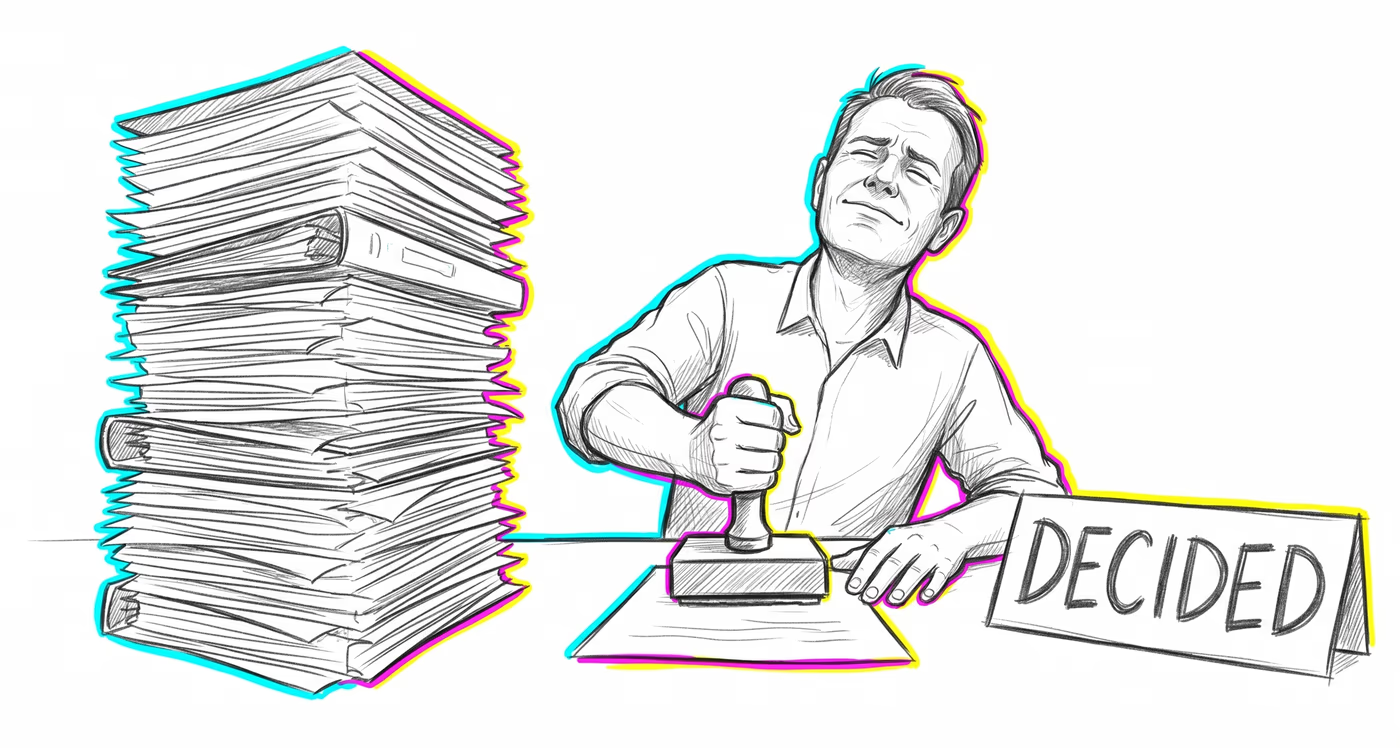
A strong desire for any definite answer rather than tolerating uncertainty, leading to premature and rigid conclusions.

WHAT IT IS

The glitch, explained plainly.

Imagine you're doing a jigsaw puzzle but it's almost bedtime. Instead of carefully finding the right piece, you just jam in the first piece that sort of fits and say 'done!' Then, even when someone shows you it's the wrong piece, you don't want to pull it out because you already decided the puzzle is finished.

Need for Closure describes a motivational continuum in which individuals vary in their desire to reach a firm, unambiguous conclusion quickly rather than sit with open-ended uncertainty. People high in this tendency engage in two signature behaviors: 'seizing'—latching onto the first available piece of information that offers a resolution—and 'freezing'—rigidly maintaining that conclusion and becoming resistant to new or contradictory evidence. This motivation is amplified by situational pressures such as time constraints, fatigue, noise, and information overload. While it operates as a stable personality trait, it can be temporarily heightened or reduced by environmental conditions, making it both a disposition and a context-sensitive state.

SOUND FAMILIAR?

Where it shows up.

  1. 01 Maria is managing a product launch with an ambiguous market signal. Rather than commissioning additional consumer research, she declares the existing data 'good enough,' locks in a pricing strategy within the first meeting, and refuses to revisit it when her analyst presents contradictory survey results the following week.
  2. 02 During jury deliberations, Hector feels increasingly agitated as the discussion enters its third hour without a verdict. He starts pressuring other jurors to 'just pick a side already,' gravitating toward the first coherent narrative presented by the prosecution and dismissing defense arguments as unnecessarily complicating things.
  3. 03 A hiring manager interviews twelve candidates over two exhausting days. By the afternoon of the second day, she starts making snap decisions about candidates within the first two minutes and mentally commits to those impressions, barely processing the rest of each interview.
  4. 04 After reading a single alarming headline about a new dietary supplement, David immediately tells his family it's dangerous and stops buying it. When his wife later shares a peer-reviewed study showing the supplement is safe, he dismisses it, saying he's already 'done his research' and sees no reason to reconsider.
  5. 05 A policy advisor reviewing proposals for urban transit reform notices that one plan is neatly organized with clear cost projections, while a competing plan acknowledges significant unknowns and presents multiple contingency scenarios. She recommends the first plan, not because its evidence is stronger, but because its certainty feels more actionable and less cognitively taxing to defend.
IN DIFFERENT DOMAINS

Where it shows up at work.

The same glitch looks different depending on the terrain. Finance, medicine, a relationship, a team — same mechanism, different costume.

Finance & investing

Investors under time pressure or information overload tend to latch onto the first analyst recommendation they encounter and hold that position rigidly, failing to incorporate subsequent earnings reports or market shifts that contradict their initial thesis.
Medicine & diagnosis

Physicians experiencing high caseloads may seize on an initial diagnosis early in a patient encounter and freeze on it, ordering confirmatory tests while neglecting to consider alternative diagnoses—a pattern that increases rates of diagnostic error.

Education & grading

Teachers may form fixed impressions of student ability based on early performance and resist updating those assessments, leading to self-fulfilling prophecies where late-blooming students are overlooked because the instructor has already reached a conclusion.

Relationships

Partners who need closure may push for premature resolution during arguments—demanding immediate apologies or definitive answers—rather than allowing space for reflection, which can escalate conflict and prevent genuine understanding.

Tech & product

Product teams may lock into an initial design direction after early user testing and resist pivoting when subsequent data reveals different user needs, particularly under tight sprint deadlines that amplify the desire for decisional finality.

Workplace & hiring

Managers high in need for closure tend to prefer autocratic decision-making styles with clear hierarchies and role definitions, and may shut down brainstorming sessions prematurely by selecting the first workable solution rather than exploring creative alternatives.

Politics Media

Voters with high need for closure are drawn to political messaging that provides simple, definitive explanations for complex social problems, and are more resistant to nuanced policy discussions that acknowledge trade-offs and uncertainty.

HOW TO SPOT IT

Ask yourself…

  • Am I rushing to a conclusion because the ambiguity is making me uncomfortable, rather than because I have enough evidence?
  • Have I stopped seeking new information or alternative explanations since forming my initial impression?
  • Am I dismissing contradictory evidence because I've already 'made up my mind,' or because the evidence is genuinely weak?
HOW TO DEFEND AGAINST IT

The playbook.

  • Implement a 'cooling off' rule: delay final decisions by a set period (e.g., 24 hours) to allow new information to surface before committing.
  • Practice 'consider the opposite': before locking in a judgment, actively generate at least two alternative explanations for the same evidence.
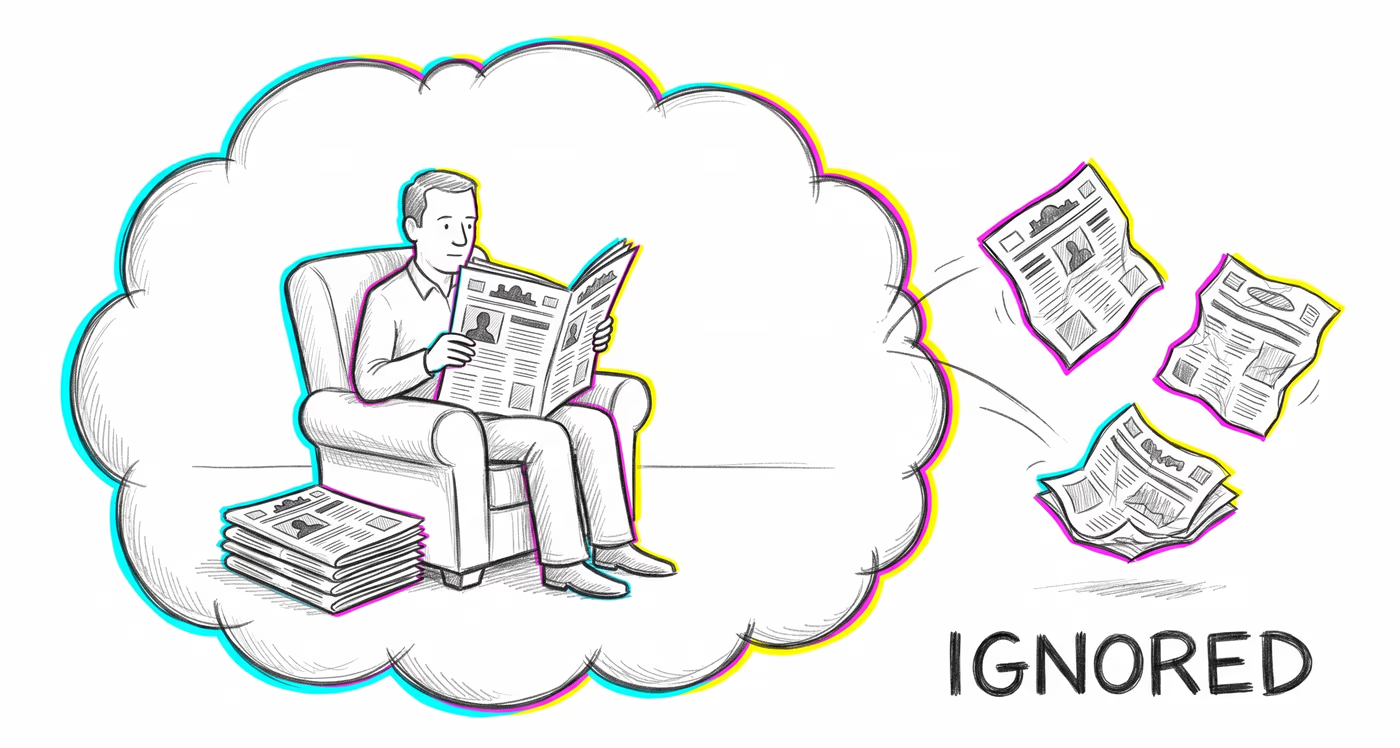
  • Ask yourself the 'newspaper test': if tomorrow's headline proved your conclusion wrong, would you have enough evidence to defend how you reached it?
  • Assign a devil's advocate role in group settings to institutionalize the challenge of premature consensus.
  • Label the discomfort: recognize that the anxiety you feel from ambiguity is a motivational state, not evidence that your first answer is correct.
FAMOUS CASES

In history.

  • The rush to attribute the 2001 anthrax letter attacks to a foreign source before evidence pointed to a domestic perpetrator illustrates institutional seizing and freezing under national security pressure.
  • Groupthink in the Bay of Pigs invasion planning, where the Kennedy administration locked onto the initial CIA plan and suppressed dissenting viewpoints, reflects collective need for closure under political urgency.
WHERE IT COMES FROM
Academic origin

Arie W. Kruglanski introduced the construct in 1989 in his theory of lay epistemics. Donna M. Webster and Kruglanski developed the Need for Closure Scale (NFCS) in 1994 and formalized the seizing-and-freezing framework in their 1996 Psychological Review paper.

Evolutionary origin

In ancestral environments, rapid decision-making under threat was essential—hesitating when facing predators or hostile strangers could be fatal. A mind biased toward quick, decisive conclusions allowed faster threat response and coordinated group action. The permanence tendency preserved hard-won knowledge in stable environments where conditions changed slowly.

IN AI SYSTEMS

How the machines inherit it.

Machine learning systems can exhibit closure-like behavior when trained with early stopping or limited data: the model 'seizes' on patterns available in initial training batches and 'freezes' on those representations. Recommender algorithms may lock users into narrow content silos by over-indexing on early behavioral signals, creating filter bubbles analogous to the seizing-freezing cycle.

Read more on Wikipedia
FREE FIELD ZINE

10 glitches quietly running your life.

A free field-zine PDF — ten cognitive glitches named, illustrated, with a defense move for each. Plus the weekly Glitch Report on Fridays — one bias named, two spotted in the wild, one defense move. Unsubscribe any time.

EXPLORE MORE

Related glitches.

LAUNCH PRICE

Train against your blindspots.

50 cards are free to preview. Buyers unlock the rest of the deck plus the interactive training — Spot-the-Bias Quiz unlimited, Swipe Deck with spaced repetition, My Blindspots, Decision Pre-Flight, the Printable Deck + Cheat Sheets, and the Field Guide e-book. $29.50$59.

Unlock the full deck

Everything below — yours forever. Pay once, use across every device.

Half-off launch — limited to the first 100 readers. Auto-applied at checkout.
$59 $29.50
one-time payment · lifetime access
  • All interactive digital cards — search, filter, flip, shuffle on any device
  • Five training modes — Spot-the-Bias Quiz, Swipe Deck, Pre-Flight, Blindspots, Journal
  • Curated Lenses + Decision Templates + Defense Playbook
  • Printable Deck PDFs + Field Guide e-book + Cheat Sheets + Anki Export
  • Every future improvement, included
Unlock  $29.50

30-day refund · no questions asked

Unlock the full deck

Everything below — yours forever. Pay once, use across every device.

Half-off launch — limited to the first 100 readers. Auto-applied at checkout.
$59 $29.50
one-time payment · lifetime access
  • All interactive digital cards — search, filter, flip, shuffle on any device
  • Five training modes — Spot-the-Bias Quiz, Swipe Deck, Pre-Flight, Blindspots, Journal
  • Curated Lenses + Decision Templates + Defense Playbook
  • Printable Deck PDFs + Field Guide e-book + Cheat Sheets + Anki Export
  • Every future improvement, included
Unlock  $29.50

30-day refund · no questions asked