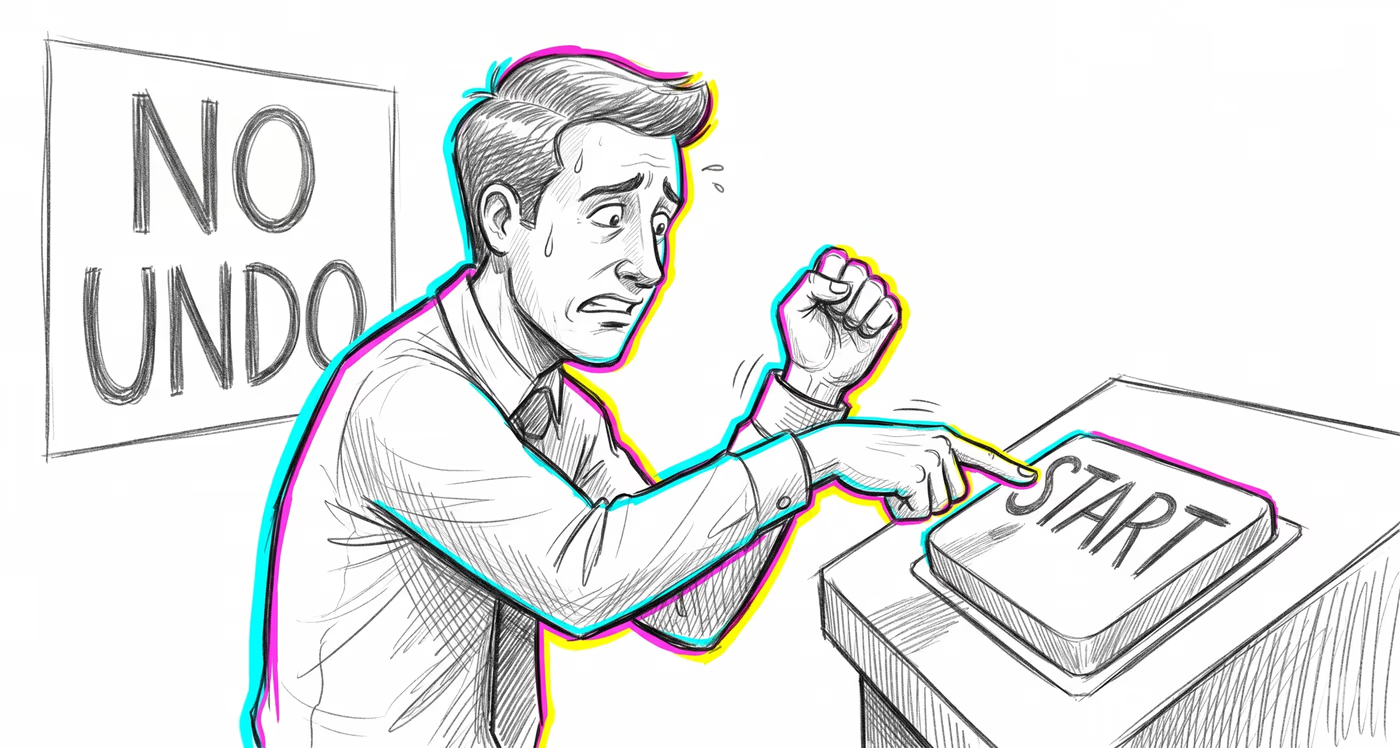
Simulation Heuristic

aka Mental Simulation Heuristic · Counterfactual Simulation

Judging likelihood or feeling regret based on how easily an alternative outcome can be mentally imagined.

WHAT IT IS

The glitch, explained plainly.

Imagine you're at a carnival and you throw a ball at a stack of bottles. If you miss by a mile, you shrug it off. But if the ball just barely grazes the top bottle and it wobbles but doesn't fall, you feel way worse — because your brain instantly plays a little movie of the bottle falling over with just a tiny bit more force. Your brain judges how bad or good something is by how easily it can imagine a different ending.

The simulation heuristic describes the mental process by which people construct imaginary scenarios—alternative versions of events that did or could happen—and use the ease of that construction to judge probability, causality, and emotional impact. When an outcome feels easily 'undone' through small mental tweaks (such as leaving five minutes earlier to catch a flight), the person experiences stronger emotional reactions like regret or relief, regardless of whether those tweaks would have actually changed the objective probability. This heuristic is especially powerful in near-miss situations, where the psychological distance between what happened and what could have happened is small and vividly imaginable. It also drives anticipatory regret, causing people to avoid decisions where they can easily picture a negative outcome unfolding.

SOUND FAMILIAR?

Where it shows up.

  1. 01 Maria missed her connecting flight by 3 minutes due to a gate change. Her colleague, who was booked on the same flight, had missed it by 2 hours because of a canceled earlier connection. Despite both being stranded overnight at the same airport, Maria is visibly far more distressed and keeps saying 'If only I had run a little faster.'
  2. 02 After a devastating earthquake, news coverage focuses heavily on a family that died because the father chose to take an unusual shortcut home that day. Viewers express far more sorrow for this family than for others who died on their normal routes, despite identical outcomes, because they can easily imagine the father simply driving his regular way home.
  3. 03 A venture capitalist turns down a startup that later becomes a billion-dollar company. She is haunted by this decision far more than dozens of other rejected startups, because the founders had personally pitched to her three times and she had come very close to writing the check. She now overweights the risk of passing on persistent founders, not because of any statistical pattern, but because the near-investment is so easy to mentally replay with a different ending.
  4. 04 A lottery player who switched his usual numbers at the last moment and lost feels devastated when his original numbers come up. Another player who has used random numbers for years and also lost feels nothing special. The first player's torment is entirely driven by how vividly he can picture the world in which he didn't switch.
  5. 05 A product manager cancels a feature launch after it narrowly missed passing QA. For weeks, she obsesses over tiny process tweaks that could have gotten it through, while ignoring a completely different feature that failed QA by a wide margin. Her planning energy is now disproportionately allocated to preventing 'near misses' rather than addressing the deeper systemic failures.
IN DIFFERENT DOMAINS

Where it shows up at work.

The same glitch looks different depending on the terrain. Finance, medicine, a relationship, a team — same mechanism, different costume.

Finance & investing

Investors experience outsized regret over stocks they nearly bought that subsequently soared, leading to impulsive 'revenge' purchases of similar assets. The ease of mentally simulating 'I almost clicked buy' distorts future risk assessment more than actual portfolio losses from positions they held.
Medicine & diagnosis

Patients who narrowly miss qualifying for a clinical trial or treatment threshold experience greater distress than those who were far from eligibility, even when the medical prognosis is identical. Clinicians may also feel disproportionate guilt over adverse outcomes that followed small, easily reversible decisions (choosing drug A over drug B) compared to outcomes from standard protocols.

Education & grading

Students who fail an exam by a single point experience dramatically more regret and self-blame than students who fail by twenty points, despite the identical consequence. Teachers may also dwell more on students who 'almost' passed, allocating disproportionate mental energy to those near-miss cases.

Relationships

People tend to ruminate far more intensely about relationships that 'almost worked' — the partner who was nearly perfect but for one issue — than about clearly incompatible matches. This mental replaying of small mutable details ('If only I hadn't said that one thing') can delay emotional closure.

Tech & product

Users who experience a system crash right before saving their work report far greater frustration than users who lose work early in a session, because the near-save is trivially easy to mentally undo. Product teams can exploit this by implementing auto-save to eliminate the high-regret 'near miss' of lost work.

Workplace & hiring

Hiring managers who nearly chose a candidate that went on to succeed spectacularly elsewhere experience outsized regret that biases their future hiring toward similar profiles, regardless of whether the pattern is statistically meaningful. Teams also dwell more on project failures caused by last-minute reversible decisions than on those caused by deep structural problems.

Politics Media

Election near-misses (razor-thin margins) generate vastly more counterfactual analysis and emotional intensity than landslides, with media and voters endlessly debating the small, mutable factors ('If only turnout had been slightly higher in one county') while ignoring broader structural causes.

HOW TO SPOT IT

Ask yourself…

  • Am I feeling stronger emotion about this outcome primarily because I can easily picture a small change that would have led to a different result?
  • Would I feel the same level of regret or distress if the 'miss' had been by a wide margin instead of a narrow one?
  • Am I confusing how easy it is to imagine an alternative with how likely that alternative actually was?
HOW TO DEFEND AGAINST IT

The playbook.

  • Ask yourself: 'Would the objective probability of success actually have been higher if I imagine this small change, or does it just feel that way because it's easy to picture?'
  • Deliberately simulate the opposite direction — imagine how things could have gone much worse — to counterbalance the upward counterfactual pull.
  • Quantify the actual probability rather than relying on narrative fluency: write down the real odds of the alternative scenario occurring.
  • Use pre-commitment: before learning an outcome, decide in advance how you will evaluate the decision based on the process, not the proximity of the result.
  • When ruminating on a near-miss, explicitly list all the other mutable factors you are ignoring — this breaks the illusion that one small change was the sole pivot point.
FAMOUS CASES

In history.

  • The 1992 Olympic medal study by Medvec, Madey, and Gilovich showed that bronze medalists appeared happier than silver medalists, because silver medalists could easily simulate winning gold while bronze medalists simulated finishing without any medal.
  • The Kahneman and Tversky 'Mr. Crane and Mr. Tees' thought experiment (1982) demonstrated that people attribute more frustration to a traveler who missed his flight by 5 minutes than one who missed by 30 minutes, despite identical outcomes.
WHERE IT COMES FROM
Academic origin

Daniel Kahneman and Amos Tversky, first presented in a 1979 lecture and formally published as a chapter in 'Judgment Under Uncertainty: Heuristics and Biases' (1982).

Evolutionary origin

The ability to mentally simulate alternative outcomes likely evolved as a planning and learning mechanism. Ancestors who could vividly imagine 'what would have happened if I had gone left instead of right' could extract causal lessons from near-misses with predators, failed hunts, or environmental hazards — refining future behavior without paying the full cost of repeated trial and error.

IN AI SYSTEMS

How the machines inherit it.

Generative language models trained on human text absorb the simulation heuristic's patterns by overrepresenting vivid, easily-narrated counterfactual scenarios in their outputs. When asked to assess risk or generate explanations, LLMs may emphasize 'near miss' narratives and mutable factors over statistically more relevant but harder-to-imagine base rates, mirroring human tendencies to equate imaginability with probability.

Read more on Wikipedia
FREE FIELD ZINE

10 glitches quietly running your life.

A free field-zine PDF — ten cognitive glitches named, illustrated, with a defense move for each. Plus the weekly Glitch Report on Fridays — one bias named, two spotted in the wild, one defense move. Unsubscribe any time.

EXPLORE MORE

Related glitches.

LAUNCH PRICE

Train against your blindspots.

50 cards are free to preview. Buyers unlock the rest of the deck plus the interactive training — Spot-the-Bias Quiz unlimited, Swipe Deck with spaced repetition, My Blindspots, Decision Pre-Flight, the Printable Deck + Cheat Sheets, and the Field Guide e-book. $29.50$59.

Unlock the full deck

Everything below — yours forever. Pay once, use across every device.

Half-off launch — limited to the first 100 readers. Auto-applied at checkout.
$59 $29.50
one-time payment · lifetime access
  • All interactive digital cards — search, filter, flip, shuffle on any device
  • Five training modes — Spot-the-Bias Quiz, Swipe Deck, Pre-Flight, Blindspots, Journal
  • Curated Lenses + Decision Templates + Defense Playbook
  • Printable Deck PDFs + Field Guide e-book + Cheat Sheets + Anki Export
  • Every future improvement, included
Unlock  $29.50

30-day refund · no questions asked

Unlock the full deck

Everything below — yours forever. Pay once, use across every device.

Half-off launch — limited to the first 100 readers. Auto-applied at checkout.
$59 $29.50
one-time payment · lifetime access
  • All interactive digital cards — search, filter, flip, shuffle on any device
  • Five training modes — Spot-the-Bias Quiz, Swipe Deck, Pre-Flight, Blindspots, Journal
  • Curated Lenses + Decision Templates + Defense Playbook
  • Printable Deck PDFs + Field Guide e-book + Cheat Sheets + Anki Export
  • Every future improvement, included
Unlock  $29.50

30-day refund · no questions asked