In-Group Bias

aka In-Group Favoritism · In-Group–Out-Group Bias · Intergroup Bias

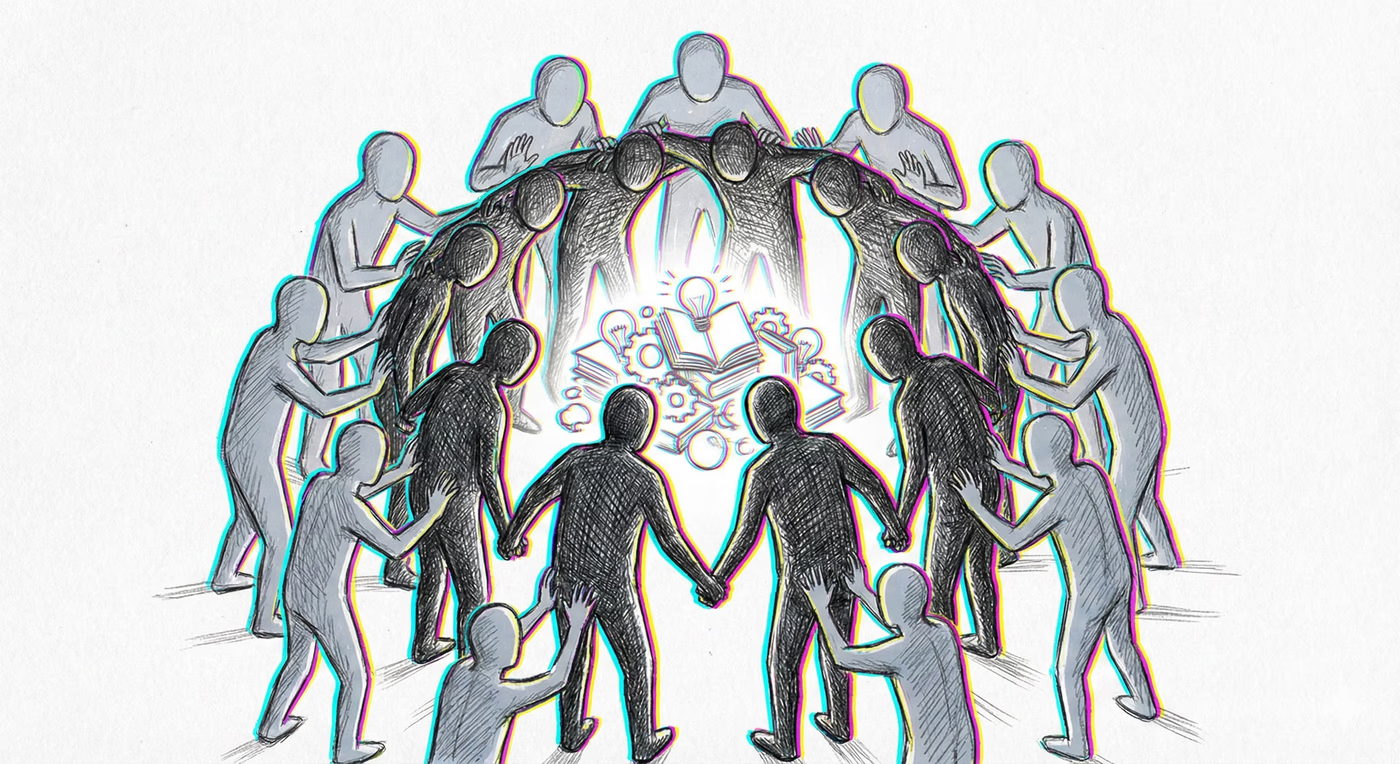
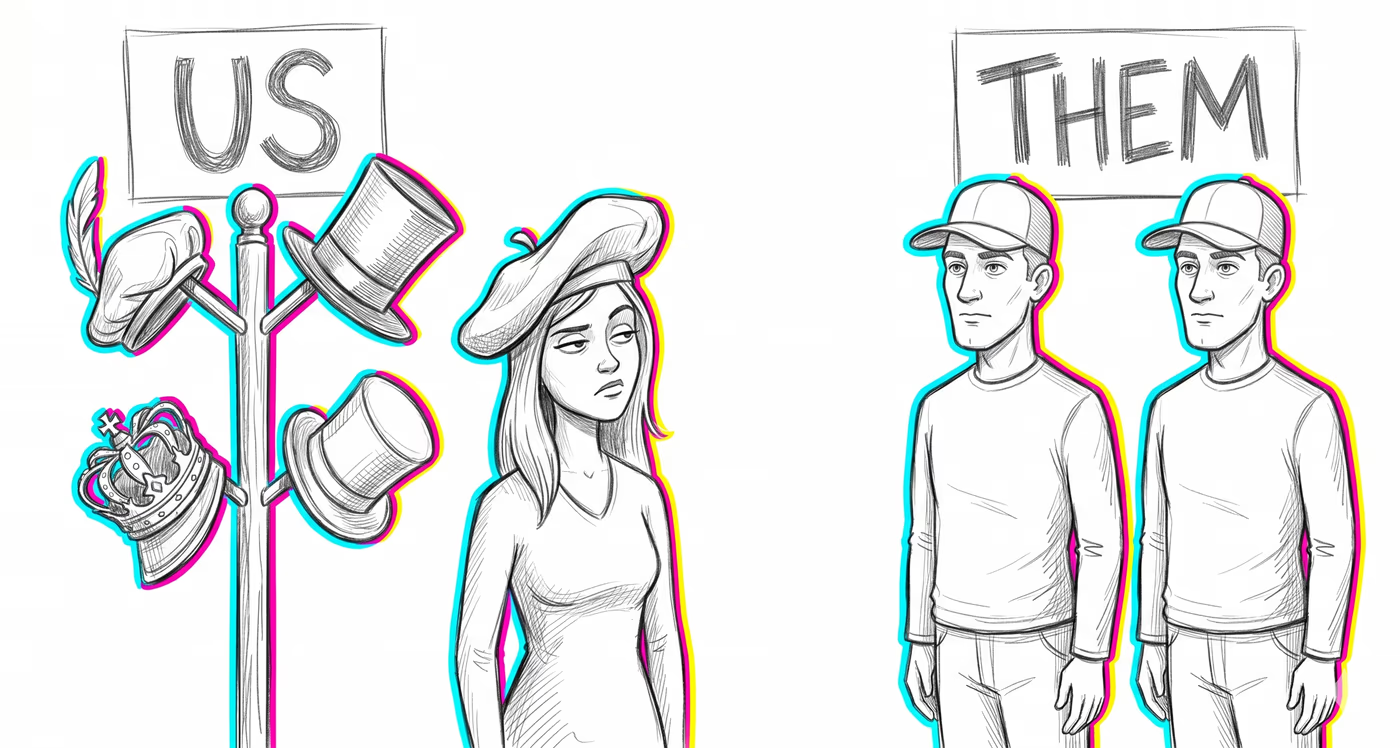
Favoring, trusting, and giving preferential treatment to people in your own group over outsiders, even when the grouping is arbitrary.

Illustration: In-Group Bias
WHAT IT IS

The glitch, explained plainly.

Imagine you're on a playground and a teacher splits everyone into the Blue Team and the Red Team just by picking names from a hat. Even though the teams mean nothing, you almost immediately start thinking your team is better, cheering harder for Blue Team kids, and wanting to share your snacks with them first. That feeling of 'my team is the best' is in-group bias — your brain automatically makes you like people more just because you share the same label.

In-group bias describes the systematic pattern by which people evaluate members of their own group more positively, allocate more resources to them, attribute better motives to their behavior, and feel greater trust and empathy toward them — while simultaneously devaluing, distrusting, or neglecting out-group members. This preferential treatment occurs across virtually any group boundary, from ethnicity and nationality to random lab assignments and sports team allegiance. Critically, the bias does not require competition, prior conflict, or even meaningful group distinctions; mere categorization into a labeled group is sufficient to trigger favoritism. The bias manifests in evaluations, resource allocation, memory encoding, empathy, and moral judgment, creating a pervasive asymmetry in how people experience and treat those they perceive as 'us' versus 'them.'

SOUND FAMILIAR?

Where it shows up.

  1. 01 A venture capital partner reviews two nearly identical startup pitches. She spends 45 minutes enthusiastically grilling the team that includes a fellow Stanford MBA, asking probing but supportive questions. She gives the other team — equally qualified founders from a state university — only 20 minutes and asks mostly skeptical questions. She later tells her partners the Stanford team just 'had more depth.'
  2. 02 During a corporate restructuring, a manager must lay off one person from her team. She keeps the employee who joined the company the same year she did and shares her love of hiking, despite the other employee having stronger performance reviews. She justifies it by saying the retained employee is 'a better culture fit.'
  3. 03 A jury deliberates a civil dispute between two business owners. One juror, who shares the defendant's ethnic background, consistently interprets ambiguous evidence in the defendant's favor and characterizes the plaintiff's identical behavior as 'suspicious.' Other jurors notice the pattern, but the juror genuinely believes he is being objective.
  4. 04 A teacher assigns group projects randomly. When grading, she notices that the group containing three students from her homeroom class produced mediocre work, but she gives them a B+ because she 'knows they tried hard.' The other group, made up of students she rarely interacts with, produced similar-quality work but receives a B-.
  5. 05 An online forum moderator is lenient when longtime community members post borderline content, issuing friendly reminders. When newer members from a rival forum post identical content, the moderator issues formal warnings or bans, reasoning that 'they should know the rules by now' — even though both groups received the same onboarding guidelines.
IN DIFFERENT DOMAINS

Where it shows up at work.

The same glitch looks different depending on the terrain. Finance, medicine, a relationship, a team — same mechanism, different costume.

Finance & investing

Investment committees tend to fund entrepreneurs from their own alumni networks or social circles, leading to systematic underinvestment in equally promising ventures led by founders from different backgrounds. Portfolio managers may also overweight stocks of companies headquartered in their home region.
Medicine & diagnosis

Physicians may unconsciously spend more time with patients who share their cultural background, provide more thorough explanations, and interpret symptoms more charitably. Studies show that patients from different racial or ethnic groups than their doctor may receive less pain medication and fewer referrals for specialist care.

Education & grading

Teachers tend to call on, encourage, and give higher evaluative feedback to students who share their gender, ethnicity, or socioeconomic markers. Peer group dynamics in classrooms also create in-group cliques that can isolate minority students from collaborative learning opportunities.

Relationships

People often warn friends about dating someone 'outside their group' — whether that means religion, class, or ethnicity — based on vague concerns about compatibility. Families may welcome partners who share their cultural background with warmth while treating different-background partners with subtle coolness or heightened scrutiny.

Tech & product

Engineering teams sometimes dismiss user research conducted by outside consultants while readily accepting nearly identical findings from internal team members. Platform recommendation algorithms can amplify in-group bias by clustering users into homogeneous communities that reinforce shared perspectives.

Workplace & hiring

Hiring managers tend to favor candidates who remind them of themselves or share alumni networks, hobbies, or demographic traits. Performance reviews show consistent patterns of higher ratings for employees who belong to the same informal social group as their evaluator.

Politics Media

Voters evaluate identical policy proposals more favorably when attributed to their own political party and more critically when attributed to the opposition. Media consumers selectively trust and share stories from outlets aligned with their ideological group while dismissing equivalent reporting from rival outlets.

HOW TO SPOT IT

Ask yourself…

  • Am I evaluating this person's idea differently than I would if they were from my group — or from an outside group?
  • Would I extend the same trust, benefit of the doubt, or resources to someone who didn't share my background or affiliation?
  • Am I attributing this person's negative behavior to their character because they're an outsider, while I'd excuse the same behavior from an insider?
HOW TO DEFEND AGAINST IT

The playbook.

  • Use structured, blind evaluation processes: remove names, photos, and group-identifying information from resumes, proposals, and performance reviews before assessment.
  • Practice individuation: before making a judgment about someone, deliberately identify three unique, personal attributes about them that have nothing to do with their group membership.
  • Apply the 'swap test': mentally replace the person with someone from the opposite group and check whether your evaluation changes. If it does, your judgment is likely group-influenced.
  • Seek superordinate identities: focus on shared goals and overarching group memberships (e.g., 'we're all on the same project team') to reduce the salience of subgroup boundaries.
  • Build genuine cross-group contact: research shows that sustained, cooperative interactions with out-group members — especially toward shared goals — reduce the automatic activation of in-group bias.
FAMOUS CASES

In history.

  • The Rwandan genocide (1994), where Hutu-Tutsi group identity was exploited to fuel mass violence against an out-group defined largely by colonial-era categorizations.
  • Sherif's Robbers Cave Experiment (1954) demonstrated that randomly assigned groups of boys rapidly developed intense in-group loyalty and out-group hostility through mere group categorization and competition.
  • Sectarian violence in Northern Ireland's Troubles, where Catholic and Protestant community identity drove decades of conflict despite shared geography and language.
  • Japanese American internment during World War II, where national in-group fear of a perceived out-group led to the forced relocation of over 120,000 citizens based solely on ethnic categorization.
WHERE IT COMES FROM
Academic origin

Henri Tajfel and colleagues formalized the concept through the minimal group paradigm experiments in 1970–1971. Tajfel and John Turner later developed Social Identity Theory (1979) to explain the psychological mechanisms underlying in-group favoritism. William Sumner introduced the related concept of ethnocentrism in 1906.

Evolutionary origin

In ancestral environments, survival depended on tight-knit coalitions for defense, resource sharing, and cooperative hunting. Quickly identifying who belonged to your band and favoring them with trust and resources increased the likelihood that those individuals would reciprocate — creating a cooperative advantage. Conversely, strangers from unknown groups posed potential threats of violence, disease, or resource competition. The brain evolved to default to trusting insiders and approaching outsiders with caution, because the cost of misplaced trust toward a hostile stranger was far greater than the cost of slight unfairness toward an outsider.

IN AI SYSTEMS

How the machines inherit it.

Machine learning models trained on data generated by homogeneous groups can embed and amplify in-group preferences — for example, facial recognition systems performing better on faces of the majority demographic group in the training data. Recommendation algorithms can create 'filter bubbles' that algorithmically reinforce in-group information consumption, and language models may reflect evaluative asymmetries present in their training corpora, generating more positive language about culturally dominant groups.

Read more on Wikipedia
FREE FIELD ZINE

10 glitches quietly running your life.

A free field-zine PDF — ten cognitive glitches named, illustrated, with a defense move for each. Plus the weekly Glitch Report on Fridays — one bias named, two spotted in the wild, one defense move. Unsubscribe any time.

EXPLORE MORE

Related glitches.

LAUNCH PRICE

Train against your blindspots.

50 cards are free to preview. Buyers unlock the rest of the deck plus the interactive training — Spot-the-Bias Quiz unlimited, Swipe Deck with spaced repetition, My Blindspots, Decision Pre-Flight, the Printable Deck + Cheat Sheets, and the Field Guide e-book. $29.50$59.

Unlock the full deck

Everything below — yours forever. Pay once, use across every device.

Half-off launch — limited to the first 100 readers. Auto-applied at checkout.
$59 $29.50
one-time payment · lifetime access
  • All interactive digital cards — search, filter, flip, shuffle on any device
  • Five training modes — Spot-the-Bias Quiz, Swipe Deck, Pre-Flight, Blindspots, Journal
  • Curated Lenses + Decision Templates + Defense Playbook
  • Printable Deck PDFs + Field Guide e-book + Cheat Sheets + Anki Export
  • Every future improvement, included
Unlock  $29.50

30-day refund · no questions asked

Unlock the full deck

Everything below — yours forever. Pay once, use across every device.

Half-off launch — limited to the first 100 readers. Auto-applied at checkout.
$59 $29.50
one-time payment · lifetime access
  • All interactive digital cards — search, filter, flip, shuffle on any device
  • Five training modes — Spot-the-Bias Quiz, Swipe Deck, Pre-Flight, Blindspots, Journal
  • Curated Lenses + Decision Templates + Defense Playbook
  • Printable Deck PDFs + Field Guide e-book + Cheat Sheets + Anki Export
  • Every future improvement, included
Unlock  $29.50

30-day refund · no questions asked