Hawthorne Effect

aka Observer Effect · Participant Reactivity · Observer Bias

Changing behavior when aware of being observed, typically performing better or more carefully than usual.

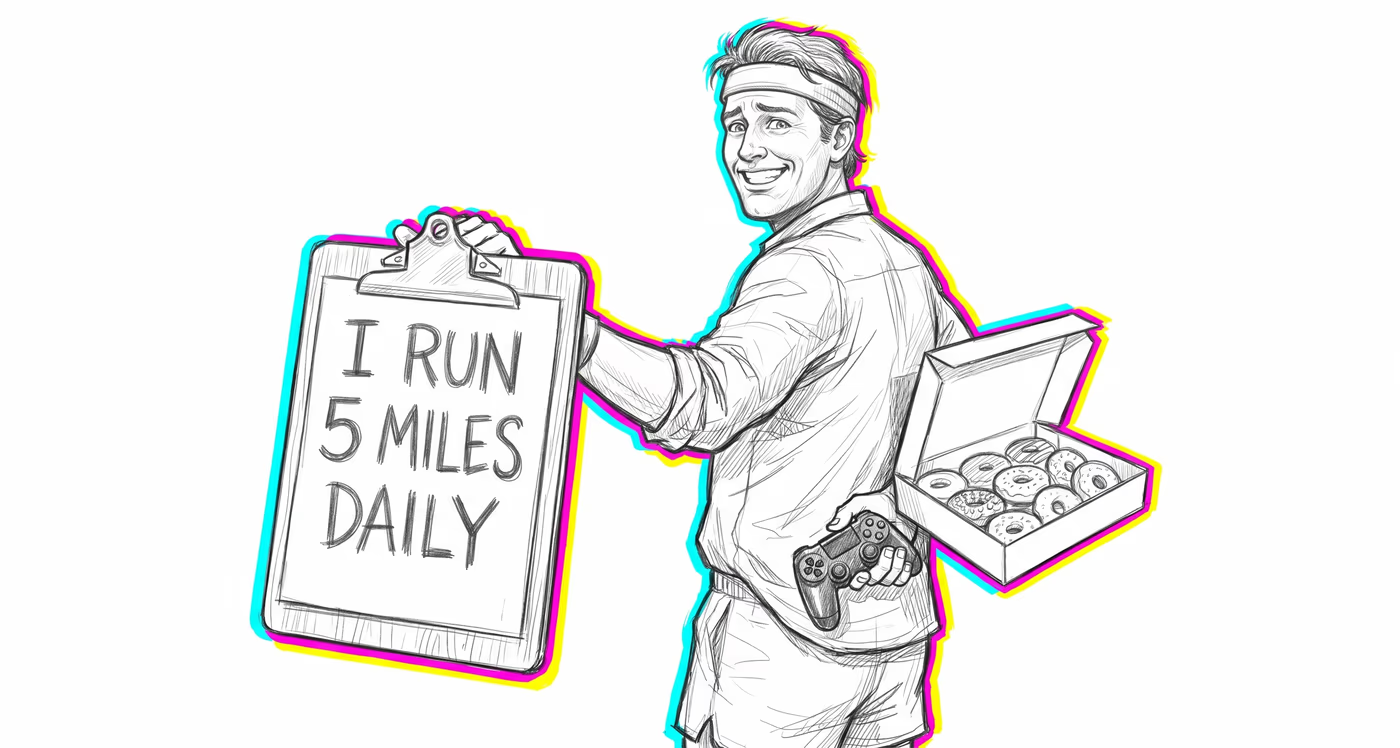
Illustration: Hawthorne Effect
WHAT IT IS

The glitch, explained plainly.

Imagine your teacher walks over and stands right behind you while you're working on a worksheet. Even though nothing about the worksheet changed, you suddenly sit up straighter, stop doodling, and try way harder—just because someone is watching. That's the Hawthorne Effect: you act differently when you know eyes are on you.

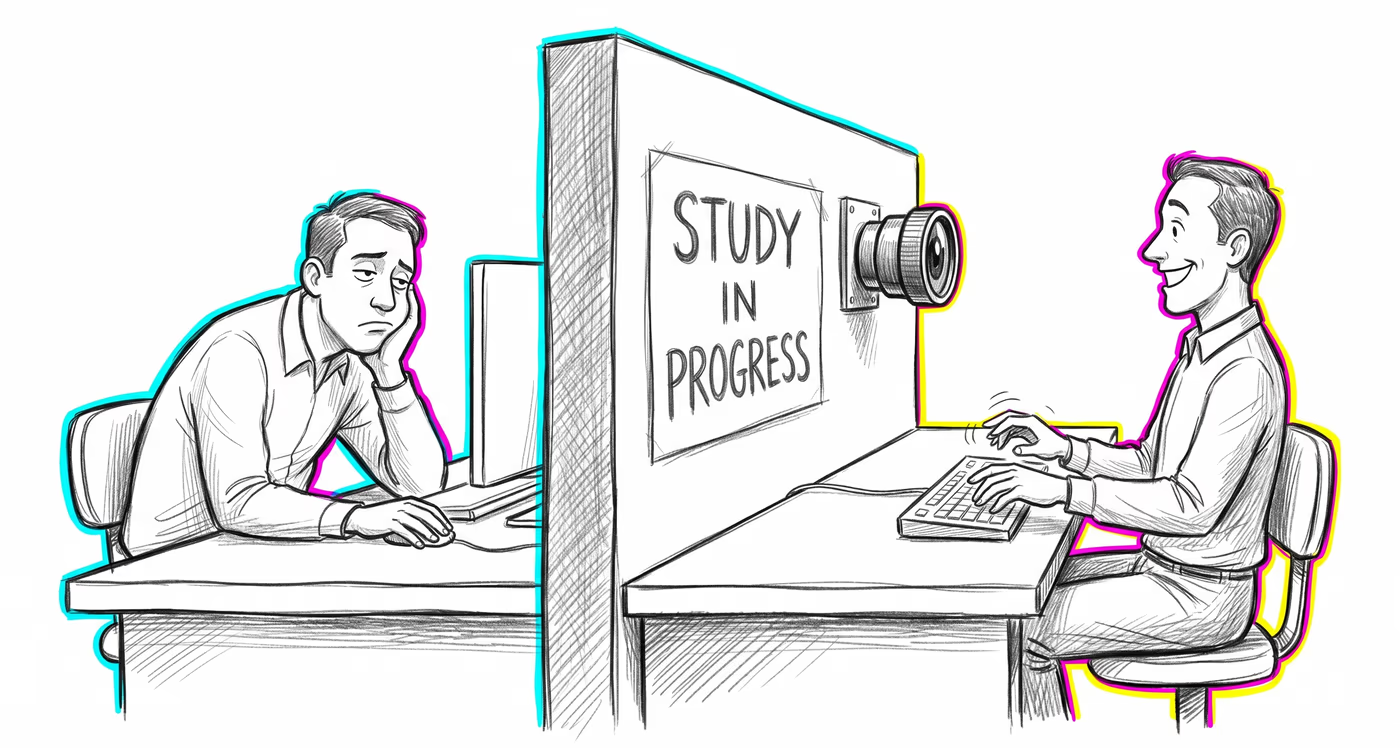
The Hawthorne Effect describes how individuals alter their behavior—often improving performance or conforming to perceived expectations—simply because they know they are being watched or studied. The effect is not driven by any actual change in conditions or incentives, but rather by the psychological awareness of being the focus of attention. It operates through a combination of social desirability pressures, the novelty of feeling singled out, and implicit assumptions about what the observer wants to see. This makes it a persistent confound in research settings and a powerful, if temporary, lever in management and clinical contexts.

SOUND FAMILIAR?

Where it shows up.

  1. 01 A hospital implements a hand hygiene audit program where nurses know which shifts are being monitored by clipboard-carrying observers. Hand-washing compliance jumps from 40% to 85% on observed shifts, but remains at 42% on unobserved ones. The hospital director proudly reports improved hygiene culture based on the audit data.
  2. 02 A school district installs cameras in classrooms as part of a teacher evaluation pilot program. For the first semester, student engagement scores and lesson quality both spike dramatically. The district credits its new evaluation rubric, but when the cameras are quietly disconnected the next year for budget reasons, scores return to baseline.
  3. 03 A pharmaceutical company runs a clinical trial where patients in both the treatment and control groups receive weekly check-in calls and detailed symptom journals. Both groups show significant health improvements compared to national averages. The research team struggles to detect a difference between groups, not realizing that the intensive monitoring itself is driving the improvement in both arms of the study.
  4. 04 A UX researcher conducts in-person usability testing and finds that users navigate a confusing checkout flow with surprisingly few errors. The team concludes the flow is intuitive enough to ship. Later, analytics from the live product reveal a 38% abandonment rate at the same checkout step—because real users aren't trying to perform well for someone watching them.
  5. 05 A company introduces a voluntary wellness program and tracks participation in a study. Employees who enroll begin exercising more, eating healthier, and reporting less stress—even before the program's interventions have started. A manager attributes the improvements to the program's onboarding materials, not recognizing that simply enrolling in a monitored wellness study changed participant behavior.
IN DIFFERENT DOMAINS

Where it shows up at work.

The same glitch looks different depending on the terrain. Finance, medicine, a relationship, a team — same mechanism, different costume.

Finance & investing

Financial auditors tend to find cleaner books during announced audit periods, as employees and managers tighten compliance and correct irregularities specifically because they know examination is imminent, masking habitual lapses that persist the rest of the year.
Medicine & diagnosis

Patients in clinical trials often show better health outcomes in both treatment and control arms compared to the general population, partly because the awareness of being monitored improves medication adherence, diet, and health behaviors regardless of the intervention itself.

Education & grading

Teachers tend to deliver more polished, engaging lessons during formal classroom observations, making scheduled evaluations unreliable measures of their everyday teaching quality. Students similarly focus more during observed assessments.

Relationships

People in new relationships present idealized versions of themselves—being more attentive, generous, and agreeable—because they feel observed and evaluated by the partner, a pattern that often fades as the sense of scrutiny diminishes over time.

Tech & product

Usability test participants try harder to complete tasks and suppress frustration when a researcher is present, leading to inflated task-completion rates and understated usability problems compared to unmoderated or real-world usage data.

Workplace & hiring

Employees increase productivity and professionalism during management walkabouts, open-office configurations, or when activity-monitoring software is introduced, but performance often reverts when the perceived observation subsides.

Politics Media

Polling respondents alter their stated preferences when interviewed face-to-face versus anonymously, inflating support for socially approved candidates or policies and underreporting socially stigmatized views—contributing to polling errors in elections.

HOW TO SPOT IT

Ask yourself…

  • Would this person (or would I) behave exactly the same way if no one were watching or measuring?
  • Am I attributing improvements to a specific intervention when the act of monitoring itself could explain the change?
  • Did the observed behavior revert once the observation or study period ended?
HOW TO DEFEND AGAINST IT

The playbook.

  • Use unobtrusive or covert measurement methods where ethically permissible to capture baseline behavior.
  • Extend observation periods so that participants habituate and revert to natural behavior before collecting key data.
  • Compare data from observed and unobserved conditions to estimate the magnitude of the observation effect.
  • Use blinded study designs where participants are unaware of which specific behaviors are being measured.
  • In workplace settings, supplement scheduled evaluations with unannounced spot checks and automated data collection.
FAMOUS CASES

In history.

  • The original Hawthorne Works illumination studies (1924–1932) at Western Electric in Cicero, Illinois, where worker productivity increased regardless of whether lighting was raised or lowered, attributed to workers knowing they were being studied.
  • Hand hygiene compliance studies in hospitals (e.g., Eckmanns 2006) found that staff compliance with hand-washing was 55% higher when they knew observers were present versus when they were not.
  • The Hawthorne effect has been cited as a confounding factor in numerous clinical trials, where both treatment and placebo groups show improvements above population baselines due to the monitoring inherent in trial participation.
WHERE IT COMES FROM
Academic origin

The term was coined by John R. P. French in 1953, based on studies conducted from 1924 to 1932 at the Hawthorne Works (Western Electric) by Elton Mayo and colleagues. Henry A. Landsberger further popularized the concept in his 1958 book 'Hawthorne Revisited.'

Evolutionary origin

In ancestral social groups, being watched by others often signaled evaluation and potential consequences for group standing. Individuals who could detect observation and adjust their behavior accordingly—appearing more cooperative, industrious, or prosocial—gained reputational benefits that increased their access to resources, mates, and alliances. This sensitivity to social monitoring became deeply wired into human cognition.

IN AI SYSTEMS

How the machines inherit it.

Training data for AI models is often generated or labeled by humans who know their work is being evaluated, potentially inflating the quality or conformity of annotations beyond what natural behavior would produce. Similarly, AI-monitored workplaces may train models on behavior that reflects employees performing for the system rather than working naturally, creating biased performance baselines.

Read more on Wikipedia
FREE FIELD ZINE

10 glitches quietly running your life.

A free field-zine PDF — ten cognitive glitches named, illustrated, with a defense move for each. Plus the weekly Glitch Report on Fridays — one bias named, two spotted in the wild, one defense move. Unsubscribe any time.

EXPLORE MORE

Related glitches.

LAUNCH PRICE

Train against your blindspots.

50 cards are free to preview. Buyers unlock the rest of the deck plus the interactive training — Spot-the-Bias Quiz unlimited, Swipe Deck with spaced repetition, My Blindspots, Decision Pre-Flight, the Printable Deck + Cheat Sheets, and the Field Guide e-book. $29.50$59.

Unlock the full deck

Everything below — yours forever. Pay once, use across every device.

Half-off launch — limited to the first 100 readers. Auto-applied at checkout.
$59 $29.50
one-time payment · lifetime access
  • All interactive digital cards — search, filter, flip, shuffle on any device
  • Five training modes — Spot-the-Bias Quiz, Swipe Deck, Pre-Flight, Blindspots, Journal
  • Curated Lenses + Decision Templates + Defense Playbook
  • Printable Deck PDFs + Field Guide e-book + Cheat Sheets + Anki Export
  • Every future improvement, included
Unlock  $29.50

30-day refund · no questions asked

Unlock the full deck

Everything below — yours forever. Pay once, use across every device.

Half-off launch — limited to the first 100 readers. Auto-applied at checkout.
$59 $29.50
one-time payment · lifetime access
  • All interactive digital cards — search, filter, flip, shuffle on any device
  • Five training modes — Spot-the-Bias Quiz, Swipe Deck, Pre-Flight, Blindspots, Journal
  • Curated Lenses + Decision Templates + Defense Playbook
  • Printable Deck PDFs + Field Guide e-book + Cheat Sheets + Anki Export
  • Every future improvement, included
Unlock  $29.50

30-day refund · no questions asked