Pygmalion Effect

aka Rosenthal Effect · Self-Fulfilling Prophecy Effect · Expectancy Effect

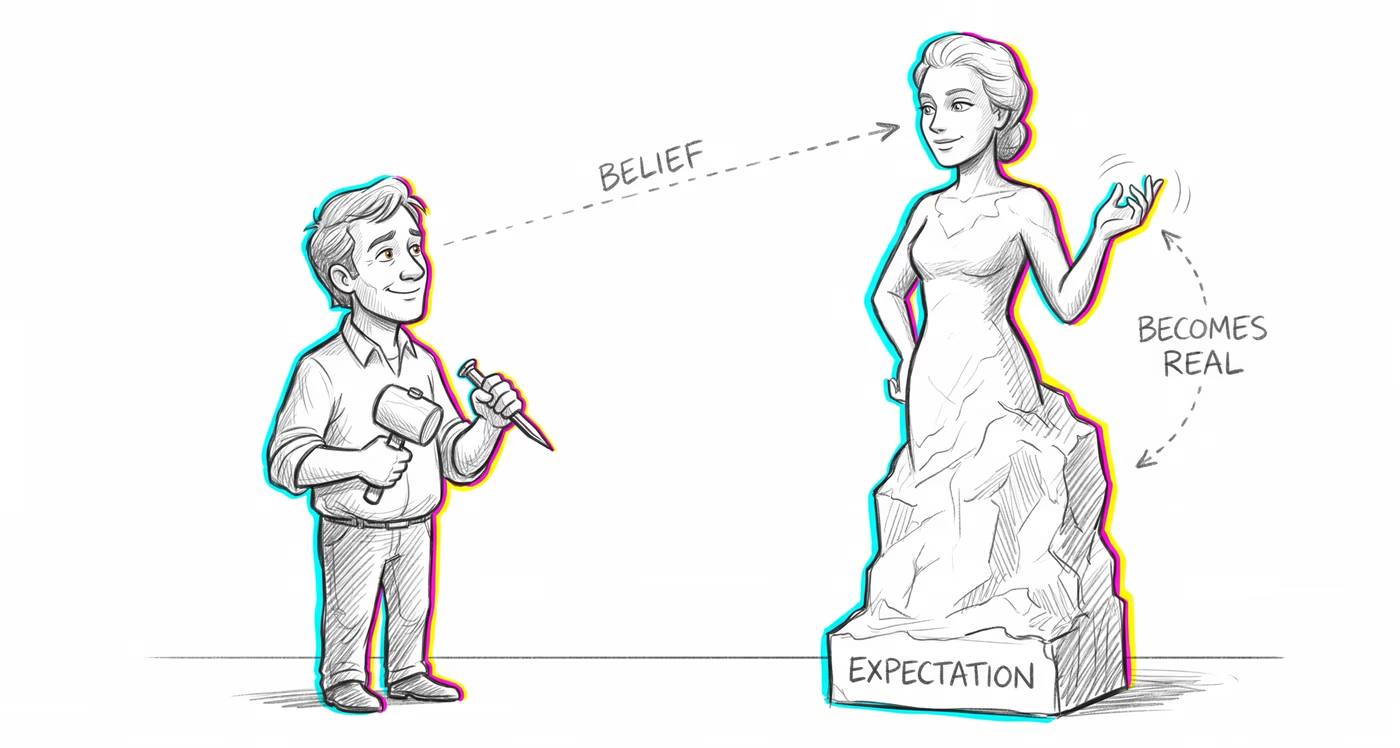
Higher expectations from an authority figure leading to better performance, because the belief subtly changes how they treat you.

Illustration: Pygmalion Effect
WHAT IT IS

The glitch, explained plainly.

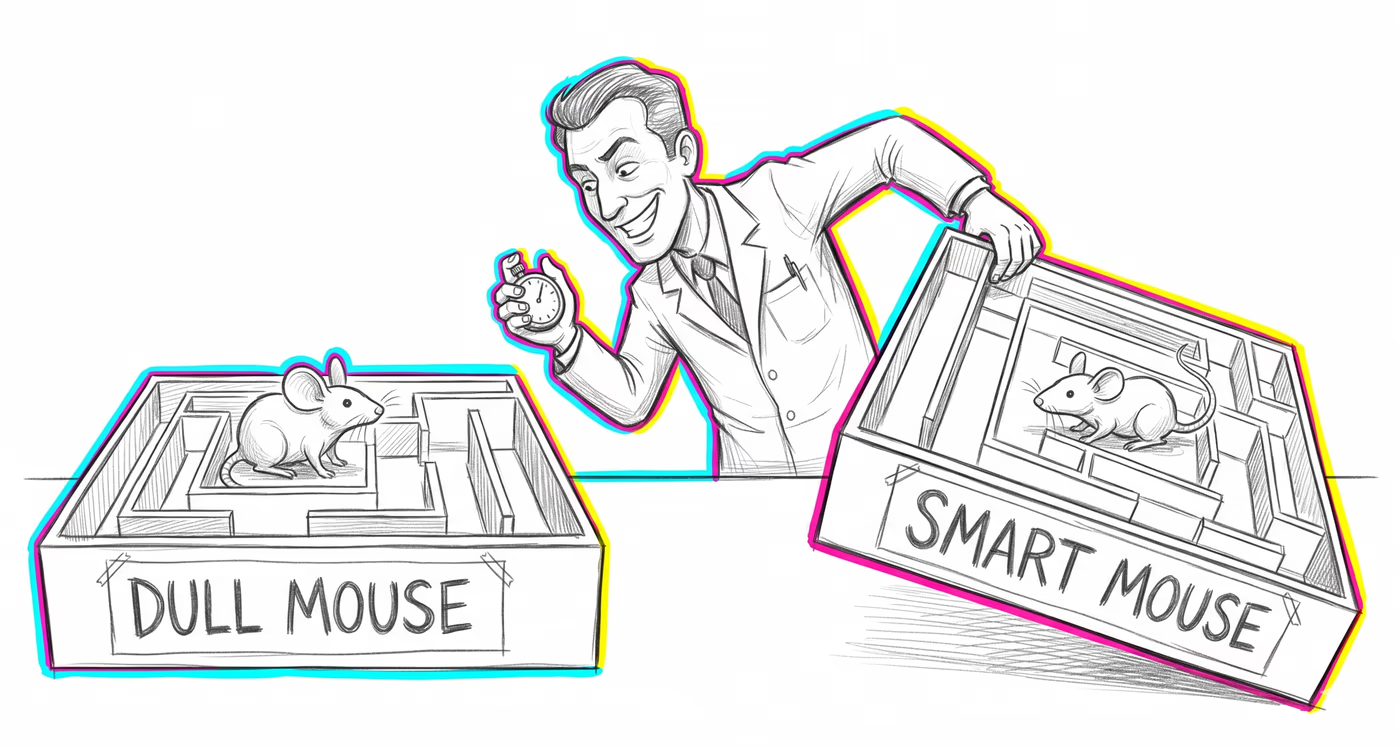
Imagine your teacher secretly thinks you're really smart. Without even realizing it, she smiles at you more, gives you harder puzzles, and helps you when you're stuck. Because she treats you like a smart kid, you start acting like a smart kid — and then you actually become one. Her belief in you kind of made it come true.

The Pygmalion Effect describes how one person's positive expectations about another person's abilities can unconsciously alter their own behavior — providing more warmth, challenge, feedback, and opportunity — which in turn boosts the target's self-efficacy and actual performance. The mechanism operates through four channels identified by Rosenthal: emotional climate (greater warmth), input (more challenging material), output (more chances to respond), and feedback (more detailed and specific coaching). Critically, the expectation-holder is typically unaware they are treating the target differently, making this a subtle but powerful form of interpersonal influence. The effect is strongest when the authority figure has little prior information about the target and when the target is younger or newer to a role, making them more susceptible to external cues about their potential.

SOUND FAMILIAR?

Where it shows up.

  1. 01 A new team lead is told by her VP that one of her direct reports, Marcus, was specifically recruited from a top competitor and is expected to be a future director. Over the next quarter, she unconsciously gives Marcus the most visible projects, invites him to senior meetings, and provides detailed coaching on his presentations. At his review, Marcus has outperformed his peers significantly.
  2. 02 Dr. Patel rotates to a new hospital ward and reads a chart note describing a patient as 'highly motivated and compliant.' She spends more time explaining treatment options, checks in more frequently, and uses an encouraging tone. The patient recovers faster than the ward average. A colleague points out the chart note was actually about a different patient with the same last name.
  3. 03 A venture capitalist tells a startup founder, 'We backed you because we think you're the kind of founder who can build a billion-dollar company.' Over the next year, the VC provides warmer introductions, more strategic advice, and faster follow-on funding than they offer to other portfolio companies. The startup outperforms its cohort, and the VC credits their own judgment in picking winners.
  4. 04 A violin instructor receives a new class roster with a note from the school principal flagging three students as 'musically gifted based on aptitude testing.' She assigns them more complex pieces, corrects their technique with greater specificity, and pairs them with advanced students. By the spring recital, those three students are performing noticeably better — though the aptitude testing never actually occurred.
  5. 05 A senior software engineer is told by his director that a junior developer on his team 'thinks like a systems architect.' He begins including her in design reviews, explaining his reasoning on tradeoffs, and assigning her ownership of a microservice. Six months later, she's promoted — and he genuinely believes he simply recognized raw talent that was already there.
IN DIFFERENT DOMAINS

Where it shows up at work.

The same glitch looks different depending on the terrain. Finance, medicine, a relationship, a team — same mechanism, different costume.

Finance & investing

Investment managers who identify certain analysts as 'high-potential' tend to assign them more complex deals, provide more mentorship, and advocate for them in promotion committees — creating a performance gap that appears to validate the original assessment but is largely a product of differential investment.

Medicine & diagnosis

Physicians who expect patients to recover well tend to communicate with more warmth, provide more detailed treatment explanations, and follow up more consistently, inadvertently improving adherence and outcomes — while patients labeled as 'difficult' or 'noncompliant' receive less engagement and fulfill that expectation.

Education & grading

Teachers who are told certain students are intellectually gifted provide those students with more challenging material, more specific feedback, more response opportunities, and a warmer emotional climate — creating measurable performance differences even when the 'gifted' label was assigned randomly.

Relationships

Partners who view each other as fundamentally kind and trustworthy tend to interpret ambiguous behaviors charitably, respond with more warmth, and create a positive feedback loop where both partners actually become more generous and attentive over time.

Tech & product

Engineering managers who believe certain team members are 'rockstars' assign them high-visibility features, pair them with strong collaborators, and shield them from tedious maintenance work — creating a two-track system where initial perception snowballs into radically different career trajectories.

Workplace & hiring

Managers' first impressions of new hires shape the quality and quantity of onboarding support, stretch assignments, and informal mentorship they receive, causing early-labeled 'top talent' to accumulate advantages that compound into performance differences mistakenly attributed to innate ability.

Politics Media

Political commentators who frame a candidate as 'rising star' or 'inevitable nominee' attract more donor attention, media coverage, and volunteer energy to that candidate, creating momentum that can become self-fulfilling regardless of the candidate's initial standing.

HOW TO SPOT IT

Ask yourself…

  • Am I giving this person more time, attention, or challenging work because I genuinely assessed their ability — or because someone told me they were exceptional?
  • If I learned that my initial positive impression of this person was based on false information, would I still rate their performance the same way?
  • Am I providing the same quality of feedback, warmth, and opportunity to everyone on my team — or am I unconsciously investing more in those I already expect to succeed?
HOW TO DEFEND AGAINST IT

The playbook.

  • Implement structured onboarding and evaluation rubrics that allocate equal challenge, feedback, and mentorship to all team members regardless of initial impressions.
  • Conduct a 'blind audit' of how you distribute your time, stretch assignments, and coaching across people you supervise — compare against what an equal distribution would look like.
  • Delay forming expectations: withhold judgment about someone's potential for at least two weeks of direct observation before adjusting your investment in them.
  • Ask yourself Rosenthal's four-factor check: Am I providing equal warmth, equally challenging input, equal opportunity to respond, and equally detailed feedback to this person compared to others?
  • Use the 'swap test' — if this person had a different name, background, or reputation, would I still be treating them this way?
FAMOUS CASES

In history.

  • Rosenthal and Jacobson's 'Pygmalion in the Classroom' study at Spruce Elementary School in San Francisco (1965-1968), where randomly labeled 'intellectual bloomers' showed significant IQ gains, especially among first and second graders.
  • Eden and Shani's 1982 Israeli Defense Forces study, where military instructors told that certain trainees had exceptional command potential produced significantly better performance from those randomly selected trainees.
  • J. Sterling Livingston's 1969 'Pygmalion in Management' case at Metropolitan Life Insurance, where new agents assigned to a manager with high expectations outperformed agents under managers with average expectations.
WHERE IT COMES FROM
Academic origin

Robert Rosenthal and Lenore Jacobson, 1968, published in 'Pygmalion in the Classroom: Teacher Expectation and Pupils' Intellectual Development.' The foundational experiment was conducted at Oak School (pseudonym) in San Francisco in 1964.

Evolutionary origin

In ancestral groups, social status and role expectations were critical for coordinating collective action. Individuals who could accurately read authority signals about their place in the group hierarchy and adjust their behavior accordingly gained survival advantages. The tendency to internalize the expectations of high-status group members likely evolved because aligning one's effort with leader expectations improved access to resources, protection, and mating opportunities within the tribe.

IN AI SYSTEMS

How the machines inherit it.

When AI training data or labeling processes embed human expectations — such as annotators rating outputs from 'expert' models more favorably — the resulting training signal amplifies those expectations into the model's behavior. Similarly, when users approach an AI system with high expectations (e.g., believing it is a more advanced model), they tend to write more thoughtful prompts and interpret outputs more charitably, creating a feedback loop that inflates perceived model quality.

Read more on Wikipedia
FREE FIELD ZINE

10 glitches quietly running your life.

A free field-zine PDF — ten cognitive glitches named, illustrated, with a defense move for each. Plus the weekly Glitch Report on Fridays — one bias named, two spotted in the wild, one defense move. Unsubscribe any time.

EXPLORE MORE

Related glitches.

LAUNCH PRICE

Train against your blindspots.

50 cards are free to preview. Buyers unlock the rest of the deck plus the interactive training — Spot-the-Bias Quiz unlimited, Swipe Deck with spaced repetition, My Blindspots, Decision Pre-Flight, the Printable Deck + Cheat Sheets, and the Field Guide e-book. $29.50$59.

Unlock the full deck

Everything below — yours forever. Pay once, use across every device.

Half-off launch — limited to the first 100 readers. Auto-applied at checkout.
$59 $29.50
one-time payment · lifetime access
  • All interactive digital cards — search, filter, flip, shuffle on any device
  • Five training modes — Spot-the-Bias Quiz, Swipe Deck, Pre-Flight, Blindspots, Journal
  • Curated Lenses + Decision Templates + Defense Playbook
  • Printable Deck PDFs + Field Guide e-book + Cheat Sheets + Anki Export
  • Every future improvement, included
Unlock  $29.50

30-day refund · no questions asked

Unlock the full deck

Everything below — yours forever. Pay once, use across every device.

Half-off launch — limited to the first 100 readers. Auto-applied at checkout.
$59 $29.50
one-time payment · lifetime access
  • All interactive digital cards — search, filter, flip, shuffle on any device
  • Five training modes — Spot-the-Bias Quiz, Swipe Deck, Pre-Flight, Blindspots, Journal
  • Curated Lenses + Decision Templates + Defense Playbook
  • Printable Deck PDFs + Field Guide e-book + Cheat Sheets + Anki Export
  • Every future improvement, included
Unlock  $29.50

30-day refund · no questions asked