Hindsight Bias

aka Knew-It-All-Along Effect · Creeping Determinism · 20/20 Hindsight

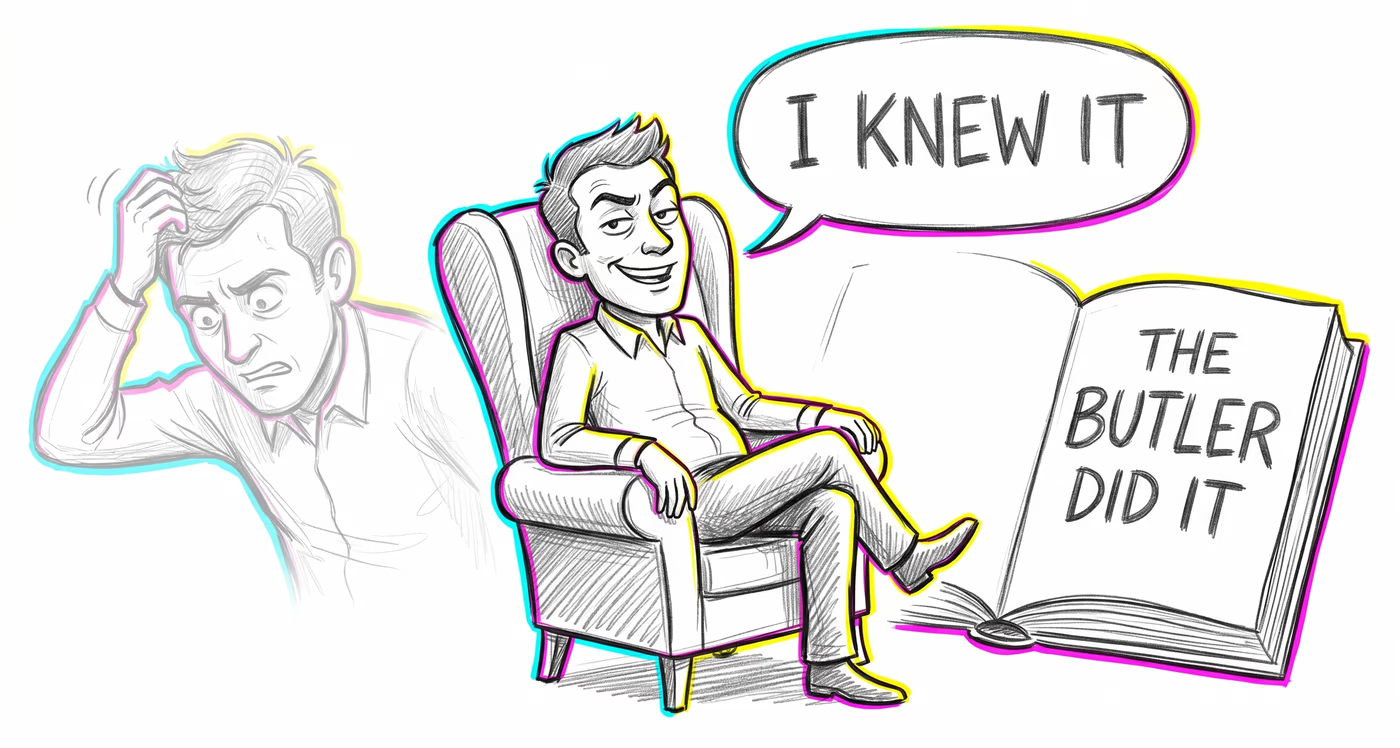
After learning an outcome, believing you knew it all along — even when you couldn't have predicted it beforehand.

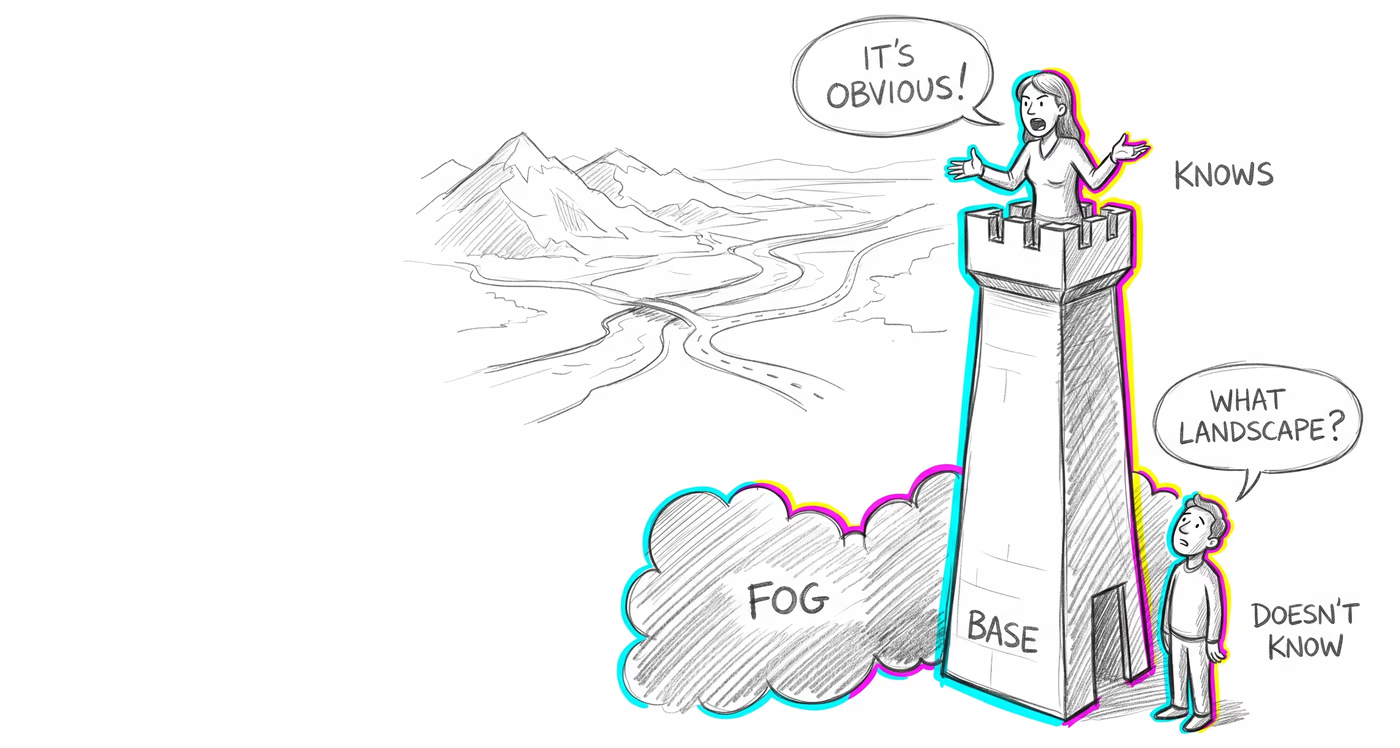
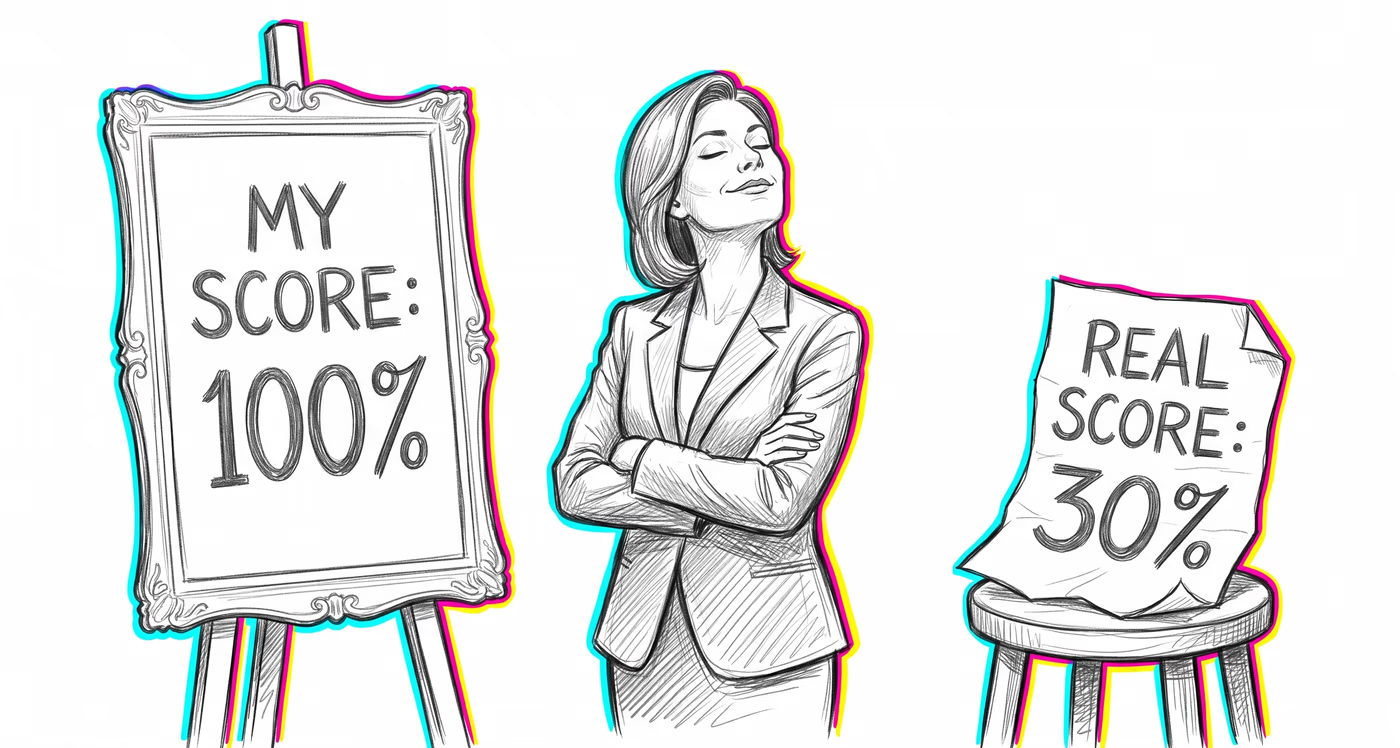
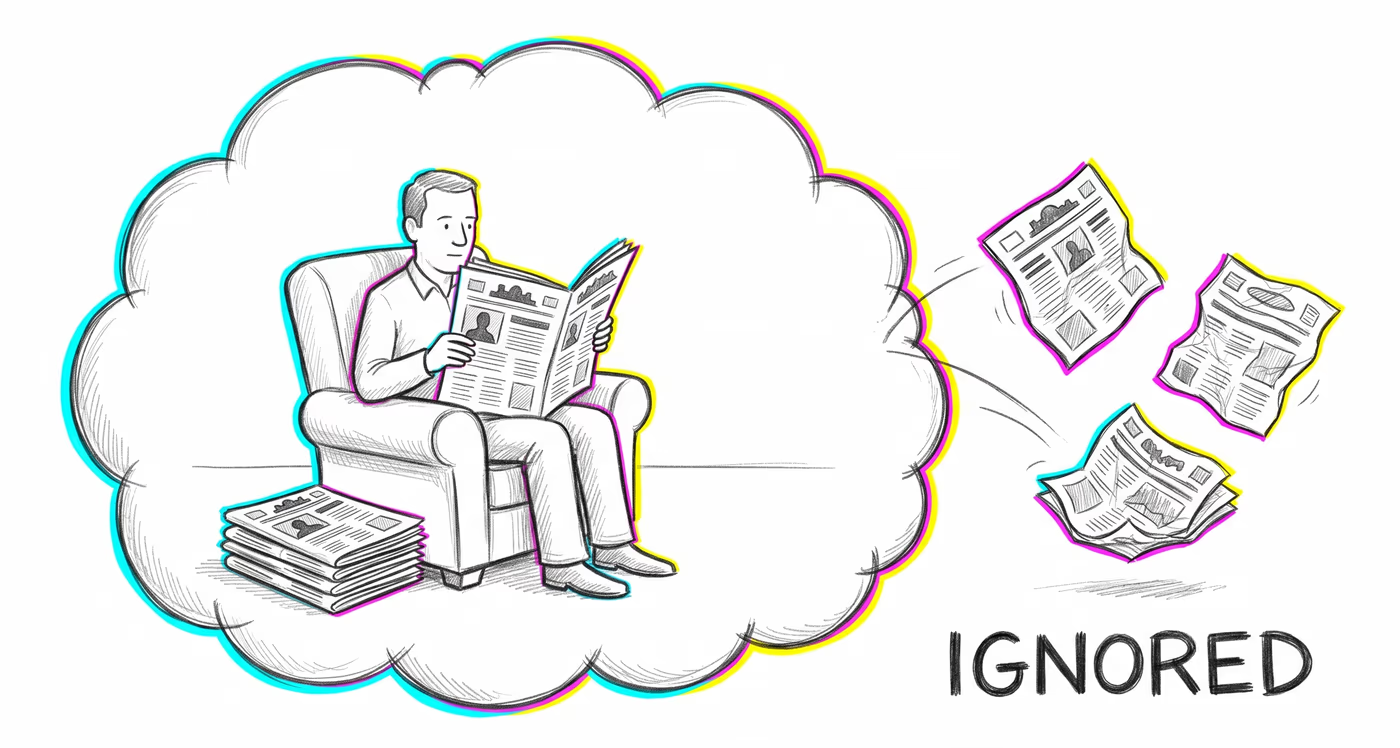
Illustration: Hindsight Bias
WHAT IT IS

The glitch, explained plainly.

Imagine you're watching a movie for the second time with a friend who hasn't seen it. When the surprise twist happens, you might say 'I totally saw that coming the first time!' But you actually didn't — you just can't un-know the ending now, so your brain tricks you into thinking you always knew.

Hindsight bias operates on three interconnected levels: memory distortion, where people misremember their original predictions as being closer to the actual outcome; inevitability, where the outcome feels like it was bound to happen given the circumstances; and foreseeability, where people inflate their belief in their own predictive abilities. The bias is fueled by the brain's automatic updating of mental models once new information arrives — outcome knowledge seamlessly integrates into existing knowledge structures, making it nearly impossible to reconstruct one's prior state of ignorance. This creates a dangerous illusion of predictability that persists even when people are explicitly warned about the bias, and it intensifies with the severity of the outcome in question.

SOUND FAMILIAR?

Where it shows up.

  1. 01 After a startup she passed on becomes a billion-dollar company, a venture capitalist reviews her old notes and insists to her partners that she saw the potential all along and only declined because of a technicality in the deal terms. Her partners check the meeting minutes and find she actually rated the company 'unlikely to scale.'
  2. 02 A history teacher, after covering how World War I began, tells his class that the assassination of Archduke Franz Ferdinand made the war 'obviously inevitable.' He genuinely cannot understand why diplomats at the time didn't see the cascade of alliances that would be triggered, forgetting that the specific chain of events was far from predetermined.
  3. 03 A software engineering team conducts a post-mortem after a server outage. The lead engineer points to a specific log entry from two weeks prior and says the warning signs were 'crystal clear.' The team agrees the failure was foreseeable and criticizes the on-call engineer for missing it — despite the fact that the same log pattern had appeared dozens of times before without incident.
  4. 04 A doctor reviews a malpractice case where a patient's rare condition was missed during an initial exam. Knowing the diagnosis, she finds it hard to believe the treating physician didn't catch it, rating the correct diagnosis as 'obvious given the symptoms' — even though the presenting symptoms matched three far more common conditions.
  5. 05 A policy analyst writes a retrospective report on a failed urban development project, concluding that the economic data 'clearly indicated' the project would fail. He uses this to argue the original planners were negligent. However, a colleague points out that his own pre-project memo expressed optimism about the same economic indicators.
IN DIFFERENT DOMAINS

Where it shows up at work.

The same glitch looks different depending on the terrain. Finance, medicine, a relationship, a team — same mechanism, different costume.

Finance & investing

Investors routinely perceive past market movements as having been predictable, leading them to overestimate their forecasting ability and take on excessive risk in future trades. After a crash, the warning signs feel 'obvious,' discouraging the adoption of systematic risk management approaches.
Medicine & diagnosis

When a patient's diagnosis is eventually confirmed, physicians reviewing the case tend to rate the correct diagnosis as more obvious than it actually was given the initial presentation, leading to harsher malpractice judgments and discouraging clinicians from ordering broad differential workups.

Education & grading

Teachers who learn a student performed poorly tend to retrospectively reinterpret earlier classroom behavior as clear warning signs, potentially leading to premature labeling of future students who display similar but benign behaviors.

Relationships

After a breakup, people reconstruct the relationship narrative to include 'red flags' that were not actually perceived as problematic at the time, which can foster cynicism and mistrust in future relationships or unfair blame toward the ex-partner.

Tech & product

Product teams conducting post-launch failure analyses tend to identify design flaws as 'obvious' in retrospect, which can lead to scapegoating individual designers rather than improving systemic testing and review processes.

Workplace & hiring

Managers evaluating past hiring decisions view unsuccessful hires as having shown clear warning signs during interviews, leading to overconfidence in their ability to 'read' candidates and resistance to structured interview processes.

Politics Media

After political events unfold, media commentators and the public reconstruct narratives that make outcomes seem inevitable, reducing accountability for intelligence or policy failures and undermining support for genuine uncertainty acknowledgment in governance.

HOW TO SPOT IT

Ask yourself…

  • Am I saying 'I knew it' — but did I actually record or voice that prediction before learning the outcome?
  • If I imagine the opposite outcome had occurred, would I be equally confident that I 'saw it coming'?
  • Am I judging someone's past decision using information that wasn't available to them at the time?
HOW TO DEFEND AGAINST IT

The playbook.

  • Keep a decision journal: Write down predictions, reasoning, and confidence levels before outcomes are known, then review them honestly afterward.
  • Practice 'consider the opposite': Before evaluating a past event, force yourself to construct a plausible narrative for an alternative outcome.
  • Use pre-mortems: Before a project begins, imagine it has failed and list reasons why — this preserves the sense of uncertainty you'll lose after the fact.
  • When reviewing others' decisions, deliberately reconstruct the information environment they had at the time, not what you know now.
  • Ask yourself: 'What would I have bet real money on before I knew the answer?' — monetary stakes reveal your actual prior confidence.
FAMOUS CASES

In history.

  • Post-9/11 criticism of U.S. intelligence agencies for missing 'obvious' warning signs, despite the signals being ambiguous among vast amounts of noise at the time.
  • The 2008 financial crisis, after which many commentators claimed the housing bubble collapse was clearly predictable, though very few economists publicly warned of it beforehand.
  • The sinking of the Titanic, which in retrospect is often described as an obviously foreseeable disaster due to insufficient lifeboats and high speed through ice fields.
  • The Challenger space shuttle disaster (1986), where post-accident analyses made the O-ring failure seem like an obvious and preventable cause, despite genuine ambiguity in pre-launch engineering assessments.
WHERE IT COMES FROM
Academic origin

Baruch Fischhoff, 1975. Formalized in his paper 'Hindsight ≠ Foresight: The Effect of Outcome Knowledge on Judgment under Uncertainty' (Journal of Experimental Psychology: Human Perception and Performance). Earlier collaborative work with Ruth Beyth (Fischhoff & Beyth, 1975) provided the first direct experimental test.

Evolutionary origin

Rapid knowledge updating after observing outcomes was adaptive for survival. Ancestors who quickly integrated the results of dangerous encounters (e.g., which berries were poisonous, which paths led to predators) into their mental models — without wasting cognitive resources maintaining outdated uncertainty — could act faster and more decisively in future similar situations.

IN AI SYSTEMS

How the machines inherit it.

Machine learning models trained on historical data can embed hindsight bias when features that only became predictive in retrospect are weighted as if they were always informative. Backtesting investment algorithms, for example, can produce inflated performance metrics because the model 'knows' which features mattered. LLMs can also reinforce hindsight bias by generating confident retrospective explanations of events that make outcomes appear more predictable than they were.

Read more on Wikipedia
FREE FIELD ZINE

10 glitches quietly running your life.

A free field-zine PDF — ten cognitive glitches named, illustrated, with a defense move for each. Plus the weekly Glitch Report on Fridays — one bias named, two spotted in the wild, one defense move. Unsubscribe any time.

EXPLORE MORE

Related glitches.

LAUNCH PRICE

Train against your blindspots.

50 cards are free to preview. Buyers unlock the rest of the deck plus the interactive training — Spot-the-Bias Quiz unlimited, Swipe Deck with spaced repetition, My Blindspots, Decision Pre-Flight, the Printable Deck + Cheat Sheets, and the Field Guide e-book. $29.50$59.

Unlock the full deck

Everything below — yours forever. Pay once, use across every device.

Half-off launch — limited to the first 100 readers. Auto-applied at checkout.
$59 $29.50
one-time payment · lifetime access
  • All interactive digital cards — search, filter, flip, shuffle on any device
  • Five training modes — Spot-the-Bias Quiz, Swipe Deck, Pre-Flight, Blindspots, Journal
  • Curated Lenses + Decision Templates + Defense Playbook
  • Printable Deck PDFs + Field Guide e-book + Cheat Sheets + Anki Export
  • Every future improvement, included
Unlock  $29.50

30-day refund · no questions asked

Unlock the full deck

Everything below — yours forever. Pay once, use across every device.

Half-off launch — limited to the first 100 readers. Auto-applied at checkout.
$59 $29.50
one-time payment · lifetime access
  • All interactive digital cards — search, filter, flip, shuffle on any device
  • Five training modes — Spot-the-Bias Quiz, Swipe Deck, Pre-Flight, Blindspots, Journal
  • Curated Lenses + Decision Templates + Defense Playbook
  • Printable Deck PDFs + Field Guide e-book + Cheat Sheets + Anki Export
  • Every future improvement, included
Unlock  $29.50

30-day refund · no questions asked