Placebo Effect

aka Placebo Response · Expectancy Effect · Meaning Response

Experiencing real improvement from an inert treatment solely because of believing it will work.

Illustration: Placebo Effect
WHAT IT IS

The glitch, explained plainly.

Imagine your mom kissing your boo-boo when you were little, and it actually felt better afterward. Your brain believed the kiss was medicine, so it started making its own feel-good chemicals. That's the placebo effect — your brain is so convinced something will help that it starts helping itself.

The placebo effect occurs when a person's belief in the efficacy of a treatment — even one with no active therapeutic ingredients — triggers genuine measurable changes in their body or subjective experience. These changes are not imaginary; neuroimaging studies have demonstrated that placebos can activate endogenous opioid pathways, trigger dopamine release in reward circuits, and modulate activity in pain-processing regions of the brain. The magnitude of the effect is powerfully shaped by contextual factors: the perceived authority of the provider, the ritual and form of the treatment (injections outperform pills; branded pills outperform generic ones), and the cultural meaning attached to the intervention. Critically, the placebo effect extends beyond pain to conditions like depression, Parkinson's disease, and irritable bowel syndrome, though it has minimal impact on objective biomarkers like tumor size or viral load.

SOUND FAMILIAR?

Where it shows up.

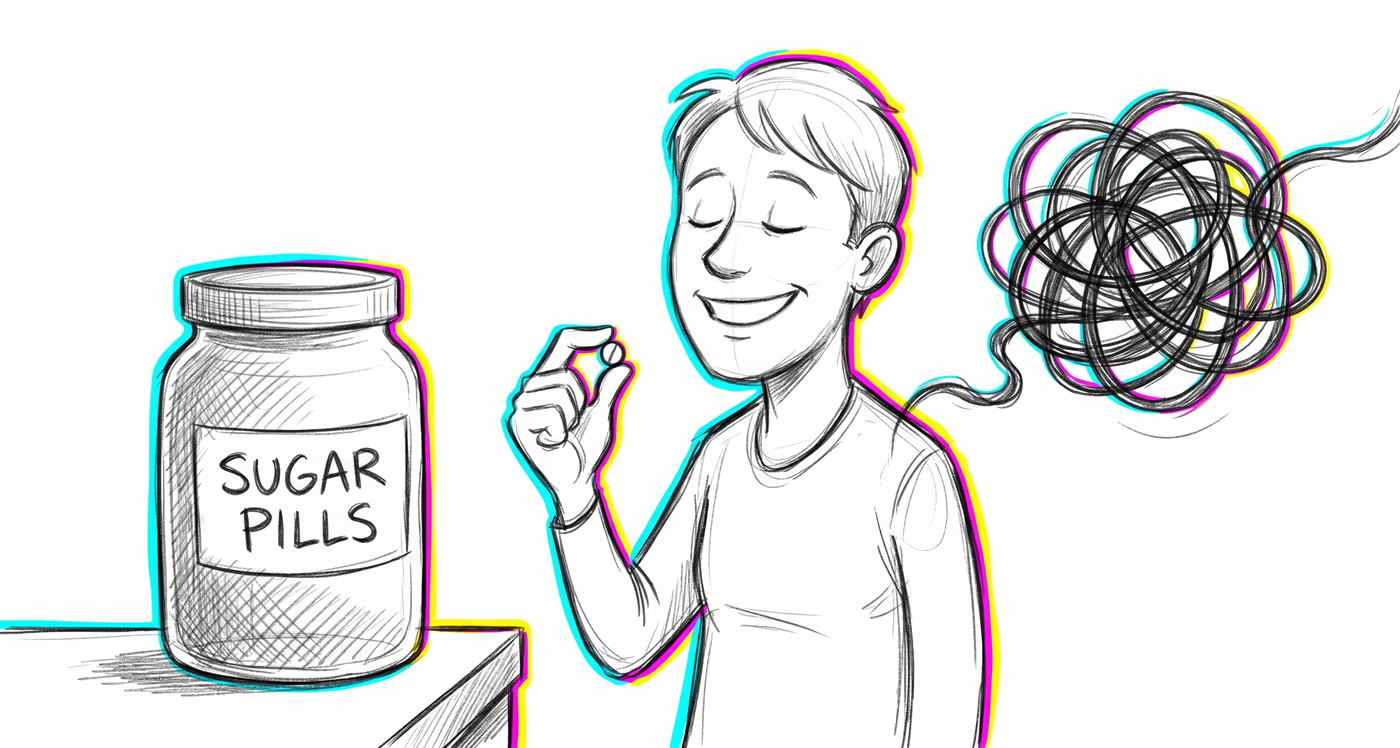
  1. 01 A patient in a clinical trial receives a sugar pill but is told it is a cutting-edge migraine medication. Over the following weeks, she reports a 40% reduction in headache frequency and genuinely experiences less pain, leading her to credit the 'new drug' for changing her life.
  2. 02 A wine club host pours the same mid-range wine into two different bottles — one with an elegant label claiming it's a $200 reserve, the other with a plain label marked $12. Guests consistently rate the 'expensive' pour as smoother, more complex, and more enjoyable, and fMRI studies confirm their pleasure centers actually activate more strongly.
  3. 03 A physical therapist introduces a new ultrasound machine to treat chronic knee pain, enthusiastically explaining the cutting-edge technology to patients. Patients report significant pain relief, but the machine was never actually turned on during their sessions — the therapist's confident presentation and the clinical ritual alone produced measurable improvement.
  4. 04 A software developer starts taking a nootropic supplement recommended by a productivity influencer. She tracks her output and notices a clear improvement in focus and lines of code written. When she later discovers the capsules contained only rice flour, she is baffled because the productivity gains were real and measurable.
  5. 05 A surgeon performs arthroscopic knee surgery on half his patients and sham surgery — making incisions but doing nothing inside the joint — on the other half. Two years later, both groups report virtually identical improvements in pain and function, with sham surgery patients just as satisfied with their outcomes.
IN DIFFERENT DOMAINS

Where it shows up at work.

The same glitch looks different depending on the terrain. Finance, medicine, a relationship, a team — same mechanism, different costume.

Finance & investing

Investors who purchase financial products from prestigious, well-branded firms may perceive better portfolio performance and feel greater confidence in their returns, even when objective performance is identical to cheaper alternatives — the 'brand premium' in finance partly operates through expectancy-driven satisfaction.

Medicine & diagnosis

Placebo responses are pervasive in clinical medicine: patients receiving sham surgeries for pain conditions often improve as much as those receiving real procedures, branded medications outperform identical generics in perceived efficacy, and the warmth and confidence of a physician measurably amplifies the therapeutic response to both real and inert treatments.

Education & grading

Students who are told a study technique is scientifically proven to boost memory may perceive themselves as learning more effectively and rate their comprehension higher, even when the technique has no empirical advantage — their belief in the method shapes their subjective experience of learning.

Relationships

Partners who believe strongly in couples therapy or a relationship book may report feeling closer and more understood after engaging with it, partly because the expectation of improvement primes them to notice positive interactions and interpret ambiguous behaviors more charitably.

Tech & product

Users consistently rate the performance of software as faster and more reliable when the interface includes premium design cues — loading animations, progress bars, and polished aesthetics — even when the underlying processing speed is identical, because design signals set expectations that shape the experience.

Workplace & hiring

Employees who are told they are participating in a cutting-edge wellness program at work report higher energy and lower stress, even when the program consists of minimal interventions — the organizational ritual and managerial endorsement function as contextual cues that amplify subjective well-being.

Politics Media

Political messaging that uses authoritative framing, expert endorsements, and professional production quality can make audiences feel more confident and reassured about a policy's effectiveness, independent of the policy's actual merits — the packaging triggers expectancy-driven approval.

HOW TO SPOT IT

Ask yourself…

  • Did I start feeling better suspiciously fast — before any treatment could realistically have taken effect?
  • Am I evaluating this product or treatment based on how much I paid, how it was packaged, or who recommended it rather than on objective results?
  • If I discovered this treatment was completely inert, would I still believe it helped me — and does that belief itself tell me something?
HOW TO DEFEND AGAINST IT

The playbook.

  • Wait for objective, measurable outcomes before evaluating whether a treatment works — track symptoms with a journal using pre-defined criteria rather than relying on how you feel in the moment.
  • Ask yourself: 'Would I credit this improvement if I knew the treatment was inert?' Use this thought experiment to separate genuine efficacy from expectancy-driven relief.
  • Seek out blinded, controlled evidence for any treatment before committing money or time — your subjective experience is a poor judge of whether an intervention is truly active.
  • Be especially skeptical when treatment packaging is elaborate, expensive, or endorsed by charismatic figures — these are exactly the contextual cues that amplify placebo responses.
  • Remember that feeling better is not the same as getting better — especially for conditions where subjective symptoms and objective disease progression can diverge.
FAMOUS CASES

In history.

  • Henry Beecher's observations during World War II, where saline injections given to wounded soldiers as morphine substitutes appeared to provide substantial pain relief, catalyzed modern placebo research.
  • The 2002 Moseley et al. sham knee surgery trial demonstrated that arthroscopic surgery for osteoarthritis was no more effective than fake surgery, fundamentally challenging orthopedic practice.
  • Open-label placebo studies by Ted Kaptchuk at Harvard (2010) showed that patients with irritable bowel syndrome improved even when explicitly told they were receiving placebos, challenging the assumption that deception is required.
WHERE IT COMES FROM
Academic origin

Henry K. Beecher formalized the concept in his 1955 paper 'The Powerful Placebo' published in JAMA, though the term 'placebo' in medical contexts dates to the late 1700s, and T.C. Graves first used 'placebo effect' in 1920. Irving Kirsch's 1985 expectancy theory and Fabrizio Benedetti's neurobiological work from the 2000s onward significantly advanced mechanistic understanding.

Evolutionary origin

The capacity for expectation-driven healing likely evolved because organisms that could mobilize endogenous recovery mechanisms in response to environmental cues of safety and care — such as the presence of a healer, the ritual of treatment, or signs that danger had passed — would recover from illness and injury faster. This mind-body coupling allowed early humans to allocate metabolic resources toward healing when contextual signals indicated the threat had subsided.

IN AI SYSTEMS

How the machines inherit it.

AI systems can exhibit a form of placebo effect when users' trust in AI-generated outputs leads them to perceive higher quality or accuracy than what the system actually delivers. Users who believe an AI system is more advanced or 'intelligent' rate its outputs higher and are less likely to catch errors, creating a feedback loop where perceived authority substitutes for actual performance — mirroring how a doctor's confidence amplifies drug efficacy.

Read more on Wikipedia
FREE FIELD ZINE

10 glitches quietly running your life.

A free field-zine PDF — ten cognitive glitches named, illustrated, with a defense move for each. Plus the weekly Glitch Report on Fridays — one bias named, two spotted in the wild, one defense move. Unsubscribe any time.

EXPLORE MORE

Related glitches.

LAUNCH PRICE

Train against your blindspots.

50 cards are free to preview. Buyers unlock the rest of the deck plus the interactive training — Spot-the-Bias Quiz unlimited, Swipe Deck with spaced repetition, My Blindspots, Decision Pre-Flight, the Printable Deck + Cheat Sheets, and the Field Guide e-book. $29.50$59.

Unlock the full deck

Everything below — yours forever. Pay once, use across every device.

Half-off launch — limited to the first 100 readers. Auto-applied at checkout.
$59 $29.50
one-time payment · lifetime access
  • All interactive digital cards — search, filter, flip, shuffle on any device
  • Five training modes — Spot-the-Bias Quiz, Swipe Deck, Pre-Flight, Blindspots, Journal
  • Curated Lenses + Decision Templates + Defense Playbook
  • Printable Deck PDFs + Field Guide e-book + Cheat Sheets + Anki Export
  • Every future improvement, included
Unlock  $29.50

30-day refund · no questions asked

Unlock the full deck

Everything below — yours forever. Pay once, use across every device.

Half-off launch — limited to the first 100 readers. Auto-applied at checkout.
$59 $29.50
one-time payment · lifetime access
  • All interactive digital cards — search, filter, flip, shuffle on any device
  • Five training modes — Spot-the-Bias Quiz, Swipe Deck, Pre-Flight, Blindspots, Journal
  • Curated Lenses + Decision Templates + Defense Playbook
  • Printable Deck PDFs + Field Guide e-book + Cheat Sheets + Anki Export
  • Every future improvement, included
Unlock  $29.50

30-day refund · no questions asked