Snob Effect

aka Reverse Bandwagon Effect · Exclusivity Effect

Wanting something more when fewer people have it, and losing interest once it becomes popular or mainstream.

WHAT IT IS

The glitch, explained plainly.

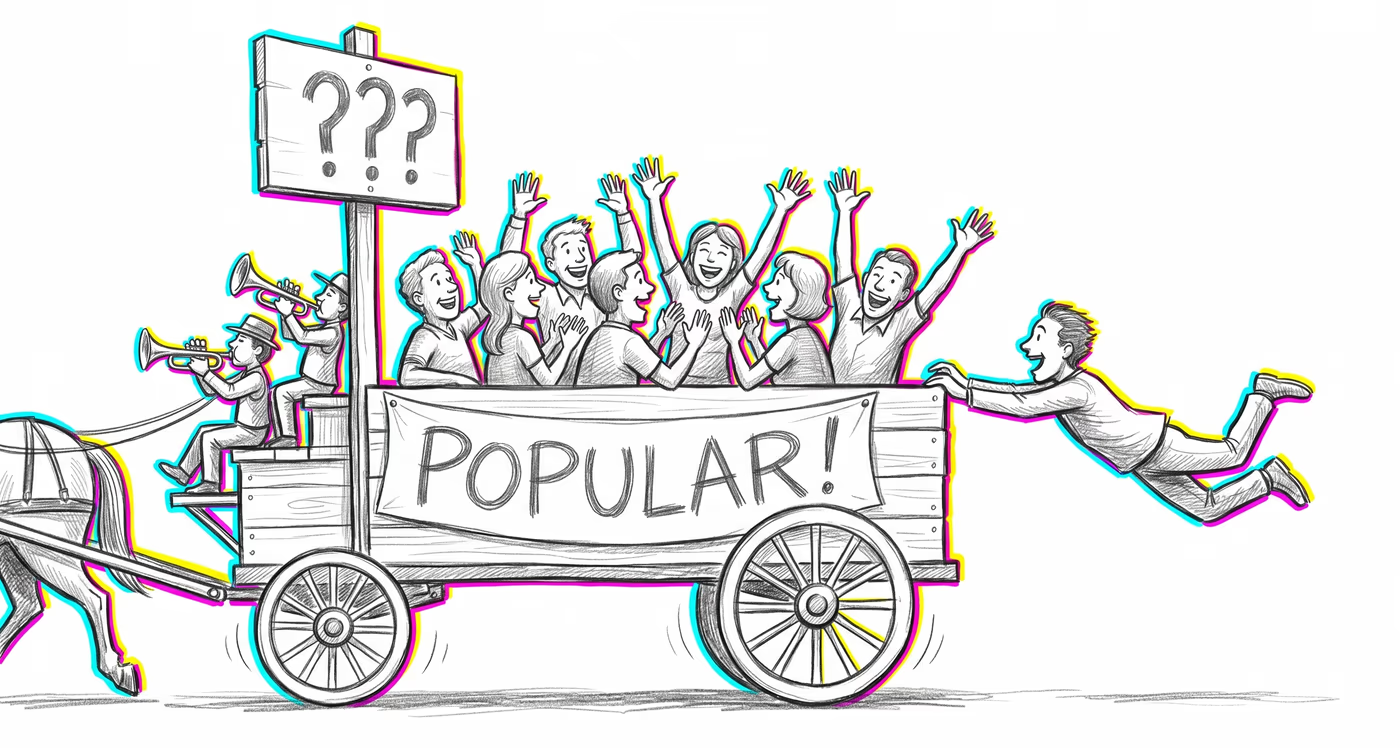
Imagine you find a really cool secret playground that nobody else knows about. It's your special place and you love it. But then every kid in school starts going there too, and suddenly it doesn't feel special anymore, so you want to find a new secret spot. You didn't stop liking the playground because it changed — you stopped liking it because everyone else showed up.

The snob effect describes a pattern of preference in which an individual's desire for a good or experience decreases as more people adopt it, driven by the need to maintain a sense of uniqueness and social distinction. Unlike standard economic models where popularity increases demand, snob-motivated consumers actively avoid mainstream choices precisely because they are mainstream. The effect extends beyond luxury goods into tastes, opinions, neighborhoods, and cultural preferences — anywhere a person's sense of identity is threatened by mass adoption. Critically, the snob effect is not simply about wanting quality; it is about wanting what others cannot or do not have, making the social exclusivity of possession more valuable than the item's functional utility.

SOUND FAMILIAR?

Where it shows up.

  1. 01 Maria has been buying handmade jewelry from a small Etsy shop for two years. When the shop gets featured on a major influencer's page and orders triple overnight, Maria feels a pang of disappointment and decides she won't order from them anymore, even though the quality and price haven't changed.
  2. 02 A craft beer enthusiast who championed a local microbrewery for years stops recommending it after it gets national distribution. He tells friends the beer 'just isn't the same,' though the recipe is identical. He begins seeking out an even smaller, harder-to-find brewery.
  3. 03 A tech executive specifically avoids buying the market-leading smartphone, opting instead for a niche brand with similar specs but far fewer users. When asked, she explains she values 'independent thinking,' but her primary selection criterion was that fewer people own it.
  4. 04 A real estate investor loses enthusiasm for a rapidly gentrifying neighborhood not because property values dropped, but because the area is now attracting 'mainstream' buyers. He redirects his search to a less-discovered area, even though the financial projections there are weaker.
  5. 05 A university professor dismisses a widely cited research methodology as 'pedestrian' and adopts a far more obscure analytical framework for her papers, despite the mainstream method being more robust. She frames her choice as intellectual rigor, but colleagues notice she only became critical of the method after it gained widespread popularity in adjacent fields.
IN DIFFERENT DOMAINS

Where it shows up at work.

The same glitch looks different depending on the terrain. Finance, medicine, a relationship, a team — same mechanism, different costume.

Finance & investing

Investors may abandon profitable, well-known asset classes or funds once they become mainstream, chasing obscure alternative investments with weaker fundamentals purely because fewer people hold them, often resulting in lower risk-adjusted returns.
Education & grading

Students or academics may dismiss widely-used textbooks, frameworks, or pedagogical methods as 'basic' and gravitate toward obscure alternatives, sometimes sacrificing pedagogical clarity for the appearance of intellectual distinctiveness.

Relationships

Individuals may reject potential romantic partners who are widely considered attractive or desirable by others, preferring 'unconventional' choices partly to signal unique taste, or they may lose attraction to a partner once that person becomes socially popular.

Tech & product

Early adopters of a platform or tool may churn once it reaches mass adoption, viewing widespread use as a signal of declining quality or relevance. Product teams may see engagement drop among power users precisely when a product succeeds in going mainstream.

Workplace & hiring

Employees or leaders may resist adopting widely-used best practices or tools, insisting on bespoke or unconventional approaches to signal sophistication, sometimes at the cost of efficiency and team alignment.

Politics Media

Voters or commentators may abandon support for a political figure or cause once it gains broad popular support, reframing their shift as principled independence rather than acknowledging discomfort with mainstream alignment.

HOW TO SPOT IT

Ask yourself…

  • Am I losing interest in this primarily because more people now like it, rather than because its actual quality has declined?
  • Would I still want this if nobody knew I had it — or is my desire tied to it being rare and exclusive?
  • Am I choosing the alternative because it's genuinely better, or because fewer people have chosen it?
HOW TO DEFEND AGAINST IT

The playbook.

  • Separate intrinsic value from social signal value: ask whether you'd still want the item if you were alone on a desert island.
  • Track your preference changes over time and flag any that correlate with an item's popularity rather than its quality.
  • Practice gratitude for things you already enjoy regardless of how many others also enjoy them.
  • Before abandoning a choice, write down three functional reasons it no longer serves you — if you can't, the motivation is likely snob-driven.
  • Deliberately try popular things with fresh eyes, evaluating them on their merits rather than their market penetration.
FAMOUS CASES

In history.

  • Louis Vuitton's brand dilution in the early 2000s: as the brand expanded distribution and logo-heavy products became ubiquitous, affluent consumers migrated to less recognizable luxury brands like Bottega Veneta, which marketed itself on subtle, logo-free exclusivity.
  • The decline of MySpace and early Facebook adoption: early tech-savvy users abandoned MySpace as it became mainstream and migrated to Facebook when it was still exclusive to university students with .edu email addresses.
WHERE IT COMES FROM
Academic origin

Harvey Leibenstein, 1950. Formalized in 'Bandwagon, Snob, and Veblen Effects in the Theory of Consumers' Demand,' published in The Quarterly Journal of Economics, Vol. 64, No. 2, pp. 183–207.

Evolutionary origin

In ancestral environments, signaling unique competencies, rare resources, or uncommon knowledge conferred status advantages within social hierarchies. Individuals who could display rare possessions or skills attracted mates, allies, and followers. The drive to differentiate oneself from the group likely evolved as a status-competition mechanism, where standing out — rather than blending in — could yield reproductive and survival advantages in contexts where social rank determined access to resources.

IN AI SYSTEMS

How the machines inherit it.

Recommendation algorithms can inadvertently suppress the snob effect by promoting popular items, causing exclusivity-seeking users to disengage. Conversely, algorithms that surface niche or rare items can exploit snob tendencies, creating filter bubbles around obscure content that users value primarily for its uncommonness rather than its quality.

Read more on Wikipedia
FREE FIELD ZINE

10 glitches quietly running your life.

A free field-zine PDF — ten cognitive glitches named, illustrated, with a defense move for each. Plus the weekly Glitch Report on Fridays — one bias named, two spotted in the wild, one defense move. Unsubscribe any time.

EXPLORE MORE

Related glitches.

LAUNCH PRICE

Train against your blindspots.

50 cards are free to preview. Buyers unlock the rest of the deck plus the interactive training — Spot-the-Bias Quiz unlimited, Swipe Deck with spaced repetition, My Blindspots, Decision Pre-Flight, the Printable Deck + Cheat Sheets, and the Field Guide e-book. $29.50$59.

Unlock the full deck

Everything below — yours forever. Pay once, use across every device.

Half-off launch — limited to the first 100 readers. Auto-applied at checkout.
$59 $29.50
one-time payment · lifetime access
  • All interactive digital cards — search, filter, flip, shuffle on any device
  • Five training modes — Spot-the-Bias Quiz, Swipe Deck, Pre-Flight, Blindspots, Journal
  • Curated Lenses + Decision Templates + Defense Playbook
  • Printable Deck PDFs + Field Guide e-book + Cheat Sheets + Anki Export
  • Every future improvement, included
Unlock  $29.50

30-day refund · no questions asked

Unlock the full deck

Everything below — yours forever. Pay once, use across every device.

Half-off launch — limited to the first 100 readers. Auto-applied at checkout.
$59 $29.50
one-time payment · lifetime access
  • All interactive digital cards — search, filter, flip, shuffle on any device
  • Five training modes — Spot-the-Bias Quiz, Swipe Deck, Pre-Flight, Blindspots, Journal
  • Curated Lenses + Decision Templates + Defense Playbook
  • Printable Deck PDFs + Field Guide e-book + Cheat Sheets + Anki Export
  • Every future improvement, included
Unlock  $29.50

30-day refund · no questions asked