Reactive Devaluation

aka Source Devaluation · Proposal Devaluation Bias

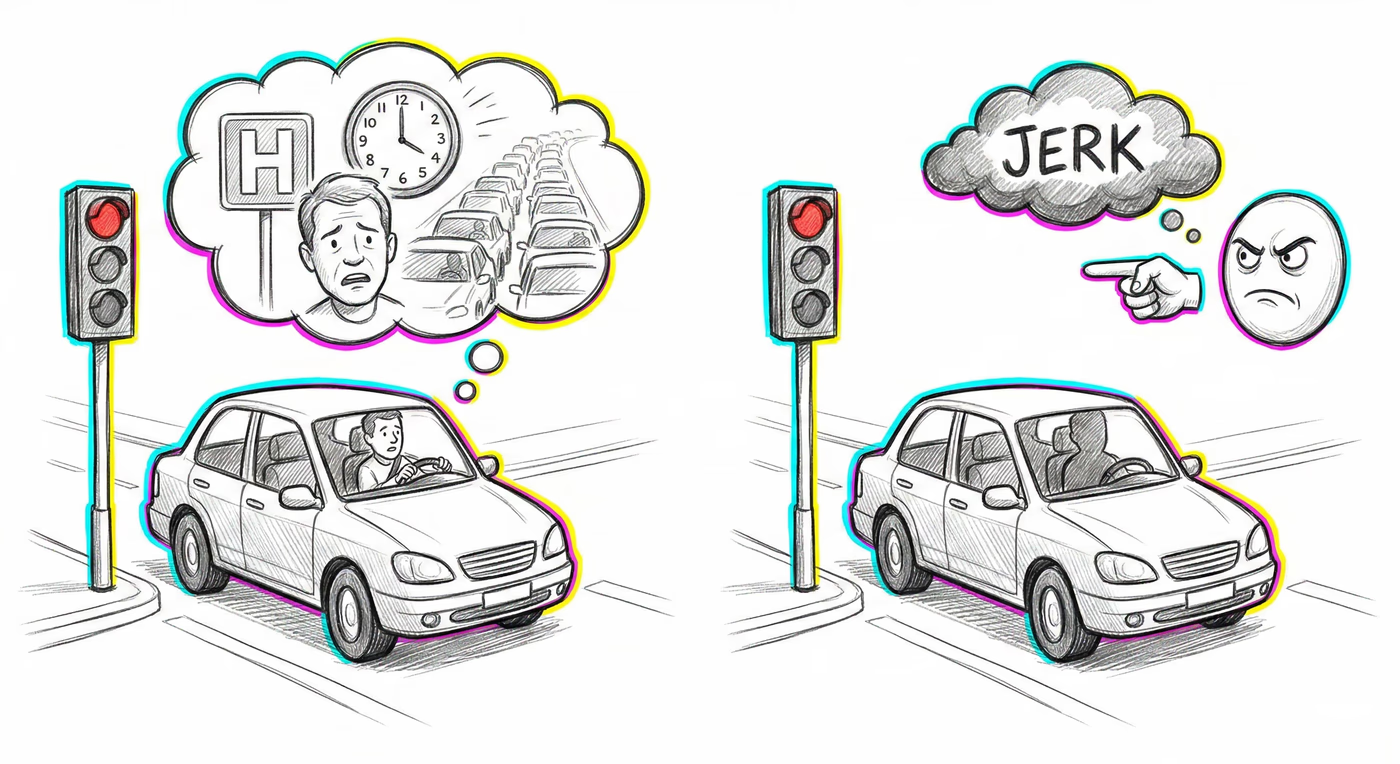
Dismissing a proposal or idea simply because it comes from someone disliked or distrusted, regardless of its actual merit.

WHAT IT IS

The glitch, explained plainly.

Imagine your least favorite kid at school suggests playing the exact game you wanted to play at recess. Suddenly, that game doesn't seem as fun anymore, just because they're the one who said it. You'd rather play something else — even though five minutes ago it was your number one pick.

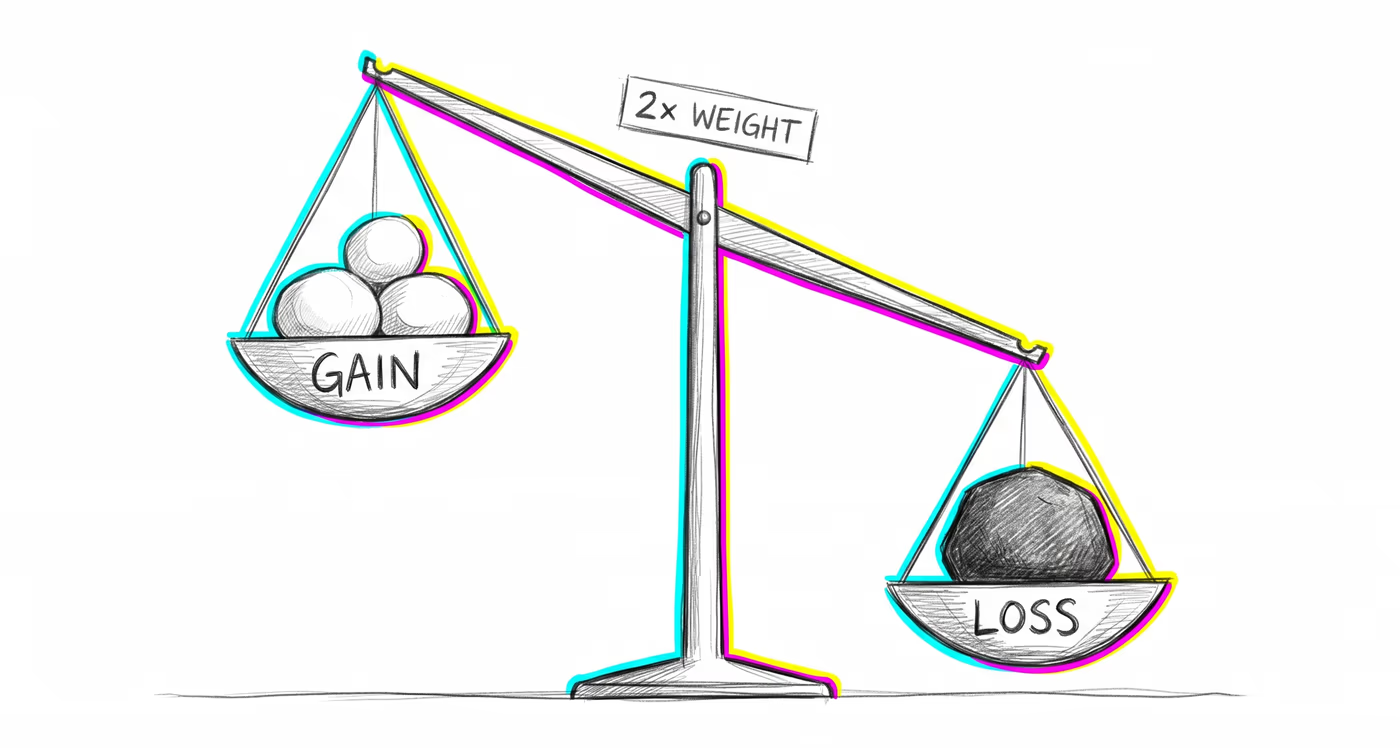
Reactive devaluation describes the systematic tendency for people to rate a proposal, concession, or compromise less favorably once they learn it comes from an opposing party, compared to how they would rate the identical proposal from a neutral or allied source. The bias extends beyond simple distrust: people may actively shift their own preferences away from whatever the adversary has offered, suddenly finding the non-offered alternatives more attractive. This phenomenon is particularly destructive in negotiations and conflict resolution, where it creates a psychological barrier that prevents parties from recognizing mutually beneficial agreements. The bias operates even when the proposal's terms are clear and unambiguous, suggesting it is driven by motivational and identity-protective processes rather than purely rational suspicion about hidden agendas.

SOUND FAMILIAR?

Where it shows up.

  1. 01 Two departments at a software company have been feuding over resource allocation for months. The marketing VP proposes a compromise that gives engineering 60% of the new hires — exactly what the engineering VP told her team would be 'a great outcome.' But when the engineering VP reads that it came from marketing, she tells her team the split is 'clearly designed to look generous while keeping the real power on their side' and counters with a demand for 75%.
  2. 02 A divorcing couple has been unable to agree on who keeps the family home. A mediator privately asks each spouse what settlement they'd accept. Both independently say they'd accept the house being sold and proceeds split 50/50. When the mediator presents this as 'your spouse's proposal,' the other spouse calls it unfair and demands 60%, even though it matches their own stated preference from minutes earlier.
  3. 03 A city council member reads an urban development plan and privately tells aides it's 'surprisingly thoughtful.' At the public meeting, she learns it was drafted by a rival council member's office. She now argues the plan 'lacks community input' and 'prioritizes the wrong neighborhoods,' requesting a complete redraft despite the plan being substantively identical to what she praised an hour ago.
  4. 04 During labor negotiations, a union had identified three concessions it would happily accept. Management offers all three in their opening proposal. Rather than accepting, the union leadership concludes that if management is offering these willingly, they must not be as valuable as originally thought, and pivots to demanding entirely different concessions that weren't even on their original priority list.
  5. 05 A pharmaceutical company proposes a transparent pricing model to regulators — one that an independent think tank had recommended six months prior and that regulators praised at the time. Now that the company itself is proposing the same model, regulators express skepticism that the formula contains hidden advantages for the company, and commission a year-long study before considering adoption, even though the terms are identical to the think tank's version they already endorsed.
IN DIFFERENT DOMAINS

Where it shows up at work.

The same glitch looks different depending on the terrain. Finance, medicine, a relationship, a team — same mechanism, different costume.

Finance & investing

Investors and analysts may dismiss merger proposals or partnership offers from rival firms as strategically self-serving, even when the terms are objectively favorable, leading to missed opportunities for value creation and prolonged hostile standoffs.

Medicine & diagnosis

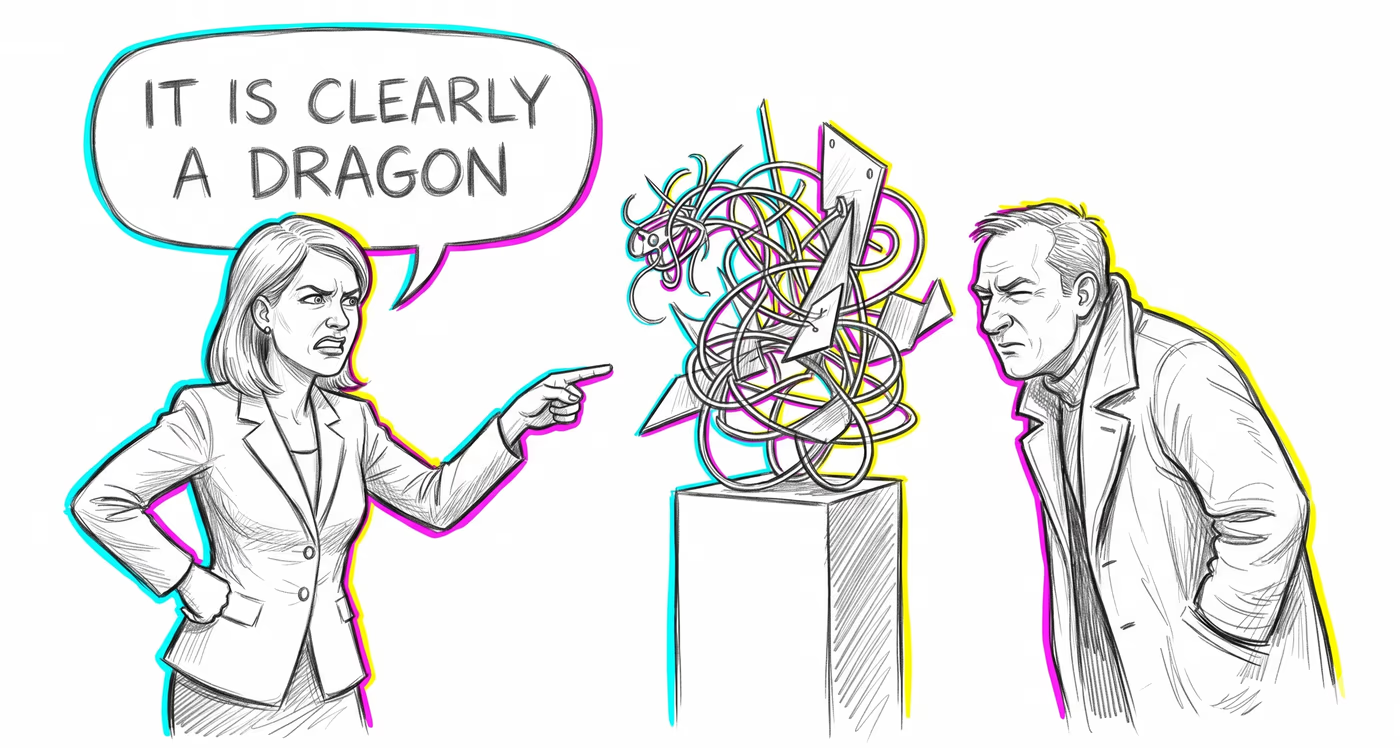
Patients who distrust a particular healthcare provider or insurance company may reject treatment recommendations or coverage offers that are clinically appropriate, simply because the suggestion originates from an entity they view as adversarial to their interests.

Education & grading

Students may dismiss constructive feedback or grading decisions from a teacher they perceive as unfair, automatically assuming the feedback is biased rather than evaluating its substantive content, which impedes learning and growth.

Relationships

During marital conflicts, partners routinely reject compromise proposals from each other that they would readily accept if suggested by a therapist or mutual friend, because the source of the proposal triggers suspicion rather than goodwill.

Tech & product

Product teams may automatically resist feature suggestions or architectural decisions proposed by a competing internal team or an acquired company's engineers, delaying integration and duplicating effort on inferior in-house alternatives.

Workplace & hiring

Managers may devalue ideas proposed by employees from rival departments or by predecessors in a role, leading to the costly reinvention of solutions that already existed and were effective.

Politics Media

Voters and legislators routinely oppose policies that align with their own stated preferences once they learn the policy was introduced by the opposing political party, contributing to legislative gridlock and partisan polarization.

HOW TO SPOT IT

Ask yourself…

  • Am I evaluating this proposal based on its actual content, or am I reacting to who proposed it?
  • Would I feel differently about this exact same offer if it came from someone I trust or from a neutral third party?
  • Have my own preferences suddenly shifted away from what I originally wanted, simply because the other side offered it?
HOW TO DEFEND AGAINST IT

The playbook.

  • Before learning who proposed it, write down what terms you would consider fair or acceptable — then compare your pre-commitment to your reaction after learning the source.
  • Use a neutral third-party mediator to present proposals, stripping away source attribution so ideas can be evaluated on merit.
  • Explicitly ask yourself: 'If my closest ally had proposed these exact same terms, would I accept them?'
  • Have both parties independently list their priorities and acceptable concessions before any proposals are exchanged, then use those lists to anchor evaluation.
  • Practice self-affirmation exercises before negotiations — research shows that affirming one's core values reduces the threat response that fuels reactive devaluation.
FAMOUS CASES

In history.

  • During the Cold War, identical nuclear arms reduction proposals were perceived very differently by American citizens depending on whether they were attributed to President Reagan or Soviet leader Gorbachev, as demonstrated by the Stillinger et al. sidewalk survey.
  • The Israeli-Palestinian peace process has been repeatedly stalled in part because both sides devalue peace proposals when attributed to the opposing side, even when the terms are favorable — documented in Maoz et al.'s 2002 research.
  • During the Stanford University apartheid divestment controversy in the late 1980s, students rated whichever divestment plan the university offered as less significant than the alternative plan the university had not offered.
WHERE IT COMES FROM
Academic origin

Lee Ross and Constance Stillinger, 1988–1991. The concept was introduced in their unpublished 1988 work at Stanford University and formally published in their 1991 paper 'Barriers to Conflict Resolution' in the Negotiation Journal.

Evolutionary origin

In ancestral tribal environments, offers from rival groups frequently concealed deception — a peace offering could mask an ambush, and shared resources could contain poison. A cognitive heuristic that automatically discounted overtures from out-group members would have been protective, helping individuals avoid exploitation by competitors whose true intentions were unknowable. The survival cost of accepting a genuinely bad deal from an enemy was catastrophic, making a conservative rejection bias adaptive even if it occasionally missed cooperative opportunities.

IN AI SYSTEMS

How the machines inherit it.

AI systems trained on negotiation data or political text may learn to weight the source identity of a proposal as a strong predictor of its quality, replicating human patterns of source-based devaluation. Recommendation algorithms may also amplify reactive devaluation by personalizing content to reinforce adversarial framing — for instance, news algorithms that surface stories emphasizing the opposition's proposals as threats rather than presenting them on their merits.

Read more on Wikipedia
FREE FIELD ZINE

10 glitches quietly running your life.

A free field-zine PDF — ten cognitive glitches named, illustrated, with a defense move for each. Plus the weekly Glitch Report on Fridays — one bias named, two spotted in the wild, one defense move. Unsubscribe any time.

EXPLORE MORE

Related glitches.

LAUNCH PRICE

Train against your blindspots.

50 cards are free to preview. Buyers unlock the rest of the deck plus the interactive training — Spot-the-Bias Quiz unlimited, Swipe Deck with spaced repetition, My Blindspots, Decision Pre-Flight, the Printable Deck + Cheat Sheets, and the Field Guide e-book. $29.50$59.

Unlock the full deck

Everything below — yours forever. Pay once, use across every device.

Half-off launch — limited to the first 100 readers. Auto-applied at checkout.
$59 $29.50
one-time payment · lifetime access
  • All interactive digital cards — search, filter, flip, shuffle on any device
  • Five training modes — Spot-the-Bias Quiz, Swipe Deck, Pre-Flight, Blindspots, Journal
  • Curated Lenses + Decision Templates + Defense Playbook
  • Printable Deck PDFs + Field Guide e-book + Cheat Sheets + Anki Export
  • Every future improvement, included
Unlock  $29.50

30-day refund · no questions asked

Unlock the full deck

Everything below — yours forever. Pay once, use across every device.

Half-off launch — limited to the first 100 readers. Auto-applied at checkout.
$59 $29.50
one-time payment · lifetime access
  • All interactive digital cards — search, filter, flip, shuffle on any device
  • Five training modes — Spot-the-Bias Quiz, Swipe Deck, Pre-Flight, Blindspots, Journal
  • Curated Lenses + Decision Templates + Defense Playbook
  • Printable Deck PDFs + Field Guide e-book + Cheat Sheets + Anki Export
  • Every future improvement, included
Unlock  $29.50

30-day refund · no questions asked