Social Comparison Bias

aka Tainted Recommendations Bias · Upward Comparison Bias

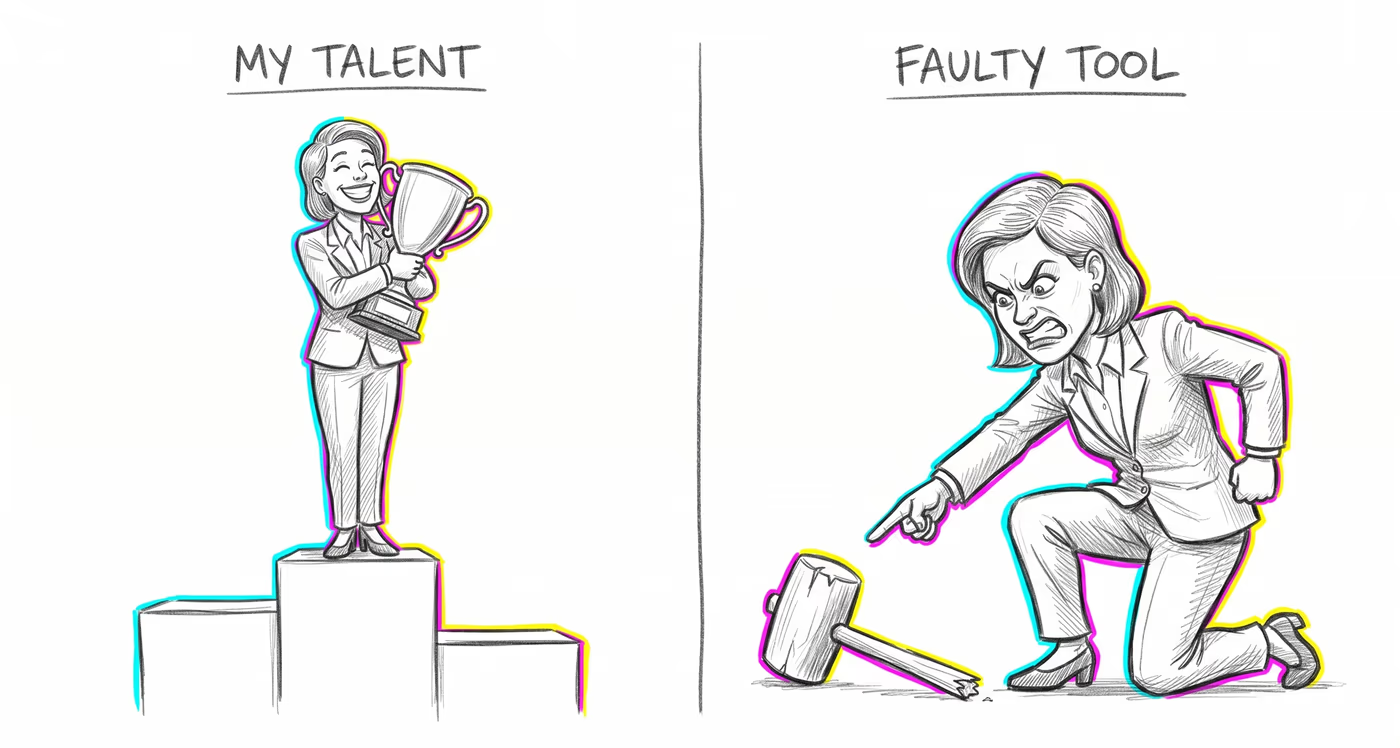
Feeling competitive with or threatened by people who excel in areas important to your self-image.

WHAT IT IS

The glitch, explained plainly.

Imagine you're the best singer in your class. When the teacher asks you to pick someone to join your group for the talent show, you pick the kid who's good at dancing—not the kid who sings even better than you. You don't want anyone making you look less special, even if the better singer would help your team win.

Social comparison bias describes the systematic distortion in judgment and behavior that arises when individuals perceive others as potential threats to their standing on valued dimensions such as skill, status, or achievement. Rather than objectively evaluating others, people unconsciously favor those who do not challenge their perceived superiority on personally relevant attributes. This bias is especially insidious in gatekeeping situations—such as hiring, promotions, or recommendations—where a person with high standing on a particular dimension will systematically avoid endorsing candidates who might surpass them on that same dimension. The result is that organizational and social decisions become subtly corrupted by self-protective motives disguised as objective assessment.

SOUND FAMILIAR?

Where it shows up.

  1. 01 Dr. Reeves chairs a faculty search committee and is the department's most published researcher. When reviewing two finalists—one with a strong teaching record and one with a publication count that rivals her own—she writes a detailed memo highlighting the teaching candidate's 'better cultural fit,' even though the department's strategic priority is increasing research output.
  2. 02 Marcus, a top-performing sales rep, is asked to recommend one of two junior reps for an accelerated leadership program. He recommends the one who excels in client retention over the one whose closing rate already matches his own, reasoning that 'we need more well-rounded leaders.'
  3. 03 A graphic designer on a hiring panel rates a portfolio as 'technically impressive but lacking creativity' after noticing the applicant's design awards exceed her own. She rates a less accomplished candidate as 'a better team player.'
  4. 04 Lisa, a varsity tennis player, is asked which of two freshmen should join the team. She enthusiastically endorses the one who plays doubles well, while describing the singles prodigy—whose serve speed exceeds hers—as 'not a great fit for team chemistry.'
  5. 05 An engineering manager with a strong background in algorithms is evaluating two internal transfer requests. He approves the systems engineer over the algorithms specialist whose solutions have been outperforming his own recent work, citing 'team skill balance' as the deciding factor.
IN DIFFERENT DOMAINS

Where it shows up at work.

The same glitch looks different depending on the terrain. Finance, medicine, a relationship, a team — same mechanism, different costume.

Finance & investing

Investment professionals may downplay or dismiss the track record of analysts whose performance metrics rival or exceed their own, leading to talent attrition and suboptimal portfolio team composition.

Medicine & diagnosis

Senior physicians on hiring committees may unconsciously favor candidates from less prestigious training programs over those from top-ranked institutions whose credentials threaten the senior physician's perceived expertise.

Education & grading

Teachers who are recognized as subject-matter experts may inadvertently discourage or undervalue students whose aptitude in that subject approaches or surpasses their own, channeling those students toward different domains.

Relationships

People may feel threatened by a partner's achievements in areas they consider central to their own identity, leading to subtle undermining behavior or withdrawal of support rather than celebration.

Tech & product

Lead developers may resist hiring or promoting engineers whose technical skills surpass their own in core competency areas, instead favoring candidates with complementary but non-threatening skill sets.

Workplace & hiring

High-performing employees in gatekeeping roles systematically recommend candidates who do not threaten their standing on their strongest dimension, gradually weakening the organization's talent pool in that area.

Politics Media

Political incumbents may work to block rising party members whose policy expertise or charisma threatens their position, framing opposition as concern for party unity or readiness.

HOW TO SPOT IT

Ask yourself…

  • Am I evaluating this person's weakness more critically because their strength threatens an area I pride myself on?
  • Would I make the same recommendation if this person's skills were in a domain I don't personally compete in?
  • Am I rationalizing my preference for a less qualified candidate with vague language like 'better fit' or 'more well-rounded'?
HOW TO DEFEND AGAINST IT

The playbook.

  • Before evaluating anyone, explicitly write down the objective criteria for the role or decision, and commit to scoring candidates against those criteria before discussing impressions.
  • Ask yourself: 'If this person's strongest skill were in a domain I don't care about, would I still have the same reservations?'
  • Use structured interviews and blind evaluations to reduce the influence of personal comparison motives.
  • Invite an outside evaluator with no stake in relative standing to provide an independent assessment.
  • Reframe a potential rival's excellence as an asset that elevates the group's reputation—and by extension, your own.
FAMOUS CASES

In history.

  • Research by Garcia, Song, and Tesser (2010) documented this bias in academic hiring committees, where faculty members systematically recommended candidates who did not threaten their standing on their strongest publication dimension.
  • Corporate succession failures where outgoing executives resisted grooming successors who might outshine their legacy, leading to leadership vacuums.
WHERE IT COMES FROM
Academic origin

Leon Festinger introduced the foundational Social Comparison Theory in 1954. The specific 'social comparison bias' in decision-making was formalized by Stephen M. Garcia, Hyunjin Song, and Abraham Tesser in 2010.

Evolutionary origin

In ancestral environments, social rank within a group directly determined access to resources, mates, and protection. Individuals who actively maintained their relative standing—by forming alliances with non-threatening peers and limiting the rise of competitors—would have had reproductive advantages. The drive to monitor and protect one's hierarchical position is deeply wired into primate social cognition.

IN AI SYSTEMS

How the machines inherit it.

Recommendation algorithms trained on human evaluative data can inherit social comparison patterns, systematically downranking candidates or content creators whose metrics threaten established high-performers in the system, perpetuating gatekeeping dynamics in automated hiring or content curation.

Read more on Wikipedia
FREE FIELD ZINE

10 glitches quietly running your life.

A free field-zine PDF — ten cognitive glitches named, illustrated, with a defense move for each. Plus the weekly Glitch Report on Fridays — one bias named, two spotted in the wild, one defense move. Unsubscribe any time.

EXPLORE MORE

Related glitches.

LAUNCH PRICE

Train against your blindspots.

50 cards are free to preview. Buyers unlock the rest of the deck plus the interactive training — Spot-the-Bias Quiz unlimited, Swipe Deck with spaced repetition, My Blindspots, Decision Pre-Flight, the Printable Deck + Cheat Sheets, and the Field Guide e-book. $29.50$59.

Unlock the full deck

Everything below — yours forever. Pay once, use across every device.

Half-off launch — limited to the first 100 readers. Auto-applied at checkout.
$59 $29.50
one-time payment · lifetime access
  • All interactive digital cards — search, filter, flip, shuffle on any device
  • Five training modes — Spot-the-Bias Quiz, Swipe Deck, Pre-Flight, Blindspots, Journal
  • Curated Lenses + Decision Templates + Defense Playbook
  • Printable Deck PDFs + Field Guide e-book + Cheat Sheets + Anki Export
  • Every future improvement, included
Unlock  $29.50

30-day refund · no questions asked

Unlock the full deck

Everything below — yours forever. Pay once, use across every device.

Half-off launch — limited to the first 100 readers. Auto-applied at checkout.
$59 $29.50
one-time payment · lifetime access
  • All interactive digital cards — search, filter, flip, shuffle on any device
  • Five training modes — Spot-the-Bias Quiz, Swipe Deck, Pre-Flight, Blindspots, Journal
  • Curated Lenses + Decision Templates + Defense Playbook
  • Printable Deck PDFs + Field Guide e-book + Cheat Sheets + Anki Export
  • Every future improvement, included
Unlock  $29.50

30-day refund · no questions asked