Veblen Effect

aka Conspicuous Consumption Effect · Veblen Good Effect · Prestige Pricing Effect

Wanting something more because it's expensive, treating high price as a signal of quality or status rather than evaluating the item itself.

WHAT IT IS

The glitch, explained plainly.

Imagine two identical lollipops. One costs 10 cents and the other costs $10. You pick the $10 one because you think it must be way better — and you want your friends to see you eating the fancy lollipop. That's the Veblen Effect: you want something more just because it's expensive, and you want people to know you have the expensive thing.

The Veblen Effect describes a paradoxical consumer behavior in which demand for a good increases as its price rises, violating the standard law of demand. This occurs because the high price itself becomes a desirable feature — it signals exclusivity, wealth, and social standing to others. The effect hinges on the visibility of the purchase; the item functions less as a utilitarian object and more as a broadcast of the buyer's economic position. Critically, the perceived quality and desirability of the product are anchored to its cost rather than to any objective assessment of its properties, meaning that lowering the price can actually reduce demand by stripping away the status signaling value.

SOUND FAMILIAR?

Where it shows up.

  1. 01 A startup founder hires a management consultant charging $500/hour over an equally qualified one charging $150/hour, reasoning that the expensive consultant 'must be better' and that telling investors about the hire will signal the company's seriousness and resources.
  2. 02 A skincare brand raises its moisturizer price from $30 to $85 without changing the formula. Sales increase because customers begin perceiving the product as 'premium' and post about it on social media as part of their luxury routine.
  3. 03 A sommelier presents two glasses of the same wine to a dinner guest, labeling one as a $12 bottle and the other as a $95 reserve. The guest reports that the '$95 wine' tastes significantly richer and more complex, and insists on ordering a full bottle of it.
  4. 04 An architect selects Italian marble tiles at three times the cost of visually indistinguishable domestic tiles for a client's kitchen, arguing that the imported material will 'hold its value' — but privately admits the real reason is that the client's social circle will recognize the brand name stamped on the invoice.
  5. 05 A nonprofit raises its annual gala ticket price from $500 to $2,000, and attendance actually grows because the higher price makes the event feel more exclusive, attracting donors who want to be seen at a prestigious gathering rather than a modestly priced one.
IN DIFFERENT DOMAINS

Where it shows up at work.

The same glitch looks different depending on the terrain. Finance, medicine, a relationship, a team — same mechanism, different costume.

Finance & investing

Investors sometimes equate a stock's high share price with quality or stability, avoiding low-priced equities not because of fundamentals but because cheapness implies risk. Similarly, high-fee fund managers are perceived as more competent than low-fee index funds, despite evidence that higher fees rarely correlate with better returns.
Medicine & diagnosis

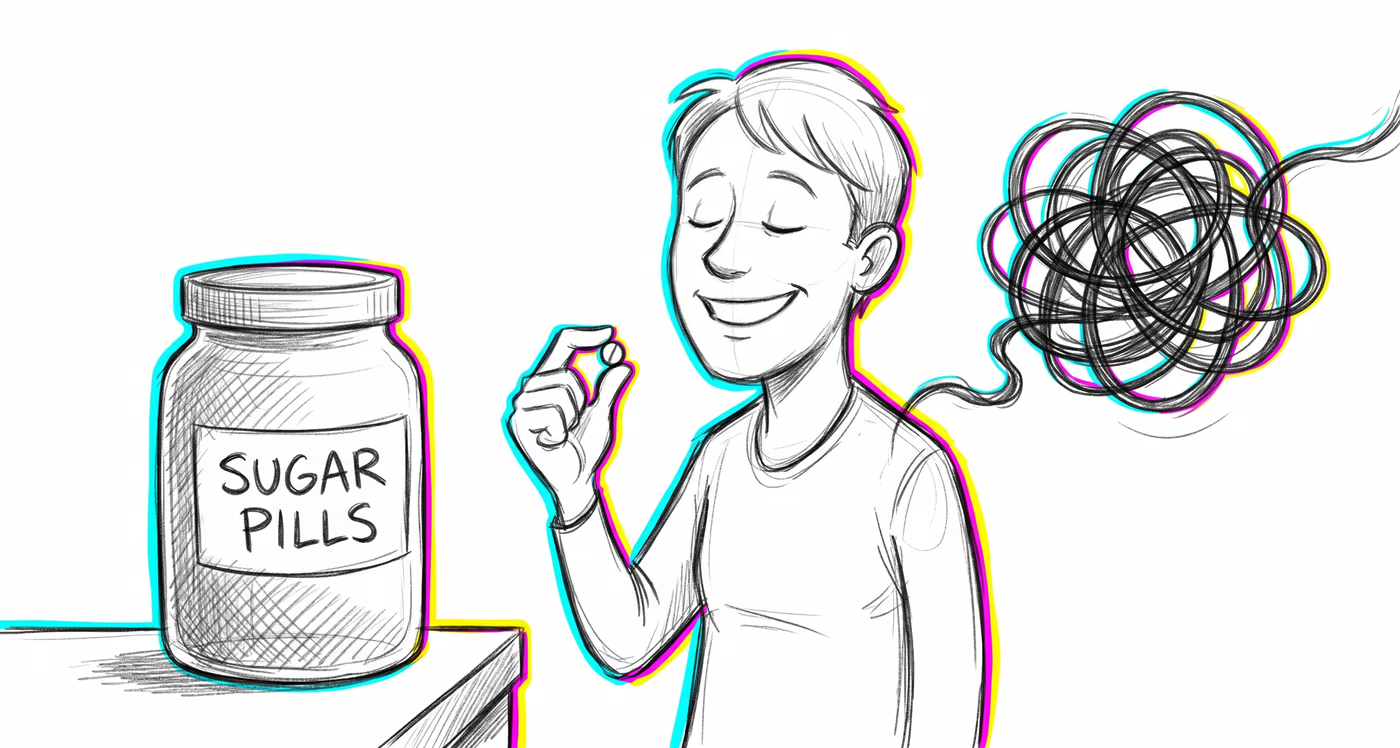
Patients often perceive brand-name medications as more effective than chemically identical generics, partly because the higher price reinforces expectations of quality. Research shows that placebos described as expensive produce stronger analgesic effects than those described as cheap, demonstrating how price cues modulate the brain's reward and pain-processing systems.

Education & grading

Expensive private schools and elite university tuitions are often assumed to deliver proportionally better education, even when outcome data shows minimal differences. Parents and students may dismiss affordable or free educational programs as inferior purely because of low cost.

Relationships

Partners may judge each other's commitment or affection by the price of gifts rather than their thoughtfulness or personal significance. Expensive engagement rings, vacations, or restaurant choices become proxies for the depth of feeling, creating pressure to spend beyond one's means to signal love.

Tech & product

Software companies sometimes increase subscription prices to reposition a product as 'enterprise-grade,' and users report higher satisfaction and trust at the premium tier despite identical feature sets. Freemium products are often dismissed as unserious or insecure compared to paid alternatives.

Workplace & hiring

Companies hiring consultants or agencies may default to the most expensive bid, believing that higher fees guarantee superior work. Internally, employees given expensive tools or equipment may be perceived as more valued and higher-performing than those with budget alternatives.

Politics Media

Political campaigns that spend lavishly on advertising and events are perceived as more legitimate and viable. Voters and donors sometimes use a candidate's fundraising totals and spending levels as a heuristic for electability, regardless of policy substance.

HOW TO SPOT IT

Ask yourself…

  • Am I drawn to this product primarily because of what its price says about me, rather than what the product actually does for me?
  • Would I still want this item if no one else could ever know how much I paid for it?
  • If an identical product were available at one-fifth the price under a different brand, would I genuinely believe it was inferior?
HOW TO DEFEND AGAINST IT

The playbook.

  • Conduct blind comparisons: Before buying, evaluate the product without seeing the price or brand (e.g., blind taste tests, feature-only spec sheets) to isolate intrinsic quality from price signaling.
  • Apply the 'invisible purchase' test: Ask yourself whether you would still choose this item if it were identical in every way but no one could ever see it or know what you paid.
  • Calculate cost-per-use: Divide the price by the number of times you will realistically use the item to anchor your evaluation in utilitarian rather than status value.
  • Identify the specific social audience you are purchasing for: Name the people whose opinion is driving your spending, then ask whether their approval is worth the price premium.
  • Set a 48-hour cooling period for prestige purchases: Delay buying any item where the primary appeal is its exclusivity or brand cachet to allow the initial status-driven excitement to fade.
FAMOUS CASES

In history.

  • The sustained premium pricing strategy of Hermès Birkin bags, where multi-year waitlists and five-figure prices have increased rather than suppressed demand, making the bag a paradigmatic Veblen good.
  • De Beers' 20th-century diamond marketing campaign, which artificially restricted supply and promoted diamonds as the only acceptable engagement stone, using high prices to manufacture perceived rarity and emotional value.
  • The 2008 Caltech/Stanford wine tasting fMRI study by Plassmann, O'Doherty, Shiv, and Rangel demonstrated that identical wines labeled with higher prices produced greater neural pleasure responses, providing direct neuroscientific evidence of the Veblen Effect.
WHERE IT COMES FROM
Academic origin

Thorstein Veblen introduced the concept of conspicuous consumption in 'The Theory of the Leisure Class' (1899). The term 'Veblen Effect' was formally coined by economist Harvey Leibenstein in his 1950 paper 'Bandwagon, Snob, and Veblen Effects in the Theory of Consumers' Demand' published in The Quarterly Journal of Economics.

Evolutionary origin

In ancestral environments, the ability to publicly demonstrate surplus resources was a reliable signal of fitness, health, and alliance value. Displaying costly ornaments or hosting lavish feasts communicated that an individual had resources beyond survival needs, making them a more attractive mate, ally, or leader. The brain evolved to attend to and reward status-signaling behaviors because higher social rank conferred tangible survival and reproductive advantages.

IN AI SYSTEMS

How the machines inherit it.

Recommendation algorithms trained on purchase data may learn that higher-priced items receive better user ratings (due to the Veblen Effect inflating satisfaction scores), leading the system to systematically recommend more expensive options. Pricing algorithms can also discover and exploit Veblen dynamics by raising prices on goods that show positive price-demand elasticity, creating feedback loops of artificial prestige inflation.

FREE FIELD ZINE

10 glitches quietly running your life.

A free field-zine PDF — ten cognitive glitches named, illustrated, with a defense move for each. Plus the weekly Glitch Report on Fridays — one bias named, two spotted in the wild, one defense move. Unsubscribe any time.

EXPLORE MORE

Related glitches.

LAUNCH PRICE

Train against your blindspots.

50 cards are free to preview. Buyers unlock the rest of the deck plus the interactive training — Spot-the-Bias Quiz unlimited, Swipe Deck with spaced repetition, My Blindspots, Decision Pre-Flight, the Printable Deck + Cheat Sheets, and the Field Guide e-book. $29.50$59.

Unlock the full deck

Everything below — yours forever. Pay once, use across every device.

Half-off launch — limited to the first 100 readers. Auto-applied at checkout.
$59 $29.50
one-time payment · lifetime access
  • All interactive digital cards — search, filter, flip, shuffle on any device
  • Five training modes — Spot-the-Bias Quiz, Swipe Deck, Pre-Flight, Blindspots, Journal
  • Curated Lenses + Decision Templates + Defense Playbook
  • Printable Deck PDFs + Field Guide e-book + Cheat Sheets + Anki Export
  • Every future improvement, included
Unlock  $29.50

30-day refund · no questions asked

Unlock the full deck

Everything below — yours forever. Pay once, use across every device.

Half-off launch — limited to the first 100 readers. Auto-applied at checkout.
$59 $29.50
one-time payment · lifetime access
  • All interactive digital cards — search, filter, flip, shuffle on any device
  • Five training modes — Spot-the-Bias Quiz, Swipe Deck, Pre-Flight, Blindspots, Journal
  • Curated Lenses + Decision Templates + Defense Playbook
  • Printable Deck PDFs + Field Guide e-book + Cheat Sheets + Anki Export
  • Every future improvement, included
Unlock  $29.50

30-day refund · no questions asked