Sleeper Effect

aka Delayed Persuasion Effect · Dissociation Effect

A message from a distrusted source becoming more persuasive over time, as the source is forgotten but the message sticks.

WHAT IT IS

The glitch, explained plainly.

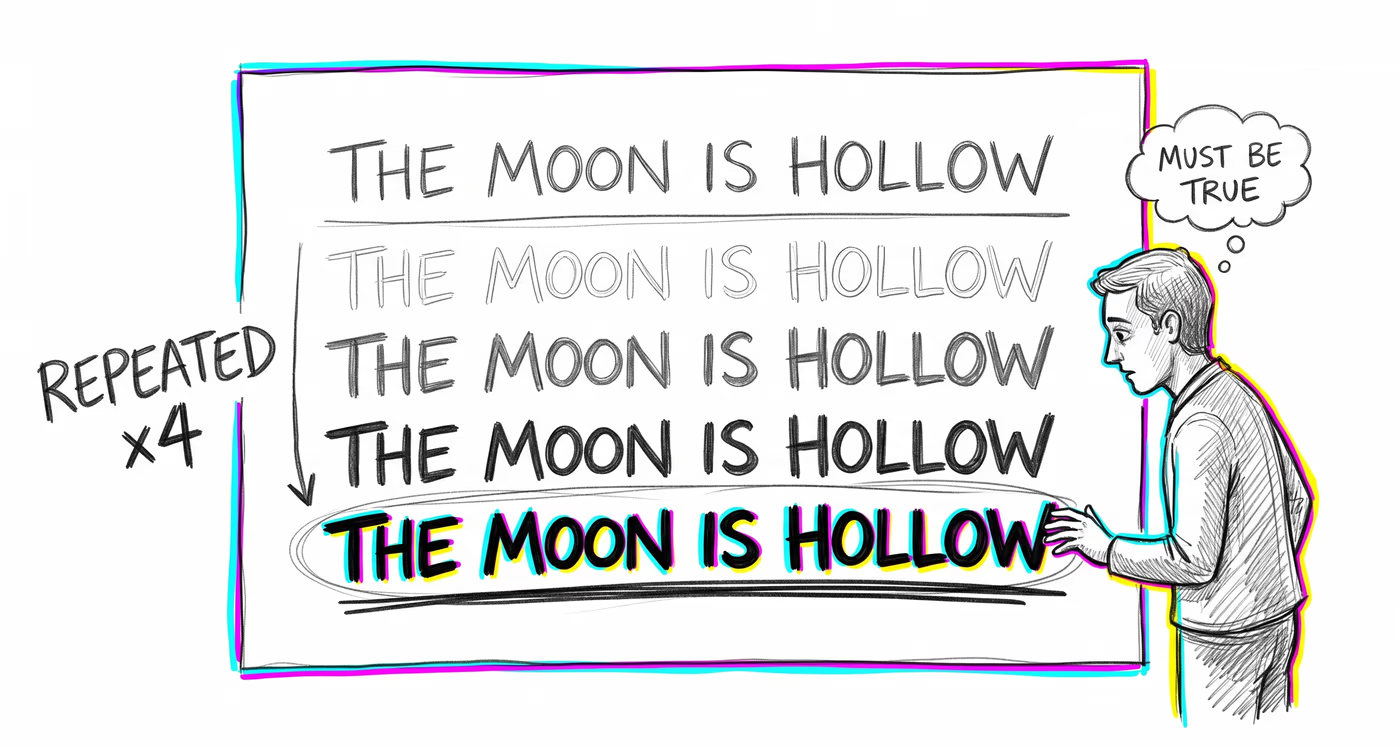
Imagine someone you don't trust tells you something interesting. At first, you think 'I shouldn't believe this — that person is a liar.' But weeks later, you remember the interesting thing they said but forget who told you. Now you start believing it because you can't remember why you were skeptical in the first place.

The Sleeper Effect describes a counterintuitive pattern in which a persuasive message initially discounted due to a low-credibility source or explicit disclaimer actually gains persuasive power over time rather than losing it. This occurs because the memory of the discounting cue (e.g., 'this came from an unreliable source') decays faster than the memory of the message content itself, leaving the arguments to operate on attitudes without the contextual skepticism that originally suppressed them. The effect is most reliably observed when recipients deeply process the message arguments before encountering the discounting cue, and when the cue follows the message rather than preceding it. Though historically difficult to replicate under controlled conditions, meta-analytic evidence supports its existence under specific conditions, making it a rare but genuine phenomenon with significant implications for propaganda, advertising, and misinformation.

SOUND FAMILIAR?

Where it shows up.

  1. 01 Maria reads a compelling article arguing that a popular dietary supplement is harmful. At the bottom, she notices it was published by a competitor's marketing team, so she dismisses the claims entirely. Three weeks later, without recalling the source, she tells her partner she's heard the supplement might be dangerous and decides to stop taking it.
  2. 02 A jury member hears powerful testimony from a witness. The judge then instructs the jury to disregard the testimony because it was obtained improperly. During deliberations two days later, the juror finds the disregarded testimony's arguments echoing in his mind and influencing his judgment, though he can no longer recall exactly why the testimony was struck from the record.
  3. 03 During a corporate strategy meeting, a junior analyst presents data suggesting the company should pivot its product line. The CEO publicly dismisses the analyst as inexperienced and unqualified. Over the following month, several executives independently begin advocating for the same pivot, citing the underlying data points without attributing them to the dismissed analyst.
  4. 04 A voter watches a documentary about environmental policy that presents strong arguments for new regulations. After the film, she learns it was funded by a lobbying group with financial interests in those regulations, and she feels manipulated. Six weeks later, filling out her ballot, she finds herself strongly favoring the environmental regulations without connecting her opinion to the documentary.
  5. 05 A doctor reads a study showing promising results for an experimental treatment. He then notices the study was funded entirely by the drug manufacturer and published in a low-tier journal, so he mentally files it as unreliable. Months later, when a patient asks about options, he finds himself recommending the treatment, vaguely recalling 'positive research' but not the credibility concerns.
IN DIFFERENT DOMAINS

Where it shows up at work.

The same glitch looks different depending on the terrain. Finance, medicine, a relationship, a team — same mechanism, different costume.

Finance & investing

Investors may initially dismiss bullish analyses from conflicted sources (e.g., analysts with undisclosed positions), but over time the optimistic projections detach from their questionable origins and begin influencing portfolio decisions as seemingly neutral market knowledge.
Medicine & diagnosis

Patients who encounter health claims from dubious sources — supplement companies, unverified wellness blogs — may initially discount them but later recall the claims as established medical knowledge, leading to self-medication or treatment non-compliance.

Education & grading

Students who read persuasive arguments in low-quality or biased sources may initially dismiss them, but later reproduce those arguments in essays or discussions as though they were established facts, having forgotten the original source's unreliability.

Relationships

Gossip from a known troublemaker about a friend or partner is initially dismissed, but over time the content of the gossip lingers while the source's unreliability fades, gradually eroding trust in the person who was gossiped about.

Tech & product

Users initially dismiss product claims from obviously biased sponsored content or paid reviews, but over time remember the feature descriptions and performance claims without recalling they came from advertisements, influencing later purchase decisions.

Workplace & hiring

An employee dismisses critical feedback about a colleague because it came from someone with a known grudge, but months later forms a negative impression of that colleague based on the same criticisms, no longer associating them with the biased source.

Politics Media

Negative political advertisements from clearly partisan sources are initially discounted by voters, but over time the specific policy criticisms or character attacks persist in memory while the partisan origin fades, shifting voter attitudes against the targeted candidate.

HOW TO SPOT IT

Ask yourself…

  • Can I actually recall where I first learned this belief or claim, or does it just feel like something I 'know'?
  • Did I initially dismiss this information for a specific reason that I can no longer clearly remember?
  • Am I treating a claim as established fact even though I have a vague sense I once found it questionable?
HOW TO DEFEND AGAINST IT

The playbook.

  • Practice source tagging: when you encounter a claim, mentally note or physically record both the claim and its source together to strengthen the associative memory link.
  • Before acting on a belief, ask yourself the 'origin audit' question: 'Where exactly did I learn this, and was that source reliable?'
  • When encountering persuasive content from a dubious source, consciously rehearse the source's unreliability alongside the message — for example, 'This claim about X was made by Y who has a conflict of interest.'
  • Set a personal rule to verify claims before repeating them, especially when you cannot recall the original source.
  • Be especially skeptical of beliefs that feel self-evident but that you cannot trace to a specific, trustworthy source.
FAMOUS CASES

In history.

  • During World War II, the U.S. Army's 'Why We Fight' propaganda films produced by Frank Capra were found by Carl Hovland's research team to have greater attitude-changing effects on soldiers nine weeks after viewing than five days after, leading to the original identification of the sleeper effect.
  • Political negative advertising in U.S. elections has been studied as a real-world instance of the sleeper effect, where attack ads from opposition-funded sources gain persuasive influence as voters forget the partisan source while retaining the negative claims.
WHERE IT COMES FROM
Academic origin

Carl Hovland, Arthur Lumsdaine, and Fred Sheffield first identified the effect in 1949 during WWII propaganda research. Hovland and Walter Weiss formalized the concept in 1951. Pratkanis, Greenwald, Leippe, and Baumgardner provided the modern differential decay interpretation in 1988. Kumkale and Albarracín published a comprehensive meta-analysis in 2004.

Evolutionary origin

In ancestral environments, information about threats and resources was valuable regardless of who delivered it. A tendency to retain useful content while discarding social metadata about the messenger may have been adaptive — if a rival warned about a predator near the watering hole, the survival-relevant content mattered more than remembering the rival's untrustworthiness.

IN AI SYSTEMS

How the machines inherit it.

AI-generated misinformation and deepfakes may exploit the sleeper effect at scale: users who initially identify AI-generated content as fake or unreliable may later recall the content's claims without remembering the artificial origin, allowing false narratives to gradually influence beliefs. Additionally, recommendation algorithms that surface content from low-credibility sources may inadvertently amplify the sleeper effect by separating content from source context over repeated exposures.

Read more on Wikipedia
FREE FIELD ZINE

10 glitches quietly running your life.

A free field-zine PDF — ten cognitive glitches named, illustrated, with a defense move for each. Plus the weekly Glitch Report on Fridays — one bias named, two spotted in the wild, one defense move. Unsubscribe any time.

EXPLORE MORE

Related glitches.

LAUNCH PRICE

Train against your blindspots.

50 cards are free to preview. Buyers unlock the rest of the deck plus the interactive training — Spot-the-Bias Quiz unlimited, Swipe Deck with spaced repetition, My Blindspots, Decision Pre-Flight, the Printable Deck + Cheat Sheets, and the Field Guide e-book. $29.50$59.

Unlock the full deck

Everything below — yours forever. Pay once, use across every device.

Half-off launch — limited to the first 100 readers. Auto-applied at checkout.
$59 $29.50
one-time payment · lifetime access
  • All interactive digital cards — search, filter, flip, shuffle on any device
  • Five training modes — Spot-the-Bias Quiz, Swipe Deck, Pre-Flight, Blindspots, Journal
  • Curated Lenses + Decision Templates + Defense Playbook
  • Printable Deck PDFs + Field Guide e-book + Cheat Sheets + Anki Export
  • Every future improvement, included
Unlock  $29.50

30-day refund · no questions asked

Unlock the full deck

Everything below — yours forever. Pay once, use across every device.

Half-off launch — limited to the first 100 readers. Auto-applied at checkout.
$59 $29.50
one-time payment · lifetime access
  • All interactive digital cards — search, filter, flip, shuffle on any device
  • Five training modes — Spot-the-Bias Quiz, Swipe Deck, Pre-Flight, Blindspots, Journal
  • Curated Lenses + Decision Templates + Defense Playbook
  • Printable Deck PDFs + Field Guide e-book + Cheat Sheets + Anki Export
  • Every future improvement, included
Unlock  $29.50

30-day refund · no questions asked