Anchoring Bias

aka Anchoring Effect · Anchoring Heuristic · Anchoring-and-Adjustment Heuristic

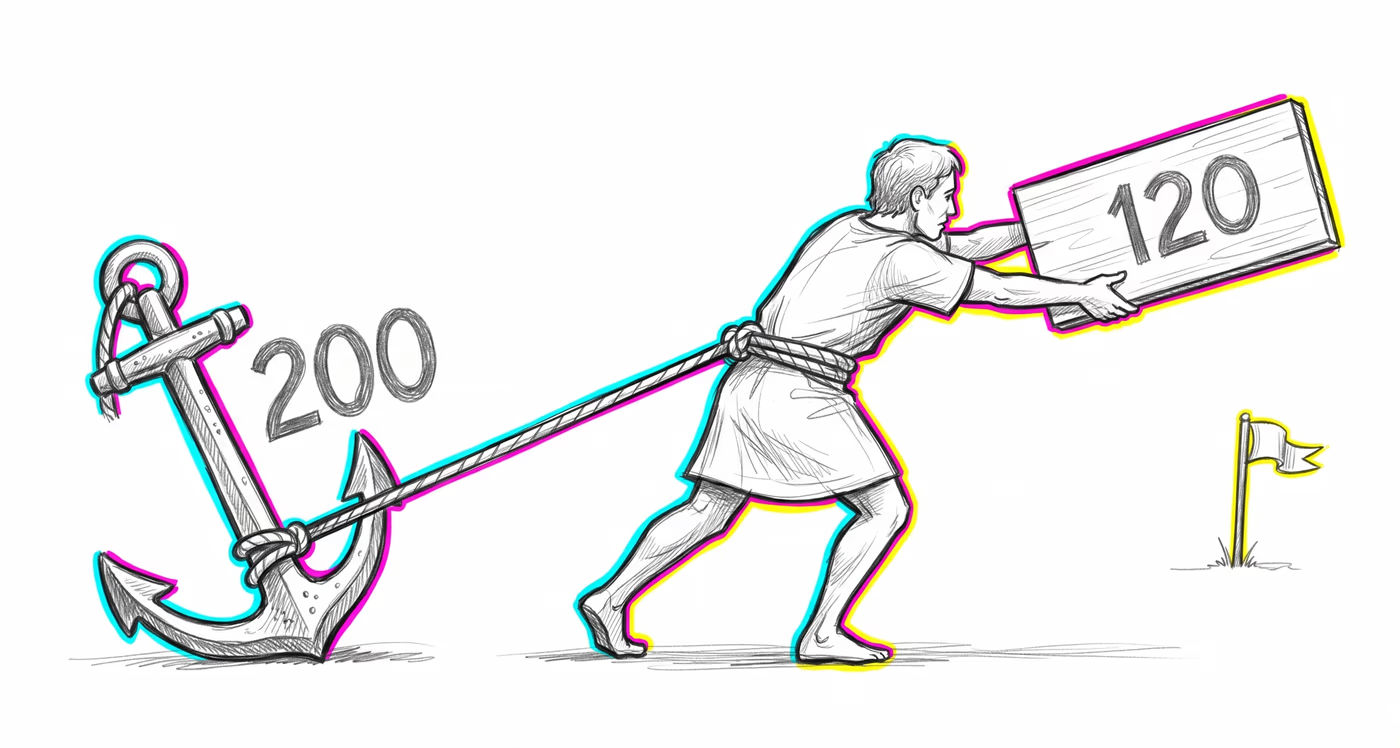
Over-relying on the first number or fact encountered, then adjusting insufficiently from that starting point.

Illustration: Anchoring Bias
WHAT IT IS

The glitch, explained plainly.

Imagine you spin a wheel and it lands on 50, then someone asks you how many jelly beans are in a jar. Even though the wheel has nothing to do with jelly beans, your guess will magically drift toward 50. It's like your brain grabs onto the first number it sees and then uses it as a starting point, only scooting a little bit away — like a dog on a leash that can wander, but not very far from the post it's tied to.

Anchoring bias occurs when an individual's numerical estimate or qualitative judgment is disproportionately influenced by an initial reference point, even when that reference point is arbitrary or irrelevant to the question at hand. The effect is remarkably robust: it persists across domains ranging from trivia questions to multi-million dollar real estate transactions, and it affects both novices and trained experts. People generate their final estimate by starting from the anchor and adjusting — but the adjustment is almost always insufficient, leaving the final answer pulled toward the anchor. Critically, simply being aware of the bias or being motivated by financial incentives does not reliably eliminate it, making it one of the most difficult cognitive biases to counteract through willpower alone.

SOUND FAMILIAR?

Where it shows up.

  1. 01 A car salesman shows Maria a luxury sedan priced at $65,000 before walking her to the mid-range lot. She ends up happily paying $38,000 for a car she'd researched online and planned to buy for no more than $30,000, convinced she saved a fortune compared to the first car she saw.
  2. 02 During a team planning meeting, the project lead casually says, 'I think this will take about 12 weeks.' When individual engineers later submit their own independent estimates, they cluster between 10 and 14 weeks, despite having previously discussed among themselves that 6-8 weeks was realistic.
  3. 03 A prosecutor demands 9 years of prison time for a robbery case. The defense attorney asks for 3 years. The judge, who has 15 years of experience and prides herself on impartiality, sentences the defendant to 6 years — roughly the midpoint — even though sentencing guidelines for comparable cases suggest 4 years.
  4. 04 Dr. Patel reads a referral note from a colleague suggesting the patient's cholesterol is 'probably around 280.' After running the actual lab test, the result is ambiguous and could be read as 240 or 260 depending on calibration. Dr. Patel records it as 260, feeling confident this is correct, without noticing how the referral note shaped his interpretation.
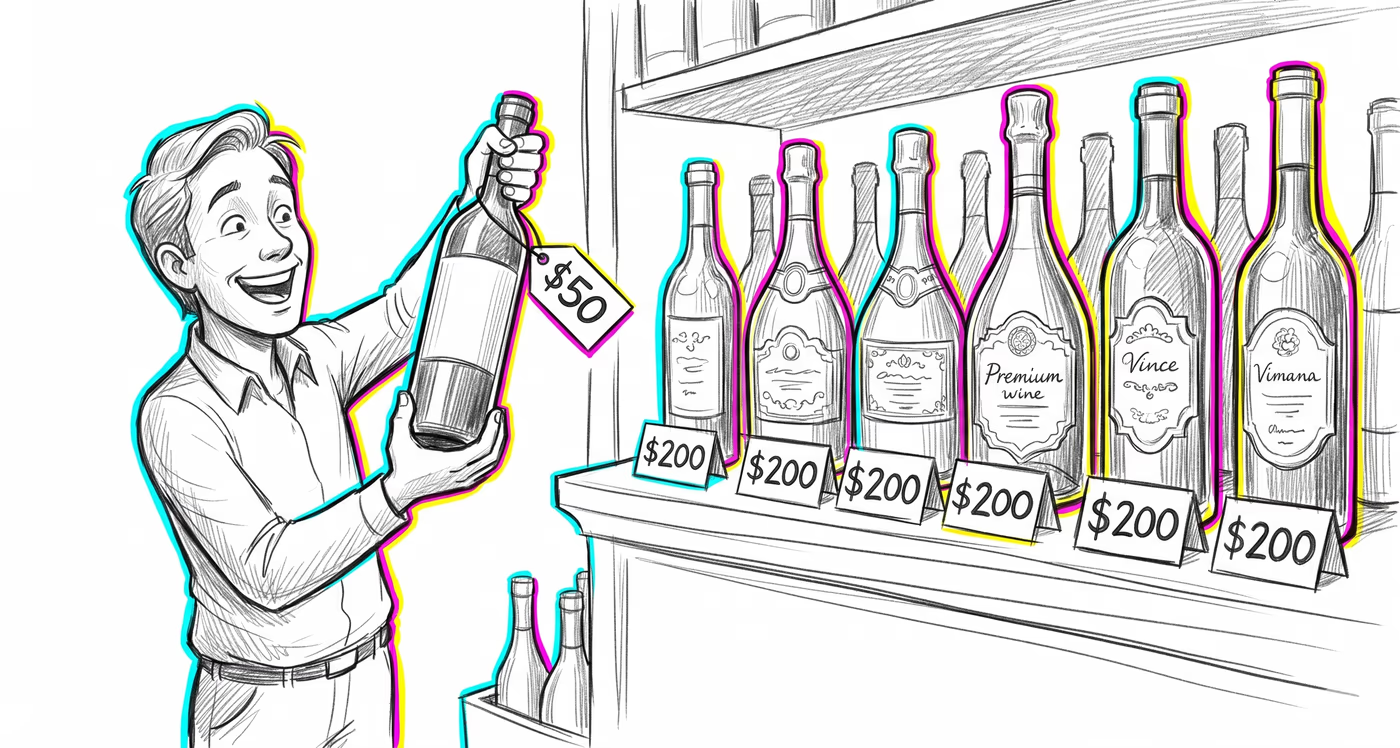
  5. 05 A startup founder pitches investors by opening with, 'Companies like ours are valued at $50 million at this stage.' The investors — who arrived planning to offer $15 million — end up negotiating between $30 million and $40 million, never returning to their original assessment despite having done thorough independent due diligence beforehand.
IN DIFFERENT DOMAINS

Where it shows up at work.

The same glitch looks different depending on the terrain. Finance, medicine, a relationship, a team — same mechanism, different costume.

Finance & investing

Investors anchor on a stock's purchase price or its 52-week high, causing them to hold losing positions waiting for a return to the anchor price or to undervalue gains because the stock hasn't reached a prior peak. Initial analyst price targets similarly anchor subsequent market expectations, even when fundamentals shift significantly.
Medicine & diagnosis

Physicians anchor on a patient's initial presenting diagnosis or referral impression, causing them to insufficiently adjust their diagnostic reasoning when new, contradictory evidence emerges. Initial lab values or vital signs can also anchor clinical expectations, leading to delayed recognition of deterioration or improvement.

Education & grading

A student's early test score anchors a teacher's expectations for their ability throughout the year, affecting how subsequent work is graded and how much attention the student receives. Similarly, grading the first essay in a stack often sets an implicit standard that anchors scores for the essays that follow.

Relationships

First impressions in dating anchor how all subsequent behavior is interpreted — an impressive first date creates a reference point that makes later, more ordinary interactions feel disappointing, while a poor first impression can make someone seem permanently less attractive regardless of later positive behavior.

Tech & product

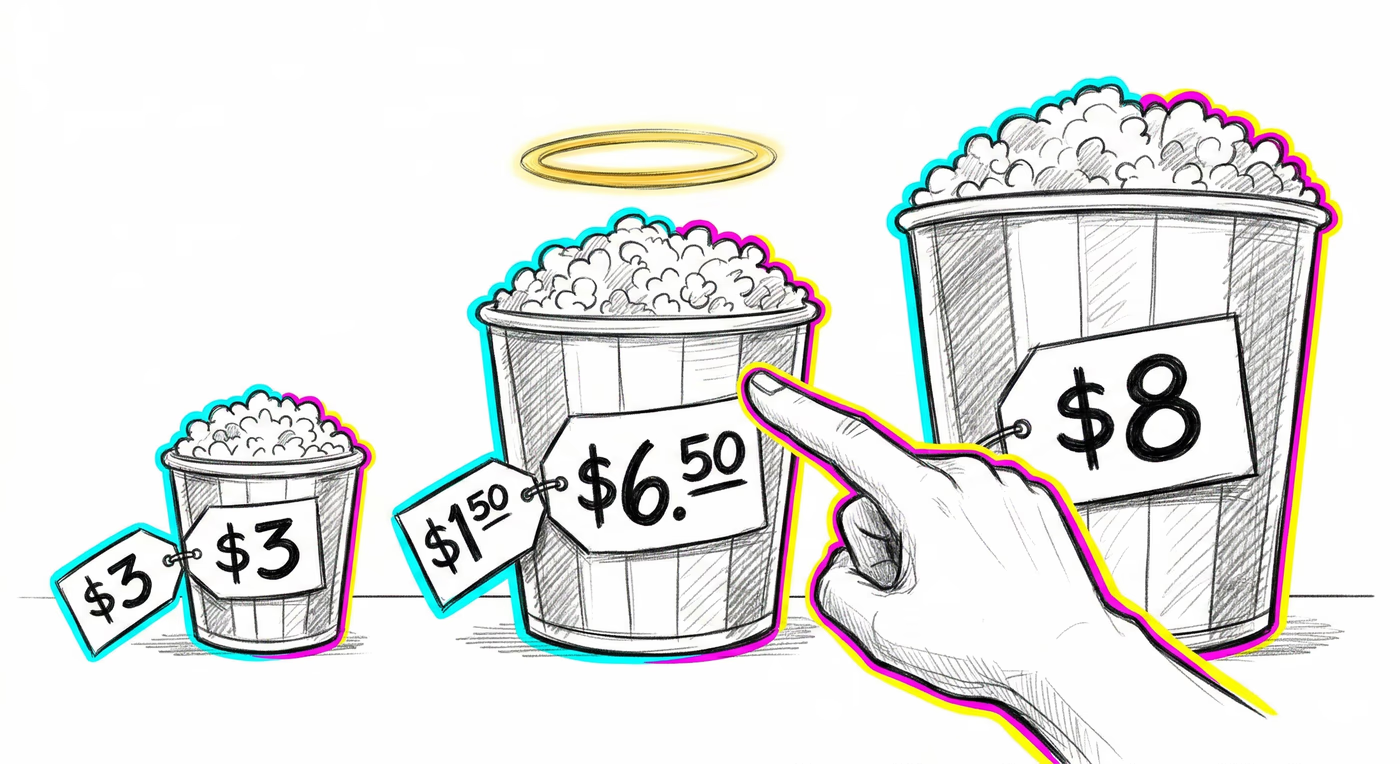
Designers use original prices crossed out next to sale prices to anchor perceived value. Default settings serve as anchors for user configuration choices, as most users adjust only slightly from the default. In A/B testing, the first version a team sees often anchors their evaluation of all subsequent variations.

Workplace & hiring

The first salary offer in a job negotiation anchors the entire compensation discussion. In performance reviews, a manager's initial impression of an employee — often based on a single early event — anchors their assessment for the entire review period, skewing final ratings.

Politics Media

Poll numbers released early in an election cycle anchor public perception of candidate viability, shaping donor behavior and media coverage in ways that become self-fulfilling. Budget negotiations are heavily influenced by whichever party proposes the first number, as all counteroffers adjust insufficiently from that anchor.

HOW TO SPOT IT

Ask yourself…

  • Was there a specific number or value I encountered before forming my estimate — and am I adjusting from it rather than reasoning independently?
  • If someone had given me a completely different starting number, would my final answer meaningfully change?
  • Am I comparing this option to the first thing I saw rather than to an objective standard or my own pre-determined criteria?
HOW TO DEFEND AGAINST IT

The playbook.

  • Before encountering any external information, generate your own independent estimate and write it down — this serves as a self-generated anchor that competes with external ones.
  • Actively consider the opposite direction: if the anchor is high, deliberately think about reasons the true value might be much lower, and vice versa.
  • Use the 'consider multiple anchors' technique: identify at least two or three different reference points and average or triangulate between them rather than adjusting from a single anchor.
  • In negotiations, research your BATNA (Best Alternative to a Negotiated Agreement) and set explicit walk-away thresholds before the discussion begins, reducing the influence of the counterparty's first offer.
  • Implement a 'cooling off' delay between receiving the anchor and making your judgment — temporal distance weakens the anchor's hold on working memory.
FAMOUS CASES

In history.

  • Northcraft & Neale (1987) demonstrated that even experienced real estate agents were significantly influenced by manipulated listing prices when appraising properties, despite denying that listing price affected their professional judgment.
  • Englich, Mussweiler & Strack (2006) showed that German judges with an average of 15 years of experience gave significantly different criminal sentences depending on randomly determined sentencing demands, even when they knew the demands were generated by dice rolls.
  • The Deepwater Horizon disaster investigation revealed that the crew misinterpreted a failed negative pressure test as successful, with investigators identifying confirmation bias in how ambiguous readings were rationalized — illustrating how an initial anchor (the expected 'pass' result) can shape interpretation of subsequent data.
WHERE IT COMES FROM
Academic origin

Amos Tversky and Daniel Kahneman, 1974, in their landmark paper 'Judgment under Uncertainty: Heuristics and Biases' published in Science. The concept was further elaborated by Epley and Gilovich (2006) who distinguished between self-generated and externally provided anchors.

Evolutionary origin

In ancestral environments, quick estimation under uncertainty was essential — judging the size of a herd, the distance to a predator, or the amount of food in a patch. Using a nearby reference point and adjusting from it was a fast, energy-efficient heuristic that produced 'good enough' answers most of the time. This shortcut conserved scarce cognitive resources while enabling rapid decisions in time-pressured survival situations.

IN AI SYSTEMS

How the machines inherit it.

Machine learning models can exhibit anchoring-like behavior when initial training data or hyperparameter values disproportionately influence the final model. In AI-assisted decision-making, when algorithms present a suggested value (e.g., a predicted price, risk score, or diagnosis), human operators anchor on that suggestion and fail to sufficiently override it even when they have access to contradicting domain knowledge. Recommendation systems anchor users on initially presented items, shaping downstream browsing and purchasing behavior.

Read more on Wikipedia
FREE FIELD ZINE

10 glitches quietly running your life.

A free field-zine PDF — ten cognitive glitches named, illustrated, with a defense move for each. Plus the weekly Glitch Report on Fridays — one bias named, two spotted in the wild, one defense move. Unsubscribe any time.

EXPLORE MORE

Related glitches.

LAUNCH PRICE

Train against your blindspots.

50 cards are free to preview. Buyers unlock the rest of the deck plus the interactive training — Spot-the-Bias Quiz unlimited, Swipe Deck with spaced repetition, My Blindspots, Decision Pre-Flight, the Printable Deck + Cheat Sheets, and the Field Guide e-book. $29.50$59.

Unlock the full deck

Everything below — yours forever. Pay once, use across every device.

Half-off launch — limited to the first 100 readers. Auto-applied at checkout.
$59 $29.50
one-time payment · lifetime access
  • All interactive digital cards — search, filter, flip, shuffle on any device
  • Five training modes — Spot-the-Bias Quiz, Swipe Deck, Pre-Flight, Blindspots, Journal
  • Curated Lenses + Decision Templates + Defense Playbook
  • Printable Deck PDFs + Field Guide e-book + Cheat Sheets + Anki Export
  • Every future improvement, included
Unlock  $29.50

30-day refund · no questions asked

Unlock the full deck

Everything below — yours forever. Pay once, use across every device.

Half-off launch — limited to the first 100 readers. Auto-applied at checkout.
$59 $29.50
one-time payment · lifetime access
  • All interactive digital cards — search, filter, flip, shuffle on any device
  • Five training modes — Spot-the-Bias Quiz, Swipe Deck, Pre-Flight, Blindspots, Journal
  • Curated Lenses + Decision Templates + Defense Playbook
  • Printable Deck PDFs + Field Guide e-book + Cheat Sheets + Anki Export
  • Every future improvement, included
Unlock  $29.50

30-day refund · no questions asked