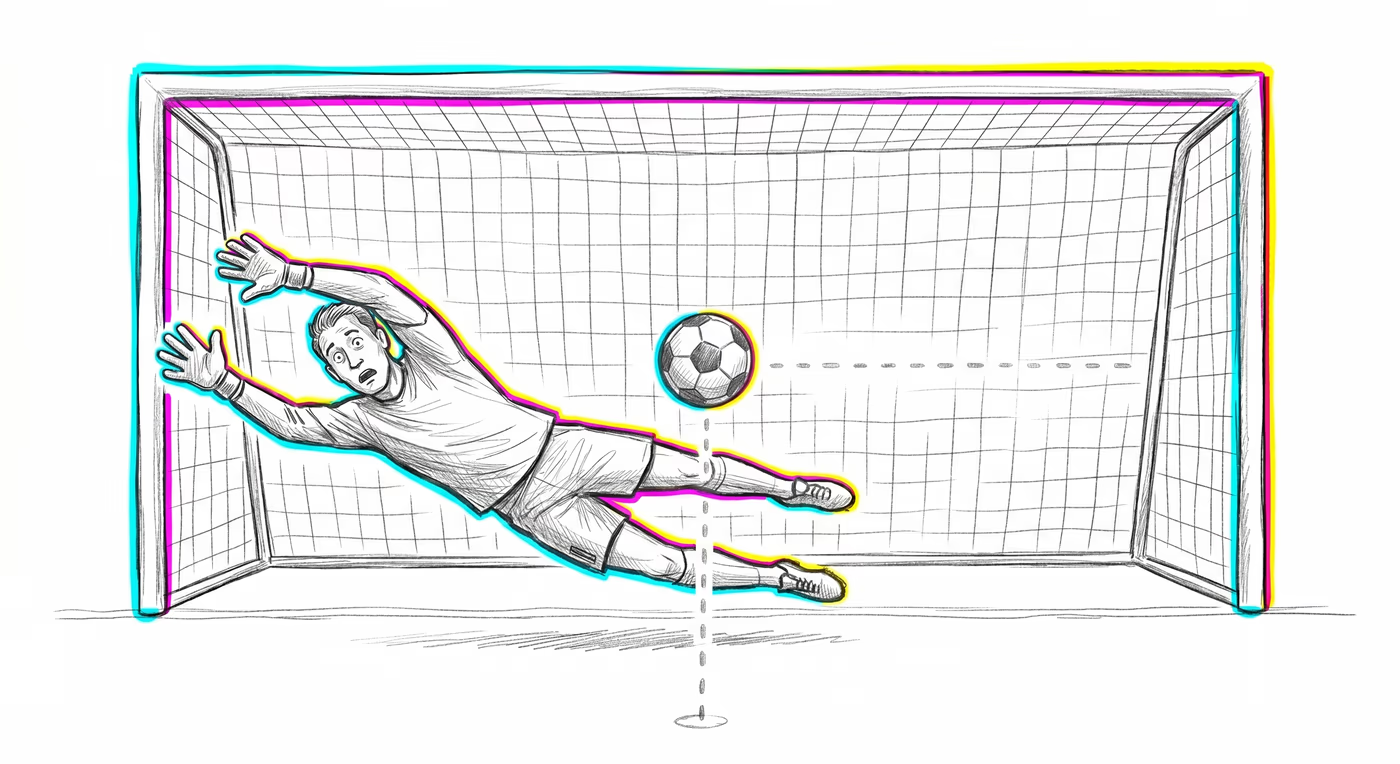
Action Bias

aka Bias for Action · Commission Bias · Intervention Bias

Favoring doing something over doing nothing, even when inaction would produce a better outcome.

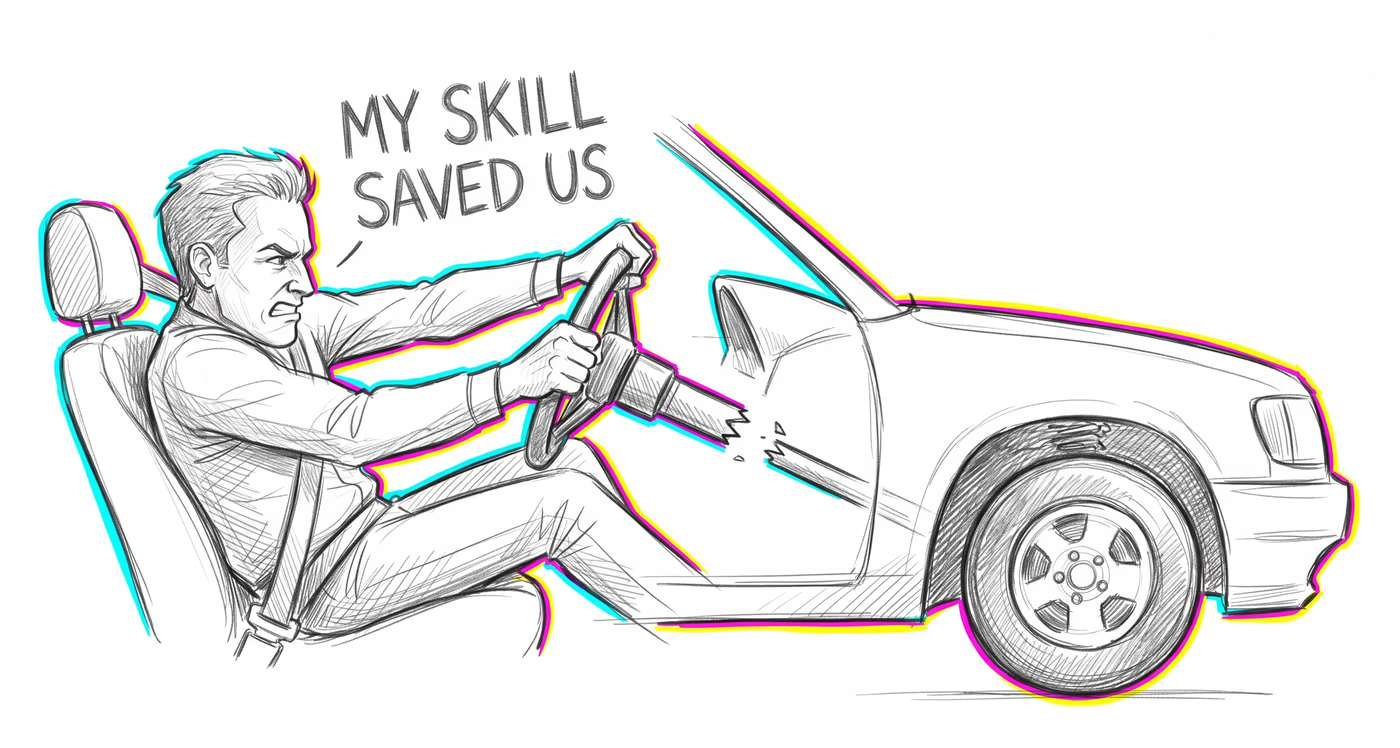
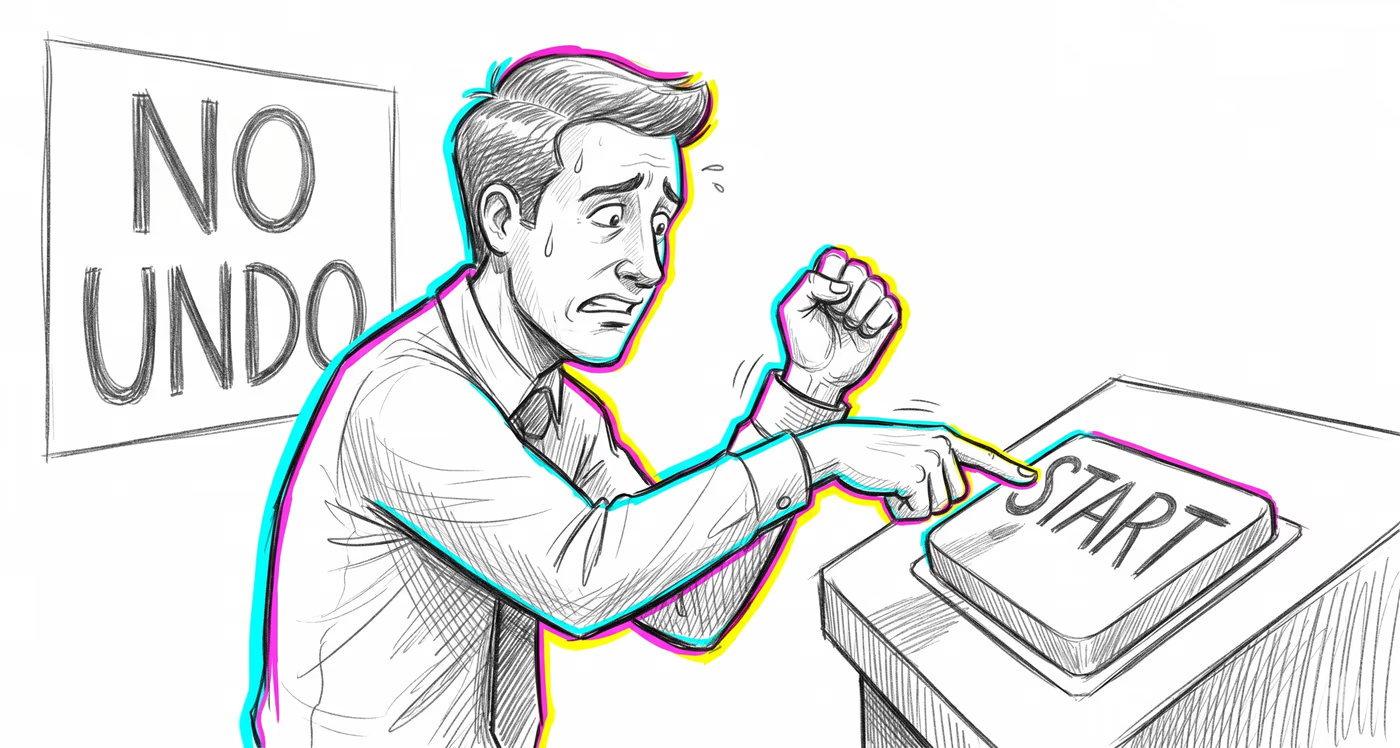
Illustration: Action Bias
WHAT IT IS

The glitch, explained plainly.

Imagine you're watching a friend's goldfish while they're away, and the fish looks a little slow. You don't really know what's wrong, but you feel like you should DO something—so you add extra food, change the water, and move the bowl. In reality, the fish was fine and all your 'helping' just stressed it out. Action bias is that itch to do something—anything—because sitting still feels wrong, even when sitting still is the smartest move.

Action bias describes the compulsion to respond to uncertain or stressful situations with visible activity, even when careful analysis suggests that doing nothing—or waiting for more information—would yield the same or better results. The bias is fueled by social expectations that equate activity with competence and passivity with negligence, making people feel they will experience greater regret from a bad outcome caused by inaction than from an equally bad outcome caused by action. This asymmetry persists across domains: physicians order unnecessary tests, investors overtrade their portfolios, and managers restructure teams reflexively during downturns. Crucially, the single action taken often satisfies the psychological need to 'do something,' which can actually prevent further, more effective actions from being considered.

SOUND FAMILIAR?

Where it shows up.

  1. 01 During a penalty shootout, goalkeeper Marco dives to his left even though post-match data shows he would have saved more shots by staying centered. When asked why, he says standing still would have felt 'lazy' if the ball went in.
  2. 02 Dr. Patel sees a patient with vague, unexplained fatigue. All initial blood work is normal, and the patient's history suggests nothing alarming. Still, she orders a CT scan, an MRI, and three specialist referrals because she feels uncomfortable telling the patient to just rest and come back in two weeks.
  3. 03 After a 5% market dip, financial advisor Chen restructures his client's entire portfolio over a weekend. Six months later, the original allocation has fully recovered and outperformed his changes. He tells colleagues he 'couldn't just sit there and watch.'
  4. 04 A new CEO, facing declining morale, immediately launches a company-wide reorganization in her first month. Veteran employees note that the previous structure was sound—the real issue was a single toxic manager. The reorg creates months of confusion, but the CEO is praised by the board for 'taking decisive action.'
  5. 05 Software team lead Raj notices a minor intermittent bug that affects 0.1% of users and tends to self-resolve. Rather than monitoring it, he reassigns three engineers to investigate, delaying a critical feature launch by two weeks. He justifies it by saying 'we can't just ignore bugs,' though the data showed watchful waiting was the optimal strategy.
IN DIFFERENT DOMAINS

Where it shows up at work.

The same glitch looks different depending on the terrain. Finance, medicine, a relationship, a team — same mechanism, different costume.

Finance & investing

Investors tend to overtrade in volatile markets, buying and selling impulsively in response to short-term fluctuations rather than holding steady with a long-term strategy. This pattern consistently erodes returns through transaction costs and poor timing, yet the discomfort of watching a portfolio dip without 'doing something' drives the behavior.
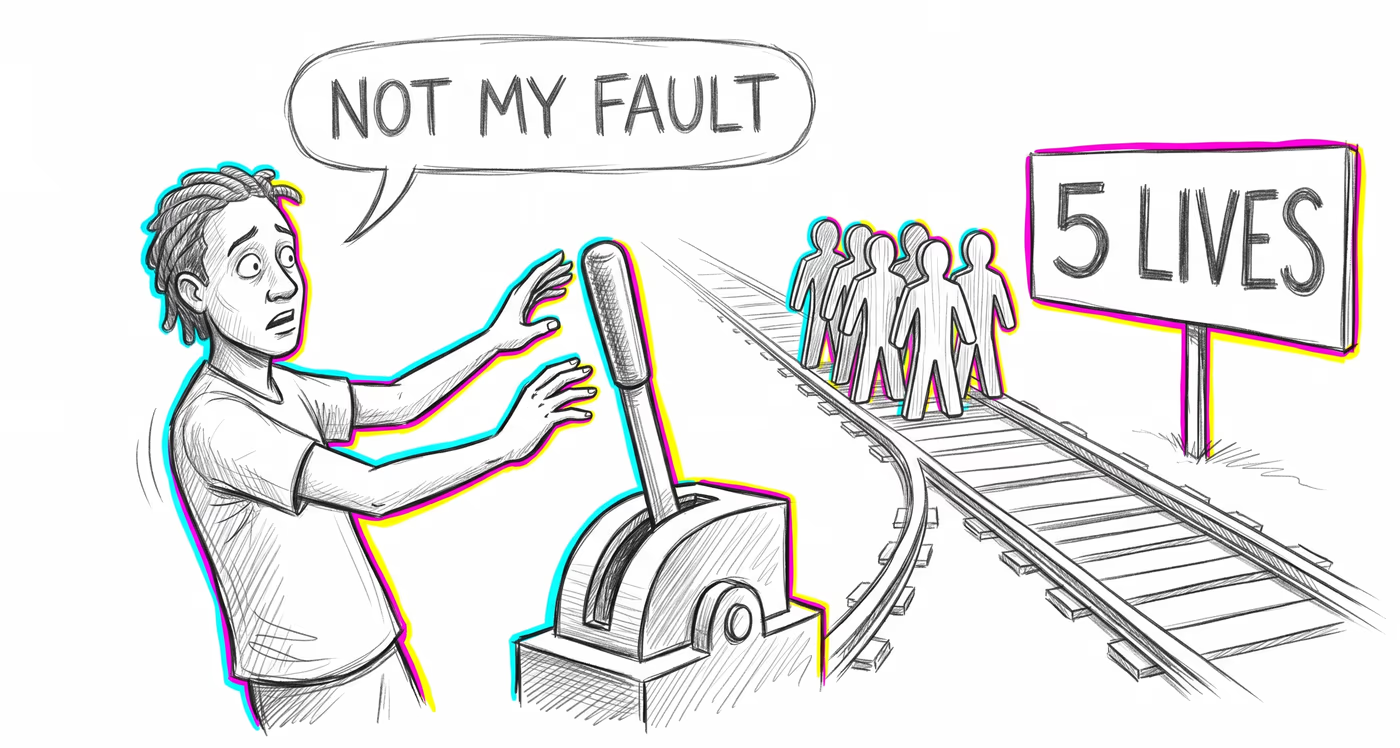
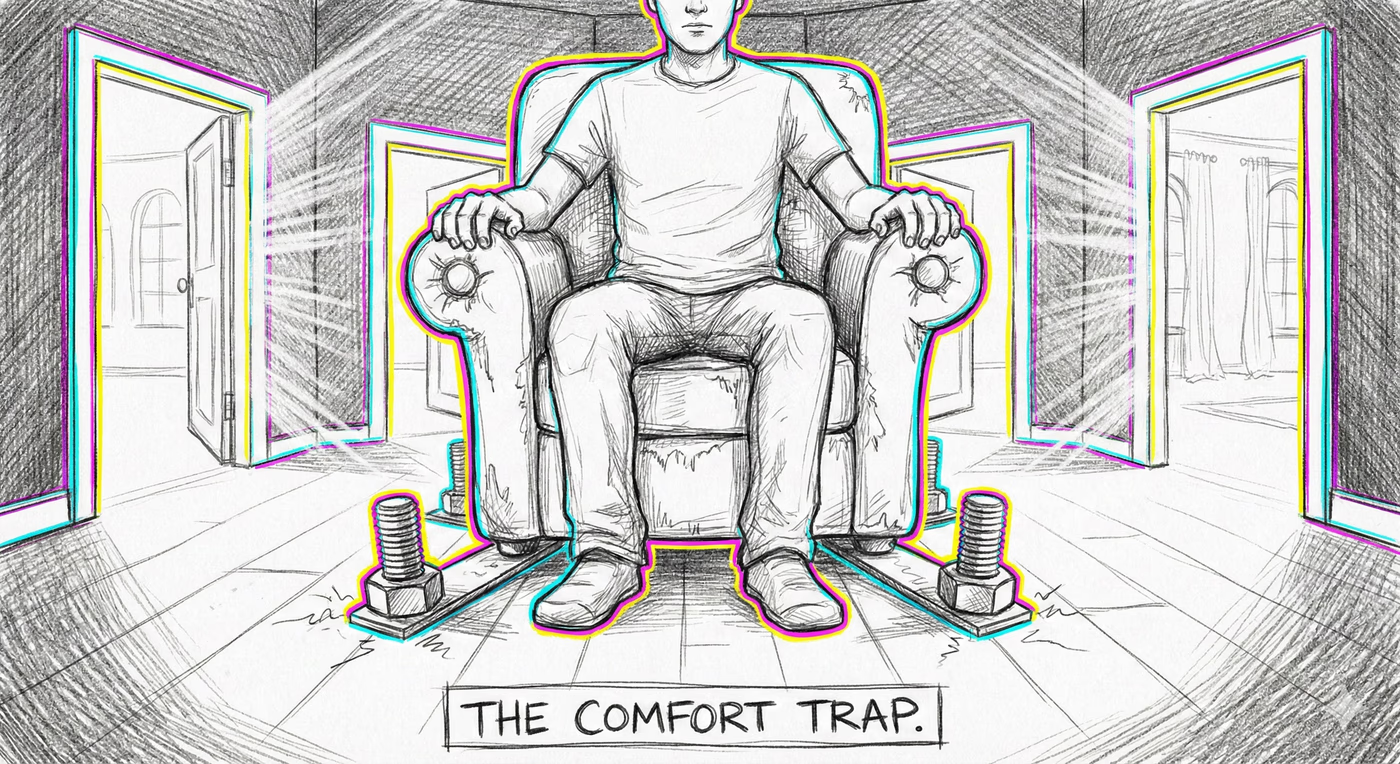
Medicine & diagnosis

Physicians confronted with ambiguous or unexplained symptoms tend to order additional tests, prescribe medications, or refer to specialists rather than recommend watchful waiting—even when evidence suggests observation is equally effective. This leads to overdiagnosis, unnecessary procedures, and cascading interventions that carry their own risks.

Education & grading

Teachers and administrators tend to intervene immediately when students struggle, introducing new programs, extra tutoring, or curriculum changes rather than allowing time for natural learning progression. This can create dependency and disrupt effective existing processes that simply needed more time.

Relationships

When a relationship hits a rough patch, people tend to initiate dramatic conversations, grand gestures, or ultimatums rather than giving space and time for tensions to resolve naturally. The compulsion to 'fix things now' can escalate minor issues into major conflicts.

Tech & product

Product teams facing declining metrics often rush to redesign interfaces or add new features rather than investigating root causes or doing nothing while gathering more data. This leads to feature bloat, user confusion, and the abandonment of designs that simply needed more time for adoption.

Workplace & hiring

Managers under pressure tend to schedule more meetings, launch new initiatives, or restructure teams in response to problems that may be transient. The visible activity signals competence to superiors but often disrupts productivity and diverts attention from the actual issue.

Politics Media

Politicians under public pressure after crises rush to pass new legislation or announce dramatic policy changes—even when existing frameworks were adequate—because being seen as 'doing something' is politically necessary regardless of whether the action addresses the actual problem.

HOW TO SPOT IT

Ask yourself…

  • Am I doing this because it will actually improve the outcome, or because doing nothing feels uncomfortable?
  • Would I feel more regret from a bad outcome after acting, or after not acting—and is that regret differential justified by the evidence?
  • If no one were watching or judging me, would I still feel the need to act right now?
HOW TO DEFEND AGAINST IT

The playbook.

  • Before acting, explicitly write down the expected outcome of acting versus not acting—force a side-by-side comparison rather than defaulting to 'do something.'
  • Implement a mandatory cooling-off period: set a rule that for non-emergency decisions, you must wait 24-72 hours before intervening.
  • Ask the 'newspaper test' in reverse: instead of imagining the headline for inaction, imagine the headline for a costly, unnecessary intervention.
  • Reframe inaction as a deliberate strategy: calling it 'watchful waiting' or 'strategic patience' makes it feel like a legitimate choice rather than passivity.
  • Track your interventions and their outcomes over time to build evidence about when action actually helped versus when it didn't.
FAMOUS CASES

In history.

  • The U.S. policy response to the September 11 attacks included rapid, sweeping legislation and military action that some scholars argue reflected action bias, as the political imperative to 'do something' may have outpaced deliberative analysis of the most effective responses.
  • During the 2008 financial crisis, many institutional investors panic-sold their holdings in the immediate aftermath, locking in losses, while those who remained inactive and held their positions generally recovered their value within a few years.
  • Bar-Eli et al.'s analysis of 286 penalty kicks in elite soccer worldwide showed goalkeepers almost always dove left or right, despite data showing that staying in the center would have been optimal—a canonical real-world demonstration of action bias under high stakes.
WHERE IT COMES FROM
Academic origin

Anthony Patt and Richard Zeckhauser, 2000 — formalized in their paper 'Action Bias and Environmental Decisions' in the Journal of Risk and Uncertainty. The concept was further popularized by Michael Bar-Eli, Ofer H. Azar, and Ilana Ritov in their 2007 study of soccer goalkeepers.

Evolutionary origin

In ancestral environments, the cost of failing to act in the face of a predator, a rival, or a sudden weather change was often fatal, while the cost of unnecessary action was typically just wasted energy. Natural selection thus favored organisms with a low threshold for action under uncertainty, because the survival penalty for under-reaction far exceeded the penalty for over-reaction.

IN AI SYSTEMS

How the machines inherit it.

AI systems can inherit action bias from training data reflecting human decision patterns—for example, clinical decision-support systems trained on physician behavior may recommend intervention over watchful waiting more often than evidence warrants, because the training data skews toward action-oriented decisions. Reinforcement learning agents may also develop action bias if reward structures penalize inaction more heavily than failed action.

Read more on Wikipedia
FREE FIELD ZINE

10 glitches quietly running your life.

A free field-zine PDF — ten cognitive glitches named, illustrated, with a defense move for each. Plus the weekly Glitch Report on Fridays — one bias named, two spotted in the wild, one defense move. Unsubscribe any time.

EXPLORE MORE

Related glitches.

LAUNCH PRICE

Train against your blindspots.

50 cards are free to preview. Buyers unlock the rest of the deck plus the interactive training — Spot-the-Bias Quiz unlimited, Swipe Deck with spaced repetition, My Blindspots, Decision Pre-Flight, the Printable Deck + Cheat Sheets, and the Field Guide e-book. $29.50$59.

Unlock the full deck

Everything below — yours forever. Pay once, use across every device.

Half-off launch — limited to the first 100 readers. Auto-applied at checkout.
$59 $29.50
one-time payment · lifetime access
  • All interactive digital cards — search, filter, flip, shuffle on any device
  • Five training modes — Spot-the-Bias Quiz, Swipe Deck, Pre-Flight, Blindspots, Journal
  • Curated Lenses + Decision Templates + Defense Playbook
  • Printable Deck PDFs + Field Guide e-book + Cheat Sheets + Anki Export
  • Every future improvement, included
Unlock  $29.50

30-day refund · no questions asked

Unlock the full deck

Everything below — yours forever. Pay once, use across every device.

Half-off launch — limited to the first 100 readers. Auto-applied at checkout.
$59 $29.50
one-time payment · lifetime access
  • All interactive digital cards — search, filter, flip, shuffle on any device
  • Five training modes — Spot-the-Bias Quiz, Swipe Deck, Pre-Flight, Blindspots, Journal
  • Curated Lenses + Decision Templates + Defense Playbook
  • Printable Deck PDFs + Field Guide e-book + Cheat Sheets + Anki Export
  • Every future improvement, included
Unlock  $29.50

30-day refund · no questions asked