Automation Bias

aka Automation-Induced Complacency · Over-Reliance on Automation

Over-relying on automated systems even when your own eyes or judgment tell you they're wrong.

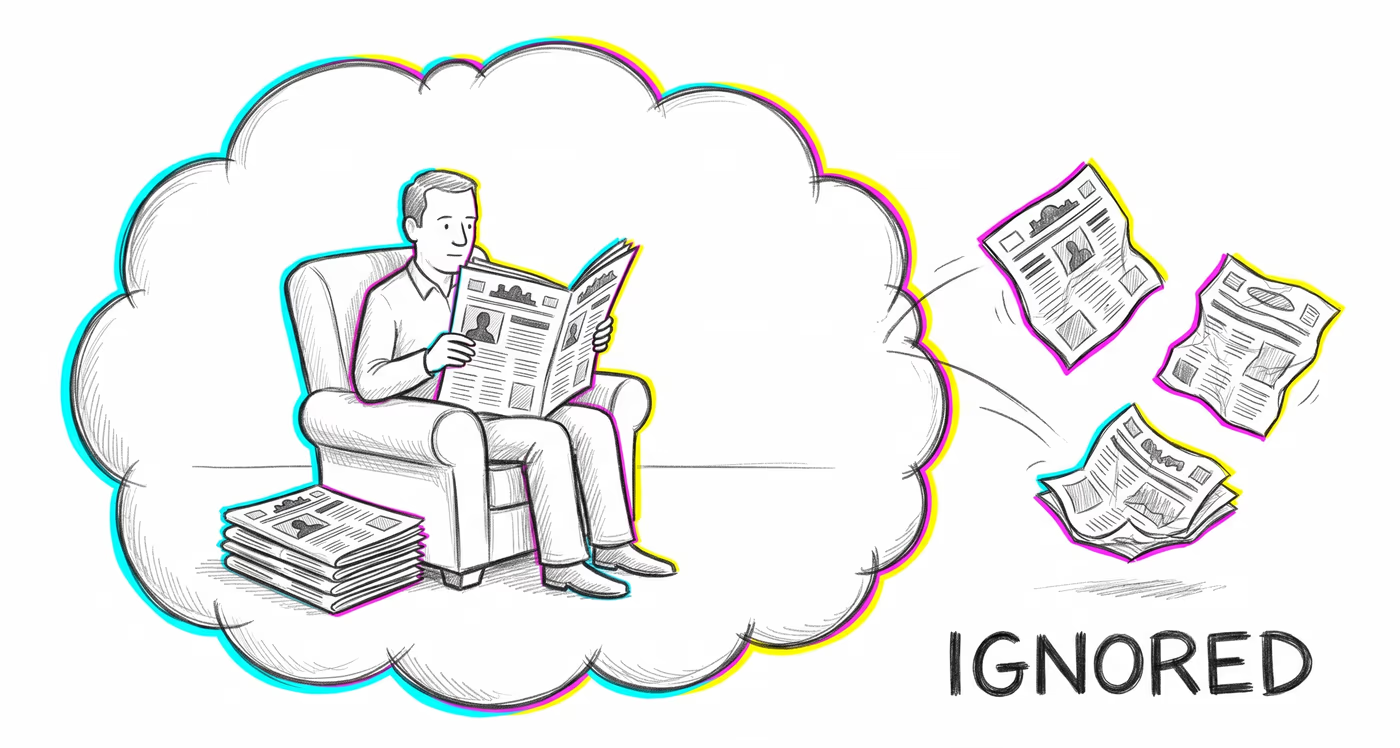
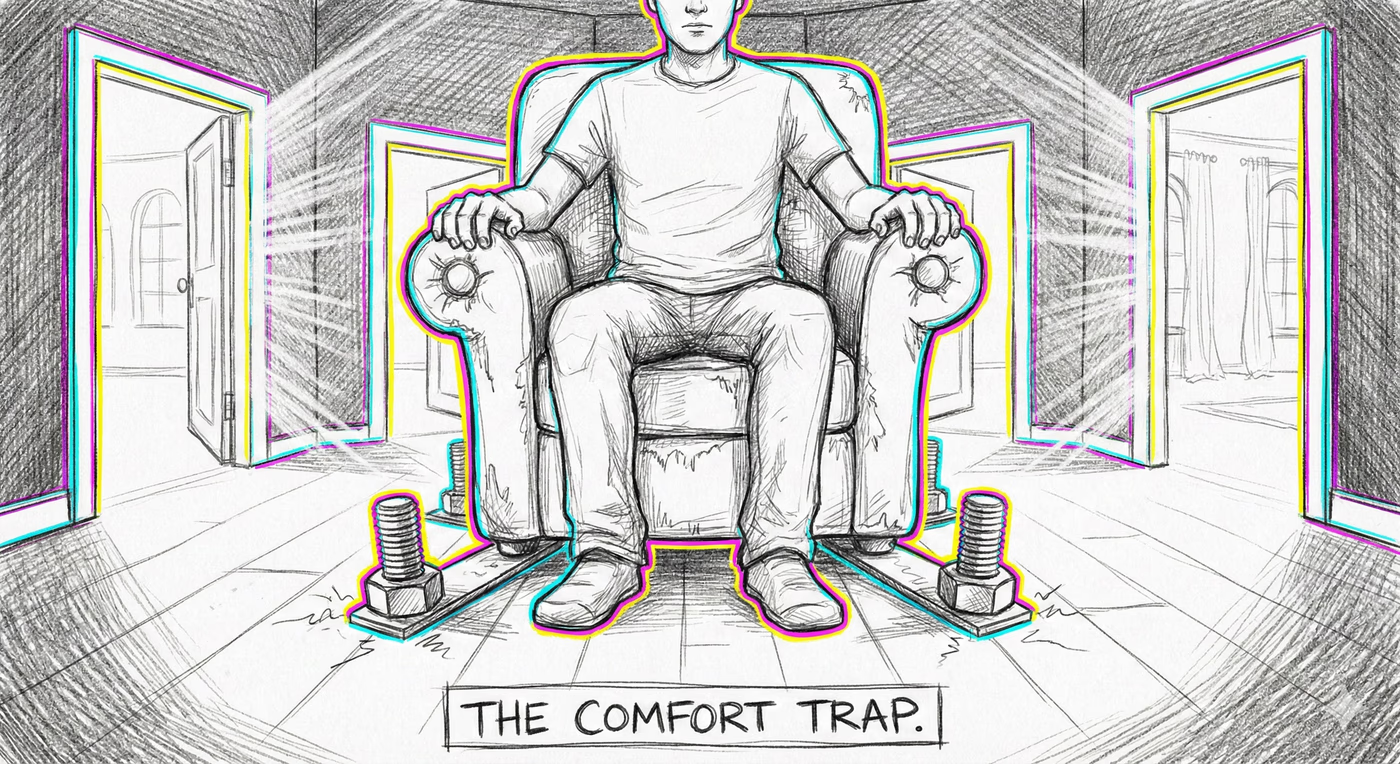
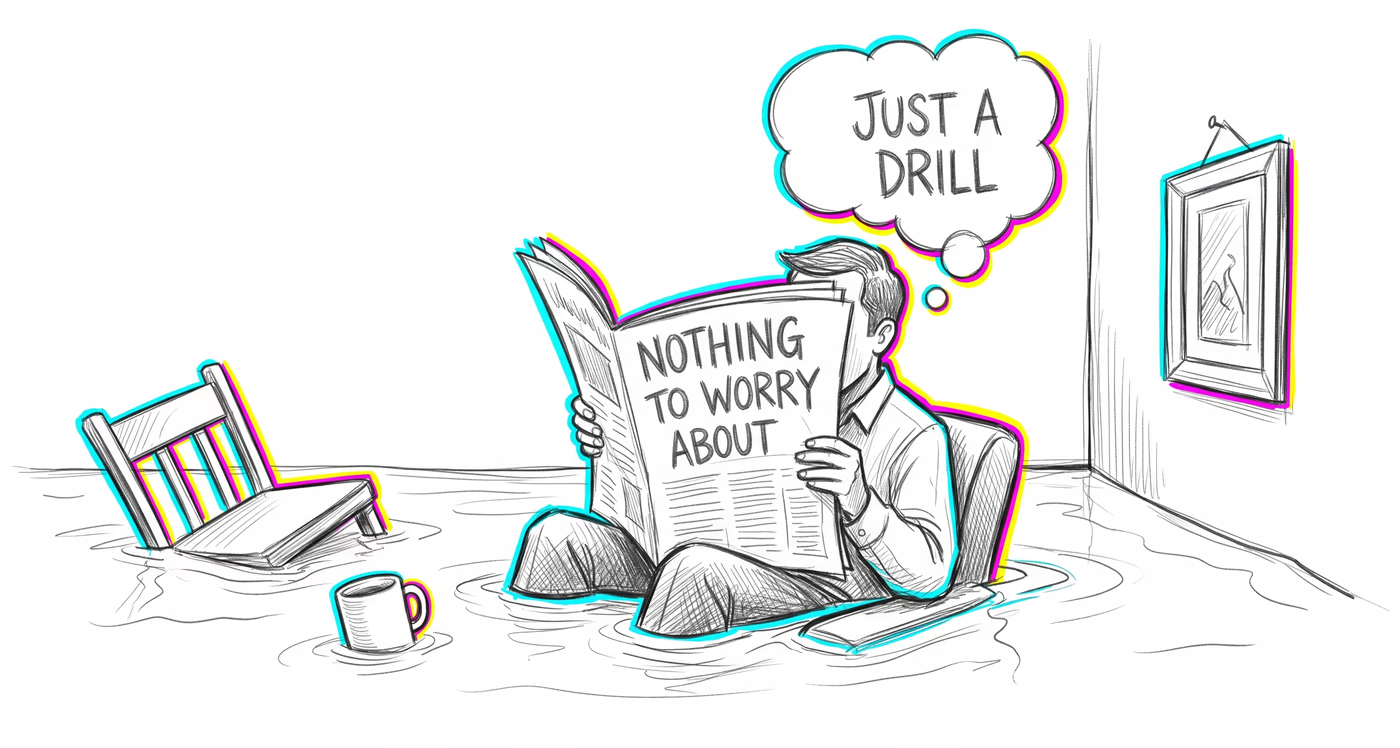
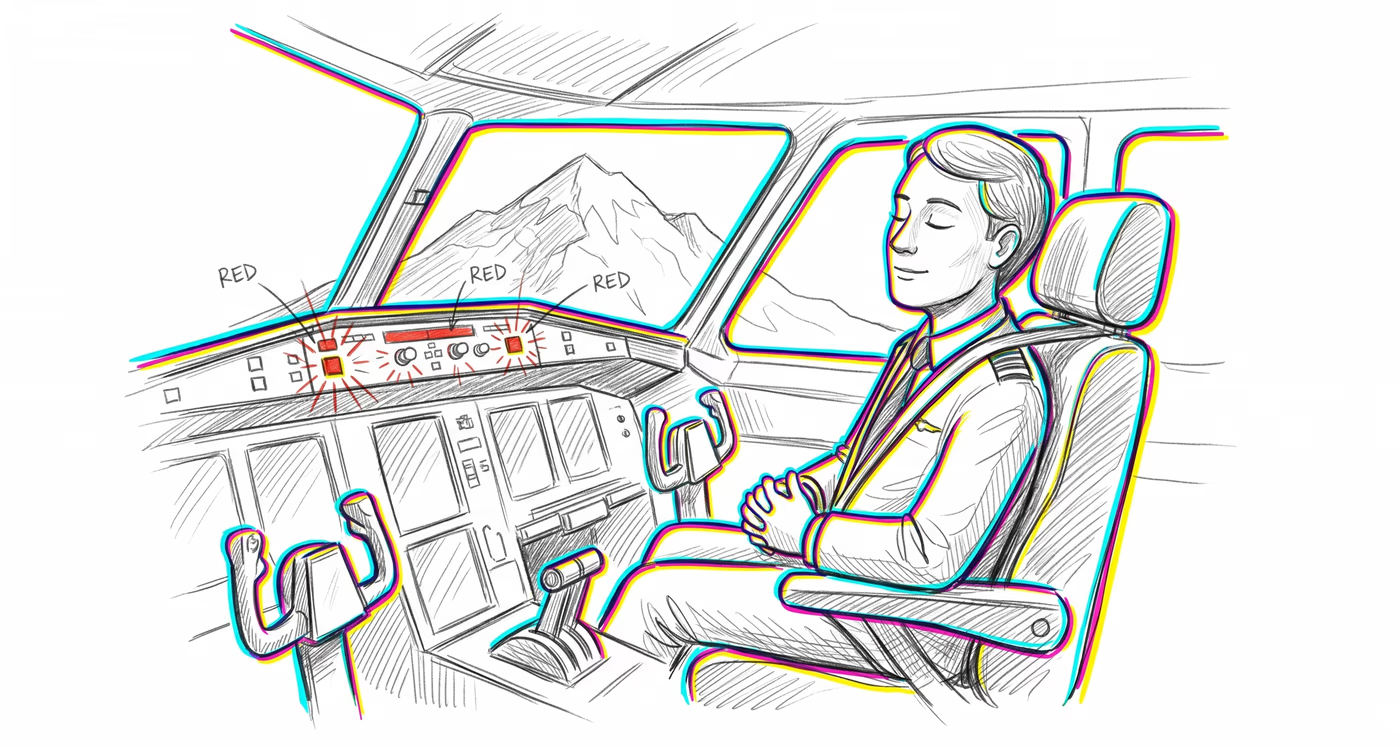
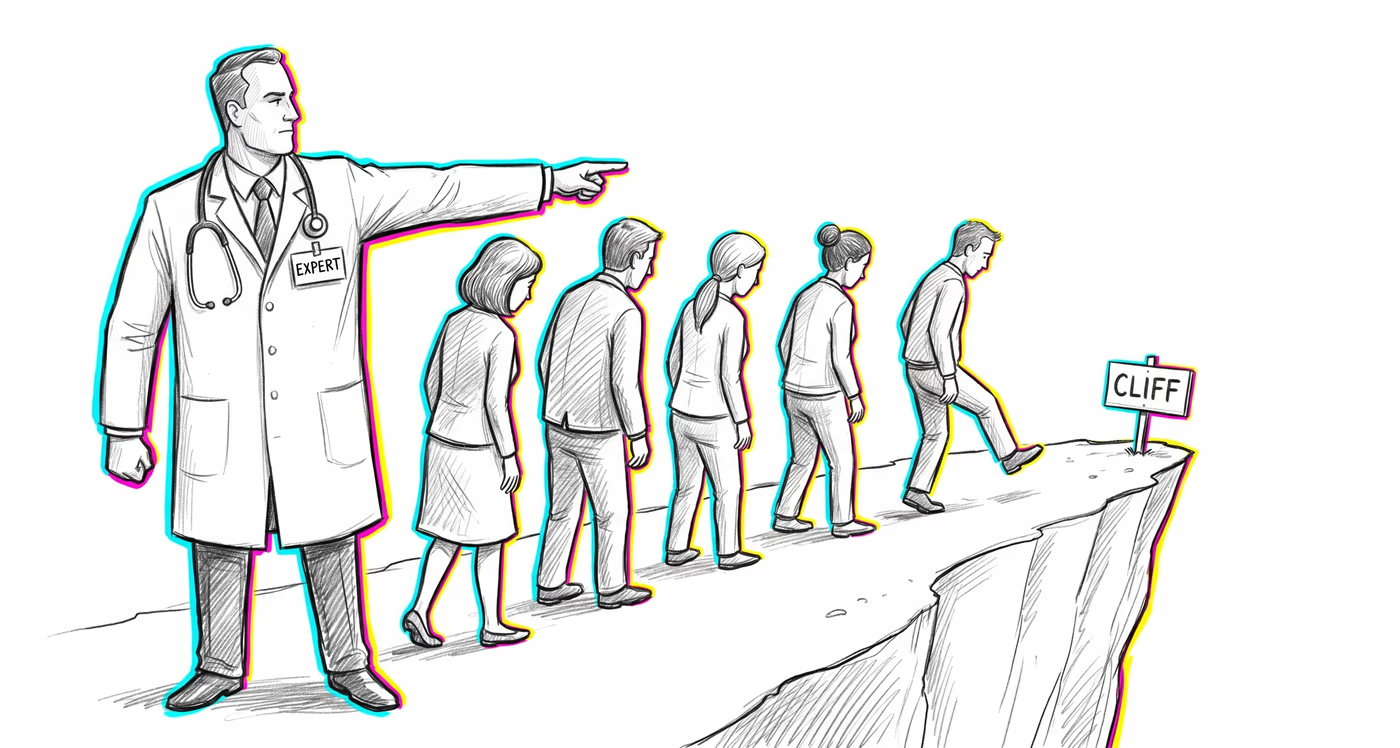
Illustration: Automation Bias
WHAT IT IS

The glitch, explained plainly.

Imagine you have a really smart robot friend who always picks the best snacks for you. After a while, you stop even looking at the snacks yourself — you just eat whatever the robot picks. Then one day the robot accidentally picks something you're allergic to, but you eat it anyway without checking because the robot is 'always right.' That's automation bias — you trusted the machine so much that you forgot to use your own eyes and brain.

Automation bias describes a systematic pattern of errors that emerge when humans interact with automated decision-support systems. It manifests in two distinct failure modes: commission errors, where people follow an automated recommendation even when it contradicts their training and other valid information, and omission errors, where people fail to notice problems because the automated system did not flag them. The bias intensifies as systems demonstrate high reliability over time, producing a paradoxical 'irony of automation' — the better a system performs, the less vigilant its human operators become, making them more vulnerable when the system eventually fails. Unlike simple laziness, automation bias reflects a deep cognitive restructuring where the automated output becomes the default anchor for judgment, displacing independent information-seeking and critical evaluation.

SOUND FAMILIAR?

Where it shows up.

  1. 01 Dr. Patel reviews a chest X-ray and initially notices a subtle shadow near the patient's left lung. However, the hospital's AI-powered diagnostic system flags the scan as 'normal — no abnormalities detected.' She glances once more at the shadow, decides it must be an artifact since the computer didn't flag it, and discharges the patient without ordering a follow-up CT scan.
  2. 02 A warehouse manager receives an automated inventory alert recommending an emergency restock of Product X. His own walk-through that morning showed shelves full of Product X — the sensor had malfunctioned. Despite this firsthand observation, he submits the restock order anyway, reasoning that 'the system tracks thousands of items and is probably picking up something I missed.'
  3. 03 An air traffic controller monitors a busy approach corridor. Her radar system shows all aircraft properly separated. She notices a brief blip suggesting two flight paths might converge in six minutes, but the automated conflict-detection system hasn't generated an alert. She decides not to issue a reroute instruction, reasoning that the system would warn her if there were a real issue.
  4. 04 A hiring manager uses an AI screening tool that ranks 200 résumés. Candidate #47 scored low on the algorithm's ranking but the manager vaguely recalls the candidate's cover letter being impressive. Rather than pulling the application for a second look, she moves on, telling herself the tool evaluates holistically and her memory is probably confusing this candidate with someone else.
  5. 05 A senior financial analyst builds a custom model to forecast quarterly earnings. When the model produces a projection that seems implausibly high, she runs a manual sanity check that supports a lower figure. She then re-examines her manual calculation, finds a minor rounding issue, and concludes that the model — which processes far more variables — must be capturing factors she can't easily quantify. She submits the model's higher number in her report.
IN DIFFERENT DOMAINS

Where it shows up at work.

The same glitch looks different depending on the terrain. Finance, medicine, a relationship, a team — same mechanism, different costume.

Finance & investing

Traders and portfolio managers over-rely on algorithmic trading signals and automated risk scoring, executing positions recommended by models without cross-checking against fundamental analysis or current market context, which can amplify losses during unprecedented market conditions the model wasn't trained on.
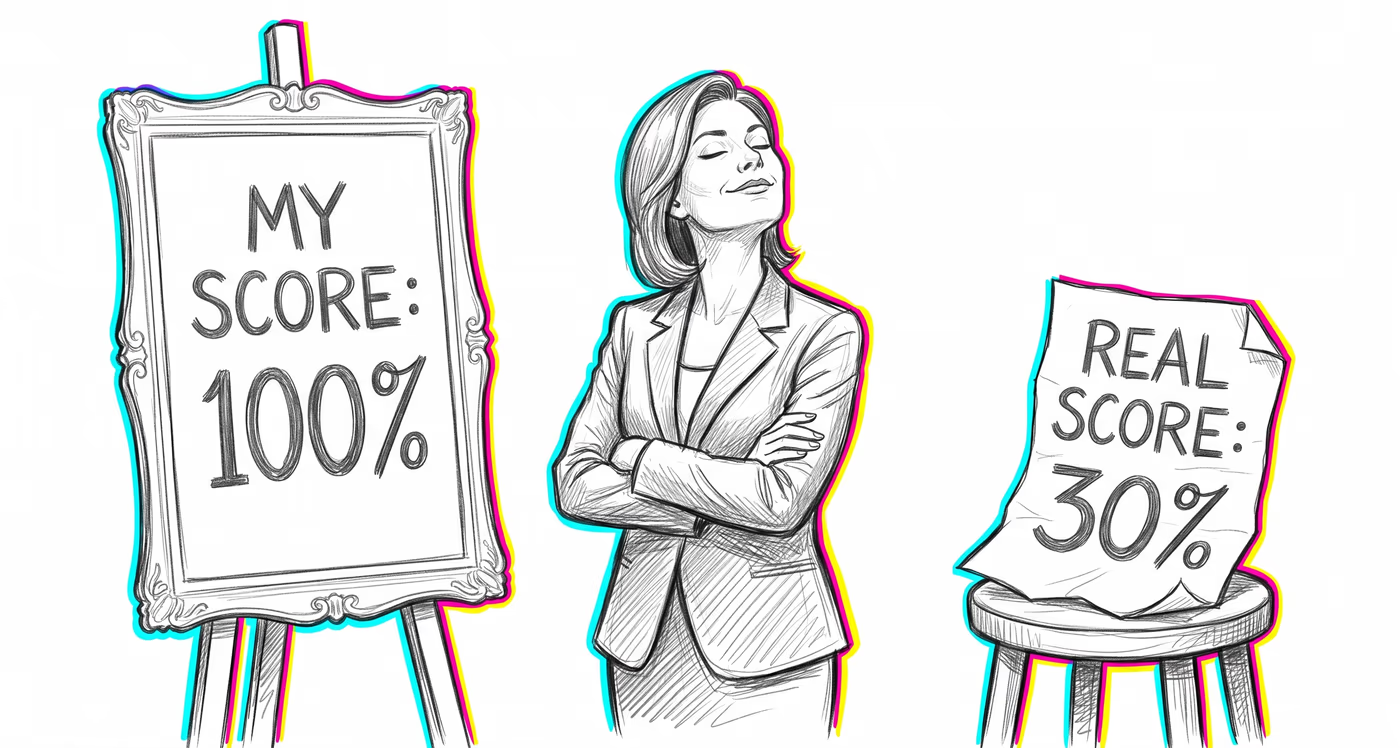
Medicine & diagnosis

Clinicians accept clinical decision support system diagnoses or drug interaction alerts without independent verification, leading to commission errors when the system gives incorrect recommendations and omission errors when the system fails to flag genuine risks, particularly dangerous with electronic health records where prior data-entry errors get perpetuated as 'authoritative.'

Education & grading

Teachers and administrators defer to automated grading systems, plagiarism detectors, or learning analytics dashboards without critically evaluating edge cases, resulting in false plagiarism accusations or misidentification of students' learning needs when the system's pattern-matching fails on atypical student work.

Relationships

People defer to dating app compatibility algorithms or relationship-assessment tools over their own intuitive sense of connection, dismissing genuine chemistry with someone who scores poorly on a matching algorithm or persisting with a poor match because the app said they were '95% compatible.'

Tech & product

Engineers and product teams accept automated test suite results, CI/CD pipeline approvals, and monitoring dashboards as definitive proof of system health, skipping manual code review or exploratory testing, which allows subtle bugs and regressions to ship when the automated checks have blind spots.

Workplace & hiring

Managers rely on automated performance metrics, employee monitoring software, and AI-generated performance reviews without seeking qualitative input, resulting in mischaracterization of employees whose work doesn't map neatly to tracked metrics and perpetuating initial scoring biases across review cycles.

Politics Media

News consumers and journalists accept algorithmically curated trending topics, automated fact-check labels, and AI-generated summaries as accurate representations of events without consulting primary sources, which allows algorithmic biases in content ranking to shape public perception of issue importance and credibility.

HOW TO SPOT IT

Ask yourself…

  • Am I accepting this system's output without checking it against at least one independent source of information?
  • If this system weren't here, what would I have concluded based on my own observation and training?
  • When was the last time I caught this system making a mistake — and if I can't remember, is that because it's perfect or because I stopped looking?
HOW TO DEFEND AGAINST IT

The playbook.

  • Practice 'trust but verify': Establish a personal rule to independently check at least one critical output from any automated system before acting on it.
  • Use the 'what if it's wrong' exercise: Before accepting any automated recommendation, spend 30 seconds imagining the system is giving bad advice and ask what you would do differently.
  • Maintain manual skills: Regularly practice the manual version of tasks you usually delegate to automation (e.g., navigate without GPS, do mental math alongside calculators, hand-check code the linter approved).
  • Build accountability checkpoints: Create workflows where someone is explicitly responsible for verifying automated outputs, not just monitoring them.
  • Track system errors: Keep a personal log of times the automated system was wrong — even minor errors — to counteract the 'perfect track record' illusion that drives complacency.
FAMOUS CASES

In history.

  • USS Vincennes (1988): The crew of the Aegis-equipped cruiser misidentified Iran Air Flight 655 as an attacking F-14, relying on the combat information system's data processing while misreading altitude readouts, killing all 290 civilians aboard.
  • Patriot missile fratricides (2003 Iraq War): Patriot batteries operating in largely automatic mode shot down a British Royal Air Force Tornado and a U.S. Navy F/A-18, as operators trusted the automated threat classification without adequate independent verification.
  • Air France Flight 447 (2009): When iced-over pitot tubes caused the autopilot to disconnect over the Atlantic, the crew — habituated to automated flight management — made errors that stalled the aircraft, resulting in 228 deaths.
  • Korean Air Lines Flight 007 (1983): The crew relied on an incorrectly programmed autopilot navigation system and never cross-checked their position manually, causing the aircraft to stray into Soviet airspace where it was shot down.
  • Enbridge Kalamazoo River oil spill (2010): Control room operators repeatedly dismissed automated alarms as false positives based on past experience with the system, allowing over over 1 million gallons of oil to spill over 17 hours.
WHERE IT COMES FROM
Academic origin

Kathleen L. Mosier and Linda J. Skitka coined the term 'automation bias' in 1996, defining it as 'the tendency to use automated cues as a heuristic replacement for vigilant information seeking and processing,' in their chapter in Parasuraman & Mouloua's 'Automation and Human Performance: Theory and Applications.'

Evolutionary origin

Humans evolved to conserve cognitive energy by delegating trust to reliable environmental cues and authoritative signals. In ancestral environments, deferring to consistent, reliable sources of information — experienced elders, observable environmental patterns — was adaptive because it freed up cognitive resources for novel threat detection. The same neural architecture that enabled efficient trust-based social learning now generalizes to automated systems, treating their consistent outputs as equivalent to a trusted tribal authority.

IN AI SYSTEMS

How the machines inherit it.

AI systems amplify automation bias in a feedback loop: users over-trust AI outputs (e.g., LLM-generated text, image classification, recommendation engines) because AI carries an aura of computational objectivity. LLMs that present confident, fluent answers — including hallucinated facts — exploit this bias because users mistake fluency for accuracy. Additionally, AI systems trained on data reflecting past human automation bias can encode and perpetuate those patterns, as seen in biased criminal recidivism scoring tools where judges deferred to algorithmically generated risk scores that embedded racial disparities.

Read more on Wikipedia
FREE FIELD ZINE

10 glitches quietly running your life.

A free field-zine PDF — ten cognitive glitches named, illustrated, with a defense move for each. Plus the weekly Glitch Report on Fridays — one bias named, two spotted in the wild, one defense move. Unsubscribe any time.

EXPLORE MORE

Related glitches.

LAUNCH PRICE

Train against your blindspots.

50 cards are free to preview. Buyers unlock the rest of the deck plus the interactive training — Spot-the-Bias Quiz unlimited, Swipe Deck with spaced repetition, My Blindspots, Decision Pre-Flight, the Printable Deck + Cheat Sheets, and the Field Guide e-book. $29.50$59.

Unlock the full deck

Everything below — yours forever. Pay once, use across every device.

Half-off launch — limited to the first 100 readers. Auto-applied at checkout.
$59 $29.50
one-time payment · lifetime access
  • All interactive digital cards — search, filter, flip, shuffle on any device
  • Five training modes — Spot-the-Bias Quiz, Swipe Deck, Pre-Flight, Blindspots, Journal
  • Curated Lenses + Decision Templates + Defense Playbook
  • Printable Deck PDFs + Field Guide e-book + Cheat Sheets + Anki Export
  • Every future improvement, included
Unlock  $29.50

30-day refund · no questions asked

Unlock the full deck

Everything below — yours forever. Pay once, use across every device.

Half-off launch — limited to the first 100 readers. Auto-applied at checkout.
$59 $29.50
one-time payment · lifetime access
  • All interactive digital cards — search, filter, flip, shuffle on any device
  • Five training modes — Spot-the-Bias Quiz, Swipe Deck, Pre-Flight, Blindspots, Journal
  • Curated Lenses + Decision Templates + Defense Playbook
  • Printable Deck PDFs + Field Guide e-book + Cheat Sheets + Anki Export
  • Every future improvement, included
Unlock  $29.50

30-day refund · no questions asked