Frequency Illusion

aka Frequency Illusion · Baader-Meinhof Effect · Frequency Bias

Noticing something far more often after first encountering it, creating the false sense that its frequency has increased.

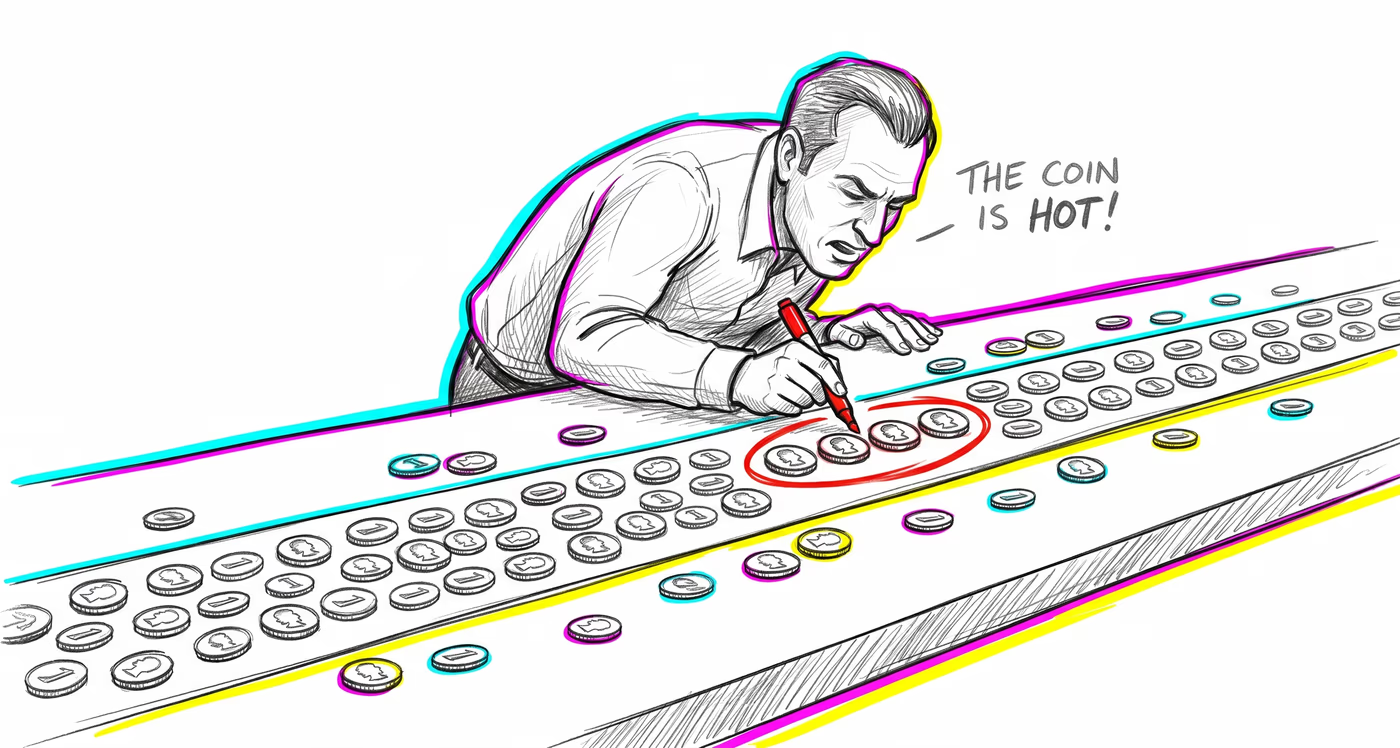
Illustration: Frequency Illusion
WHAT IT IS

The glitch, explained plainly.

Imagine you just learned the word 'penguin.' Before today, you never noticed it anywhere. But now, suddenly, there's a penguin on someone's shirt, penguins in a TV show, and a penguin sticker on a car. You think, 'Wow, penguins are EVERYWHERE today!' But penguins were always around — your brain just started paying attention because it learned the word is important.

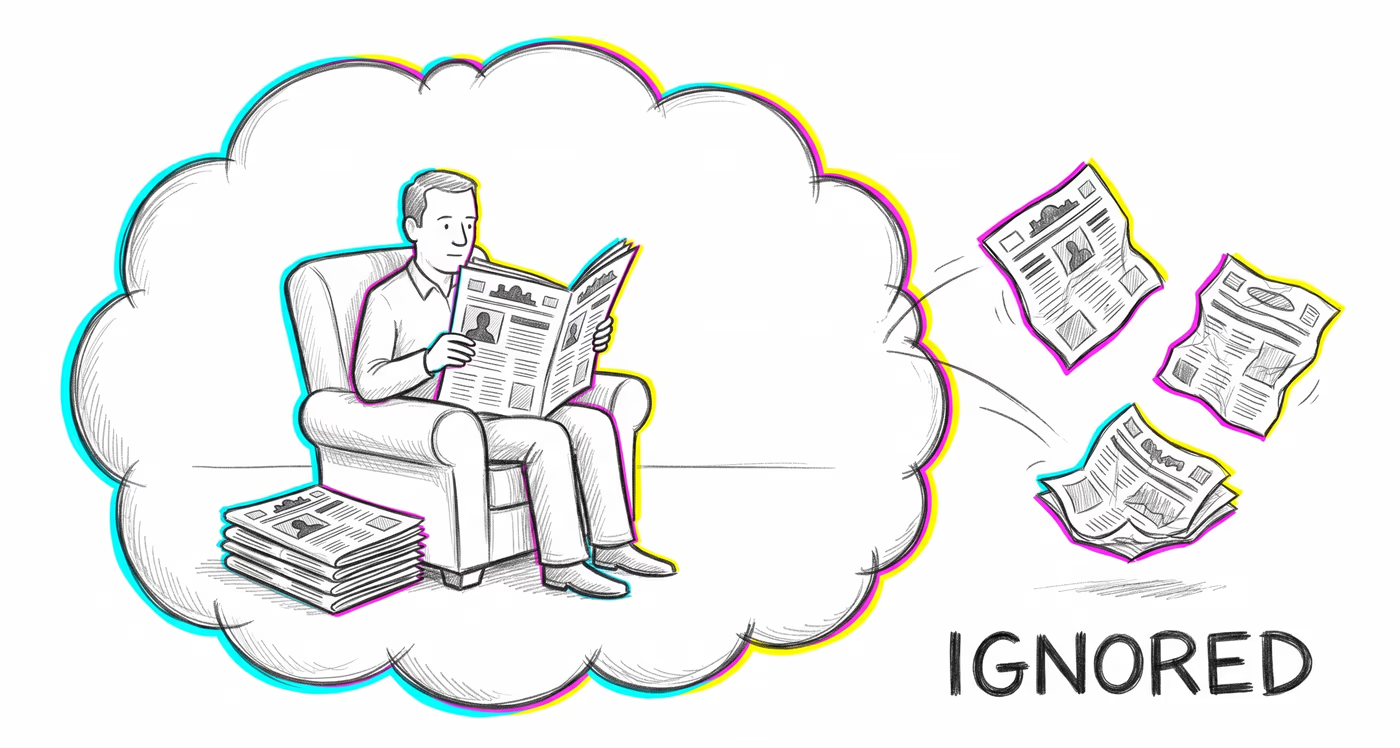
The Baader-Meinhof Phenomenon describes how, after first learning about or noticing a concept, word, product, or idea, a person begins encountering it with seemingly improbable frequency in their everyday environment. This creates a compelling but false sense that the thing itself has become more common, when in reality the person's attentional filter has simply been recalibrated to flag it as relevant. The illusion is sustained by a feedback loop: selective attention causes more frequent noticing, and confirmation bias interprets each new sighting as evidence of genuine increased prevalence, while all the times the stimulus was absent go unregistered. The phenomenon is particularly powerful because it feels deeply convincing — the sheer accumulation of noticed instances makes the statistical improbability feel real, even to people who intellectually understand the mechanism.

SOUND FAMILIAR?

Where it shows up.

  1. 01 Maria just learned the word 'defenestration' in her literature class on Monday. By Friday, she's encountered it in a crossword puzzle, a Reddit post, and a coworker's joke. She tells her friend, 'It's so weird — this word is suddenly everywhere this week.' Her friend points out the word has always appeared at roughly the same rate.
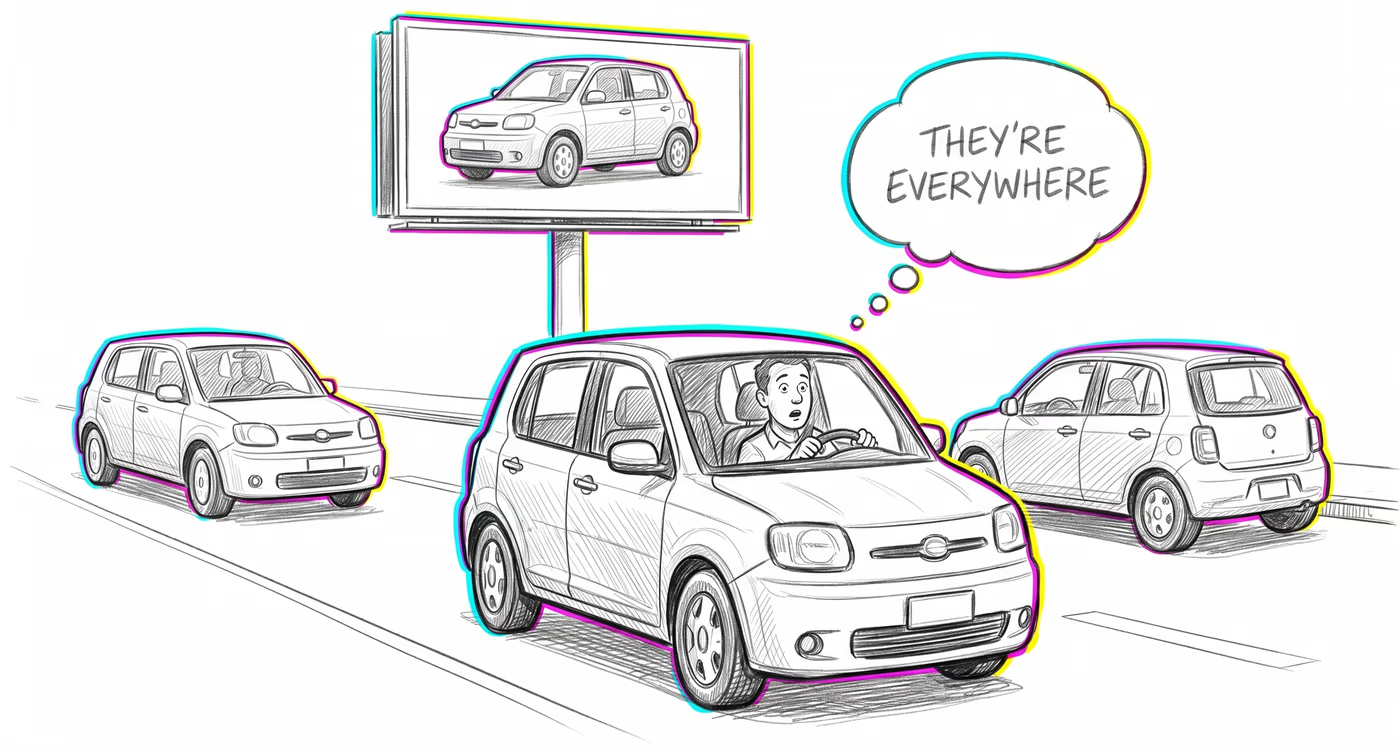
  2. 02 After test-driving a Subaru Outback, Raj drives home and counts six Outbacks on the road. Over the next three days, he keeps spotting them in parking lots and intersections. He tells his wife, 'I think Subaru must be having a huge sales surge,' even though dealership data shows no change in local sales.
  3. 03 A product manager reads an article about 'gamification' in app design. Over the following two weeks, she notices gamification mentioned in three podcasts, two LinkedIn posts, and a competitor's newsletter. She writes a memo to her team arguing that gamification is an accelerating industry trend that they need to adopt immediately, basing her urgency on the perceived spike in mentions.
  4. 04 A junior doctor attends a lecture on Addison's disease, a rare endocrine condition. During the next month of rotations, he suspects Addison's in three patients with fatigue and low blood pressure. His attending physician notes that these patients have far more common explanations for their symptoms, and that the rate of Addison's hasn't changed — only the resident's attentional radar has.
  5. 05 An investor reads a bearish analysis predicting a real estate correction. Over the next few weeks, she notices headlines about rising mortgage rates, housing inventory increases, and a local home price drop. Convinced the correction is imminent and widespread, she liquidates her real estate holdings — unaware that she has been selectively attending to bearish signals while ignoring equally prominent bullish data she would have noticed before reading the initial analysis.
IN DIFFERENT DOMAINS

Where it shows up at work.

The same glitch looks different depending on the terrain. Finance, medicine, a relationship, a team — same mechanism, different costume.

Finance & investing

Investors who learn about a specific market indicator or sector trend begin noticing confirming signals disproportionately, leading them to overestimate the prevalence and strength of the trend and make overconfident allocation decisions based on inflated perceived frequency rather than actual statistical data.

Medicine & diagnosis

Medical students and clinicians who recently studied a particular diagnosis tend to suspect it in subsequent patients at rates far exceeding its true base rate, a pattern known informally as 'medical student syndrome,' where heightened awareness masquerades as heightened prevalence.

Education & grading

Teachers who learn about a specific learning disability may begin identifying it in students at inflated rates, perceiving the condition as more common in their classroom than actual prevalence data would support, potentially leading to over-referral for assessment.

Relationships

After a friend mentions that a partner's behavior could be 'manipulative,' a person begins noticing every ambiguous action as evidence of manipulation, dramatically inflating their perception of how often such behavior actually occurs.

Tech & product

After a product team reads about a competitor's new feature, they begin noticing user requests that seem to support building a similar feature, overestimating actual demand because their attentional filters have been primed to detect related signals in feedback data.

Workplace & hiring

A manager who recently attended a workshop on 'quiet quitting' begins perceiving signs of disengagement in multiple employees who are simply working normally, inflating the perceived prevalence of the behavior across the team.

Politics Media

After learning about a particular policy issue, citizens begin noticing media coverage of it disproportionately, concluding that it has become a dominant national concern when in reality their own attentional filter has simply been re-tuned.
HOW TO SPOT IT

Ask yourself…

  • Did I only start noticing this thing after recently learning about it or encountering it for the first time?
  • Am I counting how often I see this thing but failing to track how often I don't see it?
  • Would I have noticed this thing at all two weeks ago, before it entered my awareness?
HOW TO DEFEND AGAINST IT

The playbook.

  • Before concluding something is 'everywhere,' ask yourself: when did I first learn about this? If it was recent, suspect frequency illusion.
  • Actively seek base rate data: look up actual statistics or frequency counts rather than relying on your subjective impression of prevalence.
  • Keep a tally of both hits AND misses — track the times you encounter the stimulus AND the times you don't, to counteract confirmation bias.
  • Apply the 'pre-awareness test': remind yourself that before you knew about this thing, you were surrounded by it but never noticed. The world hasn't changed; your filter has.
  • When making decisions based on perceived trends, require at least one objective data source (sales figures, search volume data, survey results) before acting on your impression of frequency.
FAMOUS CASES

In history.

  • During the early COVID-19 pandemic, after initial reports linked COVID to discolored toes ('COVID toes'), clinicians worldwide began reporting the association at seemingly high rates, partly driven by frequency illusion amplifying a signal that may have been far less prevalent than perceived.
  • In prescriptive linguistics, language commentators have repeatedly claimed that certain phrases (e.g., 'between you and I') are becoming dramatically more common, when corpus data shows stable usage rates — a pattern Arnold Zwicky specifically attributed to the frequency illusion.
WHERE IT COMES FROM
Academic origin

The popular name 'Baader-Meinhof Phenomenon' was coined by Terry Mullen in 1994 in a letter to the St. Paul Pioneer Press. The formal academic term 'Frequency Illusion' was coined by Stanford linguist Arnold Zwicky in a 2005 blog post on Language Log. The term was added to the Oxford English Dictionary in 2019.

Evolutionary origin

In ancestral environments, the ability to rapidly attune to newly discovered threats or resources — a predator's track pattern, a newly identified edible plant — conferred a significant survival advantage. Once a forager learned to recognize a particular berry, heightened sensitivity to that berry in the visual field maximized caloric intake. Similarly, once a hunter noticed signs of a specific predator, persistent scanning for that predator's cues reduced the risk of ambush.

IN AI SYSTEMS

How the machines inherit it.

Recommendation algorithms can create a digital version of the Baader-Meinhof Phenomenon: once a user interacts with a topic, the system surfaces more related content, which the user then interprets as evidence of genuine increased prevalence rather than algorithmic amplification. This creates a feedback loop where AI-curated feeds make frequency illusions self-fulfilling in the user's information environment.

Read more on Wikipedia
FREE FIELD ZINE

10 glitches quietly running your life.

A free field-zine PDF — ten cognitive glitches named, illustrated, with a defense move for each. Plus the weekly Glitch Report on Fridays — one bias named, two spotted in the wild, one defense move. Unsubscribe any time.

EXPLORE MORE

Related glitches.

LAUNCH PRICE

Train against your blindspots.

50 cards are free to preview. Buyers unlock the rest of the deck plus the interactive training — Spot-the-Bias Quiz unlimited, Swipe Deck with spaced repetition, My Blindspots, Decision Pre-Flight, the Printable Deck + Cheat Sheets, and the Field Guide e-book. $29.50$59.

Unlock the full deck

Everything below — yours forever. Pay once, use across every device.

Half-off launch — limited to the first 100 readers. Auto-applied at checkout.
$59 $29.50
one-time payment · lifetime access
  • All interactive digital cards — search, filter, flip, shuffle on any device
  • Five training modes — Spot-the-Bias Quiz, Swipe Deck, Pre-Flight, Blindspots, Journal
  • Curated Lenses + Decision Templates + Defense Playbook
  • Printable Deck PDFs + Field Guide e-book + Cheat Sheets + Anki Export
  • Every future improvement, included
Unlock  $29.50

30-day refund · no questions asked

Unlock the full deck

Everything below — yours forever. Pay once, use across every device.

Half-off launch — limited to the first 100 readers. Auto-applied at checkout.
$59 $29.50
one-time payment · lifetime access
  • All interactive digital cards — search, filter, flip, shuffle on any device
  • Five training modes — Spot-the-Bias Quiz, Swipe Deck, Pre-Flight, Blindspots, Journal
  • Curated Lenses + Decision Templates + Defense Playbook
  • Printable Deck PDFs + Field Guide e-book + Cheat Sheets + Anki Export
  • Every future improvement, included
Unlock  $29.50

30-day refund · no questions asked