Framing Effect

aka Framing Bias · Risky Choice Framing · Attribute Framing

Decisions changing depending on whether options are framed as gains or losses, even when the underlying facts are identical.

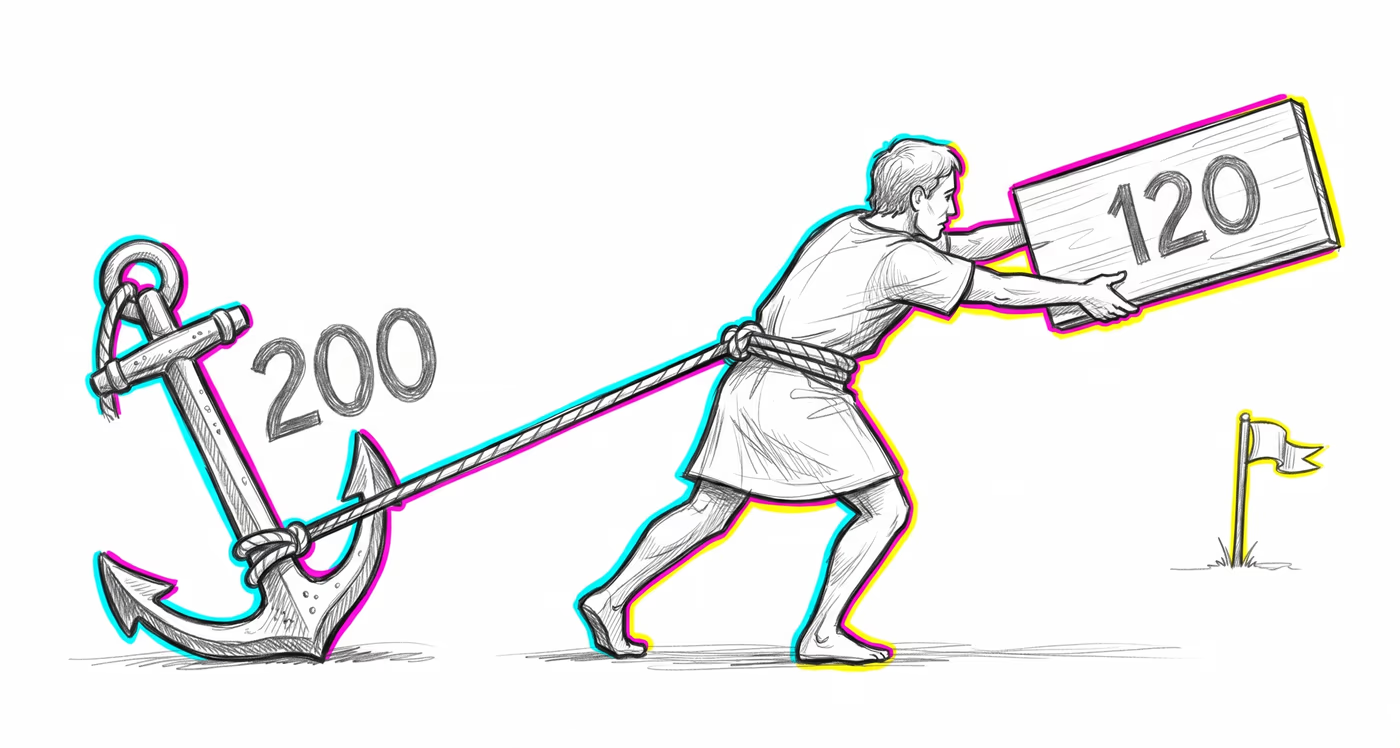
Illustration: Framing Effect
WHAT IT IS

The glitch, explained plainly.

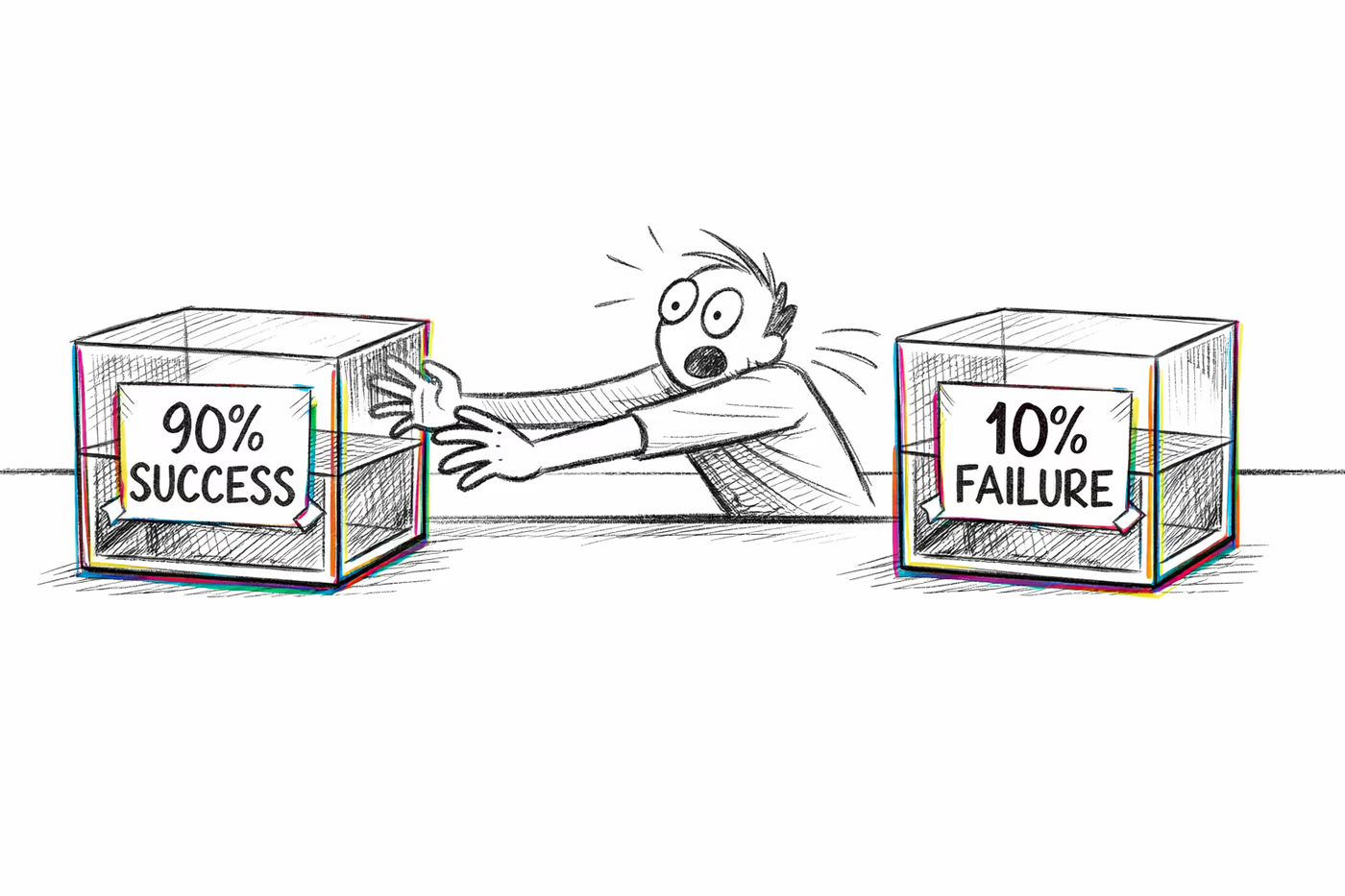
Imagine someone offers you ice cream and says 'This is made with 90% real fruit!' — you'd think that sounds great. But if they said 'This has 10% artificial stuff,' you might not want it, even though it's the exact same ice cream. The way someone tells you about something changes how you feel about it, even when nothing about the thing itself has changed.

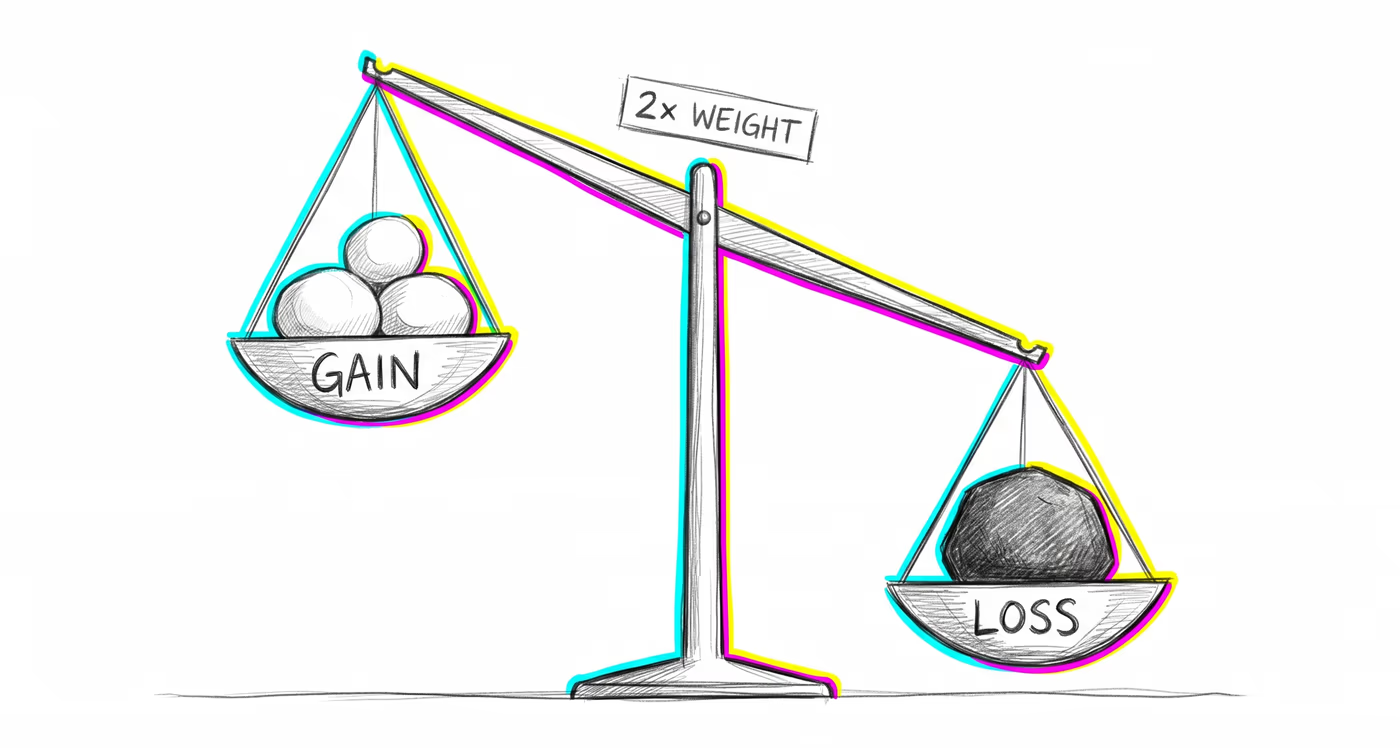
The Framing Effect occurs when equivalent information elicits different decisions depending on whether it is presented with positive language (emphasizing gains) or negative language (emphasizing losses). When options are framed as gains, people become risk-averse, preferring a certain smaller reward over a probabilistic larger one; when framed as losses, they become risk-seeking, preferring to gamble rather than accept a guaranteed loss. This asymmetry violates the economic principle of descriptive invariance — the idea that logically equivalent descriptions should produce the same choice. The effect operates through three primary subtypes: risky choice framing (altering risk preferences for identical gambles), attribute framing (changing evaluations of a single attribute like '95% effective' vs. '5% failure rate'), and goal framing (shifting motivation by emphasizing benefits of acting versus costs of not acting).

SOUND FAMILIAR?

Where it shows up.

  1. 01 A nonprofit sends out two versions of a fundraising letter. Version A says 'Your $50 donation will feed 10 children tonight.' Version B says 'Without your $50, 10 children will go hungry tonight.' Version B consistently raises 40% more money, despite describing the exact same impact.
  2. 02 A manager presents a restructuring plan to the board: 'This plan will preserve 80% of our current workforce.' The board approves it comfortably. The next quarter, when the same ongoing plan is described in a report as 'resulting in 20% job cuts,' several board members express alarm and want to revisit the decision.
  3. 03 A patient is told by Surgeon A that a procedure has a '90% success rate' and agrees to it immediately. Later, Surgeon B describes the identical procedure as having a '1 in 10 chance of failure,' and the patient requests a second opinion before proceeding. The patient doesn't realize both statements describe the same odds.
  4. 04 During contract negotiations, one side proposes keeping the current royalty rate at 8%, describing it as 'maintaining your 8% earnings share.' The other side's lawyer reframes the same deal as 'giving away 92% of revenue.' Both parties are evaluating identical terms, but neither side can agree the deal is fair because each is anchored in a different frame.
  5. 05 A city council debates a new traffic policy. An analyst shows that the proposed roundabout 'reduces fatal accidents by 34%,' and the council votes to approve it. A journalist later reports the same data as 'still allows 66% of fatal accidents to occur,' triggering public outrage and calls to reverse the decision — despite no new information being introduced.
IN DIFFERENT DOMAINS

Where it shows up at work.

The same glitch looks different depending on the terrain. Finance, medicine, a relationship, a team — same mechanism, different costume.

Finance & investing

Investment products framed as having an '80% chance of profit' attract more buyers than identical products described as having a '20% chance of loss.' Similarly, investors hold losing stocks longer when losses are framed as unrealized (paper losses) versus realized, because the frame shifts their risk tolerance.
Medicine & diagnosis

Patients are significantly more likely to consent to treatments described in terms of survival rates rather than mortality rates, even when the statistics are identical. Physicians themselves are susceptible — studies show doctors recommend surgeries more often when outcomes are presented as survival percentages rather than death percentages.

Education & grading

Students evaluate their own performance differently based on framing: scoring '80 out of 100' feels more positive than 'missing 20 points,' leading to different motivational responses. Teachers who frame feedback as 'areas to grow' versus 'mistakes made' see different levels of student engagement with identical content.

Relationships

Partners who frame disagreements as 'things we can improve together' versus 'problems in our relationship' elicit very different emotional responses and cooperative willingness from the same conversation. Relationship satisfaction surveys yield different results depending on whether questions ask about positive experiences or the absence of negative ones.

Tech & product

Subscription services that frame cancellation as 'losing your benefits' rather than 'stopping your plan' see lower churn rates. Cookie consent banners framed as 'Accept all' (default gain) versus 'Reject non-essential' (active loss prevention) heavily influence opt-in rates for data tracking.

Workplace & hiring

Performance reviews that frame an employee as 'meeting 85% of targets' elicit more positive self-assessment than 'missing 15% of targets.' Layoff announcements framed as 'retaining 90% of staff' versus 'cutting 10% of positions' produce vastly different organizational morale impacts.

Politics Media

Policies described as 'tax relief' garner more support than those described as 'tax cuts,' because 'relief' frames taxation as a burden. Media coverage of the same crime statistic — '10% increase in crime' vs. '90% of neighborhoods remain safe' — produces dramatically different levels of public fear and policy demand.

HOW TO SPOT IT

Ask yourself…

  • Would my decision change if I rewrote this information using the opposite framing — gains instead of losses, or vice versa?
  • Am I reacting to the substance of this information, or to the emotional tone of how it was worded?
  • If I strip away the adjectives and present just the raw numbers, does my preference stay the same?
HOW TO DEFEND AGAINST IT

The playbook.

  • Actively reframe: Before deciding, rewrite the information in both gain and loss terms and check if your preference reverses.
  • Extract the base numbers: Reduce the decision to raw statistics stripped of positive or negative language, then decide from that neutral representation.
  • Apply the 'newspaper test': Imagine the same outcome described by a hostile journalist and a friendly one — if your choice would change, framing is driving it.
  • Seek the complementary frame: Whenever you're given one frame, ask 'What's the other side of this number?' (e.g., if told 90% success, calculate the 10% failure yourself).
  • Introduce a cooling-off period: Delay important decisions by 24 hours to allow emotional reactions to the frame to dissipate before committing.
FAMOUS CASES

In history.

  • Tversky and Kahneman's 1981 'Asian Disease Problem' demonstrated that 72% of participants chose a certain option when framed as saving 200 lives, but 78% chose a risky option when the same scenario was framed in terms of deaths.
  • The Affordable Care Act (ACA) saw dramatically different public approval ratings depending on whether it was called 'Obamacare' (negative partisan frame) or described by its actual provisions (positive feature frame), despite being the same legislation.
  • During the COVID-19 pandemic, public compliance with health measures varied significantly depending on whether messaging emphasized lives saved (gain frame) versus deaths prevented (loss frame), influencing national policy communication strategies worldwide.
WHERE IT COMES FROM
Academic origin

Amos Tversky and Daniel Kahneman, 1981. Formalized in their paper 'The Framing of Decisions and the Psychology of Choice' published in Science (Vol. 211, pp. 453–458). Built upon their earlier Prospect Theory work from 1979.

Evolutionary origin

In ancestral environments, rapid categorical assessment of situations as threats (losses) versus opportunities (gains) was essential for survival. A forager who interpreted ambiguous stimuli through a loss frame would be more cautious and risk-averse around potential dangers, while one in a scarcity frame (already losing resources) would take greater risks to avoid starvation. This asymmetric sensitivity to framing allowed quick, context-dependent behavioral switching without requiring full analysis of every situation.

IN AI SYSTEMS

How the machines inherit it.

Language models and recommendation algorithms inherit framing biases from their training data, tending to generate outputs that reflect the dominant framing of their source material. Sentiment analysis systems can misclassify logically equivalent statements as positive or negative based solely on framing. AI-generated summaries may inadvertently shift the perceived valence of neutral information by selecting gain-framed or loss-framed phrasing. Algorithmic news curation amplifies framing effects by preferentially surfacing loss-framed content (which generates more engagement), creating a skewed information environment.

Read more on Wikipedia
FREE FIELD ZINE

10 glitches quietly running your life.

A free field-zine PDF — ten cognitive glitches named, illustrated, with a defense move for each. Plus the weekly Glitch Report on Fridays — one bias named, two spotted in the wild, one defense move. Unsubscribe any time.

EXPLORE MORE

Related glitches.

LAUNCH PRICE

Train against your blindspots.

50 cards are free to preview. Buyers unlock the rest of the deck plus the interactive training — Spot-the-Bias Quiz unlimited, Swipe Deck with spaced repetition, My Blindspots, Decision Pre-Flight, the Printable Deck + Cheat Sheets, and the Field Guide e-book. $29.50$59.

Unlock the full deck

Everything below — yours forever. Pay once, use across every device.

Half-off launch — limited to the first 100 readers. Auto-applied at checkout.
$59 $29.50
one-time payment · lifetime access
  • All interactive digital cards — search, filter, flip, shuffle on any device
  • Five training modes — Spot-the-Bias Quiz, Swipe Deck, Pre-Flight, Blindspots, Journal
  • Curated Lenses + Decision Templates + Defense Playbook
  • Printable Deck PDFs + Field Guide e-book + Cheat Sheets + Anki Export
  • Every future improvement, included
Unlock  $29.50

30-day refund · no questions asked

Unlock the full deck

Everything below — yours forever. Pay once, use across every device.

Half-off launch — limited to the first 100 readers. Auto-applied at checkout.
$59 $29.50
one-time payment · lifetime access
  • All interactive digital cards — search, filter, flip, shuffle on any device
  • Five training modes — Spot-the-Bias Quiz, Swipe Deck, Pre-Flight, Blindspots, Journal
  • Curated Lenses + Decision Templates + Defense Playbook
  • Printable Deck PDFs + Field Guide e-book + Cheat Sheets + Anki Export
  • Every future improvement, included
Unlock  $29.50

30-day refund · no questions asked