Salience Bias

aka Perceptual Salience · Saliency Bias · Salience Effect

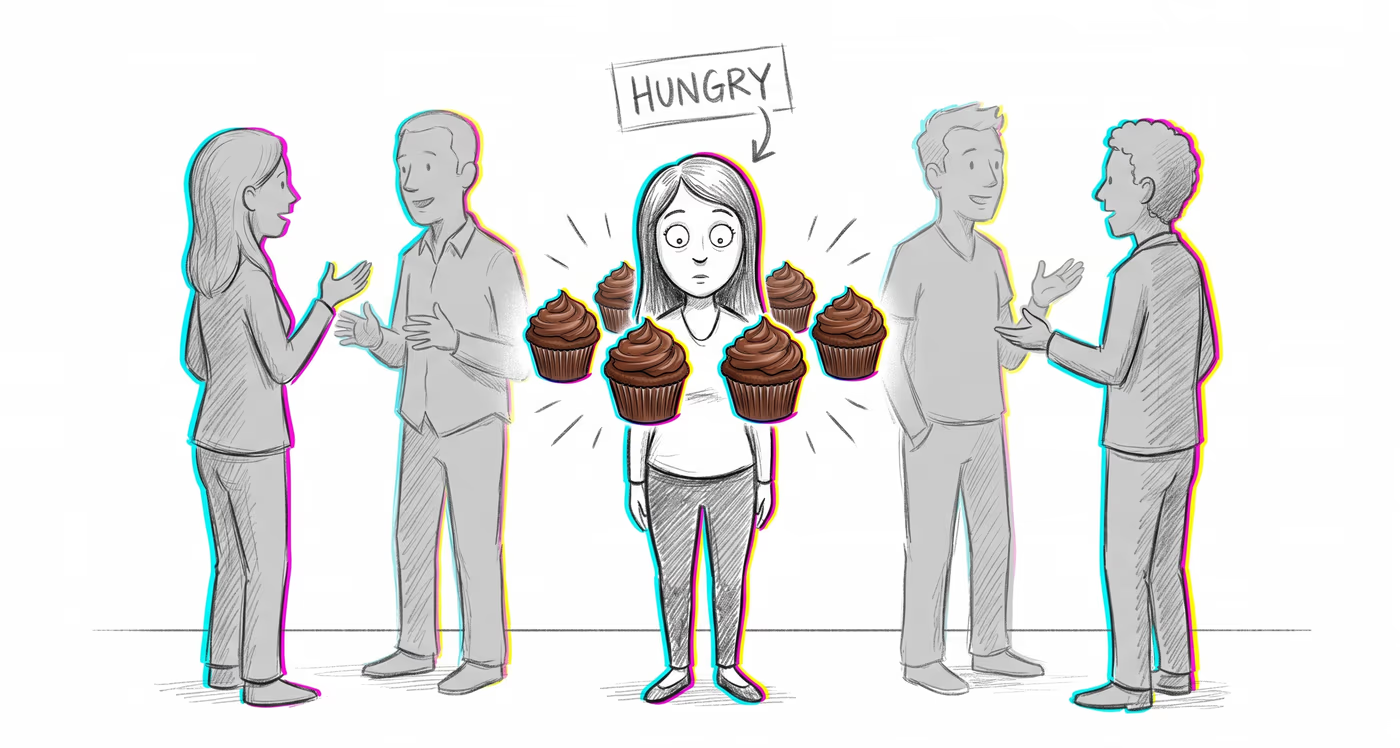
Focusing on whatever is most vivid, prominent, or emotionally striking while ignoring less noticeable but equally important details.

WHAT IT IS

The glitch, explained plainly.

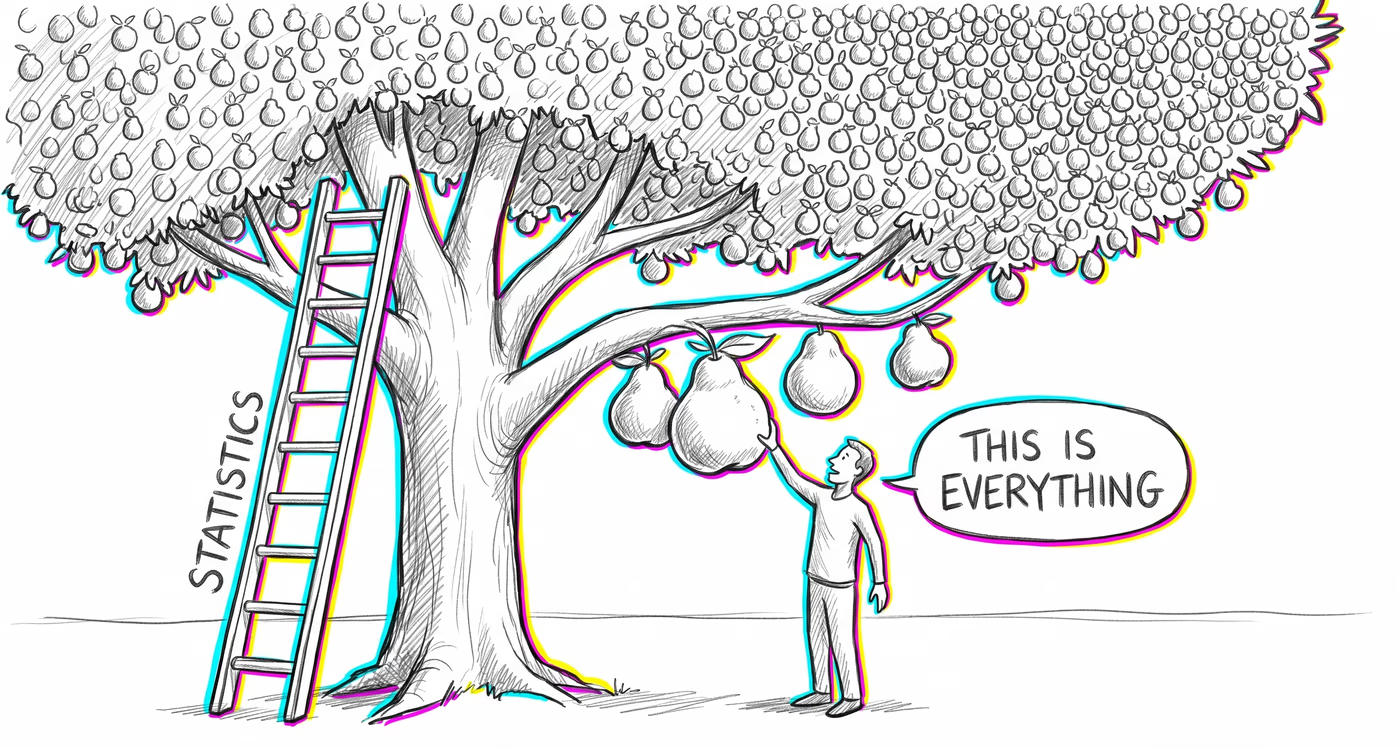
Imagine you're in a dark room and someone turns on one flashlight pointed at one corner. You'd think that corner is the most important part of the room, just because it's the only thing you can see. Salience bias is like that — your brain thinks whatever is brightest, loudest, or most dramatic is also the most important, even when the quiet stuff matters just as much.

Salience bias describes how people systematically overweight information that is perceptually conspicuous, emotionally charged, or recently encountered, while underweighting information that is subtle, abstract, or statistically more relevant. This bias operates across sensory modalities: a loud voice in a meeting, a vivid news image, or a dramatic anecdote all capture cognitive resources disproportionate to their informational value. The effect is compounded by the fact that salient information is also more easily recalled later, creating a reinforcing loop where prominent stimuli dominate both immediate perception and subsequent memory-based judgments. Unlike a simple attentional preference, salience bias systematically distorts causal reasoning — people attribute more causal influence to whatever element happens to be most noticeable, regardless of its actual explanatory power.

SOUND FAMILIAR?

Where it shows up.

  1. 01 Maria is reviewing candidates for a marketing position. One applicant stumbled over his words during the video interview, creating an awkward thirty-second pause. Despite his portfolio being the strongest of all candidates and his references being stellar, Maria keeps replaying that awkward moment in her mind and ranks him third.
  2. 02 A city council votes to allocate $2 million to install barriers on a bridge after a widely publicized suicide there, while tabling a $500,000 proposal for community mental health services that data shows would prevent far more deaths citywide. Council members cite 'resident concern' as the driving factor.
  3. 03 An investor reviews her portfolio and notices that a single tech stock dropped 15% yesterday, which made headlines. She decides to sell the stock immediately. Meanwhile, she ignores that three of her bond holdings have been steadily underperforming their benchmark for six months — a pattern that represents a larger total loss but never triggered a dramatic single-day headline.
  4. 04 A product manager prioritizes fixing a UI bug that one customer described in a passionate, detailed email with screenshots, over addressing a data-logging error that silently affects 12% of all users but has generated no complaints because users don't notice it.
  5. 05 During a hospital's quarterly review, administrators focus their discussion almost entirely on a single malpractice lawsuit that received local press coverage. They spend five minutes on a staff report showing that medication dosage errors have increased 8% across three departments — a systemic risk affecting hundreds of patients that hasn't generated any dramatic incidents yet.
IN DIFFERENT DOMAINS

Where it shows up at work.

The same glitch looks different depending on the terrain. Finance, medicine, a relationship, a team — same mechanism, different costume.

Finance & investing

Investors overreact to vivid, headline-grabbing market events like flash crashes or celebrity CEO scandals while neglecting slower, less dramatic indicators like gradual shifts in interest rates or debt-to-equity ratios that have larger cumulative impact on portfolio performance.
Medicine & diagnosis

Clinicians may anchor on the most dramatic or unusual symptom a patient presents — such as a striking rash — while underweighting subtle but diagnostically critical signs like mild lab abnormalities, leading to misdiagnosis when the salient symptom is incidental rather than causal.

Education & grading

Teachers disproportionately remember and evaluate students based on a few highly visible behaviors — such as one disruptive outburst or one brilliant answer — rather than the full pattern of consistent but unremarkable daily performance, skewing grades and recommendations.

Relationships

Partners tend to fixate on a single dramatic argument or betrayal while discounting months of quiet, steady support, causing the emotional weight of one vivid negative episode to disproportionately define the relationship narrative.

Tech & product

Product teams prioritize fixing bugs that generate visually dramatic error messages or angry social media posts, while systematically neglecting silent performance degradations or accessibility issues that affect more users but produce no conspicuous complaints.

Workplace & hiring

In performance reviews, managers disproportionately weight a recent high-visibility success or failure over an employee's sustained track record, because the dramatic event is more cognitively accessible than the aggregate pattern of steady contributions.

Politics Media

Media coverage of rare but vivid events like terrorist attacks or plane crashes causes the public to massively overestimate their frequency and risk, driving disproportionate policy responses and funding allocations compared to statistically larger but less dramatic threats like chronic disease or traffic fatalities.

HOW TO SPOT IT

Ask yourself…

  • Am I giving this information more weight because it is vivid, dramatic, or recent — or because it is actually the most relevant data point?
  • What quieter, less conspicuous information might I be ignoring right now that could change my conclusion?
  • If this same fact had been presented to me in a dry, unexciting format, would I still consider it this important?
HOW TO DEFEND AGAINST IT

The playbook.

  • Before making a decision, explicitly list all relevant factors — not just the ones that come to mind first — and assign each a weight based on objective criteria rather than vividness.
  • Apply the 'newspaper test in reverse': ask yourself what information you would never see in a headline but that a careful analyst would consider essential.
  • Use base-rate data as an anchor before incorporating any dramatic anecdote or vivid example.
  • Implement structured decision frameworks (e.g., weighted scoring matrices) that force equal consideration of all criteria, preventing any single salient factor from dominating.
  • Practice the 'silent evidence' exercise: for every conspicuous data point, deliberately ask what equally important information might be invisible, quiet, or boring.
FAMOUS CASES

In history.

  • Post-9/11, U.S. travelers shifted from flying to driving due to the salience of the terrorist attacks, leading to an estimated 1,600 additional road fatalities in the year following — the less salient but statistically greater risk was ignored.
  • The widespread fear of nuclear power after the Chernobyl and Fukushima disasters led many countries to curtail nuclear energy programs, despite coal and fossil fuel pollution causing far more deaths annually — the vivid, dramatic nature of nuclear accidents dominated public risk perception.
  • After highly publicized cases of stranger abductions, parents dramatically increased restrictions on children's outdoor play, even though abduction by strangers remained extremely rare compared to other childhood risks like household accidents.
WHERE IT COMES FROM
Academic origin

Shelley Taylor and Susan Fiske, 1975. Their foundational study 'Point of view and perceptions of causality' demonstrated that perceptual salience directly influences causal attribution judgments. They expanded the framework in their 1978 chapter 'Salience, Attention, and Attribution: Top of the Head Phenomena.'

Evolutionary origin

In ancestral environments, stimuli that stood out — a sudden movement, a bright color, a loud noise — were disproportionately likely to signal either predators, prey, or mating opportunities. Organisms that rapidly oriented toward the most perceptually prominent features of their environment survived at higher rates, making attentional capture by salient stimuli a deeply wired default.

IN AI SYSTEMS

How the machines inherit it.

Machine learning models can inherit salience bias when trained on datasets where certain features are overrepresented or more visually/textually prominent. Models may learn to weight conspicuous surface-level patterns — such as image backgrounds, formatting artifacts, or frequent but non-diagnostic keywords — over subtle but more predictive features. In NLP, LLMs tend to weight vivid, emotionally charged training examples more heavily in their outputs, and recommendation algorithms amplify salience by surfacing sensational content that generates engagement, creating feedback loops that further entrench the bias.

Read more on Wikipedia
FREE FIELD ZINE

10 glitches quietly running your life.

A free field-zine PDF — ten cognitive glitches named, illustrated, with a defense move for each. Plus the weekly Glitch Report on Fridays — one bias named, two spotted in the wild, one defense move. Unsubscribe any time.

EXPLORE MORE

Related glitches.

LAUNCH PRICE

Train against your blindspots.

50 cards are free to preview. Buyers unlock the rest of the deck plus the interactive training — Spot-the-Bias Quiz unlimited, Swipe Deck with spaced repetition, My Blindspots, Decision Pre-Flight, the Printable Deck + Cheat Sheets, and the Field Guide e-book. $29.50$59.

Unlock the full deck

Everything below — yours forever. Pay once, use across every device.

Half-off launch — limited to the first 100 readers. Auto-applied at checkout.
$59 $29.50
one-time payment · lifetime access
  • All interactive digital cards — search, filter, flip, shuffle on any device
  • Five training modes — Spot-the-Bias Quiz, Swipe Deck, Pre-Flight, Blindspots, Journal
  • Curated Lenses + Decision Templates + Defense Playbook
  • Printable Deck PDFs + Field Guide e-book + Cheat Sheets + Anki Export
  • Every future improvement, included
Unlock  $29.50

30-day refund · no questions asked

Unlock the full deck

Everything below — yours forever. Pay once, use across every device.

Half-off launch — limited to the first 100 readers. Auto-applied at checkout.
$59 $29.50
one-time payment · lifetime access
  • All interactive digital cards — search, filter, flip, shuffle on any device
  • Five training modes — Spot-the-Bias Quiz, Swipe Deck, Pre-Flight, Blindspots, Journal
  • Curated Lenses + Decision Templates + Defense Playbook
  • Printable Deck PDFs + Field Guide e-book + Cheat Sheets + Anki Export
  • Every future improvement, included
Unlock  $29.50

30-day refund · no questions asked