Illusory Correlation

aka Illusory Correlation Bias · Perceived Covariation

Perceiving a meaningful connection between two things when no such relationship actually exists.

WHAT IT IS

The glitch, explained plainly.

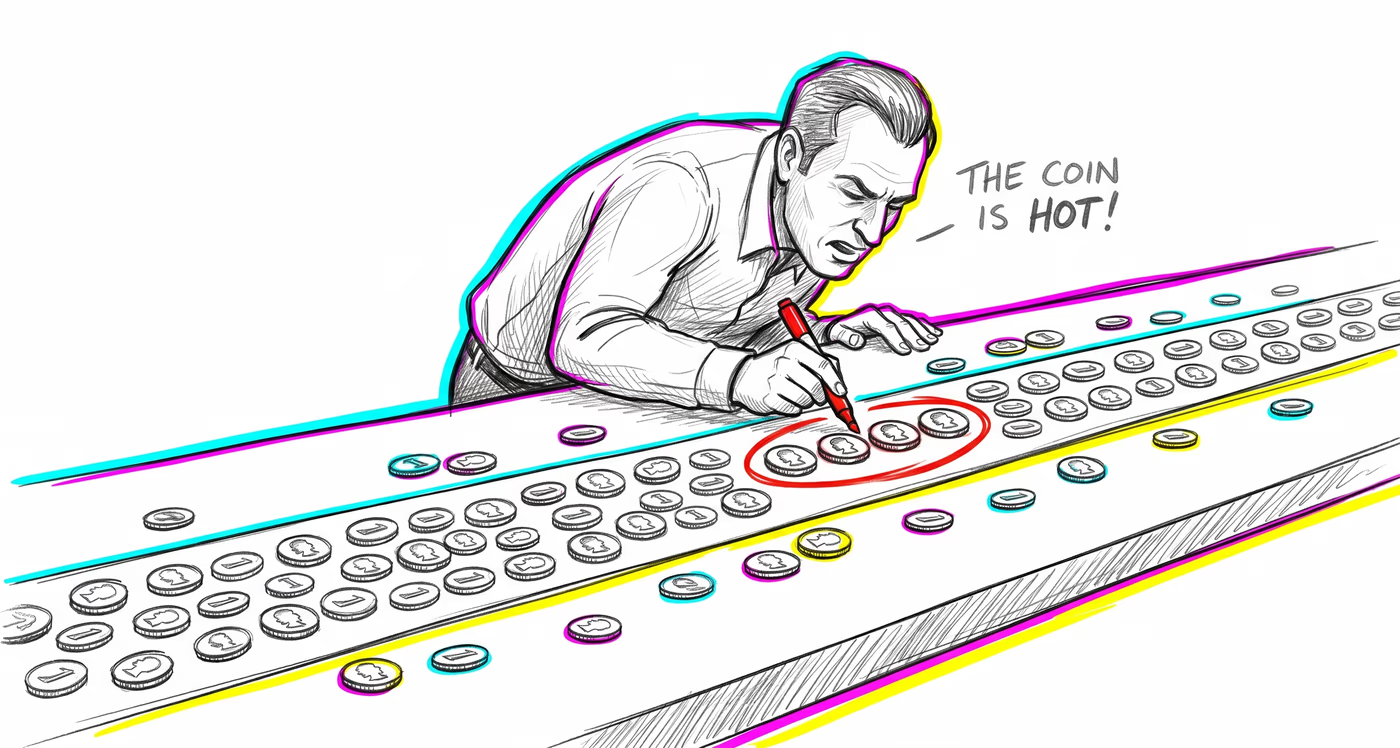
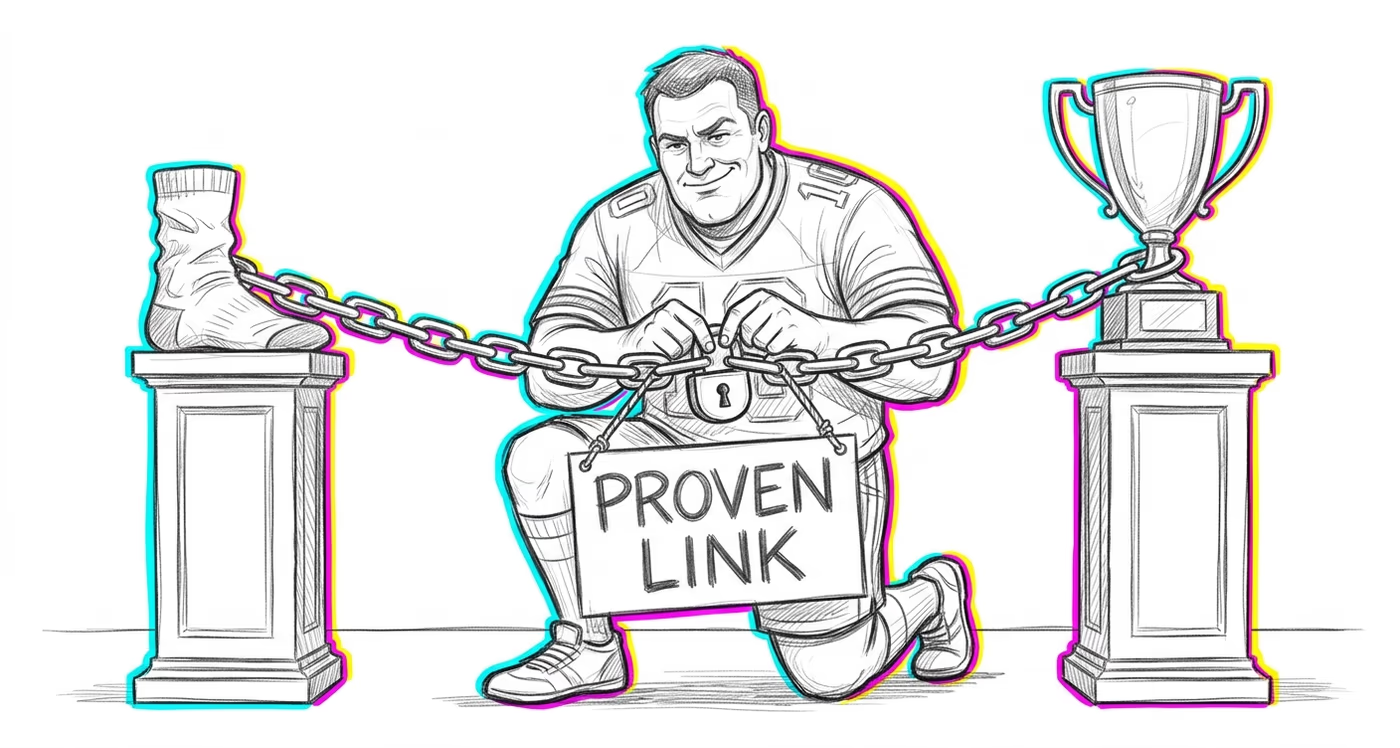
Imagine you notice that the two times you wore your red shirt, your team won the game. You didn't notice the five times your team won when you weren't wearing it, or the three times you wore it and they lost. Your brain grabbed onto the memorable match and said 'Aha, these go together!' — even though the shirt has nothing to do with winning.

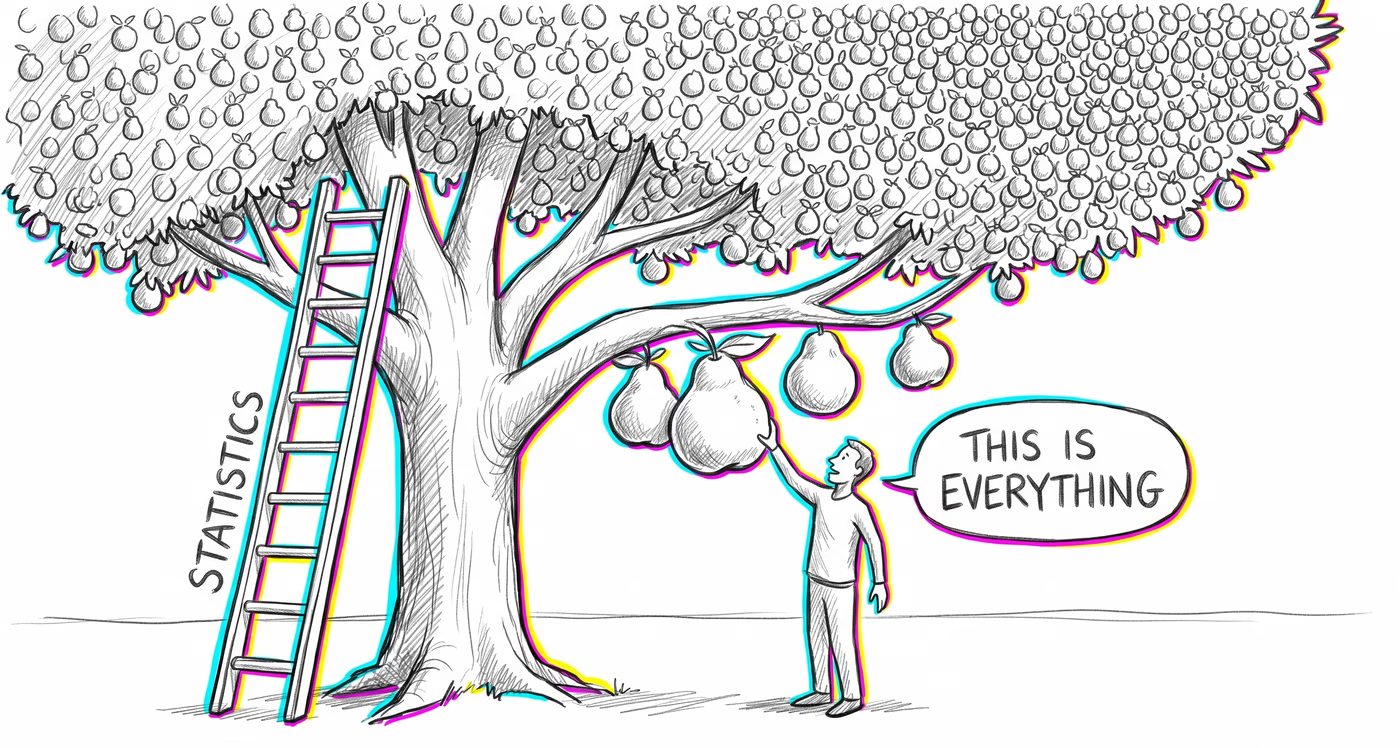
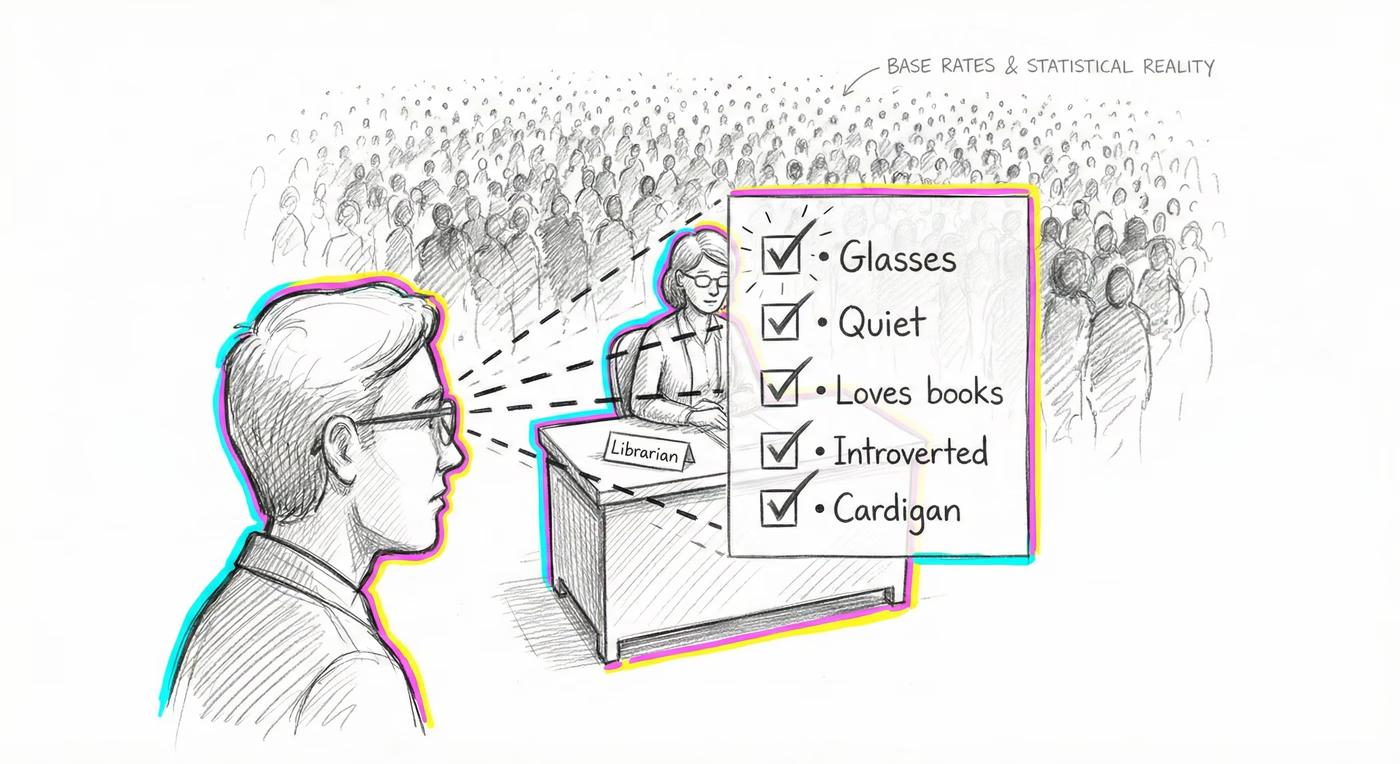
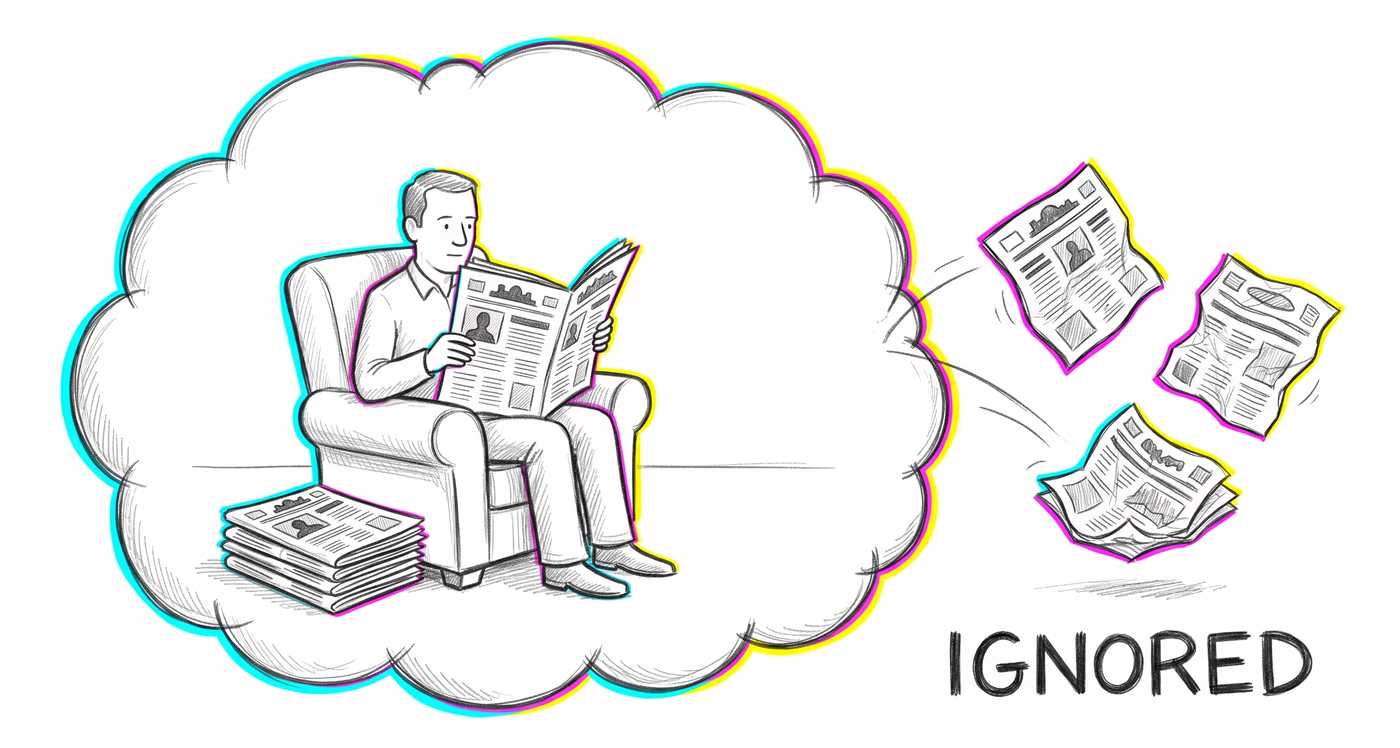
Illusory correlation occurs through two primary mechanisms: distinctiveness-based and expectancy-based processes. In the distinctiveness-based form, when two statistically infrequent events co-occur (such as a rare behavior performed by a member of a minority group), their shared novelty makes the pairing disproportionately memorable, inflating the perceived frequency of their co-occurrence. In the expectancy-based form, pre-existing beliefs or stereotypes lead people to selectively notice and recall instances that confirm the expected association while disregarding contradictory evidence. The bias is particularly insidious because it operates beneath conscious awareness, causing people to build confident causal narratives from coincidental co-occurrences, and once established, these false associations become self-reinforcing through confirmatory information processing.

SOUND FAMILIAR?

Where it shows up.

  1. 01 A nurse notices that three of her last four patients who complained of joint pain arrived on rainy days. She starts telling colleagues that damp weather causes joint flare-ups, even though her hospital's records for the past year show no statistical relationship between weather and joint pain admissions.
  2. 02 A hiring manager interviews candidates from a small, unfamiliar university. Two of the three candidates from that school performed poorly. He now routes all resumes from that university to the reject pile, despite the fact that his overall data shows the same proportion of poor interviews across all schools.
  3. 03 A product manager reviews crash reports and notices that three critical bugs were introduced by the team's only remote developer. She proposes a policy requiring all developers to work on-site, not realizing that the remote developer handles 40% of the codebase and the per-commit bug rate is actually lower than the on-site team's average.
  4. 04 A financial analyst reads about two tech companies that crashed shortly after their CEOs appeared on a particular podcast. He starts factoring podcast appearances into his risk model, despite having no systematic data showing that podcast appearances predict stock declines — he simply never tracked the dozens of companies whose stock was unaffected after the same podcast.
  5. 05 A therapist begins to believe that patients who doodle during sessions are more resistant to treatment. She recalls several doodlers who dropped out early, but hasn't tracked the doodlers who completed treatment successfully or the non-doodlers who also dropped out, leading her to make clinical notes flagging doodling as a risk factor.
IN DIFFERENT DOMAINS

Where it shows up at work.

The same glitch looks different depending on the terrain. Finance, medicine, a relationship, a team — same mechanism, different costume.

Finance & investing

Investors perceive false links between unrelated market indicators and stock performance — such as believing that a specific economic report always precedes a rally — because the memorable instances of co-occurrence overshadow the many times the pattern did not hold.

Medicine & diagnosis

Clinicians overestimate the association between certain patient demographics and diagnoses, or between specific symptoms and rare conditions, because distinctive co-occurrences (e.g., a young patient with a serious disease) are more memorable than routine presentations, distorting diagnostic reasoning.
Education & grading

Teachers may form false associations between student appearance or background characteristics and academic ability, overestimating how often students from a particular group struggle, because the few memorable instances crowd out the many counterexamples.

Relationships

People form false beliefs about their partner's behavior — such as thinking their partner always forgets important dates — because the emotionally charged instances of forgetting are far more salient than the many times their partner remembered.

Tech & product

Product teams attribute success or failure to incidental design features (like color choices or launch timing) based on a few memorable coincidences, creating internal myths that influence future product decisions without supporting data.

Workplace & hiring

Managers develop false beliefs that employees from certain teams or backgrounds are less reliable, because a few memorable instances of poor performance by those individuals are more salient than the base rate of performance across the entire workforce.

Politics Media

Media coverage of rare crimes committed by members of minority groups makes these events highly memorable, leading the public to drastically overestimate the association between that group and criminal behavior, fueling prejudice and discriminatory policy support.

HOW TO SPOT IT

Ask yourself…

  • Am I basing this association on a few vivid or memorable instances rather than systematic data?
  • Have I considered the cases where one event happened without the other, or neither event happened?
  • Would this pattern hold up if I actually tracked all four cells of the contingency table (both present, A without B, B without A, neither)?
HOW TO DEFEND AGAINST IT

The playbook.

  • Actively track all four cells of the 2x2 contingency table: event A with B, A without B, B without A, and neither — don't rely on memory alone.
  • Before accepting a perceived association, ask: 'What's my sample size, and am I remembering the confirming cases more than the disconfirming ones?'
  • Seek out base rate data and statistical evidence before forming causal beliefs from co-occurrences.
  • Use a decision journal to log predictions and outcomes, forcing yourself to confront the full distribution of results rather than relying on selective recall.
  • When you notice a pattern forming, deliberately search for counterexamples that would break the association.
FAMOUS CASES

In history.

  • The discredited Wakefield study linking the MMR vaccine to autism (1998) gained public traction partly because parents noticed temporal co-occurrence between vaccination timing and autism symptom onset, forming a persistent illusory correlation despite the study's retraction and extensive contradicting evidence.
  • Clinical psychologists for decades maintained false diagnostic associations between specific Rorschach inkblot responses and homosexuality, as demonstrated by Chapman and Chapman (1969), even though empirical data showed no such correlation.
  • The widespread belief that arthritis pain worsens with rainy weather persists despite Redelmeier and Tversky's (1996) study finding no actual correlation, because patients selectively remember pain episodes that coincided with bad weather.
WHERE IT COMES FROM
Academic origin

Loren J. Chapman (1967) coined the term and demonstrated it experimentally in 'Illusory correlation in observational report' (Journal of Verbal Learning and Verbal Behavior). Loren and Jean Chapman (1967, 1969) extended it to clinical psychology. David Hamilton and Robert Gifford (1976) applied it to stereotype formation in social psychology.

Evolutionary origin

In ancestral environments, quickly detecting co-occurrences between events — even at the cost of many false positives — was far less costly than missing a genuine association. Noticing that a certain plant grew near a water source, or that a particular sound preceded a predator's appearance, conferred survival advantages. The asymmetry between the cost of a false alarm (wasted vigilance) versus a missed detection (death) selected for a hair-trigger pattern-detection system.

IN AI SYSTEMS

How the machines inherit it.

Machine learning models trained on imbalanced datasets can learn spurious correlations between minority-class features and specific outcomes, mirroring the distinctiveness-based mechanism in human cognition. For example, if a training set contains few examples of a demographic group, and those few examples happen to co-occur with negative labels, the model may encode a false association. Recommender systems and search algorithms can also amplify illusory correlations present in user behavior data, reinforcing stereotypical associations at scale.

Read more on Wikipedia
FREE FIELD ZINE

10 glitches quietly running your life.

A free field-zine PDF — ten cognitive glitches named, illustrated, with a defense move for each. Plus the weekly Glitch Report on Fridays — one bias named, two spotted in the wild, one defense move. Unsubscribe any time.

EXPLORE MORE

Related glitches.

LAUNCH PRICE

Train against your blindspots.

50 cards are free to preview. Buyers unlock the rest of the deck plus the interactive training — Spot-the-Bias Quiz unlimited, Swipe Deck with spaced repetition, My Blindspots, Decision Pre-Flight, the Printable Deck + Cheat Sheets, and the Field Guide e-book. $29.50$59.

Unlock the full deck

Everything below — yours forever. Pay once, use across every device.

Half-off launch — limited to the first 100 readers. Auto-applied at checkout.
$59 $29.50
one-time payment · lifetime access
  • All interactive digital cards — search, filter, flip, shuffle on any device
  • Five training modes — Spot-the-Bias Quiz, Swipe Deck, Pre-Flight, Blindspots, Journal
  • Curated Lenses + Decision Templates + Defense Playbook
  • Printable Deck PDFs + Field Guide e-book + Cheat Sheets + Anki Export
  • Every future improvement, included
Unlock  $29.50

30-day refund · no questions asked

Unlock the full deck

Everything below — yours forever. Pay once, use across every device.

Half-off launch — limited to the first 100 readers. Auto-applied at checkout.
$59 $29.50
one-time payment · lifetime access
  • All interactive digital cards — search, filter, flip, shuffle on any device
  • Five training modes — Spot-the-Bias Quiz, Swipe Deck, Pre-Flight, Blindspots, Journal
  • Curated Lenses + Decision Templates + Defense Playbook
  • Printable Deck PDFs + Field Guide e-book + Cheat Sheets + Anki Export
  • Every future improvement, included
Unlock  $29.50

30-day refund · no questions asked