Functional Fixedness

aka Functional Fixity

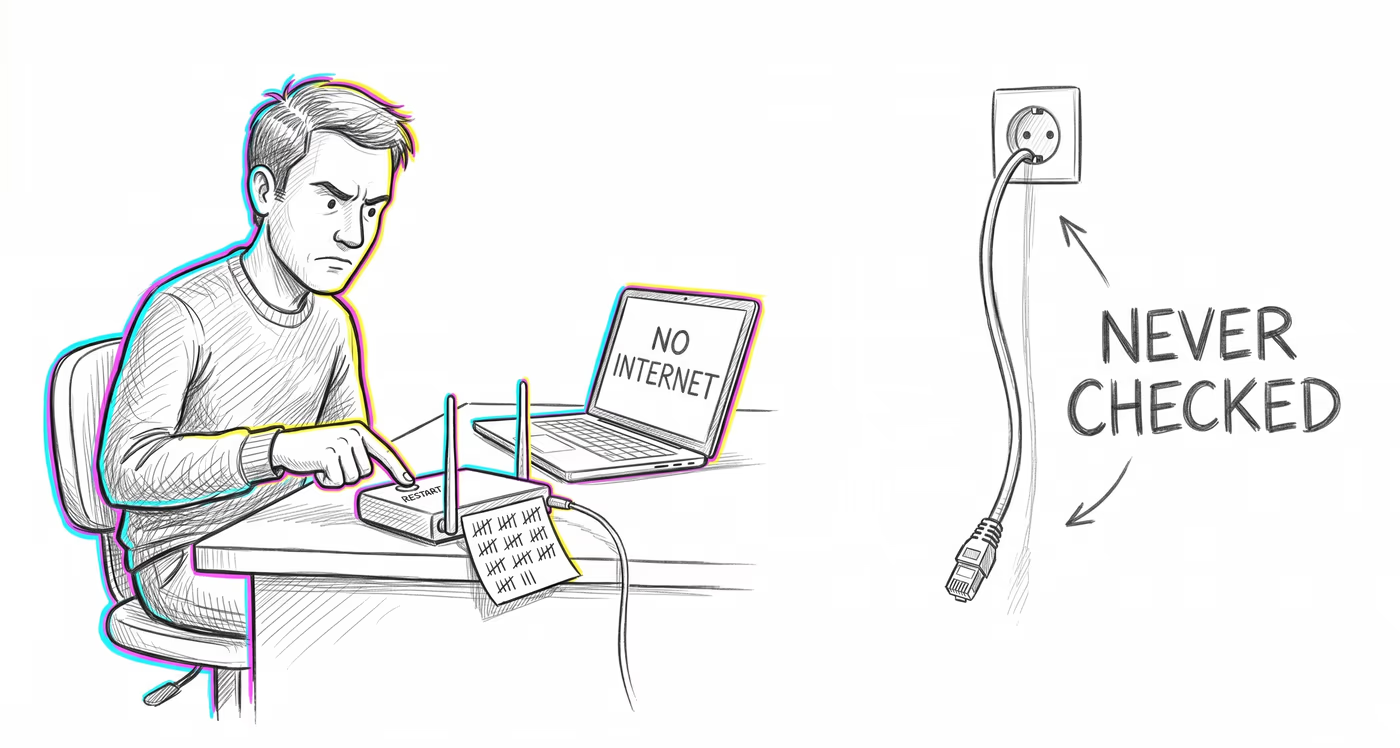
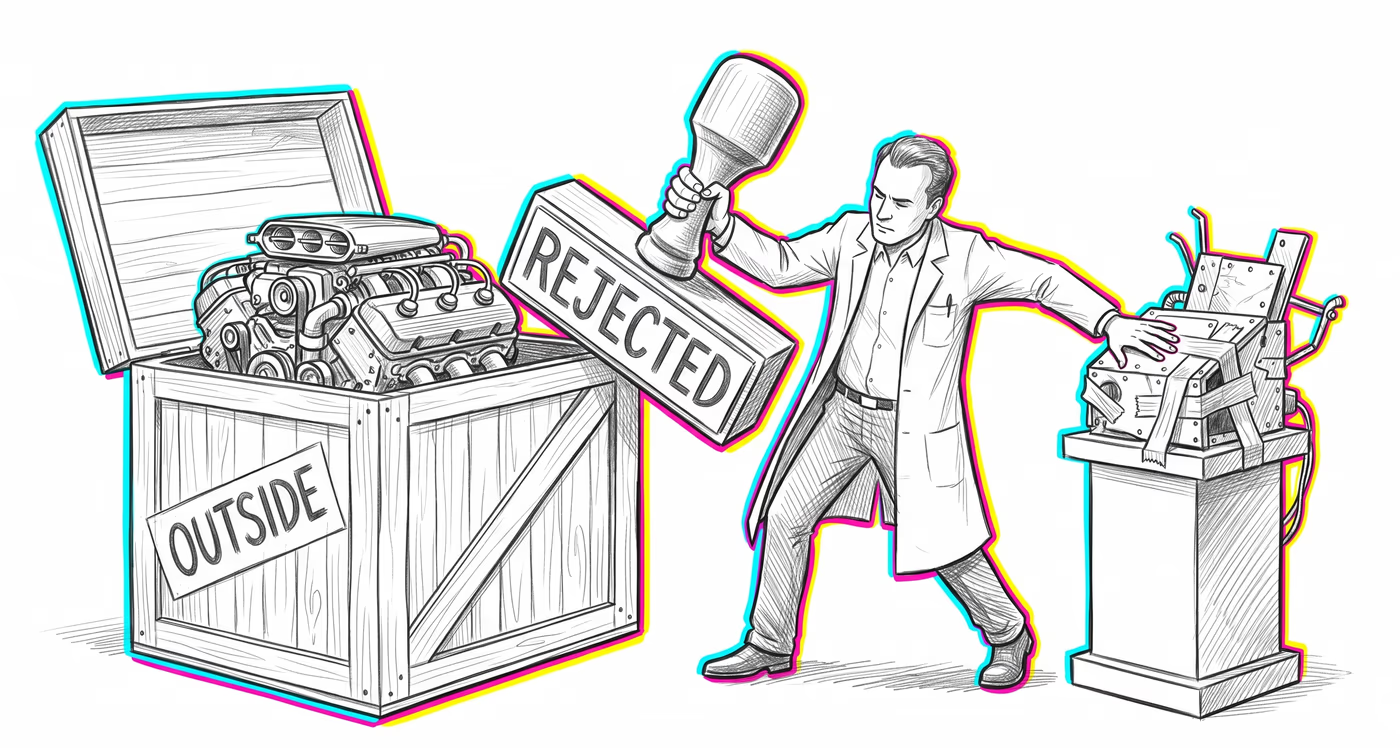
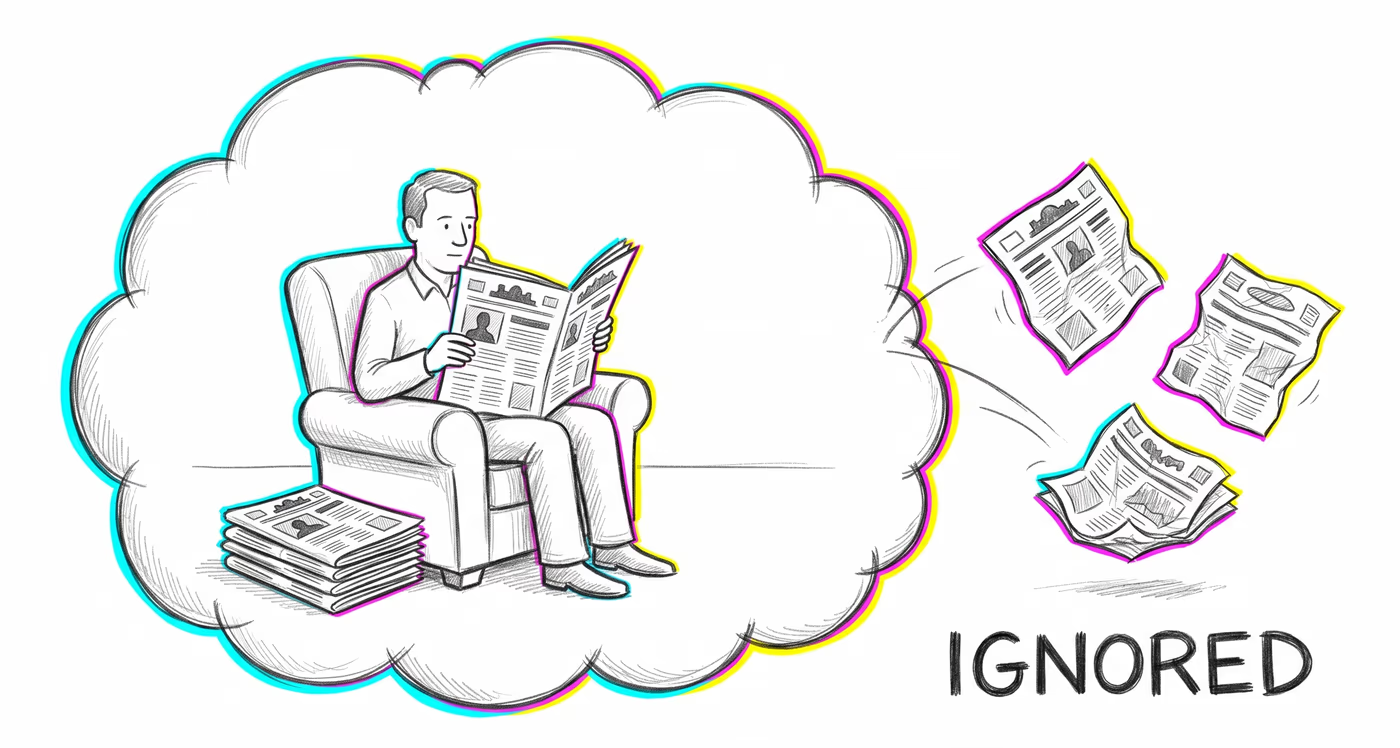
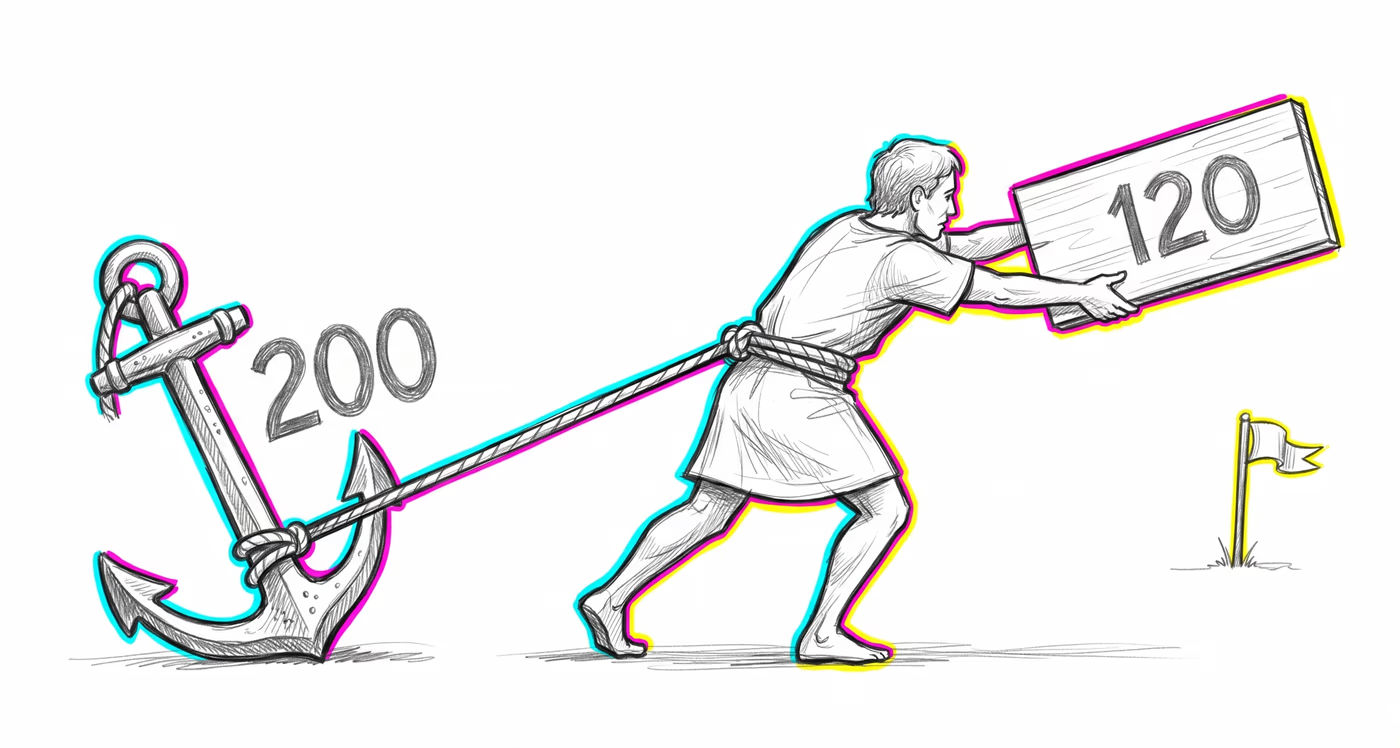
Seeing an object as only having its conventional use, blocking the ability to repurpose it for creative problem-solving.

WHAT IT IS

The glitch, explained plainly.

Imagine you need to hang a picture but you don't have a hammer. There's a heavy wrench right in front of you that would work perfectly—but because your brain files it under 'wrench stuff,' you can't see it as a 'hitting-nails thing.' It's like your brain put a name tag on every object and now refuses to let it do any job that doesn't match the tag.

Functional fixedness is a cognitive constraint in which prior knowledge of an object's designated purpose prevents a person from recognizing that the same object could serve an entirely different function in a novel context. The bias is strongest when the object has recently been seen or used in its conventional role, which locks in a mental representation that is difficult to override. It operates as a specific form of mental set—a habitual approach to problems that persists even when a creative reinterpretation of available resources would yield a solution. The phenomenon increases with age and expertise, as accumulated experience with specialized tools reinforces rigid functional categories in semantic memory.

SOUND FAMILIAR?

Where it shows up.

  1. 01 Maria needs to prop open her apartment door to carry in furniture, but she doesn't have a doorstop. She walks past a heavy dictionary on the shelf three times, searching online for where to buy a doorstop, never considering the book could serve the same purpose.
  2. 02 During a camping trip, Tom realizes he forgot a bottle opener. He holds the bottle cap and stares at his Swiss Army knife, pocket change, and a lighter, but only tries to pry the cap with his teeth because he mentally categorizes each item by its primary function and none of them is 'a bottle opener.'
  3. 03 A startup engineer needs to waterproof a prototype sensor for a field test tomorrow. She has silicone sealant, rubber gloves, and plastic wrap in the lab. She spends hours sourcing a custom waterproof casing online, never considering that dipping the sensor in the silicone sealant and wrapping it in a cut rubber glove finger would create an adequate seal.
  4. 04 A product team is designing a meditation app and decides they need to license calming music. Nobody suggests repurposing the white-noise engine already built into the company's sleep app, because everyone perceives it as 'the sleep feature' rather than as a general ambient-sound generator that could serve meditation too.
  5. 05 A hospital supply manager faces a shortage of IV pole hooks during an emergency surge. Maintenance staff have dozens of unused S-hooks and coat hangers in storage that could be bent into functional IV-bag holders, but the supply manager continues calling vendors for official medical-grade hooks because the existing hardware is mentally filed under 'janitorial supplies.'
IN DIFFERENT DOMAINS

Where it shows up at work.

The same glitch looks different depending on the terrain. Finance, medicine, a relationship, a team — same mechanism, different costume.

Finance & investing

Investors and financial planners tend to view financial instruments only by their conventional purpose—savings accounts for saving, insurance for protection—and fail to recognize that certain insurance products can serve as investment vehicles or that a home equity line can function as an emergency fund, leading to suboptimal portfolio construction.
Medicine & diagnosis

Clinicians may overlook repurposing existing medications for off-label uses because they mentally associate each drug only with its approved indication, slowing the adoption of treatments like using blood pressure medications for anxiety or anti-seizure drugs for chronic pain management.

Education & grading

Teachers often rely on textbooks and worksheets as the sole vehicles for instruction, struggling to see everyday objects, games, or student-generated content as legitimate teaching tools, which limits experiential and creative learning opportunities.

Relationships

People may view a partner's strengths only through the lens of their established role—the 'provider' or the 'caregiver'—and fail to recognize that the same person could contribute meaningfully in completely different ways, such as creative planning or emotional mentorship, leading to underutilization of each other's abilities.

Tech & product

Development teams frequently build entirely new components or libraries for a feature when an existing internal tool or API endpoint could be adapted to the task, because they mentally label each module by its original purpose and do not consider repurposing it.

Workplace & hiring

Managers tend to assign employees only to roles matching their job title or department function, overlooking transferable skills—a data analyst with graphic design ability, for instance—which leads to unnecessary hiring and missed internal talent.

Politics Media

Policy makers and media analysts often apply frameworks from their domain of origin rigidly—treating economic tools only for economic problems and military tools only for security threats—and fail to see how educational programs, infrastructure investments, or diplomatic channels could address the same issues more effectively.

HOW TO SPOT IT

Ask yourself…

  • Am I dismissing a possible solution only because the object involved wasn't designed for this purpose?
  • If I described this object purely by its physical properties—weight, shape, material—rather than its name, would new uses become apparent?
  • Am I searching for a 'proper' tool when something already in front of me could work with minor adaptation?
HOW TO DEFEND AGAINST IT

The playbook.

  • Use the Generic Parts Technique: break every object into its raw physical components (shape, material, weight) and ask what each component could do, stripping away labels and names.
  • Restate the problem in abstract terms—instead of 'I need a screwdriver,' say 'I need something thin and rigid enough to turn a slotted groove.'
  • Practice the 'alternative uses' exercise regularly: pick a random everyday object and list 10 unconventional uses in two minutes to build cognitive flexibility.
  • Invite an outsider or someone from a different discipline to look at the problem—they lack the domain-specific functional associations that cause fixedness.
  • When stuck, physically remove the conventional tool from view; its absence forces the brain to search for substitutes rather than fixate on the missing item.
FAMOUS CASES

In history.

  • During the Apollo 13 crisis in 1970, NASA engineers had to overcome functional fixedness to build a makeshift CO2 filter from duct tape, plastic bags, and cardboard—items whose conventional uses were entirely unrelated to air filtration—to save the crew's lives.
  • The invention of the Post-it Note at 3M arose when Spencer Silver's 'failed' adhesive—too weak for its intended purpose—was repurposed by Art Fry as a repositionable bookmark, requiring both men to overcome the assumption that a weak adhesive was simply defective.
WHERE IT COMES FROM
Academic origin

Karl Duncker, a Gestalt psychologist, introduced the concept in his 1935 German publication 'Zur Psychologie des produktiven Denkens' and formalized it in his 1945 English monograph 'On Problem-Solving' (Psychological Monographs, 58(5)). Adamson (1952) replicated and extended Duncker's experiments, and Glucksberg (1962) further studied the interaction of motivation and functional fixedness.

Evolutionary origin

In ancestral environments, quickly recognizing what a tool is for and deploying it without deliberation provided a survival advantage—using a sharp stone to cut, a stick to dig, or a gourd to carry water. Locking in reliable tool-function associations allowed rapid, efficient responses, especially under time pressure from predators or environmental threats. The cost of occasionally missing a creative repurposing was far less than the cost of hesitating while re-evaluating every object from scratch.

IN AI SYSTEMS

How the machines inherit it.

Machine learning models trained on labeled datasets inherit functional fixedness-like rigidity: an image classifier trained to identify hammers as 'tools for driving nails' may fail to classify a hammer being used as a paperweight or doorstop. Similarly, recommendation algorithms tend to suggest objects and content only within their trained categorical use, reinforcing narrow functional associations and limiting serendipitous discovery of novel applications.

Read more on Wikipedia
FREE FIELD ZINE

10 glitches quietly running your life.

A free field-zine PDF — ten cognitive glitches named, illustrated, with a defense move for each. Plus the weekly Glitch Report on Fridays — one bias named, two spotted in the wild, one defense move. Unsubscribe any time.

EXPLORE MORE

Related glitches.

LAUNCH PRICE

Train against your blindspots.

50 cards are free to preview. Buyers unlock the rest of the deck plus the interactive training — Spot-the-Bias Quiz unlimited, Swipe Deck with spaced repetition, My Blindspots, Decision Pre-Flight, the Printable Deck + Cheat Sheets, and the Field Guide e-book. $29.50$59.

Unlock the full deck

Everything below — yours forever. Pay once, use across every device.

Half-off launch — limited to the first 100 readers. Auto-applied at checkout.
$59 $29.50
one-time payment · lifetime access
  • All interactive digital cards — search, filter, flip, shuffle on any device
  • Five training modes — Spot-the-Bias Quiz, Swipe Deck, Pre-Flight, Blindspots, Journal
  • Curated Lenses + Decision Templates + Defense Playbook
  • Printable Deck PDFs + Field Guide e-book + Cheat Sheets + Anki Export
  • Every future improvement, included
Unlock  $29.50

30-day refund · no questions asked

Unlock the full deck

Everything below — yours forever. Pay once, use across every device.

Half-off launch — limited to the first 100 readers. Auto-applied at checkout.
$59 $29.50
one-time payment · lifetime access
  • All interactive digital cards — search, filter, flip, shuffle on any device
  • Five training modes — Spot-the-Bias Quiz, Swipe Deck, Pre-Flight, Blindspots, Journal
  • Curated Lenses + Decision Templates + Defense Playbook
  • Printable Deck PDFs + Field Guide e-book + Cheat Sheets + Anki Export
  • Every future improvement, included
Unlock  $29.50

30-day refund · no questions asked