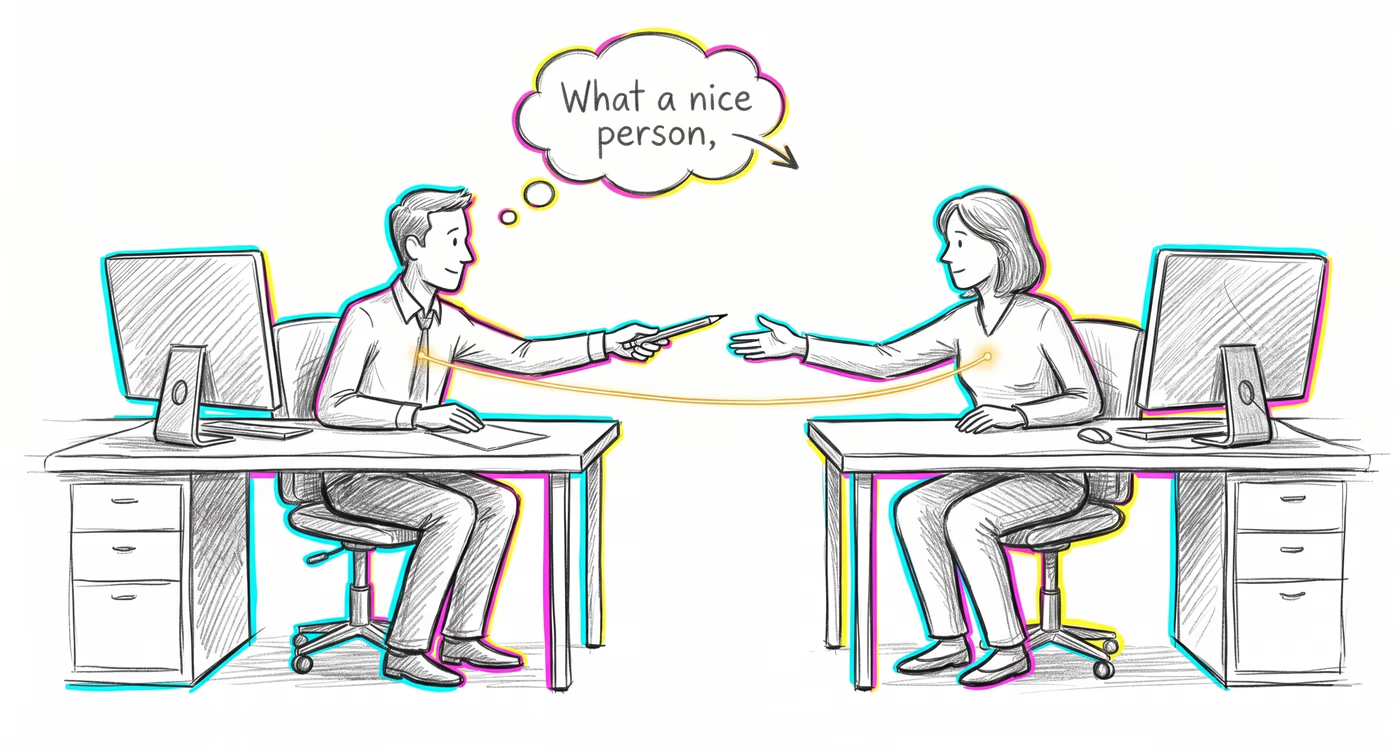
Ben Franklin Effect

aka Benjamin Franklin Effect · Favor-Liking Effect

Liking someone more after doing them a favor, because the mind concludes they must be likable to deserve it.

Illustration: Ben Franklin Effect
WHAT IT IS

The glitch, explained plainly.

Imagine you share your favorite toy with a kid you don't really like at the playground. Your brain gets confused: 'Why would I share my toy with someone I don't like?' So your brain decides, 'I guess I actually do like them!' — and suddenly you want to play with them more.

The Ben Franklin Effect describes a counterintuitive reversal in how attitudes form: rather than helping those we already like, we come to like those we have helped. When a person performs a favor for someone they feel neutral or negative toward, the inconsistency between the kind action and the unkind feeling creates psychological tension. To resolve this tension, the favor-doer unconsciously adjusts their attitude, convincing themselves they must actually like the recipient. The effect also operates in reverse — harming someone can lead to increased dislike of the victim, as the aggressor rationalizes their cruelty by dehumanizing the target.

SOUND FAMILIAR?

Where it shows up.

  1. 01 Marcus doesn't particularly care for his new team member, Raj. When Raj asks Marcus to explain a tricky software configuration, Marcus reluctantly walks him through it. Over the following weeks, Marcus finds himself volunteering to help Raj with other tasks and tells a friend, 'Raj is actually a really solid guy.'
  2. 02 A politician who initially dismissed a rival asks to borrow the rival's research notes for an upcoming committee meeting. After the rival graciously provides them, the politician finds herself speaking positively about the rival to her staff, despite nothing else about their relationship having changed.
  3. 03 Elena has been consistently cold toward a volunteer at her community center. When the volunteer asks Elena for advice on organizing a fundraiser — her area of expertise — Elena agrees and spends an hour coaching him. Afterward, Elena tells her partner that the volunteer is 'actually quite dedicated and sincere,' a view she never held before the conversation.
  4. 04 A venture capitalist who was skeptical of a startup founder agrees to make a warm introduction to a potential partner as a small personal favor. After making the introduction, the VC starts championing the founder's pitch at partner meetings, having shifted from skepticism to genuine enthusiasm without any new information about the company.
  5. 05 During a corporate merger, a senior executive who privately opposes the deal is asked by the acquiring CEO to personally mentor a junior leader from the other company. After months of investing time and guidance, the executive becomes one of the merger's most vocal internal supporters, rationalizing that the people involved must be worth the effort she put in.
IN DIFFERENT DOMAINS

Where it shows up at work.

The same glitch looks different depending on the terrain. Finance, medicine, a relationship, a team — same mechanism, different costume.

Finance & investing

Financial advisors who provide free consultations or small favors to prospective clients may develop inflated positive assessments of those clients' portfolios or trustworthiness, letting the warmth generated by their own helpfulness cloud objective financial judgment.
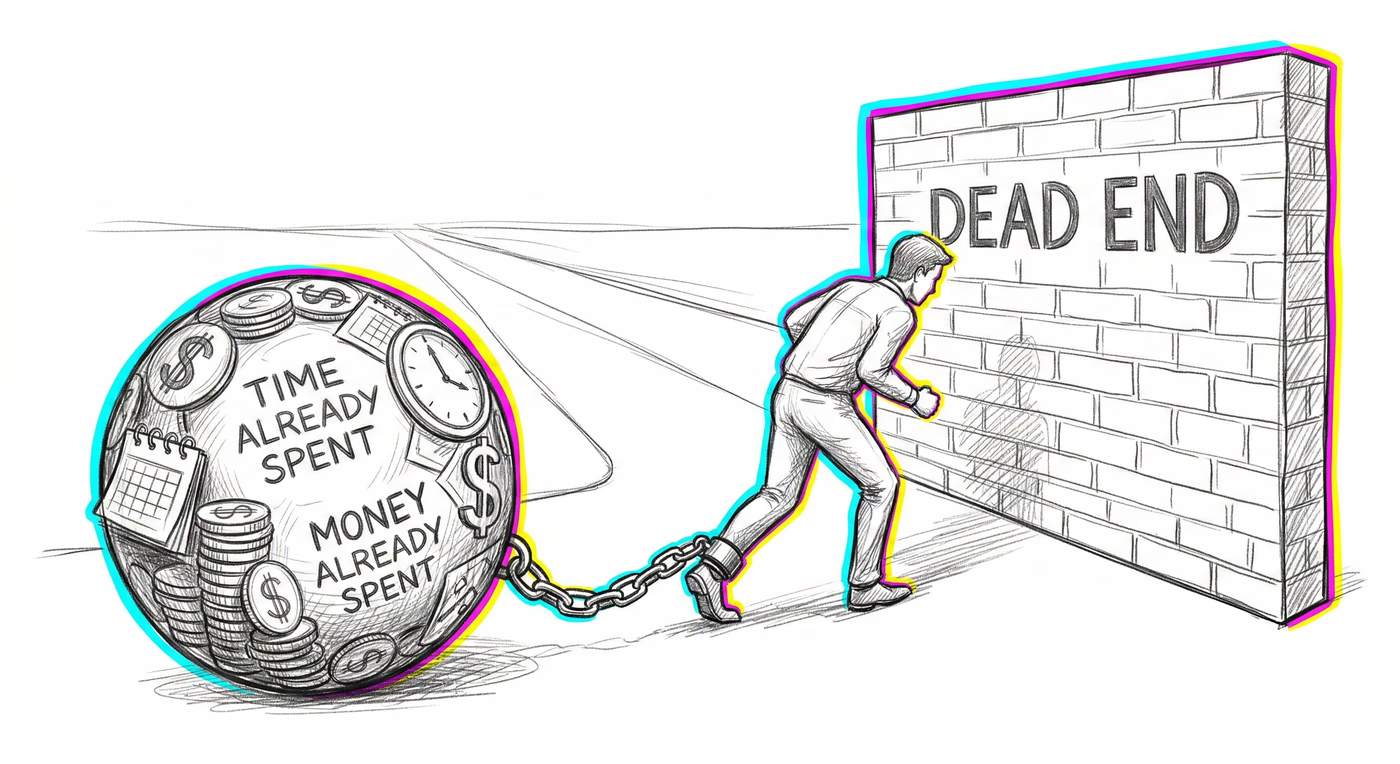
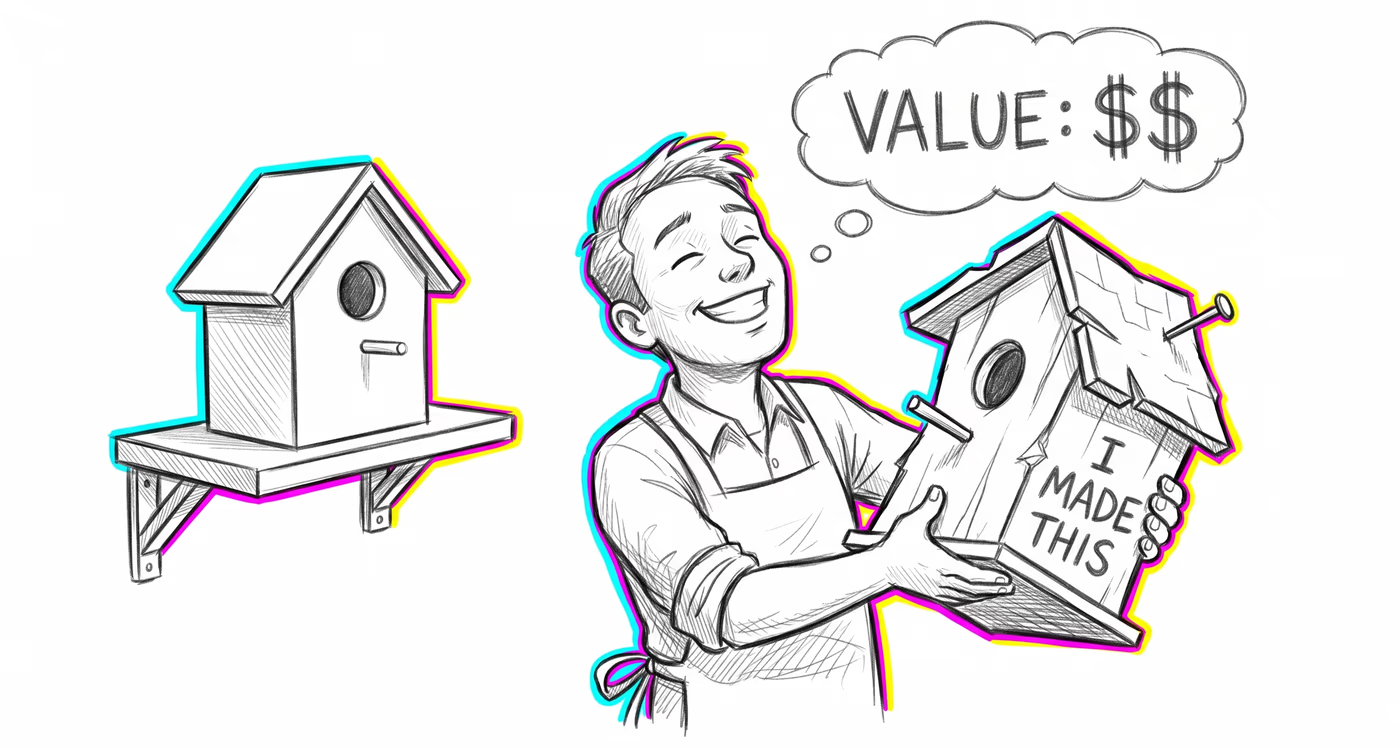
Medicine & diagnosis

Healthcare workers who go out of their way to accommodate difficult patients — staying late, making extra calls — may develop disproportionately favorable views of those patients, potentially leading to less critical evaluation of treatment adherence or symptom reporting.

Education & grading

Teachers who invest additional tutoring time in struggling students often develop stronger positive feelings toward those specific students, which can unconsciously bias grading or lead to preferential attention, independent of academic performance improvements.

Relationships

Partners who have made significant sacrifices for a relationship — relocating, funding a spouse's career change — may come to idealize the relationship more strongly, not because it improved, but because the magnitude of their investment demands psychological justification through increased affection.

Tech & product

Products that ask users for small contributions early on — rating content, completing a profile, customizing settings — can leverage the Ben Franklin Effect to increase user attachment and loyalty, as users rationalize their effort by concluding the product must be valuable.

Workplace & hiring

Managers who mentor or advocate for an employee tend to develop increasing positive bias toward that employee over time, as each act of investment further cements the belief that the employee deserves the support, making objective performance evaluation more difficult.

Politics Media

Volunteers who canvass, donate, or perform favors for a political candidate often become more ideologically aligned with that candidate over time — their investment of effort reshapes their political attitudes to justify the labor they've contributed.

HOW TO SPOT IT

Ask yourself…

  • Did I recently do this person a favor, and am I now seeing them more positively than I did before — has anything actually changed about them?
  • Am I justifying the time or effort I invested in someone by upgrading my opinion of them rather than evaluating them independently?
  • Would I feel the same way about this person if I hadn't helped them — or is my positive feeling a product of my own actions?
HOW TO DEFEND AGAINST IT

The playbook.

  • Before and after doing someone a favor, explicitly write down your assessment of them. Compare notes to see if your attitude shifted without new evidence about their character.
  • Ask yourself: 'If a stranger had done this exact same favor for this person, would I still describe them the same way I'm describing them now?'
  • When you notice growing warmth toward someone you previously disliked, pause and list concrete reasons for the change. If you can only cite your own actions (not their behavior), the Ben Franklin Effect may be operating.
  • Be especially vigilant when someone you barely know or mildly dislike asks you for a personal favor — recognize that your subsequent feelings may be attitude-alignment, not genuine discovery.
  • In professional contexts, separate investment decisions from personal feelings by using structured evaluation criteria that don't depend on your subjective impression of a person.
FAMOUS CASES

In history.

  • Benjamin Franklin's own account of winning over a hostile Pennsylvania legislator by asking to borrow a rare book from the man's personal library, turning a political rival into a lifelong friend.
  • The Stanford Prison Experiment (1971) demonstrated the reverse mechanism: guards who performed increasingly cruel acts toward prisoners developed genuine contempt and hostility toward them, rationalizing their behavior by dehumanizing their victims.
WHERE IT COMES FROM
Academic origin

Named after Benjamin Franklin's 18th-century autobiographical account. Empirically formalized by Jon Jecker and David Landy in 1969. Theoretical grounding provided by Leon Festinger's cognitive dissonance theory (1957) and Daryl Bem's self-perception theory (1967).

Evolutionary origin

In ancestral environments, cooperative alliances were essential for survival. A psychological mechanism that increased positive feelings toward those you invested effort in would strengthen reciprocal bonds and encourage continued cooperation within the group. Feeling warmth toward someone you helped would make you more likely to help them again, solidifying mutual-aid networks that improved both parties' chances of survival.

IN AI SYSTEMS

How the machines inherit it.

In recommendation systems, when a model is trained on user interaction data where users invest effort (reviews, ratings, shares), the system can amplify a feedback loop — users who contribute effort to content are assumed to prefer it more strongly, which biases recommendations toward content the user has already engaged with rather than content they might genuinely enjoy. This mirrors the Ben Franklin Effect at an algorithmic level, mistaking behavioral investment for true preference.

Read more on Wikipedia
FREE FIELD ZINE

10 glitches quietly running your life.

A free field-zine PDF — ten cognitive glitches named, illustrated, with a defense move for each. Plus the weekly Glitch Report on Fridays — one bias named, two spotted in the wild, one defense move. Unsubscribe any time.

EXPLORE MORE

Related glitches.

LAUNCH PRICE

Train against your blindspots.

50 cards are free to preview. Buyers unlock the rest of the deck plus the interactive training — Spot-the-Bias Quiz unlimited, Swipe Deck with spaced repetition, My Blindspots, Decision Pre-Flight, the Printable Deck + Cheat Sheets, and the Field Guide e-book. $29.50$59.

Unlock the full deck

Everything below — yours forever. Pay once, use across every device.

Half-off launch — limited to the first 100 readers. Auto-applied at checkout.
$59 $29.50
one-time payment · lifetime access
  • All interactive digital cards — search, filter, flip, shuffle on any device
  • Five training modes — Spot-the-Bias Quiz, Swipe Deck, Pre-Flight, Blindspots, Journal
  • Curated Lenses + Decision Templates + Defense Playbook
  • Printable Deck PDFs + Field Guide e-book + Cheat Sheets + Anki Export
  • Every future improvement, included
Unlock  $29.50

30-day refund · no questions asked

Unlock the full deck

Everything below — yours forever. Pay once, use across every device.

Half-off launch — limited to the first 100 readers. Auto-applied at checkout.
$59 $29.50
one-time payment · lifetime access
  • All interactive digital cards — search, filter, flip, shuffle on any device
  • Five training modes — Spot-the-Bias Quiz, Swipe Deck, Pre-Flight, Blindspots, Journal
  • Curated Lenses + Decision Templates + Defense Playbook
  • Printable Deck PDFs + Field Guide e-book + Cheat Sheets + Anki Export
  • Every future improvement, included
Unlock  $29.50

30-day refund · no questions asked