Sunk Cost Fallacy

aka Concorde Fallacy · Concorde Effect · Escalation of Commitment

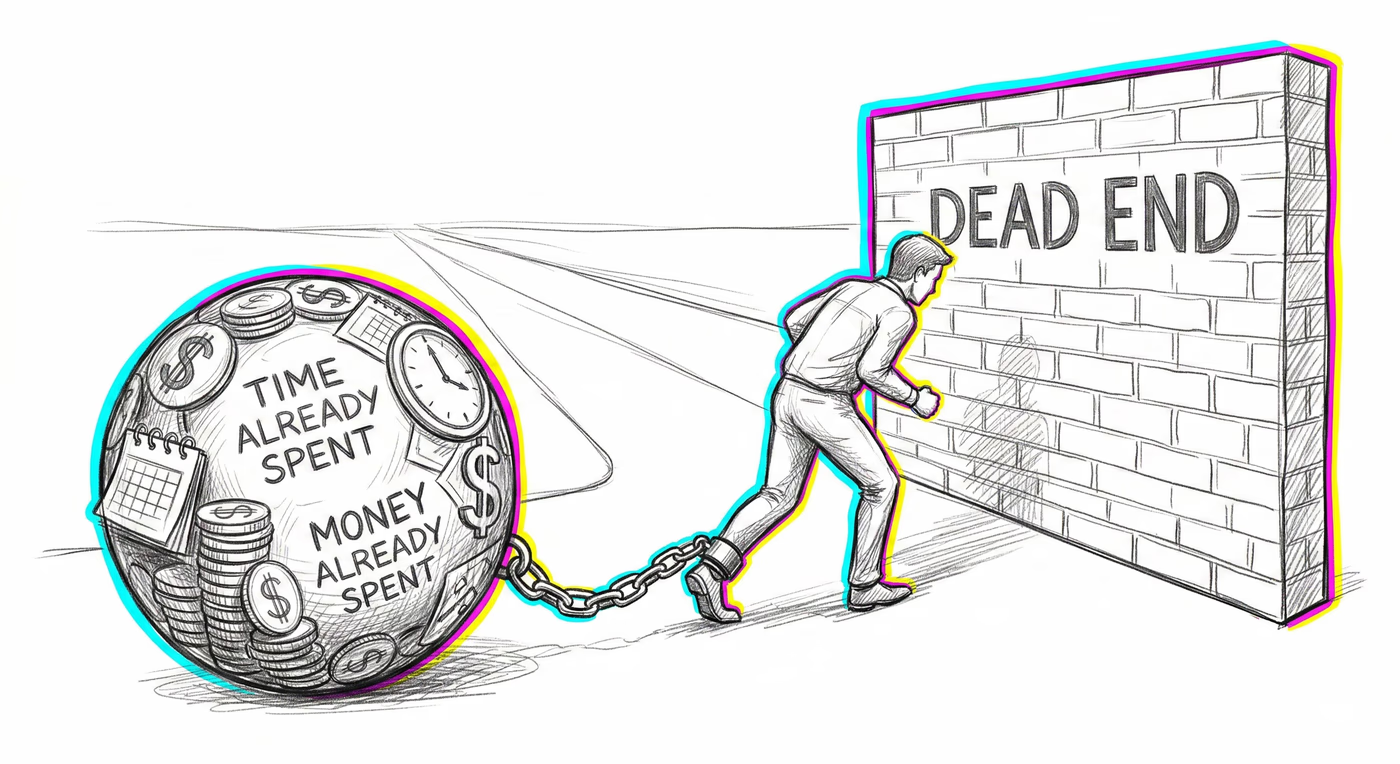
Continuing to invest in something because of what's already been spent, even when quitting would be the smarter move.

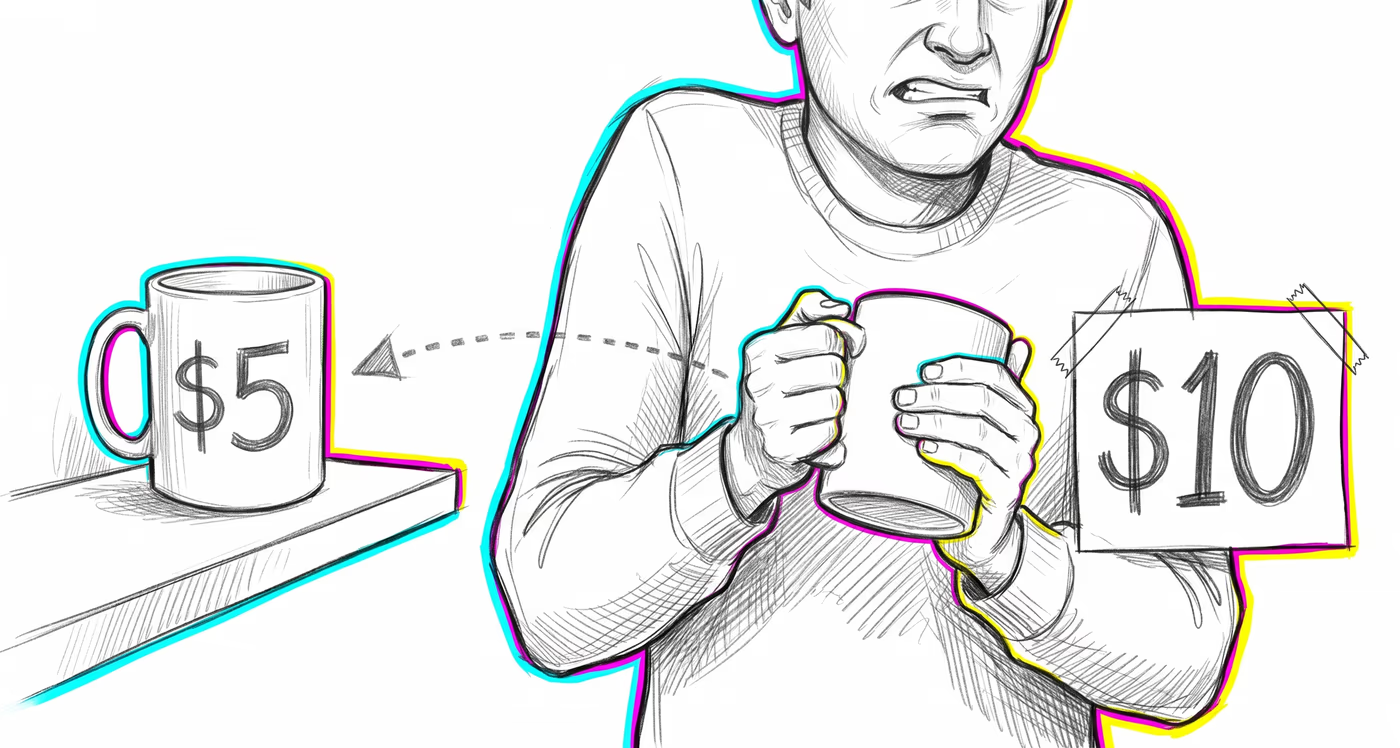
Illustration: Sunk Cost Fallacy
WHAT IT IS

The glitch, explained plainly.

Imagine you buy a big tub of ice cream, take a few bites, and realize you don't like the flavor at all. But instead of just throwing it away, you force yourself to eat the whole thing because you already paid for it — even though every spoonful makes you feel worse. That's the Sunk Cost Fallacy: doing something you don't want to do just because you already spent something on it, even when quitting would make you happier right now.

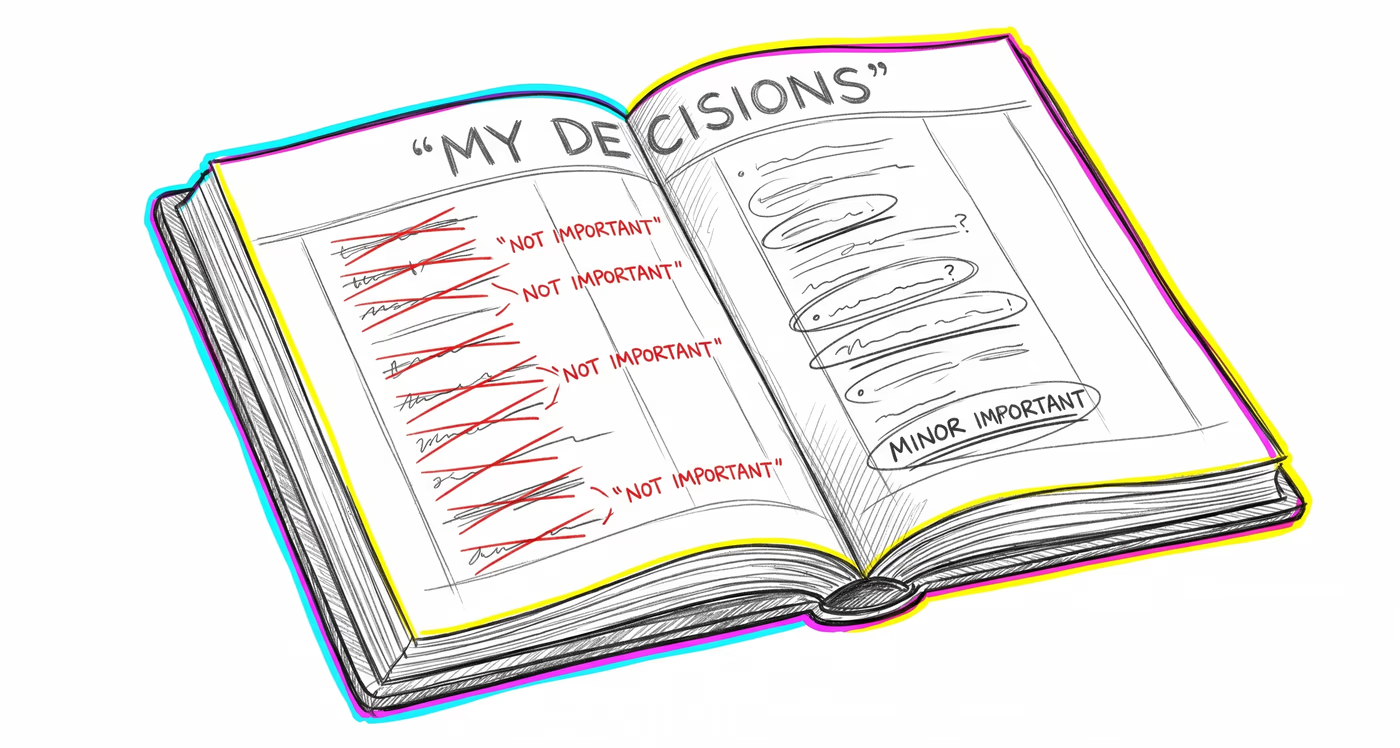
The Sunk Cost Fallacy describes a systematic pattern in which individuals escalate their commitment to a course of action precisely because they have already invested heavily in it, treating irrecoverable past expenditures as though they obligate future behavior. Rather than evaluating decisions purely on their prospective costs and benefits, people mentally 'carry forward' what they have already spent and feel compelled to justify those past outlays through continued investment. This creates a self-reinforcing cycle: each new investment increases the psychological pressure to continue, which in turn triggers more investment, even when objective evidence clearly indicates that stopping would minimize total losses. The bias is remarkably robust, affecting not only naive individuals but also highly trained professionals, sophisticated organizations, and even governments operating with full economic analysis at their disposal.

SOUND FAMILIAR?

Where it shows up.

  1. 01 A startup founder has spent $300,000 and two years developing a product. Market research now clearly shows that customers don't want it, and a pivot to a different product would be more profitable. She tells her advisor: 'We can't stop now — we've come too far and invested too much to just walk away from all of that work.'
  2. 02 A city council has spent $50 million on a new transit line that is now projected to cost triple its original budget and serve far fewer riders than estimated. When a council member proposes cancellation, the mayor argues: 'We've already poured $50 million of taxpayer money into this. Stopping now would mean all that money was for nothing.'
  3. 03 A software engineer has spent three months building a custom internal tool. A new off-the-shelf solution has just launched that does the same thing better and cheaper. When his manager suggests switching, the engineer insists on finishing his version first, reasoning that it would be wasteful to abandon months of coding effort even though integrating the purchased solution would save the team time going forward.
  4. 04 Maria has been in a graduate program for four years but has lost all passion for the field and has a strong job offer in an unrelated industry she loves. She turns down the offer, telling herself: 'I've already put four years into this degree — it would be foolish to leave now when I'm so close to finishing, even though I know I'll never use it.'
  5. 05 A venture capital firm has invested in three funding rounds for a company that continues to miss its targets. An independent analysis shows the company is unlikely to become profitable. At the board meeting, a partner argues for a fourth round of funding, noting that if they don't protect their existing investment, the prior rounds will have been 'a total loss' — even though a fresh analyst reviewing only the company's future prospects would never recommend the investment.
IN DIFFERENT DOMAINS

Where it shows up at work.

The same glitch looks different depending on the terrain. Finance, medicine, a relationship, a team — same mechanism, different costume.

Finance & investing

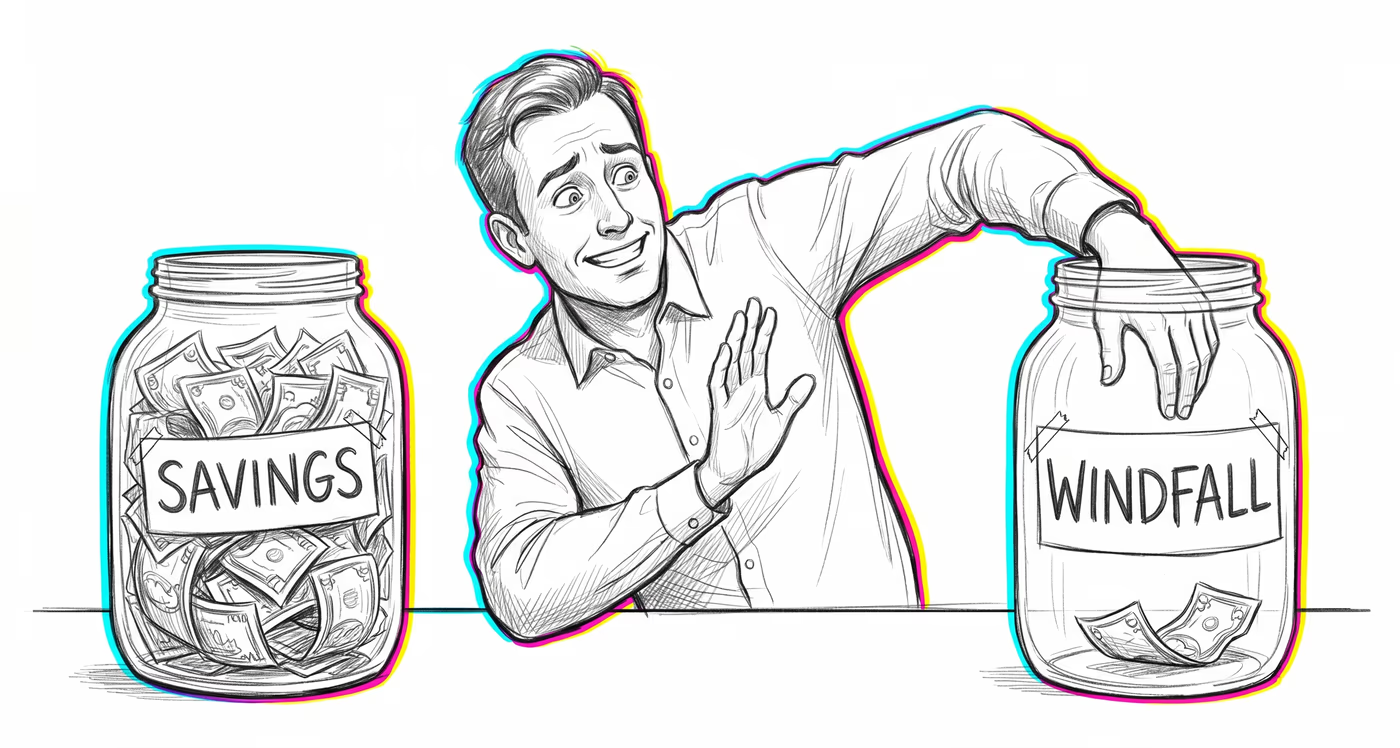
Investors hold onto declining stocks or failing positions far too long because selling would 'lock in' the loss, while continuing to hold preserves the psychological fiction that the original investment might still pay off. This manifests as the disposition effect, where investors sell winners too early and ride losers too long, directly eroding portfolio returns.
Medicine & diagnosis

Physicians may persist with a treatment plan that isn't producing results because significant time, cost, and patient suffering have already been invested in it, rather than switching to an alternative therapy. Patients similarly resist changing doctors or treatment approaches after extensive prior engagement, even when outcomes are poor.

Education & grading

Students continue pursuing majors or degree programs they've lost interest in because of the years and tuition already invested, rather than switching to a field that better fits their evolving goals. Institutions continue funding underperforming programs because of the historical investment in faculty, facilities, and curriculum development.

Relationships

People remain in unfulfilling or even harmful relationships because of the years, emotional energy, and shared experiences they've invested, treating the relationship's history as a reason to continue rather than evaluating its future potential independently.

Tech & product

Teams continue building on legacy codebases or outdated technology stacks because of the enormous development effort already invested, rather than migrating to superior platforms. Product managers resist killing features that consumed significant development resources but show poor user adoption metrics.

Workplace & hiring

Managers retain underperforming employees far longer than warranted because of the time and resources spent on hiring, onboarding, and training them. Organizations persist with failing strategic initiatives because of the reputational and political costs already invested in championing them.

Politics Media

Governments continue funding failing public projects and military operations because admitting failure would imply that prior expenditures of public money and, in wartime, lives were 'wasted.' Politicians frame continuation as honoring past sacrifice, making it politically toxic to advocate for rational withdrawal.

HOW TO SPOT IT

Ask yourself…

  • Am I continuing this primarily because of what I've already spent, or because the future benefits genuinely outweigh the future costs?
  • If I had NOT already invested anything, would I choose to start this project/relationship/investment today given what I now know?
  • Am I framing quitting as 'wasting' my past investment, rather than as 'saving' my future resources?
HOW TO DEFEND AGAINST IT

The playbook.

  • Apply the 'Fresh Eyes' test: Ask yourself, 'If a brand-new person stepped into my position today with zero history, would they choose to continue this?' If not, that's your signal.
  • Set 'kill criteria' in advance: Before starting any major investment, define specific, measurable conditions under which you will walk away, and commit to honoring them.
  • Reframe quitting as saving: Instead of thinking 'I'm wasting what I spent,' think 'I'm saving everything I would spend from this point forward.'
  • Separate the decision-maker from the original investor: Have someone with no emotional stake in the prior investment evaluate the go/no-go decision on future merits alone.
  • Practice regular 'zero-based' reviews: Periodically evaluate all ongoing commitments as if you were deciding to start them from scratch today, ignoring all historical costs.
FAMOUS CASES

In history.

  • The Concorde supersonic jet program: British and French governments continued funding for decades despite clear evidence of commercial unviability, ultimately spending over $2.8 billion before the first flight and continuing operations for 27 more years.
  • The Vietnam War: U.S. policymakers repeatedly cited prior sacrifices of soldiers' lives and billions in spending as justification for continued military engagement, even as evidence mounted that the strategic objectives were unattainable.
  • The Tennessee-Tombigbee Waterway Project: U.S. Congress continued funding despite massive cost overruns, with senators explicitly arguing that termination would 'waste' the funds already invested.
  • Blockbuster's rejection of Netflix: After investing heavily in physical retail infrastructure, Blockbuster dismissed a $50 million acquisition offer from Netflix and continued investing in its existing model as competition from streaming intensified.
  • U.S. nuclear power plant construction: Throughout the 1970s-80s, utility companies continued pouring money into economically unviable nuclear construction projects, with public commissions later finding patterns consistent with sunk cost reasoning.
WHERE IT COMES FROM
Academic origin

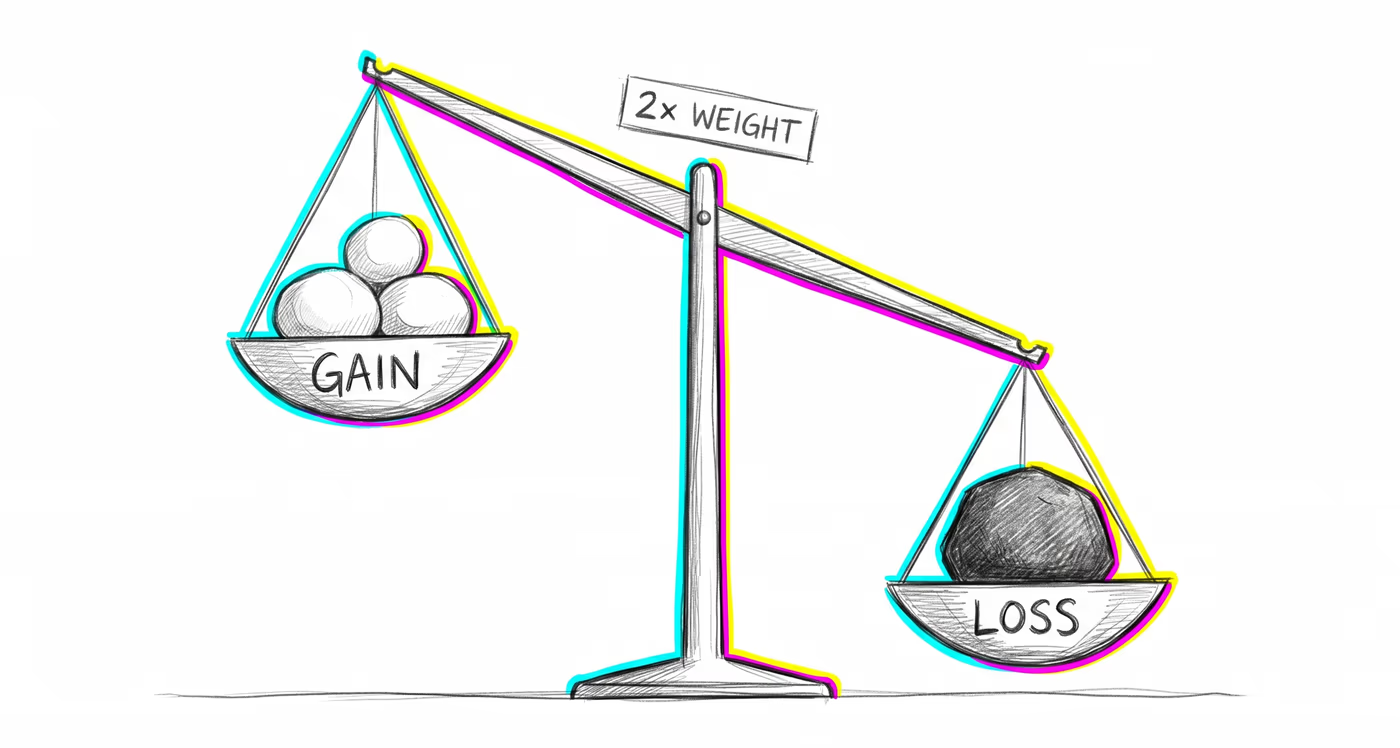
Formalized by Hal R. Arkes and Catherine Blumer in their 1985 paper 'The Psychology of Sunk Cost' published in Organizational Behavior and Human Decision Processes. Earlier conceptual groundwork was laid by Richard Thaler (1980) on mental accounting, Barry Staw (1976) on escalation of commitment, and Kahneman & Tversky (1979) on prospect theory and loss aversion. The term 'Concorde Fallacy' was introduced by Richard Dawkins and Tamsin Carlisle in a 1976 Animal Behaviour article.

Evolutionary origin

In ancestral environments, persistence with a partially completed goal — finishing a hunt, completing a shelter, or seeing a seasonal food-gathering expedition through — was usually the optimal strategy because abandoning mid-effort genuinely wasted scarce resources with no alternative uses. The 'don't waste' instinct promoted goal persistence that enhanced survival when options were few and switching costs were genuinely high.

IN AI SYSTEMS

How the machines inherit it.

In deep reinforcement learning, agents exhibit sunk cost-like behavior by persisting with suboptimal episode trajectories to completion rather than terminating early, 'polluting' replay buffers with uninformative data and wasting compute. More broadly, organizations exhibit sunk cost reasoning toward AI systems themselves — continuing to invest in underperforming ML pipelines, outdated model architectures, or poorly designed training datasets because of the resources already spent building them, rather than starting fresh with better approaches. LLMs trained on human-generated text can also reproduce sunk cost reasoning patterns in their outputs when advising on decisions.

Read more on Wikipedia
FREE FIELD ZINE

10 glitches quietly running your life.

A free field-zine PDF — ten cognitive glitches named, illustrated, with a defense move for each. Plus the weekly Glitch Report on Fridays — one bias named, two spotted in the wild, one defense move. Unsubscribe any time.

EXPLORE MORE

Related glitches.

LAUNCH PRICE

Train against your blindspots.

50 cards are free to preview. Buyers unlock the rest of the deck plus the interactive training — Spot-the-Bias Quiz unlimited, Swipe Deck with spaced repetition, My Blindspots, Decision Pre-Flight, the Printable Deck + Cheat Sheets, and the Field Guide e-book. $29.50$59.

Unlock the full deck

Everything below — yours forever. Pay once, use across every device.

Half-off launch — limited to the first 100 readers. Auto-applied at checkout.
$59 $29.50
one-time payment · lifetime access
  • All interactive digital cards — search, filter, flip, shuffle on any device
  • Five training modes — Spot-the-Bias Quiz, Swipe Deck, Pre-Flight, Blindspots, Journal
  • Curated Lenses + Decision Templates + Defense Playbook
  • Printable Deck PDFs + Field Guide e-book + Cheat Sheets + Anki Export
  • Every future improvement, included
Unlock  $29.50

30-day refund · no questions asked

Unlock the full deck

Everything below — yours forever. Pay once, use across every device.

Half-off launch — limited to the first 100 readers. Auto-applied at checkout.
$59 $29.50
one-time payment · lifetime access
  • All interactive digital cards — search, filter, flip, shuffle on any device
  • Five training modes — Spot-the-Bias Quiz, Swipe Deck, Pre-Flight, Blindspots, Journal
  • Curated Lenses + Decision Templates + Defense Playbook
  • Printable Deck PDFs + Field Guide e-book + Cheat Sheets + Anki Export
  • Every future improvement, included
Unlock  $29.50

30-day refund · no questions asked