IKEA Effect

aka Labor-Love Effect · DIY Valuation Bias · Effort-Valuation Effect

Placing disproportionately high value on things you partially created or assembled, regardless of their quality.

WHAT IT IS

The glitch, explained plainly.

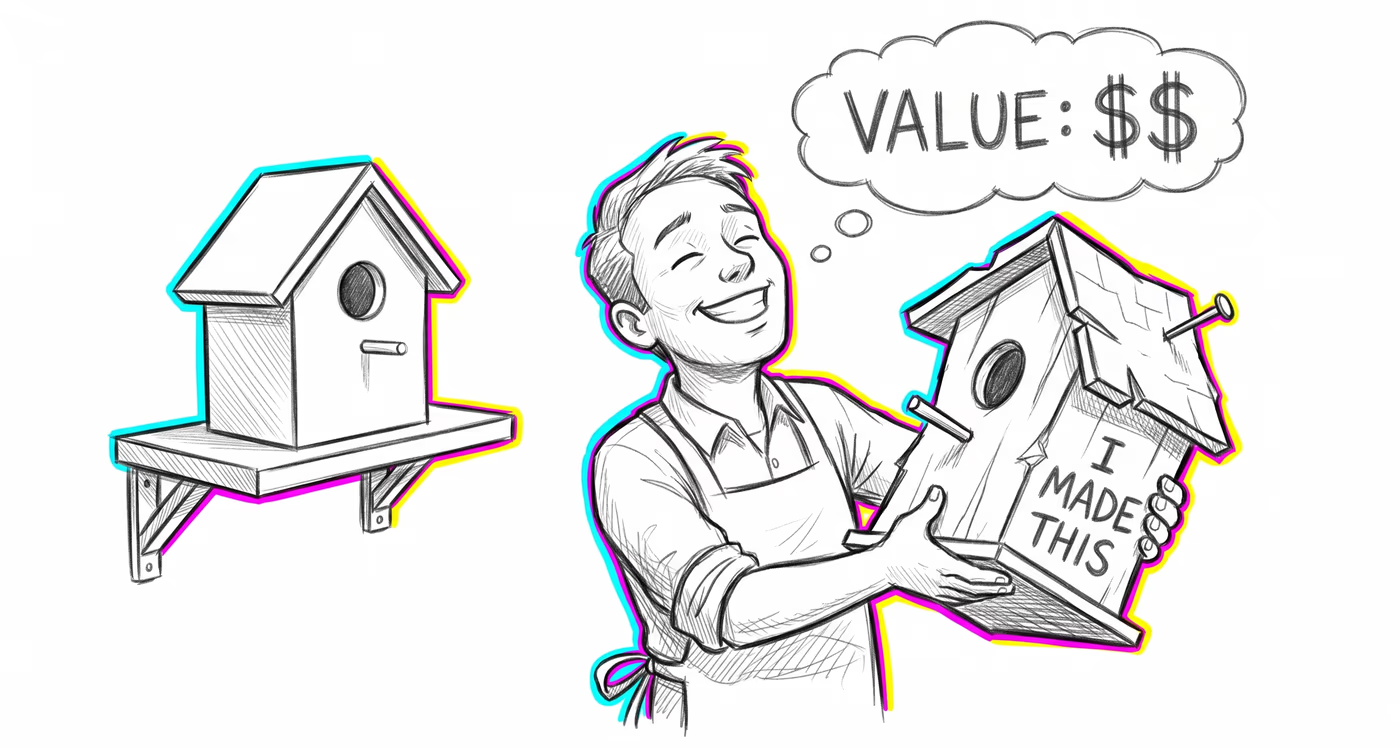
Imagine you draw a picture. It's kind of wobbly and the colors are messy, but you LOVE it because YOU made it. Your friend draws a much prettier picture, but you still like yours better. That's because your brain thinks: 'I worked hard on this, so it must be really special.'

The IKEA Effect describes how investing personal labor into the creation or assembly of a product systematically inflates its perceived value in the creator's eyes, often to a degree that rivals or exceeds the valuation of objectively superior, professionally made alternatives. This bias extends well beyond furniture assembly to cooking, crafting, software development, and any domain where personal effort produces a tangible output. Critically, the effect depends on successful completion—if the task is abandoned or the product destroyed before finishing, the inflated valuation dissipates. The bias operates even when the labor follows preset instructions with zero customization, suggesting that the mere act of building, not personalization, drives the overvaluation.

SOUND FAMILIAR?

Where it shows up.

  1. 01 Priya spent three weekends building a custom standing desk from raw lumber. When her partner points out that a commercially available desk has better ergonomics and costs less, Priya insists her desk is worth more because she selected every plank and sanded it herself. She prices it at $800 on a resale listing—double what the commercial desk costs.
  2. 02 A startup CTO built the company's internal analytics dashboard from scratch over six months. A vendor now offers a far more powerful tool at a reasonable subscription cost. During the evaluation meeting, the CTO consistently highlights minor flaws in the vendor product while overlooking major gaps in the internal tool, ultimately recommending that the team continue investing in 'their' dashboard.
  3. 03 A teacher designs a semester-long curriculum from scratch instead of adopting a peer-reviewed, evidence-based curriculum freely available online. When student test scores come in lower than the district average, the teacher attributes the results to student effort rather than questioning the self-designed curriculum's quality, and begins planning an even more elaborate version for next year.
  4. 04 Marcus mixes his own protein powder blend from individual supplements he orders online. Objective taste tests by his gym friends consistently rank a popular commercial brand higher, and a nutritionist confirms the commercial blend has a better amino acid profile. Marcus still insists his blend is superior because he 'knows exactly what's in it and put it together himself.'
  5. 05 A policy think tank spent two years developing a proprietary economic model. When an independent review shows that a widely-used open-source model produces more accurate forecasts, the team argues that their model captures 'nuances that outsiders can't appreciate' and lobbies leadership to keep funding it rather than switching.
IN DIFFERENT DOMAINS

Where it shows up at work.

The same glitch looks different depending on the terrain. Finance, medicine, a relationship, a team — same mechanism, different costume.

Finance & investing

Investors who build their own stock-picking models or manually assembled portfolios tend to overestimate their returns and resist switching to passively managed index funds with demonstrably better performance, because the labor of research and selection inflates perceived portfolio quality.
Medicine & diagnosis

Clinicians who develop their own treatment protocols or diagnostic checklists may overvalue them relative to evidence-based standardized guidelines, resisting adoption of superior external protocols because personal effort inflates confidence in the homegrown approach.

Education & grading

Teachers who create their own lesson plans and materials from scratch tend to rate them as more effective than commercially published, peer-reviewed curricula—even when student outcomes suggest otherwise—because the labor of creation biases self-assessment.

Relationships

People who invest significant effort in planning dates, decorating shared spaces, or handmaking gifts tend to overestimate how much their partner values those contributions, leading to disappointment when the partner's reaction doesn't match the creator's inflated sense of the effort's worth.

Tech & product

Product teams that build internal tools or custom features from scratch resist adopting superior third-party solutions. UX designers who prototype their own flows overvalue them relative to data-driven alternatives. Companies also leverage the IKEA Effect by letting users customize products (avatars, dashboards, configurations), increasing perceived value and retention.

Workplace & hiring

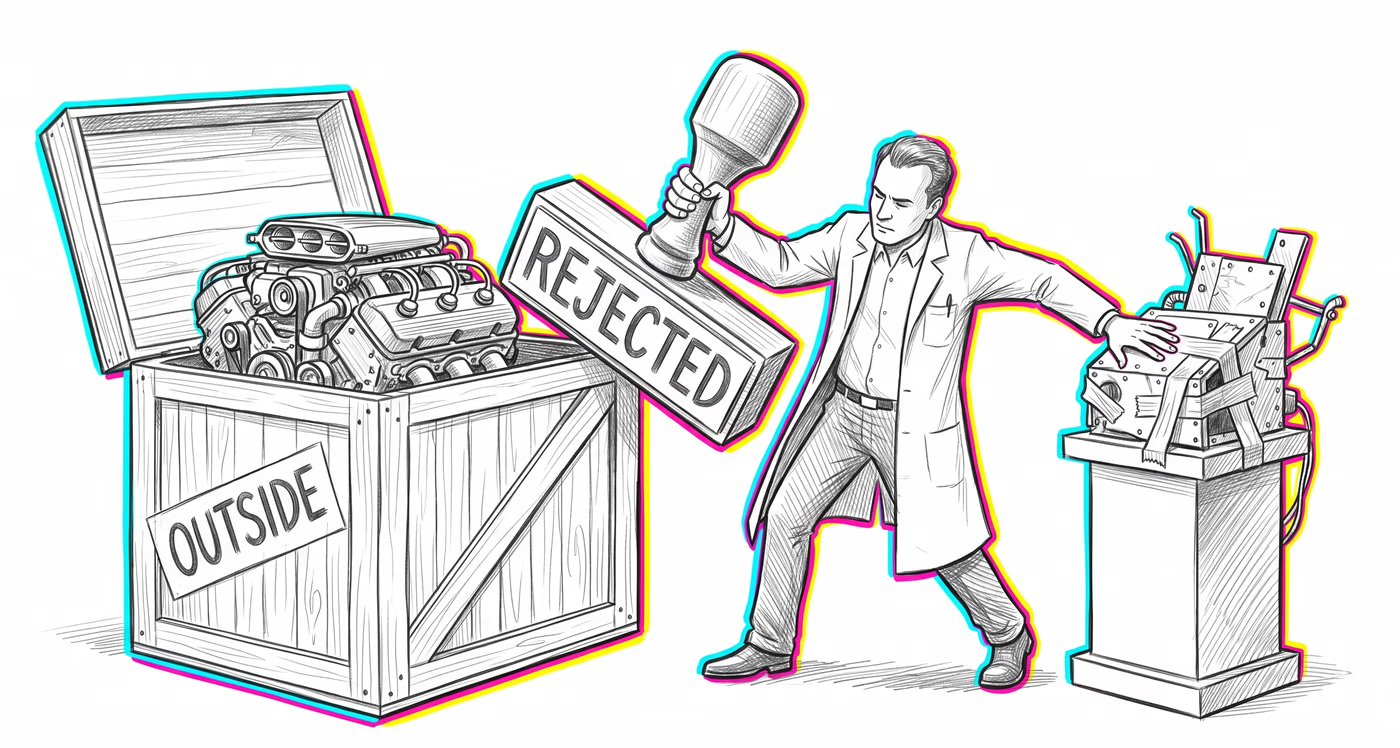
Teams that develop internal processes, frameworks, or tools from the ground up disproportionately defend them against external replacements. This manifests as 'Not Invented Here' syndrome, where organizations reject objectively better external solutions because internally built ones feel more valuable to those who created them.

Politics Media

Grassroots political campaigns where volunteers invest personal labor in canvassing, phone banking, and organizing tend to produce supporters who overvalue the campaign's platform and resist acknowledging weaknesses, because their personal effort investment inflates their perception of the cause's merit.

HOW TO SPOT IT

Ask yourself…

  • Am I defending this because it's genuinely better, or because I made it?
  • If someone else had built this exact thing, would I still value it this highly?
  • Would I recommend my own creation to a stranger with no knowledge of who built it?
HOW TO DEFEND AGAINST IT

The playbook.

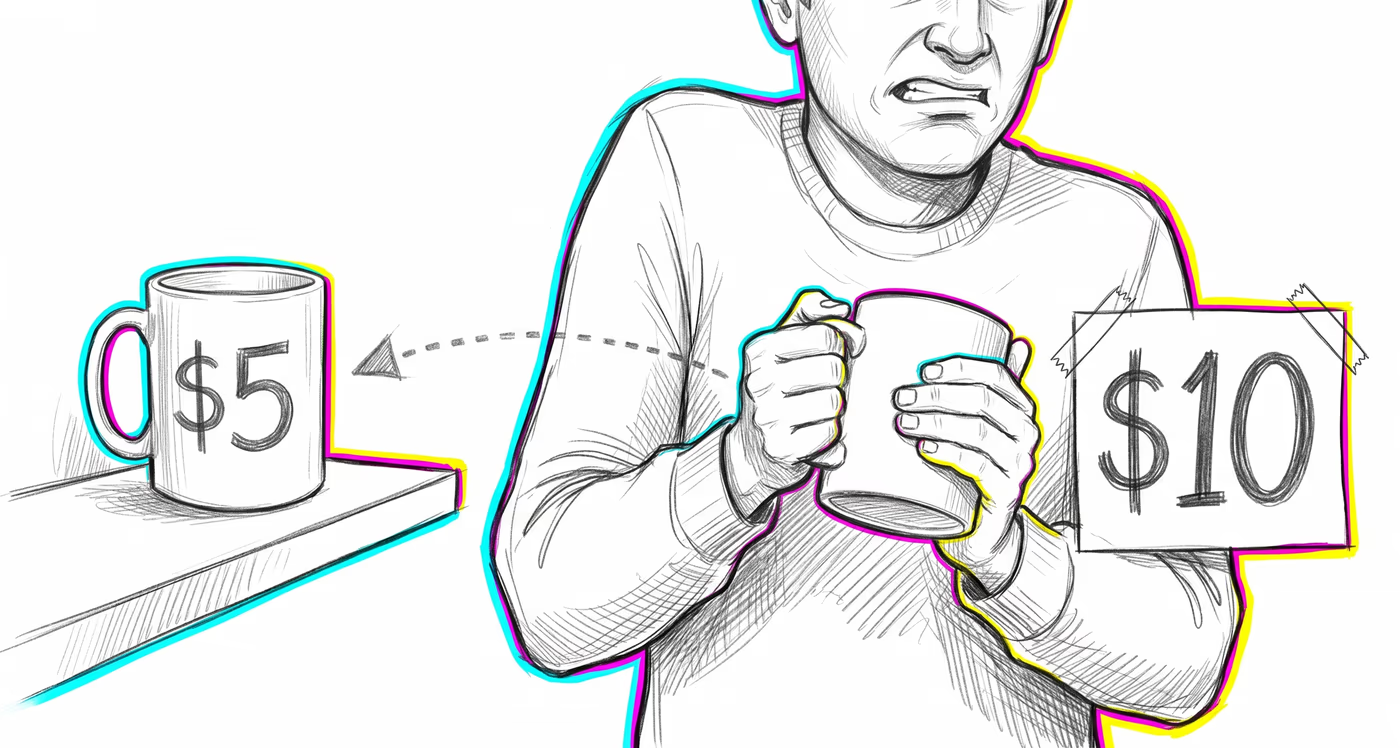
  • Before evaluating something you built, ask: 'What would a neutral buyer pay for this at a garage sale?'—this reframes valuation from the creator's perspective to the market's.
  • Seek blind feedback: present your creation alongside alternatives without revealing which one is yours, and let others evaluate them on objective criteria.
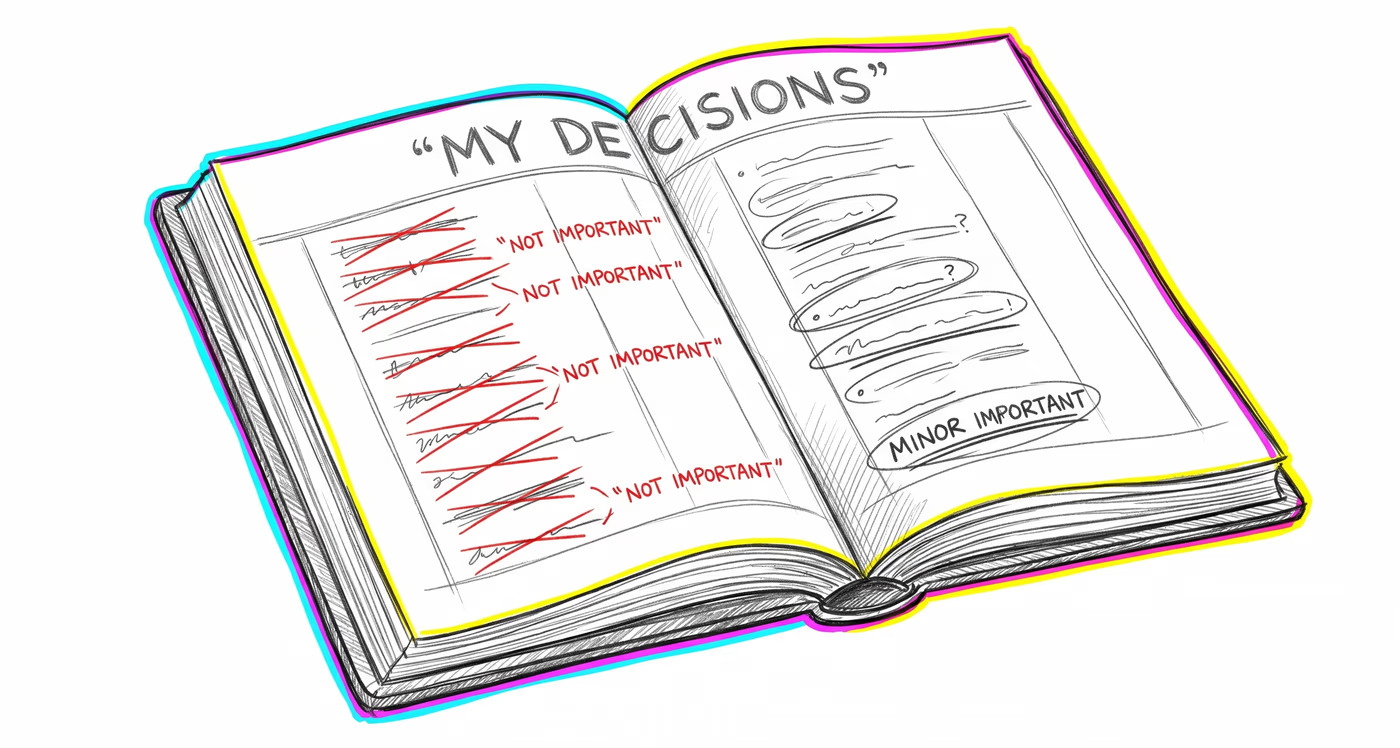
  • Apply the 'Kill Your Darlings' rule from writing: periodically force yourself to justify each self-made component as if you were choosing it fresh today, with no prior investment.
  • Assign a 'devil's advocate' role on teams to specifically challenge internally built solutions and present the best case for external alternatives.
  • Set pre-commitment criteria before starting a project: define objective quality benchmarks that will determine whether to keep or replace the output, regardless of effort invested.
FAMOUS CASES

In history.

  • A widely cited but historically disputed story from the 1950s claims that instant cake mixes initially underperformed because they were too easy, and that requiring bakers to add a fresh egg boosted sales by creating a sense of ownership. While commonly used to illustrate the IKEA Effect, food historians note the reformulation was primarily driven by product quality improvements.
  • Build-A-Bear Workshop built a billion-dollar business model on the IKEA Effect, charging premium prices for teddy bears that customers assemble themselves—bears that cost the company less to produce precisely because consumers provide the labor.
WHERE IT COMES FROM
Academic origin

Formally named and studied by Michael I. Norton (Harvard Business School), Daniel Mochon (Yale/Tulane University), and Dan Ariely (Duke University) in a 2011 working paper, published in the Journal of Consumer Psychology in 2012.

Evolutionary origin

In ancestral environments, investing physical effort to craft tools, build shelters, or prepare food had direct survival implications. Individuals who felt attached to and protective of items they labored to create were more likely to maintain, defend, and reuse those resources rather than abandon them—conferring a survival advantage. This effort-reward linkage also reinforced persistent task completion, which was adaptive for long-term projects like constructing shelters or curing food.

IN AI SYSTEMS

How the machines inherit it.

AI systems trained on user-generated content may inherit the inflated valuations that creators assign to their own work, skewing recommendation algorithms or quality ratings. In human-AI collaboration, users who contribute even minimal input to an AI-generated output (such as editing a prompt or tweaking generated text) may overvalue the final result and resist further AI-driven improvements. Additionally, developers who build custom ML models may resist adopting superior pre-trained models due to effort invested in their homegrown approach.

Read more on Wikipedia
FREE FIELD ZINE

10 glitches quietly running your life.

A free field-zine PDF — ten cognitive glitches named, illustrated, with a defense move for each. Plus the weekly Glitch Report on Fridays — one bias named, two spotted in the wild, one defense move. Unsubscribe any time.

EXPLORE MORE

Related glitches.

LAUNCH PRICE

Train against your blindspots.

50 cards are free to preview. Buyers unlock the rest of the deck plus the interactive training — Spot-the-Bias Quiz unlimited, Swipe Deck with spaced repetition, My Blindspots, Decision Pre-Flight, the Printable Deck + Cheat Sheets, and the Field Guide e-book. $29.50$59.

Unlock the full deck

Everything below — yours forever. Pay once, use across every device.

Half-off launch — limited to the first 100 readers. Auto-applied at checkout.
$59 $29.50
one-time payment · lifetime access
  • All interactive digital cards — search, filter, flip, shuffle on any device
  • Five training modes — Spot-the-Bias Quiz, Swipe Deck, Pre-Flight, Blindspots, Journal
  • Curated Lenses + Decision Templates + Defense Playbook
  • Printable Deck PDFs + Field Guide e-book + Cheat Sheets + Anki Export
  • Every future improvement, included
Unlock  $29.50

30-day refund · no questions asked

Unlock the full deck

Everything below — yours forever. Pay once, use across every device.

Half-off launch — limited to the first 100 readers. Auto-applied at checkout.
$59 $29.50
one-time payment · lifetime access
  • All interactive digital cards — search, filter, flip, shuffle on any device
  • Five training modes — Spot-the-Bias Quiz, Swipe Deck, Pre-Flight, Blindspots, Journal
  • Curated Lenses + Decision Templates + Defense Playbook
  • Printable Deck PDFs + Field Guide e-book + Cheat Sheets + Anki Export
  • Every future improvement, included
Unlock  $29.50

30-day refund · no questions asked