Compromise Effect

aka Extremeness Aversion · Middle Option Bias

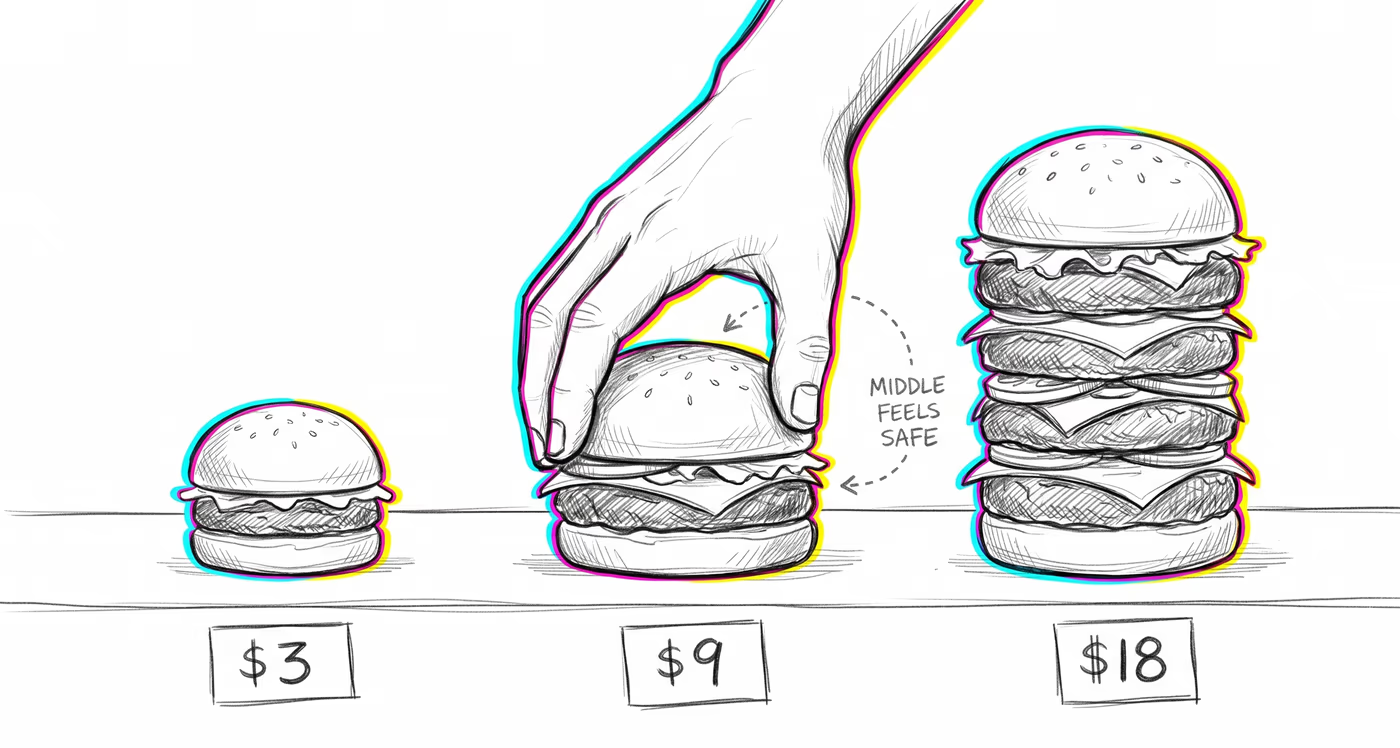
The tendency for people to disproportionately prefer the middle option in a choice set, avoiding alternatives positioned at the extremes on key attributes.

Illustration: Compromise Effect
WHAT IT IS

The glitch, explained plainly.

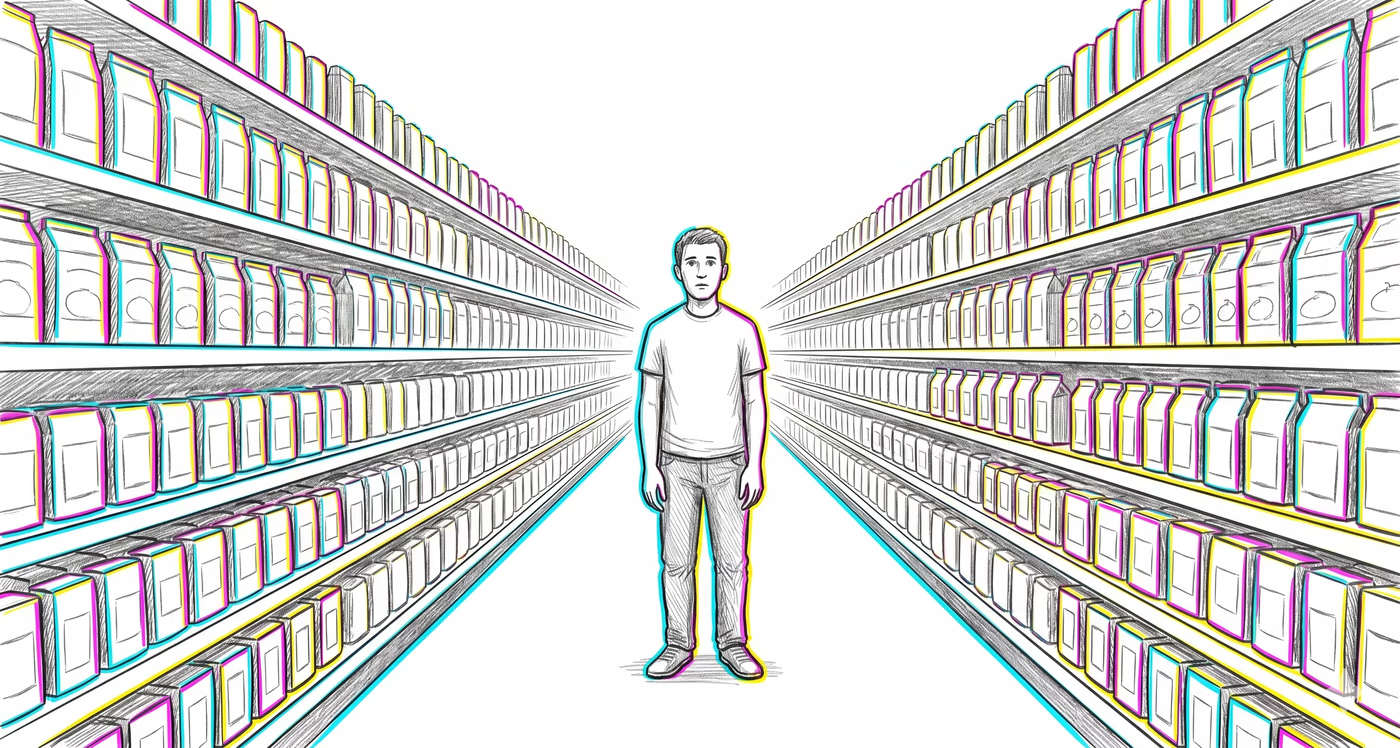
Imagine you're at a toy store and you see a tiny toy, a medium toy, and a huge toy. The tiny one seems too boring and the huge one seems like too much, so you pick the medium one—not because you actually like it best, but because it feels safest in the middle. That's what grown-ups do too when they pick the medium-priced phone or the medium-sized coffee.

The compromise effect occurs when an option gains disproportionate market share simply because it sits between two more extreme alternatives on relevant attributes such as price and quality. Unlike a true preference shift based on new information, this change arises purely from the relational structure of the choice set—add or remove an extreme option and the share of the middle option fluctuates accordingly. The effect is amplified when decision-makers anticipate needing to justify their choice to others, as the middle option provides a ready-made rationale that is difficult to criticize. It represents a fundamental violation of the classical economic principle of independence of irrelevant alternatives, revealing that preferences are often constructed on the fly rather than pre-existing.

SOUND FAMILIAR?

Where it shows up.

  1. 01 A SaaS company offers three pricing tiers: Basic at $9/month, Professional at $29/month, and Enterprise at $99/month. After adding the Enterprise tier—which few customers actually need—sign-ups for Professional jump by 30%, even though its features haven't changed at all.
  2. 02 Priya is buying a blender and sees three models: one at $40 with 3 speeds, one at $80 with 6 speeds, and one at $150 with 10 speeds and a food processor attachment. She picks the $80 blender, telling herself it's 'the smart choice,' even though she only ever makes smoothies and the cheapest model would have been sufficient.
  3. 03 A real estate agent shows a couple three houses: a cramped starter home, a sprawling mansion way above budget, and a mid-sized colonial that the agent actually wants to sell. The couple gravitates toward the colonial, feeling it represents the reasonable middle ground, without realizing the other two viewings were strategically chosen to frame it that way.
  4. 04 During salary negotiations, a hiring manager presents three compensation packages: one heavy on base salary but with no equity, one with minimal salary but large equity, and a balanced package in between. The candidate selects the balanced package, reasoning it is the most 'sensible,' even though her financial situation and risk tolerance would have made the high-equity package significantly more valuable.
  5. 05 A consultant preparing a proposal for a client creates three options: a bare-bones audit, a comprehensive transformation program, and a mid-scope engagement. She knows the mid-scope option has the highest margins and structures the other two specifically so the mid-scope looks like the natural, defensible choice. The client's procurement committee selects it, citing its balance of thoroughness and cost-efficiency.
IN DIFFERENT DOMAINS

Where it shows up at work.

The same glitch looks different depending on the terrain. Finance, medicine, a relationship, a team — same mechanism, different costume.

Finance & investing

Investors selecting from fund options gravitate toward moderately aggressive portfolios when presented alongside both conservative and high-risk alternatives, often regardless of whether the moderate option aligns with their actual risk tolerance or time horizon.
Medicine & diagnosis

When physicians present treatment options framed as a spectrum—watchful waiting, moderate intervention, and aggressive surgery—patients disproportionately choose the moderate intervention, even when clinical evidence may more strongly support one of the extremes for their specific condition.

Education & grading

Students choosing course loads tend to select a moderate number of credits when shown minimum, recommended, and maximum options, even when their academic goals and capacity would benefit from a different load.

Relationships

When mediating between two positions in a conflict, people tend to gravitate toward a midpoint split rather than evaluating which position has more merit, treating 'meeting in the middle' as inherently fair.

Tech & product

Product teams strategically design three-tier pricing or feature sets so that the target tier sits in the middle, knowing that users will disproportionately select it as the 'safe' option—a deliberate application of choice architecture.

Workplace & hiring

In hiring, when a committee reviews three candidates framed as underqualified, well-qualified, and overqualified, they consistently favor the middle candidate even when the 'overqualified' candidate might bring greater long-term value.

Politics Media

Media framing of policy debates as having an extreme left position, an extreme right position, and a centrist compromise leads audiences to view the middle option as inherently more reasonable, regardless of the actual evidence supporting each position.

HOW TO SPOT IT

Ask yourself…

  • Am I choosing this option primarily because it sits between two extremes, or because it genuinely best meets my needs?
  • If the most expensive or cheapest option were removed from this set, would I still pick the same thing?
  • Am I gravitating toward the middle because it feels easiest to justify, rather than because I've evaluated each option on its own merits?
HOW TO DEFEND AGAINST IT

The playbook.

  • Evaluate each option independently before comparing them: write down what you need and score each option against those criteria in isolation.
  • Mentally remove the most extreme option from the set and ask whether your preference changes—if it does, your choice was driven by context, not value.
  • Define your requirements and budget before seeing the options, so your decision criteria exist before the choice set frames your thinking.
  • Ask: 'Would I still choose this if it were the most expensive option in a different set?' to test whether your preference is intrinsic or relational.
  • When shopping, research one option at a time rather than viewing them side by side in a curated three-tier presentation.
FAMOUS CASES

In history.

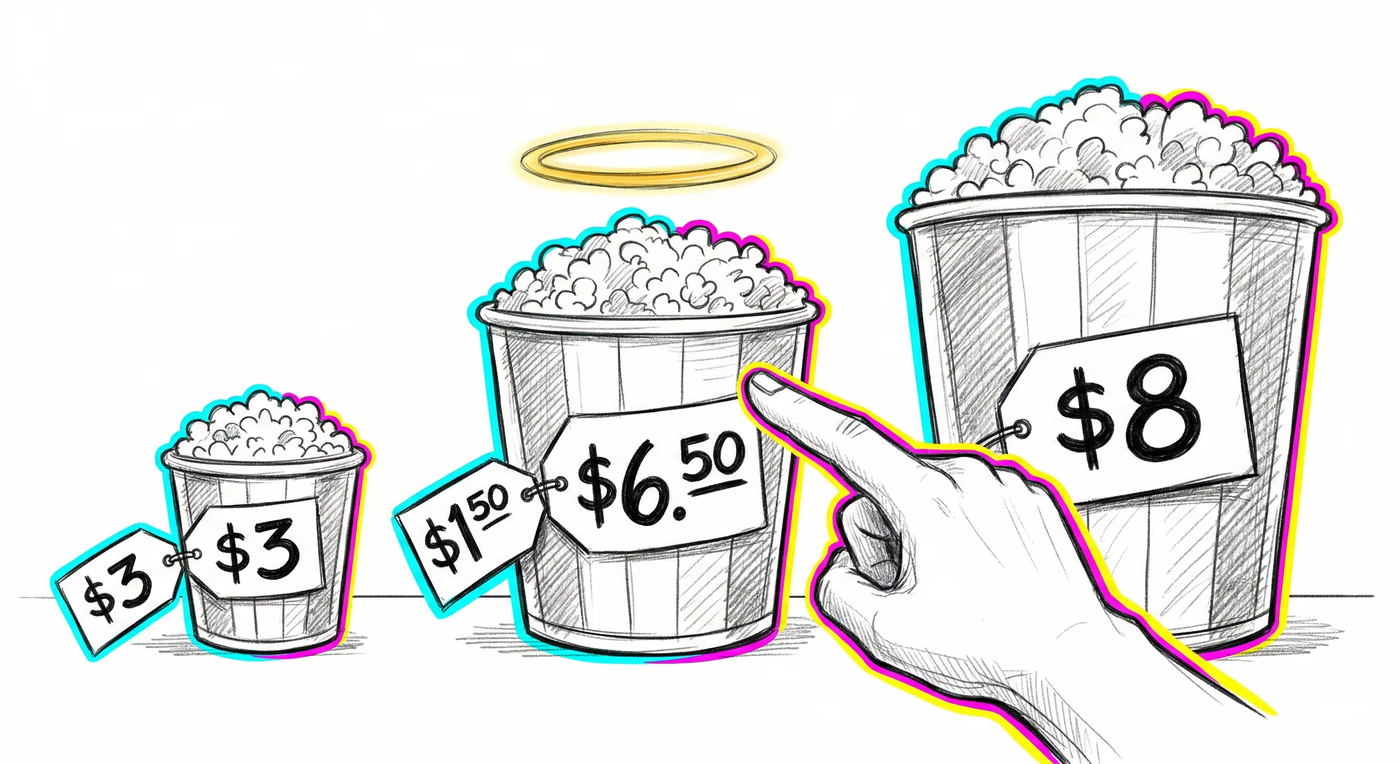
  • Williams-Sonoma reportedly doubled sales of a $275 bread maker after introducing a $429 premium model, which made the original look like the sensible middle option—a widely cited marketing case illustrating the compromise effect.
  • The Economist magazine's famous subscription pricing (web-only, print-only, print+web) was analyzed as a real-world example of how a seemingly dominated option can reshape preference toward a target 'compromise' tier.
WHERE IT COMES FROM
Academic origin

Itamar Simonson first formally identified and named the compromise effect in 1989. Simonson and Amos Tversky further developed the theoretical framework of extremeness aversion in 1992.

Evolutionary origin

In ancestral environments, extreme foraging or territorial strategies carried high variance in outcomes—an extreme gamble on a distant food source could mean starvation, while an overly conservative strategy could mean missed opportunities. Gravitating toward intermediate, moderate options reduced catastrophic risk and provided more stable expected returns, favoring survival in unpredictable environments.

IN AI SYSTEMS

How the machines inherit it.

Recommendation algorithms that present three-tiered options (e.g., product bundles, subscription plans) can inadvertently or deliberately exploit the compromise effect by structuring choice sets so that the highest-margin option occupies the middle position. Additionally, AI-generated product comparisons may frame alternatives in ways that make a preferred option appear as the natural compromise, amplifying this bias in automated decision-support systems.

FREE FIELD ZINE

10 glitches quietly running your life.

A free field-zine PDF — ten cognitive glitches named, illustrated, with a defense move for each. Plus the weekly Glitch Report on Fridays — one bias named, two spotted in the wild, one defense move. Unsubscribe any time.

EXPLORE MORE

Related glitches.

LAUNCH PRICE

Train against your blindspots.

50 cards are free to preview. Buyers unlock the rest of the deck plus the interactive training — Spot-the-Bias Quiz unlimited, Swipe Deck with spaced repetition, My Blindspots, Decision Pre-Flight, the Printable Deck + Cheat Sheets, and the Field Guide e-book. $29.50$59.

Unlock the full deck

Everything below — yours forever. Pay once, use across every device.

Half-off launch — limited to the first 100 readers. Auto-applied at checkout.
$59 $29.50
one-time payment · lifetime access
  • All interactive digital cards — search, filter, flip, shuffle on any device
  • Five training modes — Spot-the-Bias Quiz, Swipe Deck, Pre-Flight, Blindspots, Journal
  • Curated Lenses + Decision Templates + Defense Playbook
  • Printable Deck PDFs + Field Guide e-book + Cheat Sheets + Anki Export
  • Every future improvement, included
Unlock  $29.50

30-day refund · no questions asked

Unlock the full deck

Everything below — yours forever. Pay once, use across every device.

Half-off launch — limited to the first 100 readers. Auto-applied at checkout.
$59 $29.50
one-time payment · lifetime access
  • All interactive digital cards — search, filter, flip, shuffle on any device
  • Five training modes — Spot-the-Bias Quiz, Swipe Deck, Pre-Flight, Blindspots, Journal
  • Curated Lenses + Decision Templates + Defense Playbook
  • Printable Deck PDFs + Field Guide e-book + Cheat Sheets + Anki Export
  • Every future improvement, included
Unlock  $29.50

30-day refund · no questions asked