Decoy Effect

aka Asymmetric Dominance Effect · Attraction Effect

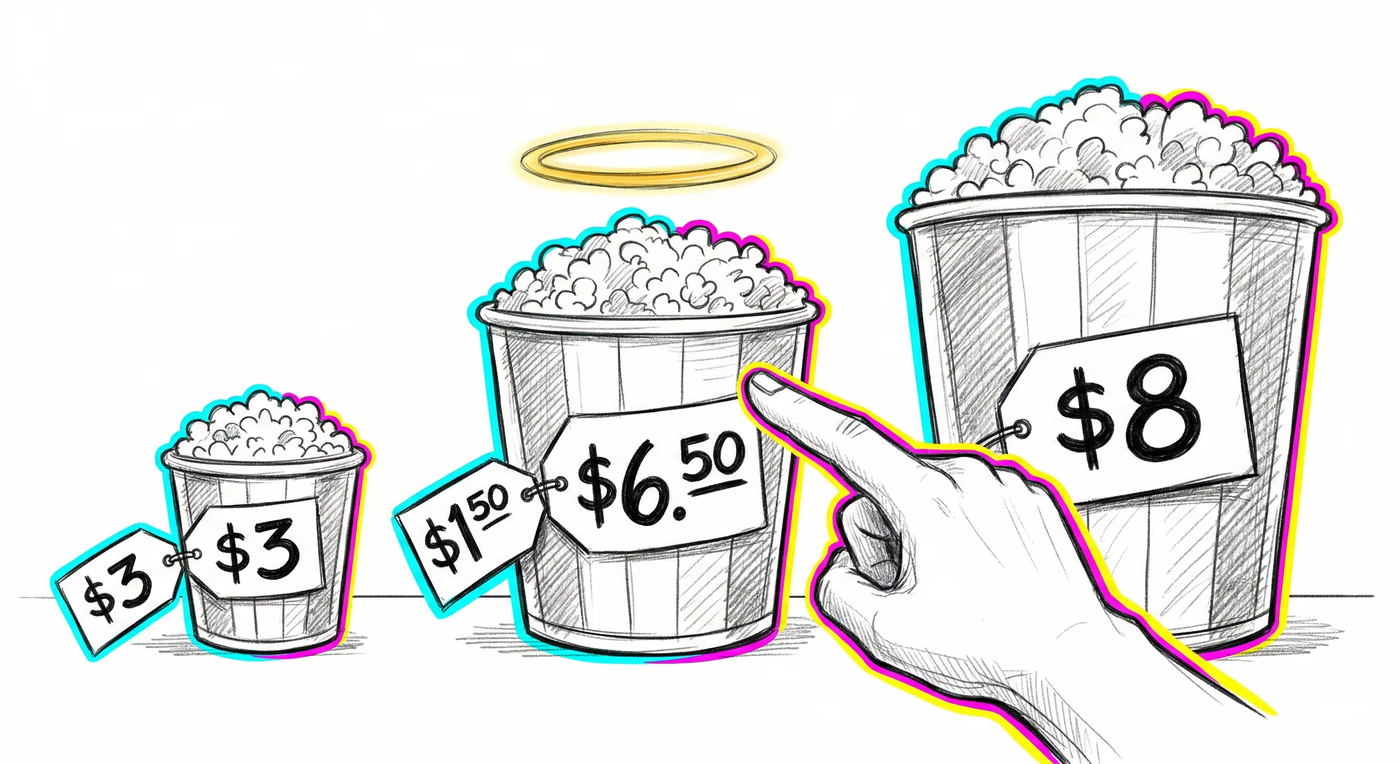
Preferences between two options shifting when a third, clearly inferior option is introduced alongside them.

Illustration: Decoy Effect
WHAT IT IS

The glitch, explained plainly.

Imagine you're at an ice cream shop choosing between a small cone for $2 and a big sundae for $6. You're not sure which one you want. Then you notice a medium cone for $5.50. Nobody would buy the medium because for just 50 cents more you get a whole sundae. But suddenly the sundae looks like an amazing deal, and you pick it — even though before, you were leaning toward the small cone.

The decoy effect occurs when a third option, designed to be clearly inferior to one existing choice (the 'target') but only partially inferior to another (the 'competitor'), is added to a decision set. This asymmetrically dominated option is not meant to be selected; its sole purpose is to make the target appear more attractive by providing an easy point of comparison. The effect violates a foundational principle of rational choice theory known as 'regularity,' which states that adding a new option to a set should never increase the market share of an existing option. It is particularly potent when individuals are initially indifferent between the two original alternatives and when the attributes being compared are roughly equal in importance to the decision-maker.

SOUND FAMILIAR?

Where it shows up.

  1. 01 A software company offers two plans: Basic at $10/month with 10GB storage, and Premium at $25/month with 100GB storage. Sales are split evenly. They then add a 'Plus' plan at $24/month with only 15GB storage. Premium sales jump to 70% even though the Plus plan gets almost zero subscribers.
  2. 02 A hiring manager is torn between two candidates: one with stronger technical skills and one with stronger leadership experience. HR adds a third candidate to the shortlist who has slightly worse technical skills than Candidate A and much worse leadership skills. The manager now feels confident selecting Candidate A, calling it 'the obvious choice.'
  3. 03 A nonprofit is choosing between two grant proposals. Proposal A requests $50,000 for community health outreach; Proposal B requests $80,000 for a youth mentoring program. A third proposal arrives requesting $78,000 for a less developed community health initiative. The committee, previously leaning toward the mentoring program, now unanimously backs Proposal A, citing its superior cost-effectiveness — a comparison they only articulated after seeing the third proposal.
  4. 04 A real estate agent shows a couple two houses: a modern condo downtown and a spacious suburban home. Before making an offer, the agent shows them a third property — a suburban home nearly as expensive as the second but with a smaller yard and fewer amenities. The couple immediately chooses the spacious suburban home, feeling certain it's the best value.
  5. 05 A consulting firm is bidding on a project and submits three pricing packages to a client. Package A is bare-bones at $40,000. Package C is full-service at $120,000. Package B offers slightly more than A but costs $110,000. The client, who had been budgeting for something lean, selects Package C, explaining that it's clearly the best deal relative to B. The firm had designed Package B specifically to never be chosen.
IN DIFFERENT DOMAINS

Where it shows up at work.

The same glitch looks different depending on the terrain. Finance, medicine, a relationship, a team — same mechanism, different costume.

Finance & investing

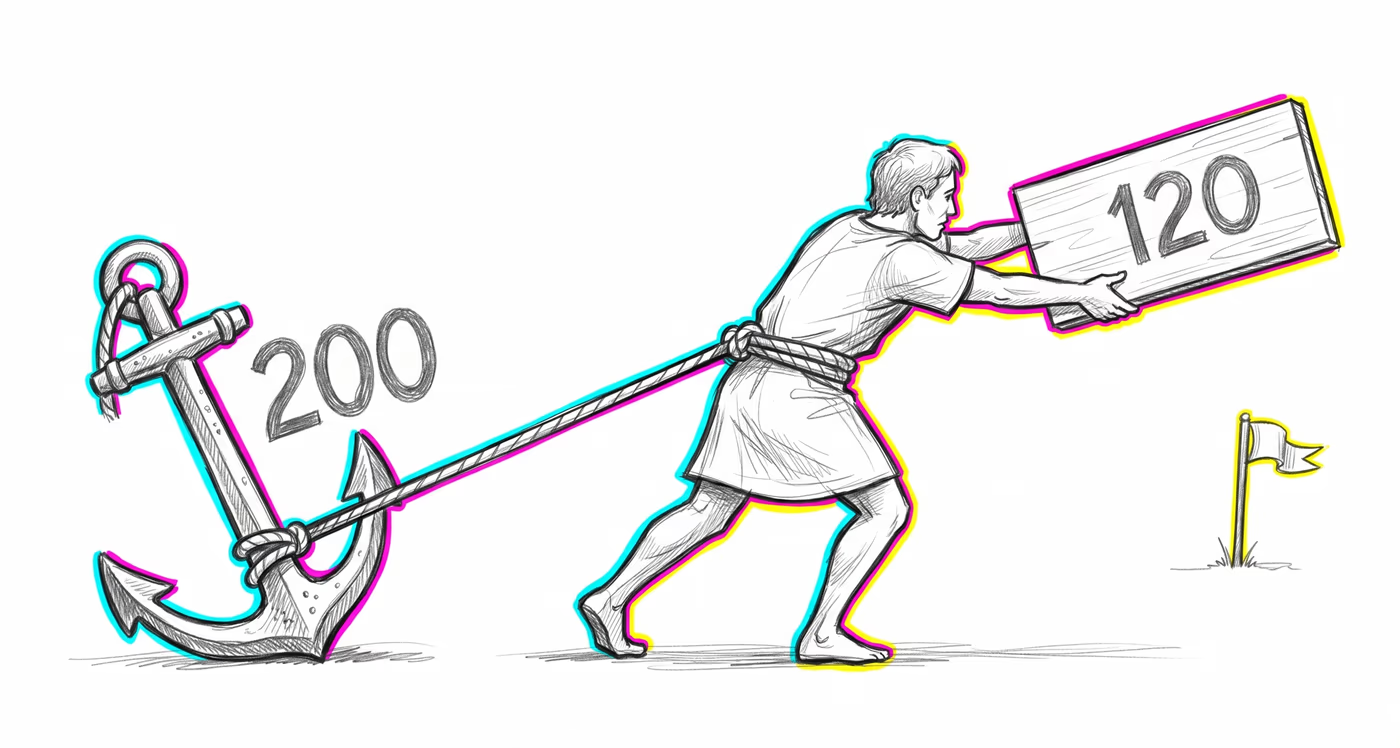
Investment platforms and brokerages often structure fund options so that a mediocre mid-tier fund makes the premium fund appear clearly superior on a fee-to-return ratio, steering investors toward higher-fee products they might not have chosen in a two-option comparison.
Medicine & diagnosis

Hospital pricing structures sometimes include a mid-range treatment package that is nearly as expensive as the comprehensive package but offers significantly fewer services, nudging patients toward the costlier comprehensive option rather than the basic one they initially considered.

Education & grading

Universities may present scholarship and financial aid packages alongside a 'partial scholarship' option that makes the full-tuition package seem like an exceptional deal, influencing students' enrollment decisions beyond pure academic fit.

Relationships

People sometimes unconsciously introduce a less attractive social option — like suggesting an undesirable restaurant alongside their preferred choice and a mediocre one — to steer a partner or friend toward their preferred plan while making the decision feel mutual.

Tech & product

SaaS companies routinely design three-tier pricing pages where the middle tier is intentionally unappealing relative to the top tier, increasing conversion to premium plans. The middle tier exists not to sell but to make the top tier seem like obviously superior value.

Workplace & hiring

Managers presenting project proposals sometimes include a weak third option to guide leadership toward approving their preferred initiative, making it appear dominant by comparison rather than on its standalone merits.

Politics Media

Political campaigns may introduce a spoiler candidate or frame a policy debate with an obviously inferior third option to make one position appear clearly superior, shifting public preference through comparative context rather than substantive argument.

HOW TO SPOT IT

Ask yourself…

  • Am I choosing this option primarily because it looks great compared to another option that nobody would actually pick?
  • If I removed the worst option from this set, would I still make the same choice?
  • Am I evaluating each option on its own merits, or am I relying on comparisons between options to justify my preference?
HOW TO DEFEND AGAINST IT

The playbook.

  • Evaluate each option in isolation first: write down what you'd pay for each choice before comparing them side-by-side.
  • Mentally remove the least attractive option from the set and check whether your preference remains the same.
  • Ask yourself: 'Would I choose this if only two options existed?' If not, the third option may be a decoy.
  • Define your actual needs and budget constraints before reviewing options, then filter out anything that doesn't match.
  • Be suspicious of any three-tier pricing where the middle tier seems designed to be unappealing.
FAMOUS CASES

In history.

  • The Economist's famous subscription pricing (online-only, print-only, and print+online at the same price as print-only), popularized by Dan Ariely, where the print-only option served as a decoy that dramatically boosted print+online subscriptions.
  • Williams-Sonoma reportedly doubled sales of a $275 bread maker after introducing a slightly larger model at $429, which served as an unintentional decoy making the original seem like a bargain.
WHERE IT COMES FROM
Academic origin

Joel Huber, John W. Payne, and Christopher Puto, 1982, in their paper 'Adding Asymmetrically Dominated Alternatives: Violations of Regularity and the Similarity Hypothesis' published in the Journal of Consumer Research.

Evolutionary origin

In ancestral environments, comparative evaluation was essential for rapid foraging and mate selection decisions. Detecting that one option was strictly better than a nearby alternative provided a reliable heuristic for identifying superior resources without exhaustive analysis. This relative-comparison shortcut conserved cognitive energy in environments where fast decisions about food sources, shelter, or allies conferred survival advantages.

IN AI SYSTEMS

How the machines inherit it.

Recommendation systems can inadvertently or deliberately trigger the decoy effect by inserting asymmetrically dominated options into product listings or search results, steering users toward target items. Research has shown that when personalized recommendations are involved, the decoy effect can be attenuated, but in non-personalized recommendation contexts, decoys significantly increase target item selection. E-commerce algorithms can also exploit this by dynamically adjusting which products appear alongside a target item to create asymmetric dominance.

Read more on Wikipedia
FREE FIELD ZINE

10 glitches quietly running your life.

A free field-zine PDF — ten cognitive glitches named, illustrated, with a defense move for each. Plus the weekly Glitch Report on Fridays — one bias named, two spotted in the wild, one defense move. Unsubscribe any time.

EXPLORE MORE

Related glitches.

LAUNCH PRICE

Train against your blindspots.

50 cards are free to preview. Buyers unlock the rest of the deck plus the interactive training — Spot-the-Bias Quiz unlimited, Swipe Deck with spaced repetition, My Blindspots, Decision Pre-Flight, the Printable Deck + Cheat Sheets, and the Field Guide e-book. $29.50$59.

Unlock the full deck

Everything below — yours forever. Pay once, use across every device.

Half-off launch — limited to the first 100 readers. Auto-applied at checkout.
$59 $29.50
one-time payment · lifetime access
  • All interactive digital cards — search, filter, flip, shuffle on any device
  • Five training modes — Spot-the-Bias Quiz, Swipe Deck, Pre-Flight, Blindspots, Journal
  • Curated Lenses + Decision Templates + Defense Playbook
  • Printable Deck PDFs + Field Guide e-book + Cheat Sheets + Anki Export
  • Every future improvement, included
Unlock  $29.50

30-day refund · no questions asked

Unlock the full deck

Everything below — yours forever. Pay once, use across every device.

Half-off launch — limited to the first 100 readers. Auto-applied at checkout.
$59 $29.50
one-time payment · lifetime access
  • All interactive digital cards — search, filter, flip, shuffle on any device
  • Five training modes — Spot-the-Bias Quiz, Swipe Deck, Pre-Flight, Blindspots, Journal
  • Curated Lenses + Decision Templates + Defense Playbook
  • Printable Deck PDFs + Field Guide e-book + Cheat Sheets + Anki Export
  • Every future improvement, included
Unlock  $29.50

30-day refund · no questions asked