Loss Aversion

aka Loss-Gain Asymmetry · Losses Loom Larger Than Gains

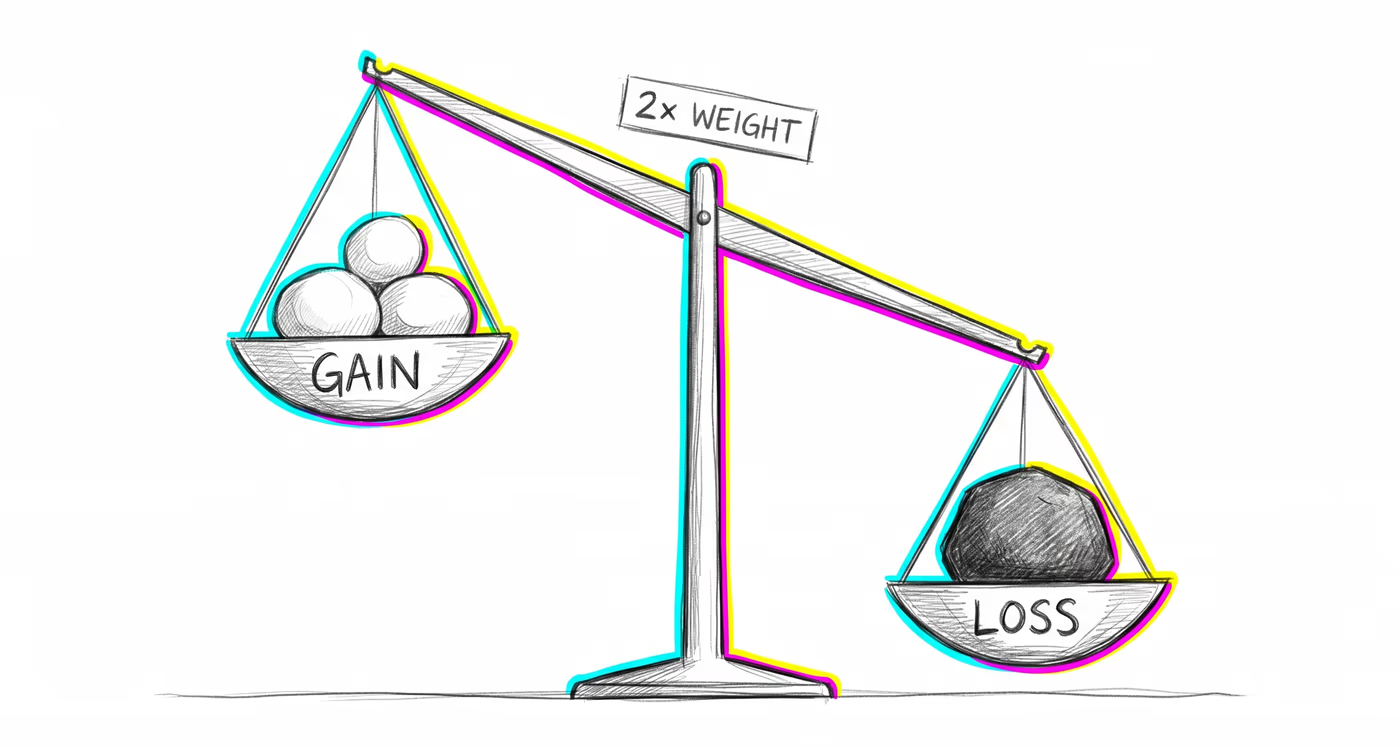
The pain of losing something feeling roughly twice as powerful as the pleasure of gaining the same thing.

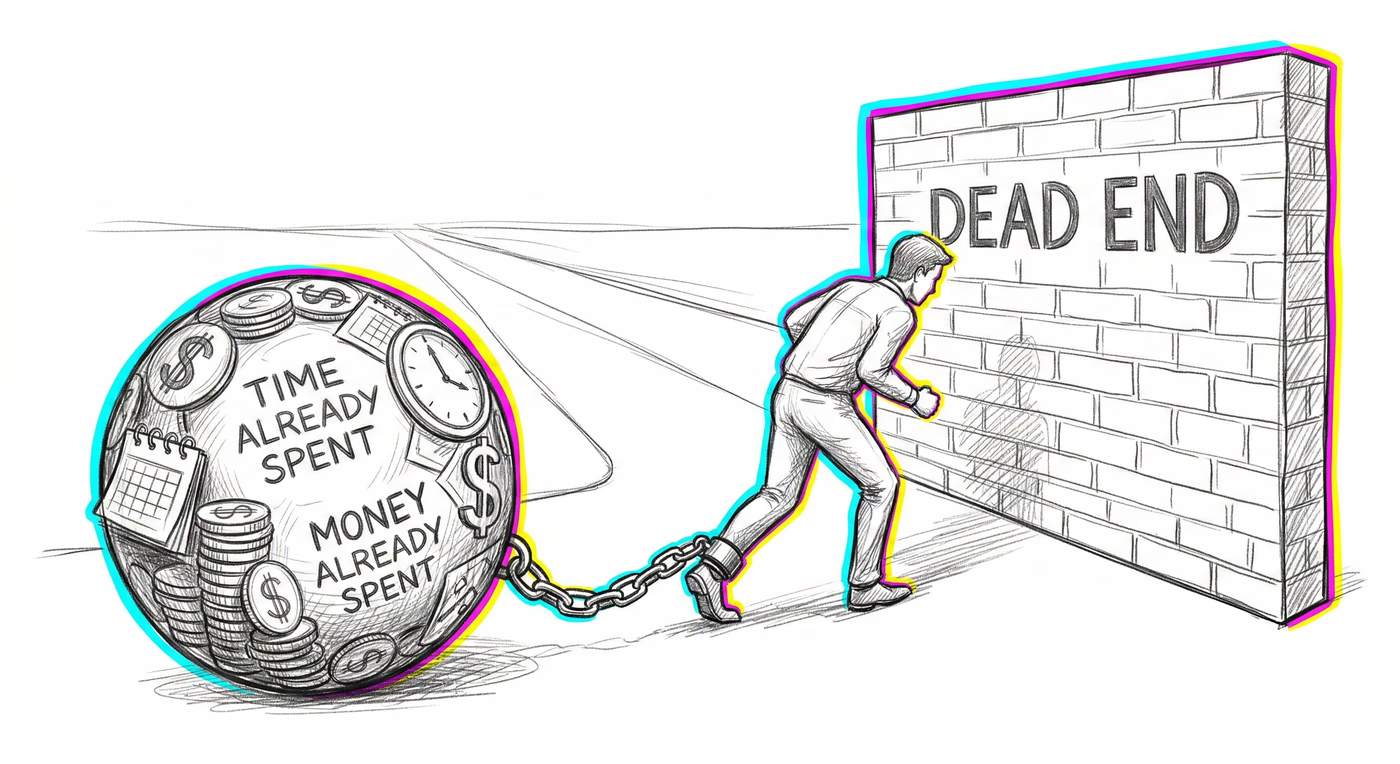
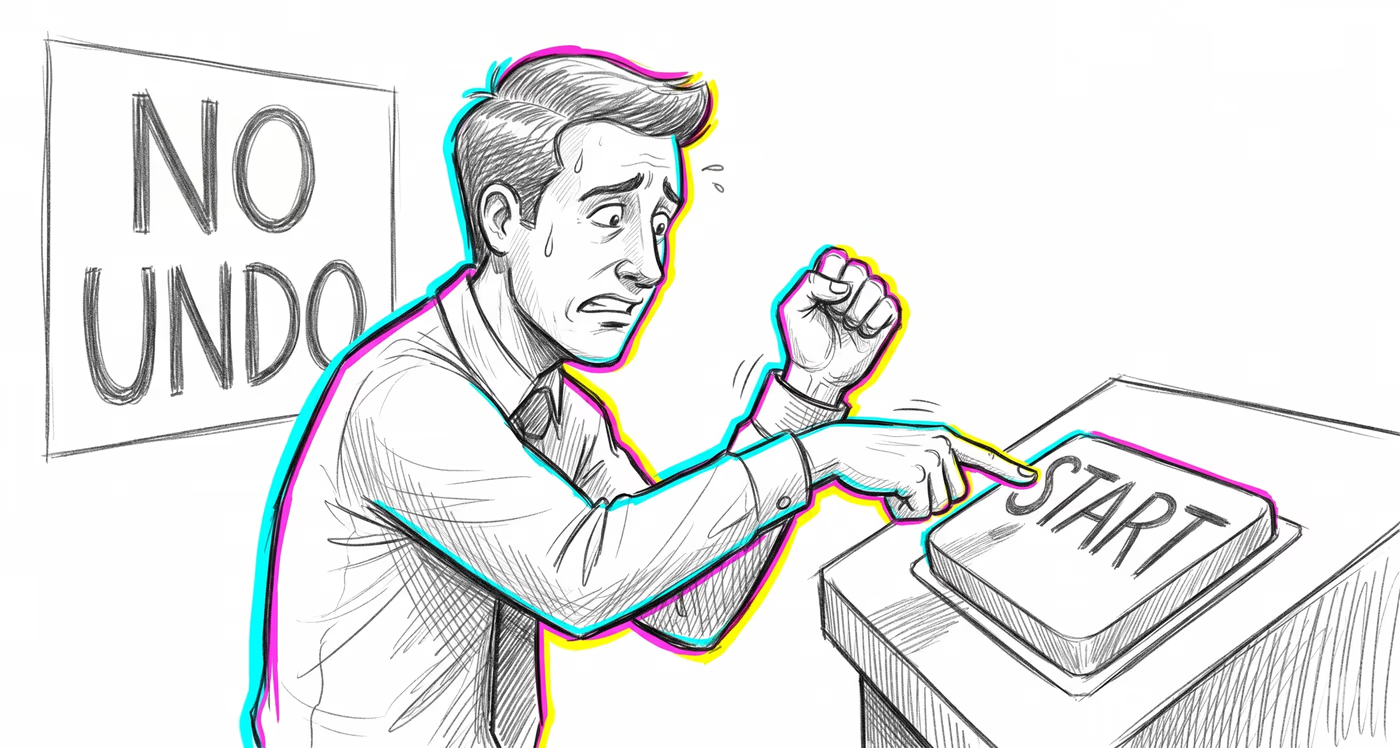
Illustration: Loss Aversion
WHAT IT IS

The glitch, explained plainly.

Imagine you find a $20 bill on the ground and feel happy. Now imagine you reach into your pocket and realize you lost a $20 bill. That sad feeling is much bigger than the happy feeling — even though it's the exact same amount of money. Your brain treats losing things as a much bigger deal than winning things.

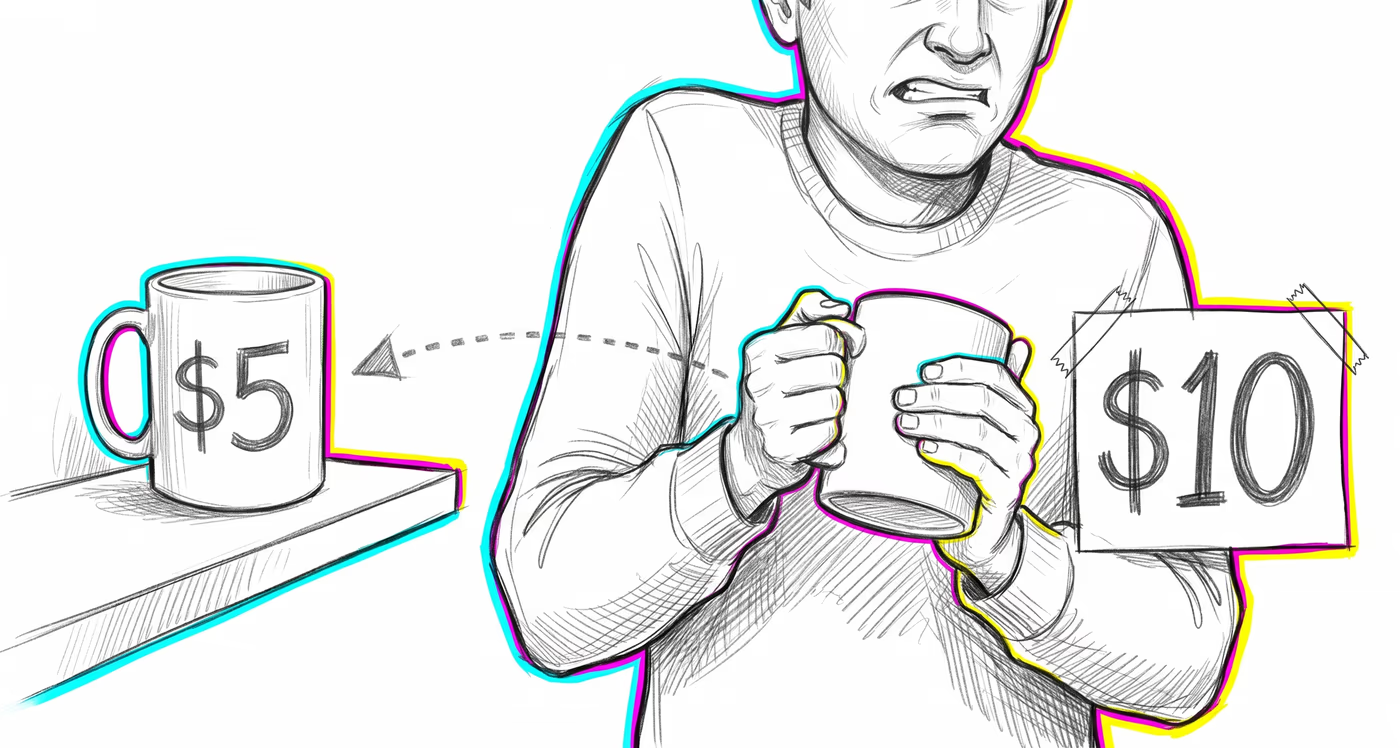
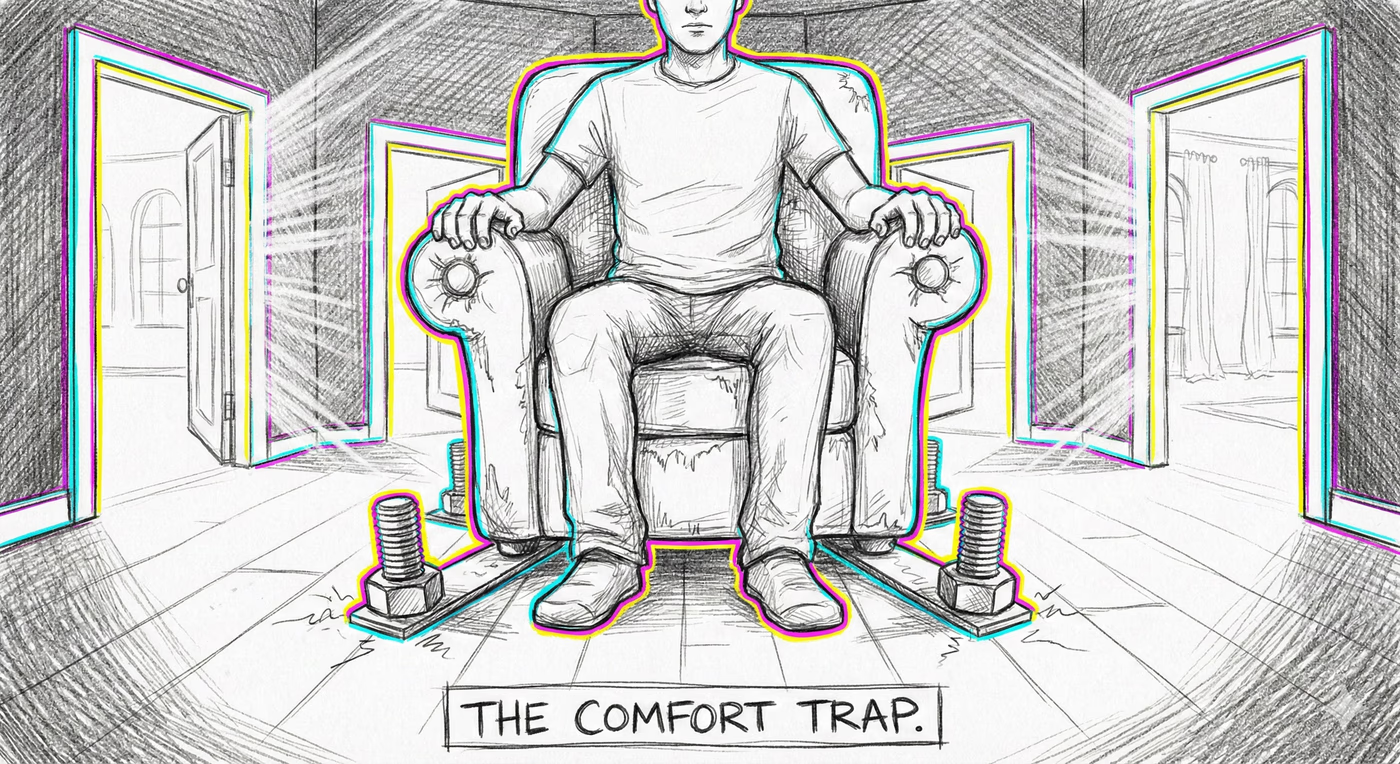
Loss aversion describes the robust finding that people evaluate potential losses and potential gains asymmetrically: a loss of a given magnitude is felt more intensely than a gain of the same magnitude. This asymmetry profoundly shapes decision-making, causing individuals to reject gambles and opportunities with positive expected value simply because they involve a chance of loss. The bias operates relative to a reference point — typically the status quo — so that outcomes below that reference feel disproportionately painful. Loss aversion underpins many related economic anomalies including the endowment effect, the status quo bias, the disposition effect in investing, and the effectiveness of penalty framing over reward framing in behavior change.

SOUND FAMILIAR?

Where it shows up.

  1. 01 Maria is offered a coin-flip bet: heads she wins $150, tails she loses $100. Despite the positive expected value, she declines because the thought of losing $100 bothers her far more than the prospect of gaining $150 excites her.
  2. 02 A company's employees are given the option to switch to a new benefits package that, by every objective metric, is slightly better. Fewer than 15% of employees opt in because they fixate on two minor perks they would lose in the transition, even though the new package adds five superior benefits.
  3. 03 A city council must choose between two public health programs. Program A is described as 'saving 200 out of 600 lives.' Program B is described as 'a one-third probability that all 600 will be saved and a two-thirds probability that none will be saved.' Most council members strongly prefer Program A — but when Program A is reframed as '400 out of 600 will die,' they suddenly shift to preferring Program B, because the certain-death framing triggers an outsized aversion to the definite loss.
  4. 04 Kevin's financial advisor shows him that reallocating his portfolio from bonds to a diversified stock index would, based on 30-year historical data, increase his expected retirement savings by $200,000. Kevin declines because he keeps imagining the worst-case scenario where he loses $80,000 in a single downturn, even though the probability-weighted outcome strongly favors switching.
  5. 05 A software team debates removing an obscure feature that only 2% of users ever access. Despite data showing that removing it would simplify the codebase and speed up the product for everyone, the team resists because the vocal minority who would 'lose' the feature weigh more heavily in their minds than the silent majority who would gain performance improvements.
IN DIFFERENT DOMAINS

Where it shows up at work.

The same glitch looks different depending on the terrain. Finance, medicine, a relationship, a team — same mechanism, different costume.

Finance & investing

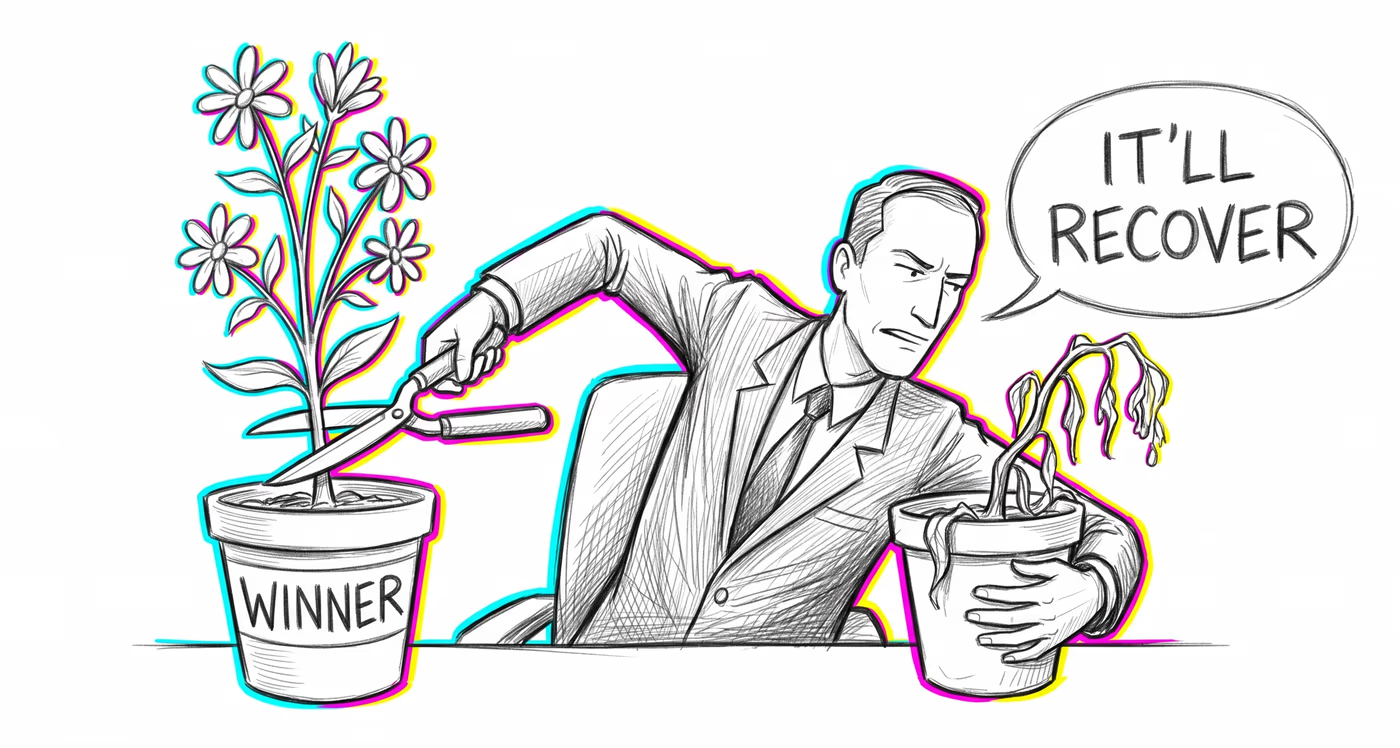
Investors exhibit the disposition effect — selling winning stocks too quickly to 'lock in' gains while holding losing stocks far too long to avoid realizing a loss. This same asymmetry inflates the equity premium, as investors demand outsized returns from stocks to compensate for the outsized pain of potential losses compared to bonds.
Medicine & diagnosis

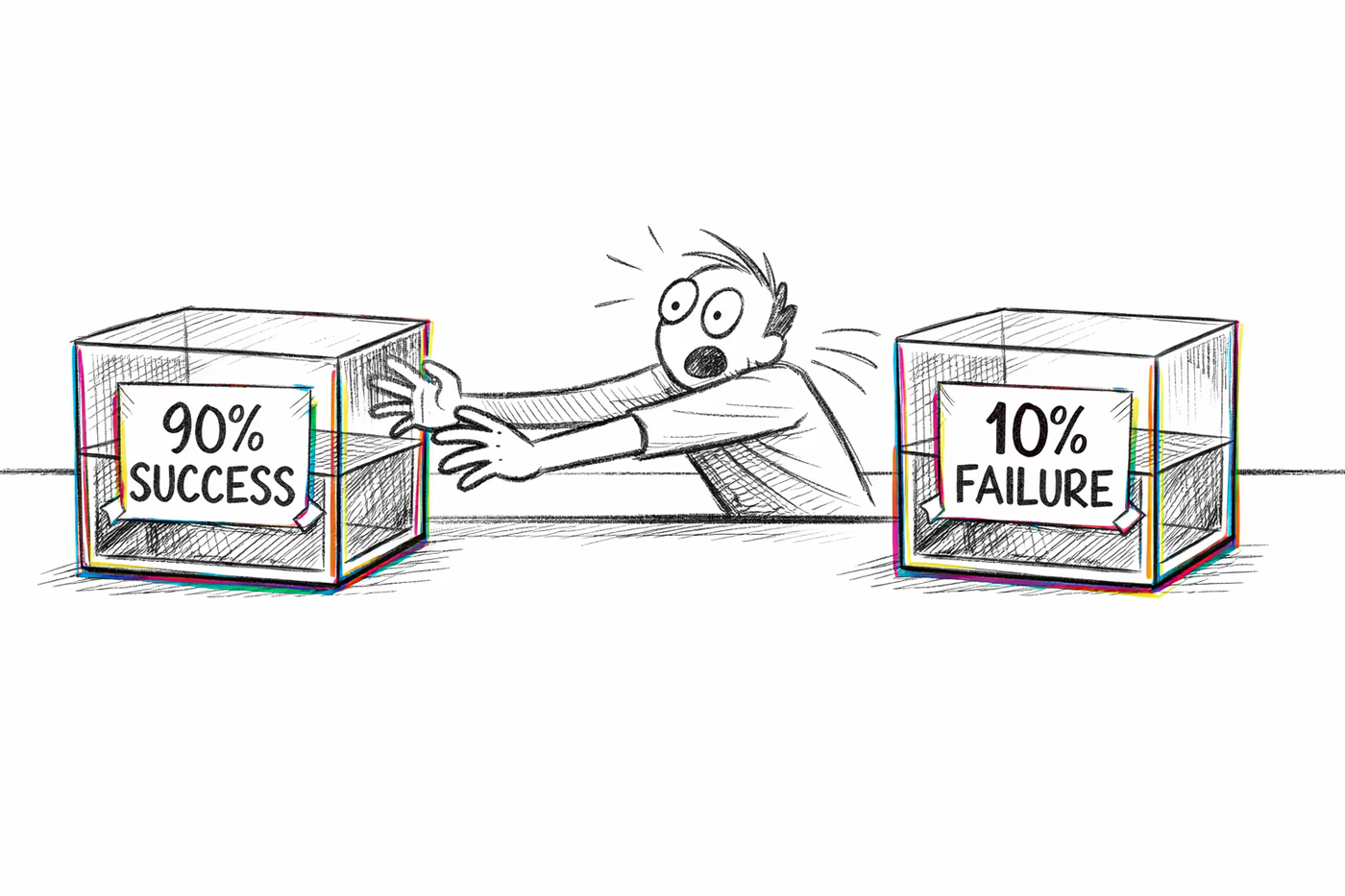
Patients may refuse a surgery with a 90% survival rate when it is framed as having a 10% mortality rate, even though the information is identical. Physicians themselves may avoid recommending aggressive but beneficial treatments because the pain of a bad outcome looms larger than the satisfaction of a good one.

Education & grading

Students who have earned a high grade may stop taking intellectual risks — choosing easy assignments or avoiding challenging courses — because the potential loss of their GPA feels more threatening than the potential gain of deeper learning.

Relationships

People stay in unfulfilling relationships longer than they should because the concrete losses of leaving (shared home, mutual friends, familiar routines) feel more painful than the abstract gains of finding a better match. This asymmetry also makes people disproportionately upset by small negative interactions relative to positive ones.

Tech & product

Free trial periods exploit loss aversion: once users have incorporated a product into their workflow during the trial, canceling feels like losing something they already possess. Subscription services and 'freemium' models rely on the same principle — users are more motivated to avoid losing access than they were to gain it initially.

Workplace & hiring

Managers resist reorganizations or policy changes that would produce net gains for the team because the specific roles or perks being eliminated feel like tangible losses, while the improvements feel abstract. In salary negotiations, employees react more intensely to a proposed benefit reduction than to an equivalent missed raise.

Politics Media

Political campaigns that frame opponents' policies as 'what you will lose' are more persuasive than those framing their own policies as 'what you will gain.' Voters are more mobilized by the threat of losing existing rights or programs than by the promise of new ones of equivalent value.

HOW TO SPOT IT

Ask yourself…

  • Am I avoiding this option mainly because of what I might lose, rather than evaluating what I stand to gain?
  • If I didn't already have what I'm trying to protect, would I actively choose to acquire it at its current cost?
  • Would I make the same decision if the exact same facts were framed as a gain rather than a loss?
HOW TO DEFEND AGAINST IT

The playbook.

  • Reframe decisions in terms of net outcome rather than gains vs. losses: ask 'What is my total expected position after this choice?' instead of 'What could I lose?'
  • Apply the 'broad frame' technique (Sokol-Hessner et al., 2009): mentally treat each decision as one of many in a long series, which dilutes the emotional impact of any single loss.
  • Use pre-commitment strategies: decide in advance under what conditions you will cut losses (e.g., a stop-loss rule), removing the emotional decision from the moment of pain.
  • Conduct a 'status quo audit': periodically ask 'If I were starting from scratch, would I choose my current situation?' to expose hidden loss-aversion-driven inertia.
  • Practice cognitive reappraisal: consciously adopt a detached, third-person perspective ('What would a rational advisor tell me to do?') to dampen amygdala-driven emotional reactivity.
FAMOUS CASES

In history.

  • The equity premium puzzle: Benartzi and Thaler (1995) argued that loss aversion explains why investors have historically demanded an irrationally large premium for holding stocks over bonds, given that long-run stock returns consistently outperform.
  • New Coke (1985): Coca-Cola's reformulation triggered massive consumer backlash not because the new formula was objectively worse (blind taste tests favored it), but because consumers experienced the removal of the original formula as a painful loss of something they already had.
  • The Organ Donation Opt-In vs. Opt-Out Policy Divide: Countries with opt-out organ donation policies (where you 'lose' donor status by actively opting out) have dramatically higher donation rates than opt-in countries, a pattern directly attributable to loss aversion and status quo bias.
WHERE IT COMES FROM
Academic origin

Daniel Kahneman and Amos Tversky, 1979, in their seminal paper 'Prospect Theory: An Analysis of Decision under Risk' published in Econometrica. The concept was further formalized for riskless choice in Tversky and Kahneman (1991) and connected to the endowment effect in Kahneman, Knetsch, and Thaler (1990).

Evolutionary origin

For organisms operating near the edge of survival, a day's lost food could mean death, while a day's extra food provided diminishing marginal returns (especially without reliable storage). Asymmetric pressure — where failing to avoid a threat was far more costly than failing to seize an opportunity — selected for brains that prioritize loss avoidance. As Kahneman noted, organisms that treat threats as more urgent than opportunities have a better chance to survive and reproduce.

IN AI SYSTEMS

How the machines inherit it.

Recommendation algorithms trained on user engagement data can learn to exploit loss aversion by emphasizing scarcity cues, countdown timers, and loss-framed notifications ('Your cart is about to expire!') because these patterns generate more clicks. Additionally, ML models optimized to minimize loss functions can exhibit asymmetric sensitivity to false negatives versus false positives in ways that mirror human loss aversion if training data reflects human loss-averse labeling patterns.

Read more on Wikipedia
FREE FIELD ZINE

10 glitches quietly running your life.

A free field-zine PDF — ten cognitive glitches named, illustrated, with a defense move for each. Plus the weekly Glitch Report on Fridays — one bias named, two spotted in the wild, one defense move. Unsubscribe any time.

EXPLORE MORE

Related glitches.

LAUNCH PRICE

Train against your blindspots.

50 cards are free to preview. Buyers unlock the rest of the deck plus the interactive training — Spot-the-Bias Quiz unlimited, Swipe Deck with spaced repetition, My Blindspots, Decision Pre-Flight, the Printable Deck + Cheat Sheets, and the Field Guide e-book. $29.50$59.

Unlock the full deck

Everything below — yours forever. Pay once, use across every device.

Half-off launch — limited to the first 100 readers. Auto-applied at checkout.
$59 $29.50
one-time payment · lifetime access
  • All interactive digital cards — search, filter, flip, shuffle on any device
  • Five training modes — Spot-the-Bias Quiz, Swipe Deck, Pre-Flight, Blindspots, Journal
  • Curated Lenses + Decision Templates + Defense Playbook
  • Printable Deck PDFs + Field Guide e-book + Cheat Sheets + Anki Export
  • Every future improvement, included
Unlock  $29.50

30-day refund · no questions asked

Unlock the full deck

Everything below — yours forever. Pay once, use across every device.

Half-off launch — limited to the first 100 readers. Auto-applied at checkout.
$59 $29.50
one-time payment · lifetime access
  • All interactive digital cards — search, filter, flip, shuffle on any device
  • Five training modes — Spot-the-Bias Quiz, Swipe Deck, Pre-Flight, Blindspots, Journal
  • Curated Lenses + Decision Templates + Defense Playbook
  • Printable Deck PDFs + Field Guide e-book + Cheat Sheets + Anki Export
  • Every future improvement, included
Unlock  $29.50

30-day refund · no questions asked