Contrast Effect

aka Perceptual Contrast Effect · Background Contrast Effect · Contrast Bias

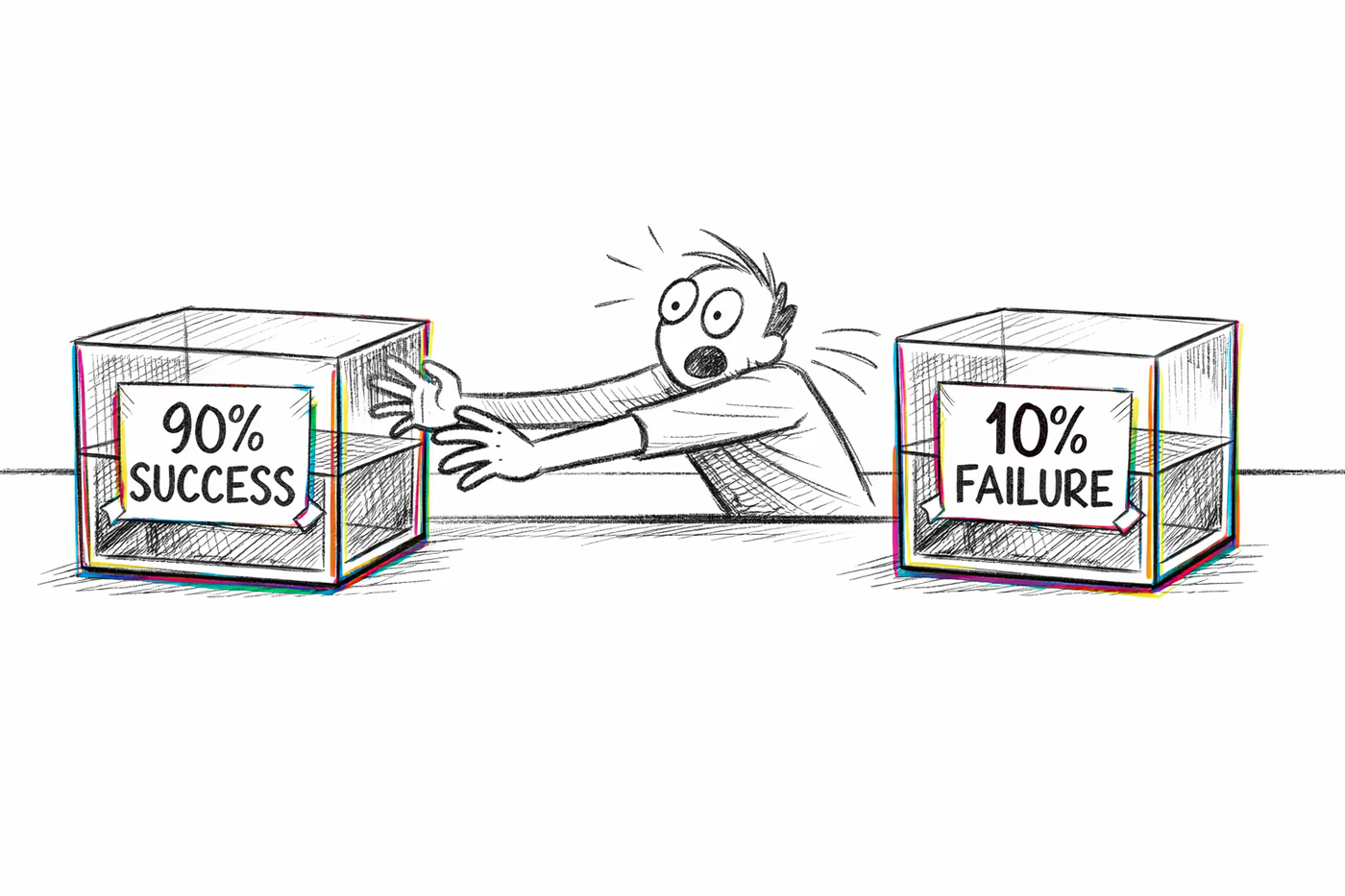
Perception of something being distorted by what was seen just before it — making differences feel larger than they are.

Illustration: Contrast Effect
WHAT IT IS

The glitch, explained plainly.

Imagine you eat a really sour lemon, and then you eat a strawberry. The strawberry will taste way sweeter than it normally does because your mouth is still remembering that sour lemon. Your brain judges things by comparing them to whatever it just experienced, not by what they actually are on their own.

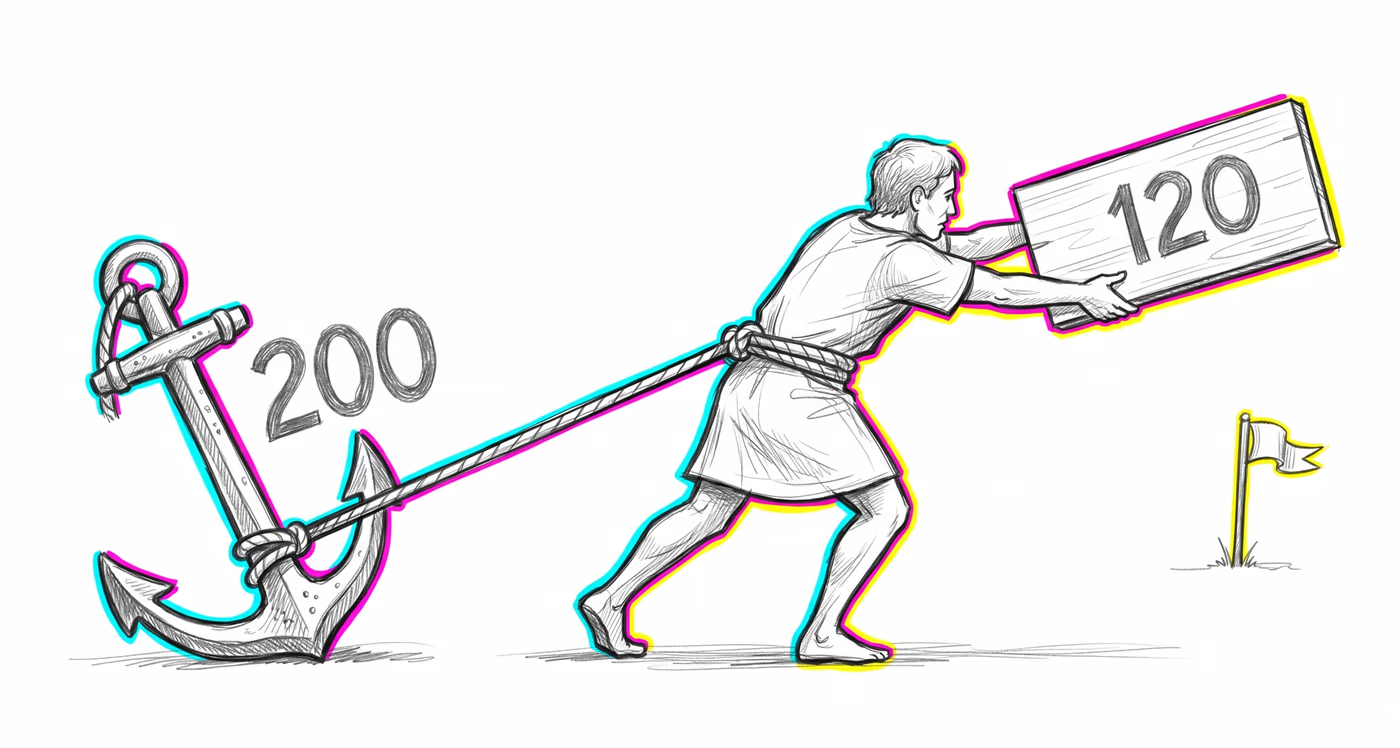
The Contrast Effect occurs when the evaluation of a person, object, or experience is systematically shifted by the presence of a preceding or adjacent stimulus that differs significantly along the same dimension. When something moderate follows something extreme, the moderate item is perceived as farther from the extreme anchor than it would be judged in isolation — a phenomenon that applies across sensory perception, social judgment, pricing, attractiveness ratings, and performance evaluations. The effect can operate in both directions: a 'positive contrast' makes something seem better after exposure to something worse, while a 'negative contrast' makes something seem worse after exposure to something better. Critically, the items being compared must belong to the same general category for the distortion to take hold; comparing across unrelated categories does not trigger the effect.

SOUND FAMILIAR?

Where it shows up.

  1. 01 A hiring manager interviews a candidate with strong qualifications and relevant experience. However, the previous interviewee was a once-in-a-decade talent with an Ivy League PhD and a decade at a top firm. The manager rates the current candidate as 'underwhelming' and passes, even though under normal circumstances she would have been rated as an excellent hire.
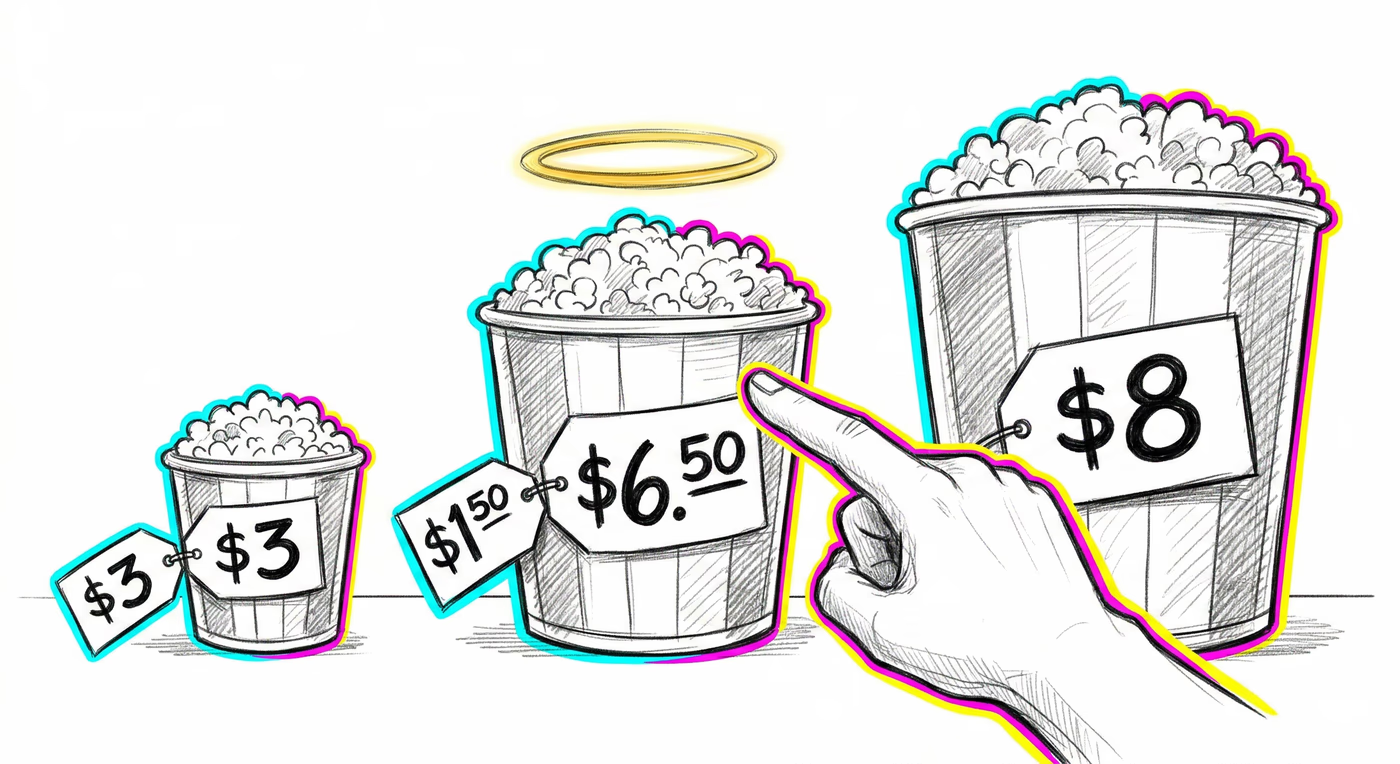
  2. 02 A car salesman first shows a customer a top-of-the-line $85,000 SUV loaded with every option. After spending twenty minutes admiring it, he walks the customer over to the $42,000 mid-range model. The customer, who originally planned to spend $30,000, now feels the $42,000 car is 'reasonably priced' and signs the paperwork without hesitation.
  3. 03 A professor grades a stack of 30 essays. The first three happen to be outstanding. By the time she reaches the fourth essay — objectively a solid B+ — she gives it a C+, noting in her comments that it 'lacks depth and originality.' When she later re-reads the same essay on its own, she revises it upward to a B+.
  4. 04 After binge-watching a critically acclaimed prestige drama series, Marco starts a well-reviewed comedy show his friends recommended. He turns it off after one episode, telling them 'it was boring and poorly written,' even though he would have enjoyed it had he watched it at any other time.
  5. 05 A real estate agent deliberately schedules showings of two overpriced, poorly maintained houses before showing a buyer the house she actually wants to sell. The target house is merely average for the neighborhood, but the buyer excitedly describes it as 'an amazing find' and offers above asking price, convinced they've discovered a hidden gem.
IN DIFFERENT DOMAINS

Where it shows up at work.

The same glitch looks different depending on the terrain. Finance, medicine, a relationship, a team — same mechanism, different costume.

Finance & investing

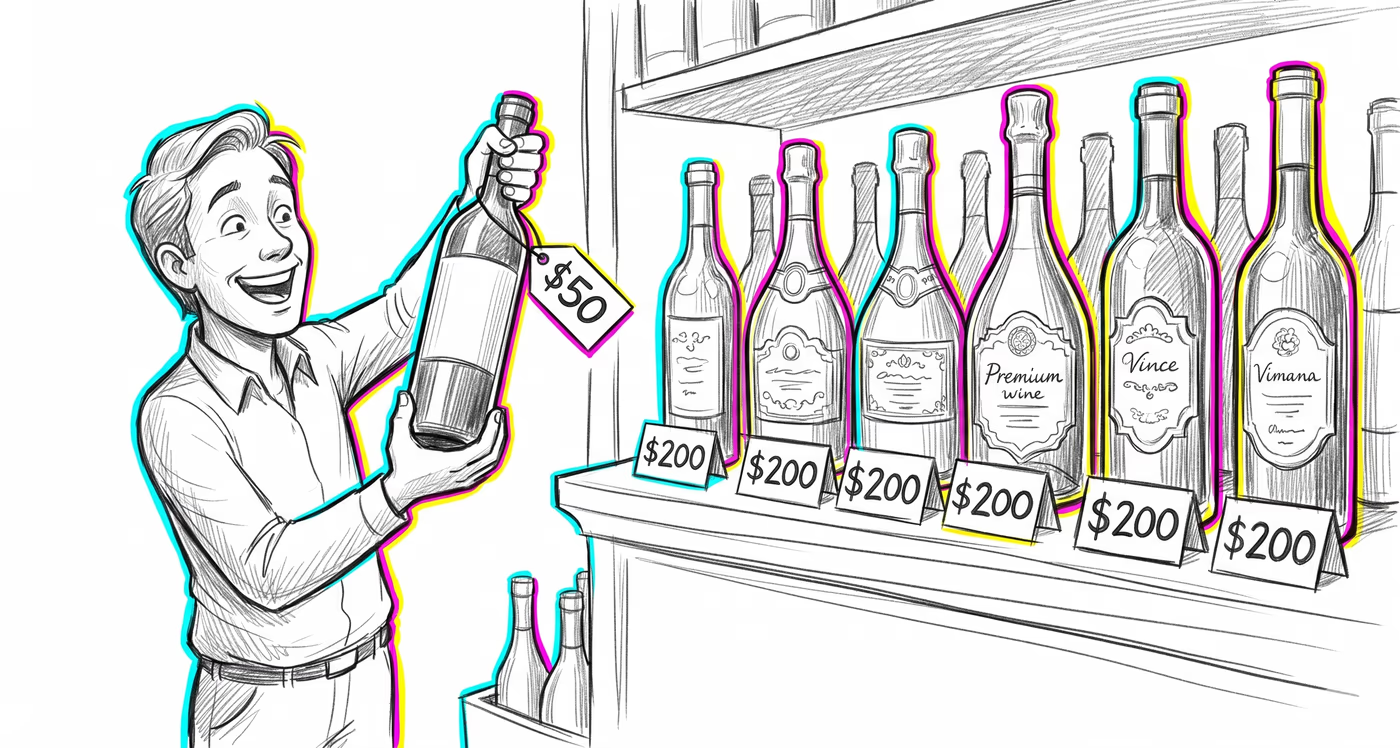
Investors perceive a stock's performance as impressive or disappointing based primarily on what other stocks in their portfolio recently did, rather than evaluating returns against objective benchmarks. Similarly, a fee of $200 seems trivial when presented alongside a $50,000 purchase, leading to uncritical acceptance of add-on costs.

Medicine & diagnosis

A patient's reported pain level or symptom severity can be rated differently by clinicians depending on the previous patient they treated. After treating a patient with an acute, life-threatening emergency, a physician may unconsciously downgrade the urgency of the next patient's moderate symptoms, potentially leading to delayed treatment.
Education & grading

Teachers grading sequentially tend to inflate or deflate scores based on the quality of the preceding work rather than applying consistent rubric standards. A student presenting after an exceptional peer may receive harsher feedback despite delivering an objectively competent performance.

Relationships

People evaluate their current romantic partner's attractiveness or suitability more negatively after prolonged exposure to idealized portrayals of relationships in media, or after encountering a particularly charming or attractive person at a social event. This can erode satisfaction with an otherwise healthy relationship.

Tech & product

Product designers exploit the contrast effect by displaying premium pricing tiers alongside standard ones, making the standard option appear more affordable. Similarly, showing a complex, cluttered 'before' interface next to a clean redesign amplifies perceived improvement, even when the redesign has its own usability issues.

Workplace & hiring

Performance reviews conducted sequentially are vulnerable to contrast distortion: an average employee reviewed immediately after a top performer receives lower ratings than the same employee reviewed after a poor performer. Calibration meetings and structured rubrics are designed to counteract this pattern.

Politics Media

Media outlets juxtapose extreme positions or events to make moderate positions seem more appealing or more alarming. A political candidate appears moderate and reasonable primarily because they are contrasted against a more extreme opponent, rather than being evaluated on the absolute merits of their platform.

HOW TO SPOT IT

Ask yourself…

  • Am I judging this on its own merits, or am I comparing it to whatever I just experienced?
  • Would my evaluation be different if I encountered this item, person, or option in isolation?
  • Is someone deliberately controlling what I see first to influence how I feel about what comes next?
HOW TO DEFEND AGAINST IT

The playbook.

  • Evaluate items in isolation by adding temporal or spatial distance between comparisons — don't judge back-to-back.
  • Ask 'Compared to what?' explicitly every time you notice a strong positive or negative reaction to something.
  • Use absolute scoring rubrics or pre-established criteria rather than relying on relative impressions.
  • Randomize presentation order when evaluating multiple options (resumes, proposals, products) to prevent systematic contrast.
  • Before making a purchase or judgment, step away and return later to reduce the influence of the most recent comparison anchor.
FAMOUS CASES

In history.

  • Real estate agents routinely use 'setup properties' — showing buyers less desirable listings first to make the target property seem far more attractive by comparison, a well-documented industry tactic.
  • Kenrick & Gutierres (1980) demonstrated that male college students who watched Charlie's Angels rated photos of average-looking women as significantly less attractive than students who had not been watching the show, illustrating media-driven contrast effects on social perception.
  • Retail pricing strategies such as J.C. Penney's failed 'everyday low prices' experiment (2012) highlighted how consumers relied on contrast with original marked-up prices to feel they were getting a deal; removing the high anchor eliminated the contrast and collapsed sales.
WHERE IT COMES FROM
Academic origin

The concept of perceptual contrast was noted by philosopher John Locke in the 17th century (lukewarm water experiment). Wilhelm Wundt identified contrast as a fundamental principle of perception in the early 20th century. Harry Helson formalized the underlying mechanism through his Adaptation-Level Theory (1947), and Norbert Schwarz and Herbert Bless developed the inclusion/exclusion model of assimilation and contrast effects in 1992.

Evolutionary origin

The contrast mechanism likely evolved as part of the brain's edge-detection and change-detection systems. In ancestral environments, detecting relative differences — a shadow that is darker than its surroundings, a movement against a still backdrop, a change in sound intensity — was far more survival-relevant than measuring absolute values. Amplifying contrasts between stimuli allowed for faster identification of predators, ripe food, and environmental threats in cluttered, noisy natural environments.

IN AI SYSTEMS

How the machines inherit it.

Machine learning models can exhibit contrast-like effects when training data ordering or batch composition influences learned weights. In recommendation systems, the perceived quality of a suggested item may depend on what was shown previously in the feed, distorting engagement metrics. LLMs can also display contrast sensitivity: the same prompt evaluated differently depending on the conversation context or preceding examples, leading to inconsistent scoring or evaluation outputs.

Read more on Wikipedia
FREE FIELD ZINE

10 glitches quietly running your life.

A free field-zine PDF — ten cognitive glitches named, illustrated, with a defense move for each. Plus the weekly Glitch Report on Fridays — one bias named, two spotted in the wild, one defense move. Unsubscribe any time.

EXPLORE MORE

Related glitches.

LAUNCH PRICE

Train against your blindspots.

50 cards are free to preview. Buyers unlock the rest of the deck plus the interactive training — Spot-the-Bias Quiz unlimited, Swipe Deck with spaced repetition, My Blindspots, Decision Pre-Flight, the Printable Deck + Cheat Sheets, and the Field Guide e-book. $29.50$59.

Unlock the full deck

Everything below — yours forever. Pay once, use across every device.

Half-off launch — limited to the first 100 readers. Auto-applied at checkout.
$59 $29.50
one-time payment · lifetime access
  • All interactive digital cards — search, filter, flip, shuffle on any device
  • Five training modes — Spot-the-Bias Quiz, Swipe Deck, Pre-Flight, Blindspots, Journal
  • Curated Lenses + Decision Templates + Defense Playbook
  • Printable Deck PDFs + Field Guide e-book + Cheat Sheets + Anki Export
  • Every future improvement, included
Unlock  $29.50

30-day refund · no questions asked

Unlock the full deck

Everything below — yours forever. Pay once, use across every device.

Half-off launch — limited to the first 100 readers. Auto-applied at checkout.
$59 $29.50
one-time payment · lifetime access
  • All interactive digital cards — search, filter, flip, shuffle on any device
  • Five training modes — Spot-the-Bias Quiz, Swipe Deck, Pre-Flight, Blindspots, Journal
  • Curated Lenses + Decision Templates + Defense Playbook
  • Printable Deck PDFs + Field Guide e-book + Cheat Sheets + Anki Export
  • Every future improvement, included
Unlock  $29.50

30-day refund · no questions asked