Recency Effect

aka Recency Bias · Serial Position Recency · End-of-List Effect

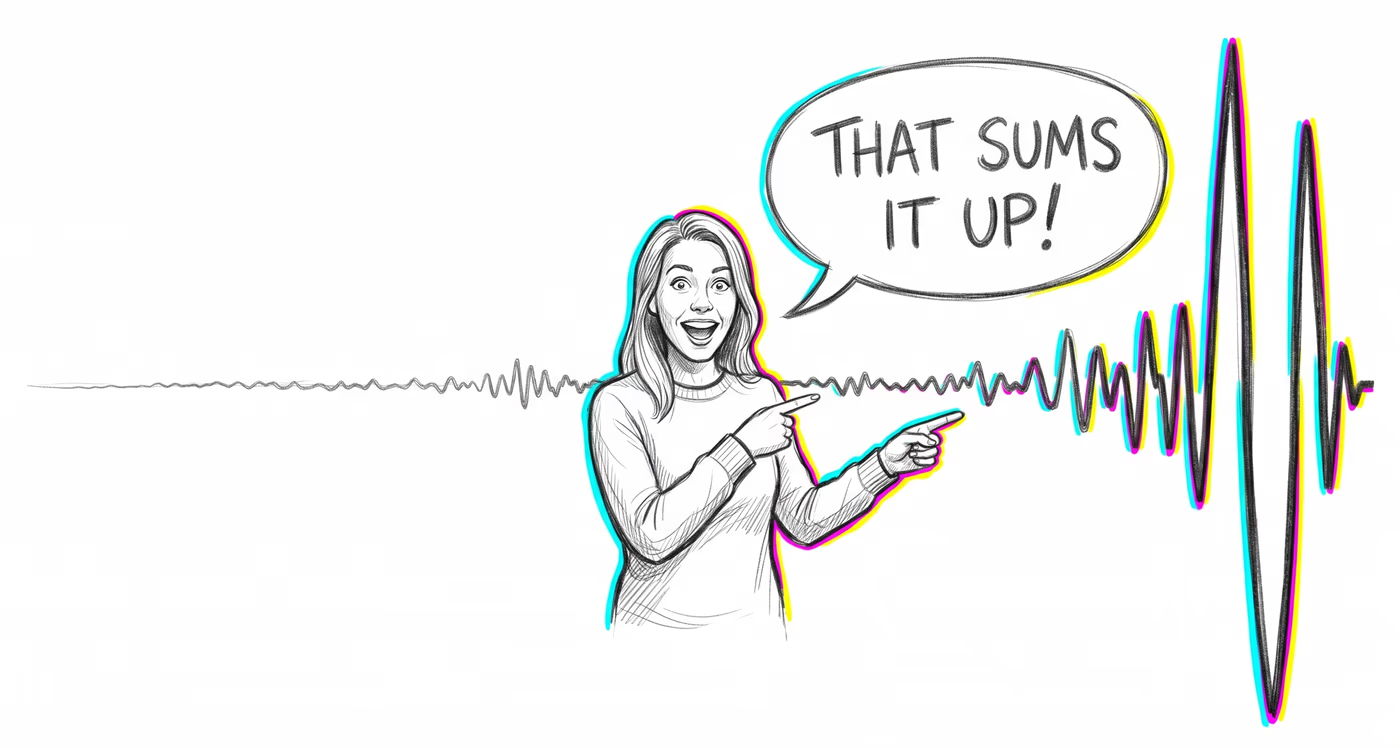
The most recently encountered information being remembered best and carrying outsized influence on judgments.

WHAT IT IS

The glitch, explained plainly.

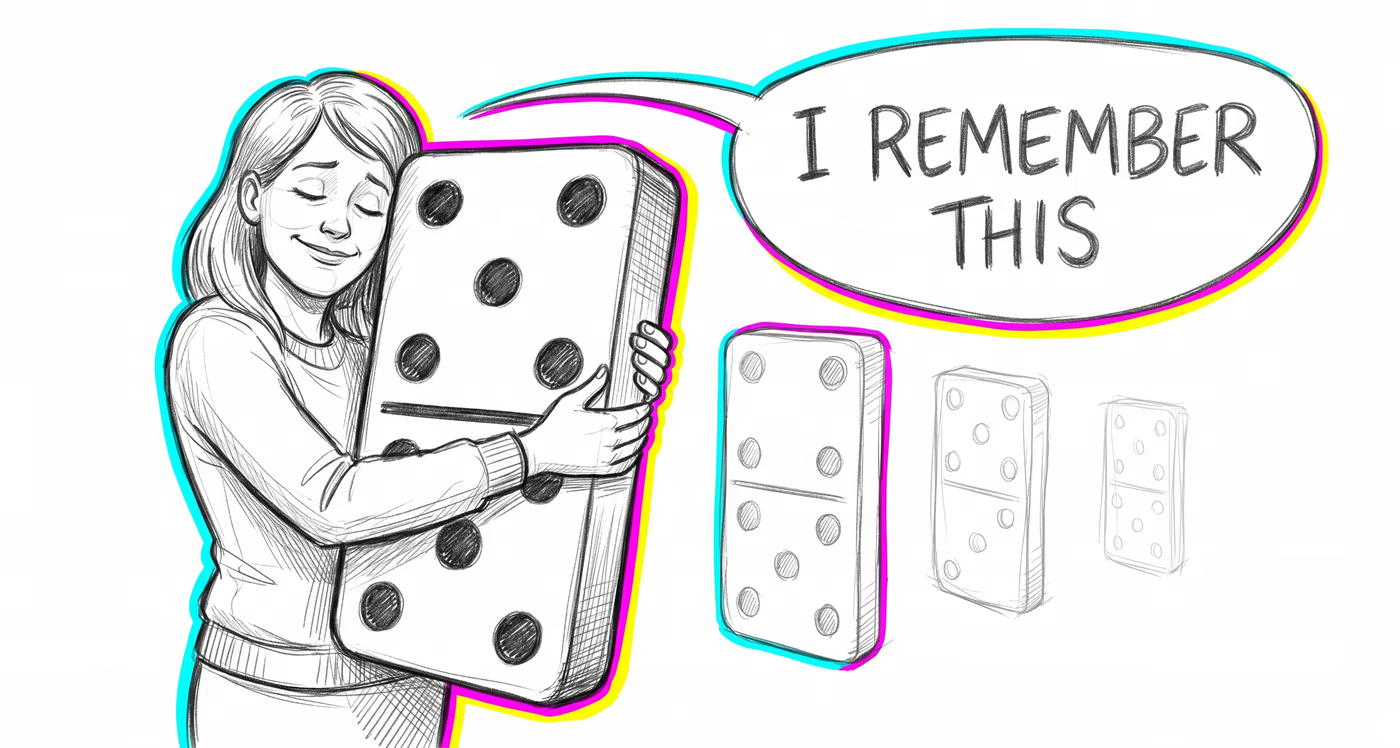
Imagine someone reads you a really long list of animals. When they ask you which ones you remember, you'll probably blurt out the last few animals you heard, because they're still bouncing around in your head. The ones from the beginning are harder to remember, and the ones from the middle? Almost gone. It's like your brain has a tiny whiteboard that only holds the last few things written on it.

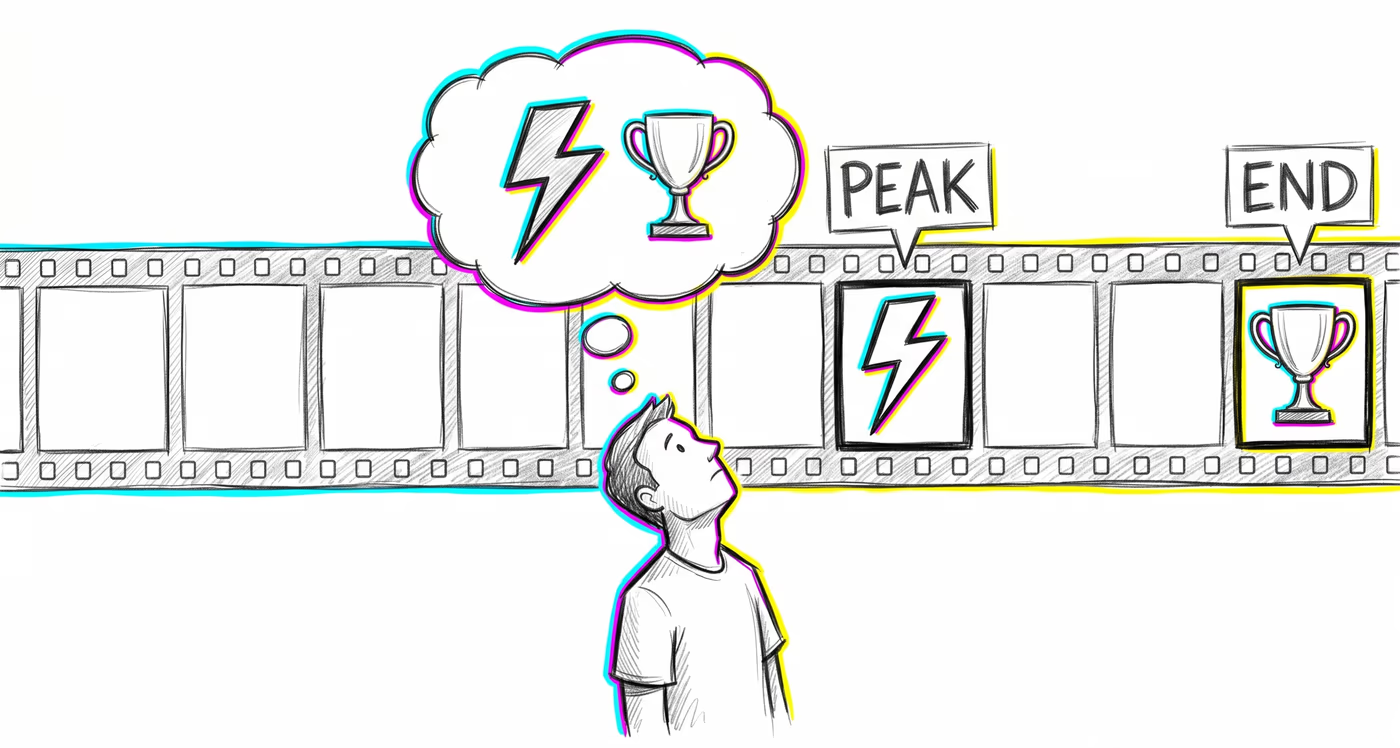
The Recency Effect describes how items, arguments, or experiences presented last in a sequence are recalled more easily and vividly than those encountered earlier, because they remain active in short-term (working) memory at the time of retrieval. This creates a systematic distortion: people judge entire experiences, performances, or bodies of evidence based heavily on whatever happened most recently, often discounting or forgetting earlier data points entirely. The effect is strongest when recall happens immediately after presentation and diminishes sharply when a distractor task or delay is introduced between the final item and the recall attempt. Beyond simple list recall, the recency effect pervades real-world evaluations—from performance reviews to courtroom verdicts—anytime sequential information must be synthesized into a single judgment.

SOUND FAMILIAR?

Where it shows up.

  1. 01 A hiring manager interviews six candidates back-to-back for a role. When filling out her evaluation forms afterward, she finds herself writing the most detailed and favorable notes for the sixth candidate, even though her in-the-moment impression of the second candidate was actually stronger. She recommends candidate six for a second round.
  2. 02 A teacher reviews a student's portfolio of ten essays written over the semester. The last two essays were noticeably weaker due to the student's illness, while the first eight demonstrated steady growth. The teacher assigns a 'needs improvement' grade for the semester, feeling that the student's work had declined overall.
  3. 03 A jury deliberates after a week-long trial. One juror argues passionately that the defendant seems guilty, citing details almost exclusively from the defense attorney's final cross-examination—where a witness stumbled—while dismissing the strong alibi evidence presented on day two. Other jurors find themselves unable to clearly recall the earlier testimony and begin to agree.
  4. 04 An investor reviews his fund's five-year track record, which shows four years of strong returns followed by one mediocre quarter. He decides to pull out and reallocate, writing in his journal that the fund 'just isn't performing anymore,' despite the long-term data clearly showing above-market returns.
  5. 05 A product manager reads through fifty user feedback submissions in one sitting to decide feature priorities. When she summarizes the findings to her team, the themes she highlights map almost perfectly to the last dozen submissions she read, while ideas that were repeated heavily in the first thirty entries go unmentioned.
IN DIFFERENT DOMAINS

Where it shows up at work.

The same glitch looks different depending on the terrain. Finance, medicine, a relationship, a team — same mechanism, different costume.

Finance & investing

Investors tend to extrapolate the most recent market trend into the future—buying aggressively after a recent rally or panic-selling after a recent downturn—while ignoring longer-term cyclical patterns, leading to poorly timed entries and exits.
Medicine & diagnosis

Physicians may anchor diagnosis or treatment adjustments on the patient's most recent lab results or symptoms, underweighting a longer history that tells a different story—such as ordering aggressive intervention after one anomalous reading despite months of stable values.

Education & grading

Teachers evaluating cumulative student performance tend to weight the most recent assignments or test scores disproportionately, potentially undervaluing steady improvement earlier in the term or overpenalizing a late stumble.

Relationships

People often judge the health of a relationship based on the most recent interaction—a single argument can make a generally happy partnership feel broken, while a pleasant evening can temporarily mask long-standing problems.

Tech & product

Users rate apps and services based heavily on their most recent session; a single buggy update can tank satisfaction scores that were previously high, and product teams may chase the latest complaint rather than addressing systemic issues reflected in historical data.

Workplace & hiring

Annual performance reviews are systematically skewed toward the employee's behavior in the most recent weeks or months, a well-documented pattern in organizational psychology that leads to inaccurate evaluations and misallocated raises or promotions.

Politics Media

Voters tend to weigh the most recent economic conditions or political events when casting ballots, often ignoring a candidate's longer track record—a phenomenon political strategists exploit by timing announcements and initiatives close to election day.

HOW TO SPOT IT

Ask yourself…

  • Am I forming this judgment primarily based on what happened most recently, rather than the full body of evidence?
  • If I rearranged the order in which I received this information, would my conclusion change?
  • Can I recall specific details from the beginning and middle of this sequence as clearly as I can recall the end?
HOW TO DEFEND AGAINST IT

The playbook.

  • Take structured notes throughout any sequential evaluation process so that earlier information is documented, not just remembered.
  • Introduce a deliberate delay between receiving the final piece of information and making a decision, allowing the recency advantage to decay.
  • Randomize or rotate the order in which you review candidates, proposals, or evidence across different evaluation sessions.
  • Use standardized scoring rubrics that force equal-weight assessment of all items, regardless of when they were encountered.
  • Before finalizing any judgment, explicitly review the beginning and middle of the sequence — ask yourself what you may have forgotten.
FAMOUS CASES

In history.

  • Research on jury decision-making has shown that the party delivering the final closing argument (typically the defense) has a measurable advantage due to recency, influencing verdicts in criminal trials.
  • Studies of the Eurovision Song Contest and talent competitions like American Idol found that performers appearing later in the lineup consistently received higher scores, partly attributable to recency effects in sequential judging.
  • The 2008 financial crisis saw widespread investor behavior consistent with recency bias, as many continued investing in a rising market based on recent gains and then refused to re-enter after the crash because recent losses dominated their expectations.
WHERE IT COMES FROM
Academic origin

The serial position effect, encompassing both primacy and recency, was first systematically studied by Hermann Ebbinghaus in the 1880s. The term 'recency' in memory research traces to Mary Whiton Calkins (1896). The recency effect was rigorously formalized in Bennet B. Murdock's 1962 free recall experiments and further supported by Murray Glanzer and Anita R. Cunitz's 1966 dual-store experiments.

Evolutionary origin

In ancestral environments, the most recent sensory input was typically the most survival-relevant—the rustling in the bush just now mattered more than one heard an hour ago. Prioritizing the freshest information allowed rapid threat detection and response. A memory system biased toward recency ensured that organisms acted on the current state of their environment rather than outdated signals.

IN AI SYSTEMS

How the machines inherit it.

Language models and recommendation systems can exhibit recency bias when trained on temporally ordered data, disproportionately reflecting patterns from the most recent training examples. In sequential recommendation engines, items interacted with most recently dominate next-item predictions, potentially creating filter bubbles. In fine-tuning and reinforcement learning from human feedback, evaluator recency bias can cause models to optimize for the end of generated outputs at the expense of overall quality.

Read more on Wikipedia
FREE FIELD ZINE

10 glitches quietly running your life.

A free field-zine PDF — ten cognitive glitches named, illustrated, with a defense move for each. Plus the weekly Glitch Report on Fridays — one bias named, two spotted in the wild, one defense move. Unsubscribe any time.

EXPLORE MORE

Related glitches.

LAUNCH PRICE

Train against your blindspots.

50 cards are free to preview. Buyers unlock the rest of the deck plus the interactive training — Spot-the-Bias Quiz unlimited, Swipe Deck with spaced repetition, My Blindspots, Decision Pre-Flight, the Printable Deck + Cheat Sheets, and the Field Guide e-book. $29.50$59.

Unlock the full deck

Everything below — yours forever. Pay once, use across every device.

Half-off launch — limited to the first 100 readers. Auto-applied at checkout.
$59 $29.50
one-time payment · lifetime access
  • All interactive digital cards — search, filter, flip, shuffle on any device
  • Five training modes — Spot-the-Bias Quiz, Swipe Deck, Pre-Flight, Blindspots, Journal
  • Curated Lenses + Decision Templates + Defense Playbook
  • Printable Deck PDFs + Field Guide e-book + Cheat Sheets + Anki Export
  • Every future improvement, included
Unlock  $29.50

30-day refund · no questions asked

Unlock the full deck

Everything below — yours forever. Pay once, use across every device.

Half-off launch — limited to the first 100 readers. Auto-applied at checkout.
$59 $29.50
one-time payment · lifetime access
  • All interactive digital cards — search, filter, flip, shuffle on any device
  • Five training modes — Spot-the-Bias Quiz, Swipe Deck, Pre-Flight, Blindspots, Journal
  • Curated Lenses + Decision Templates + Defense Playbook
  • Printable Deck PDFs + Field Guide e-book + Cheat Sheets + Anki Export
  • Every future improvement, included
Unlock  $29.50

30-day refund · no questions asked