Declinism

aka Declinism · Golden Age Fallacy

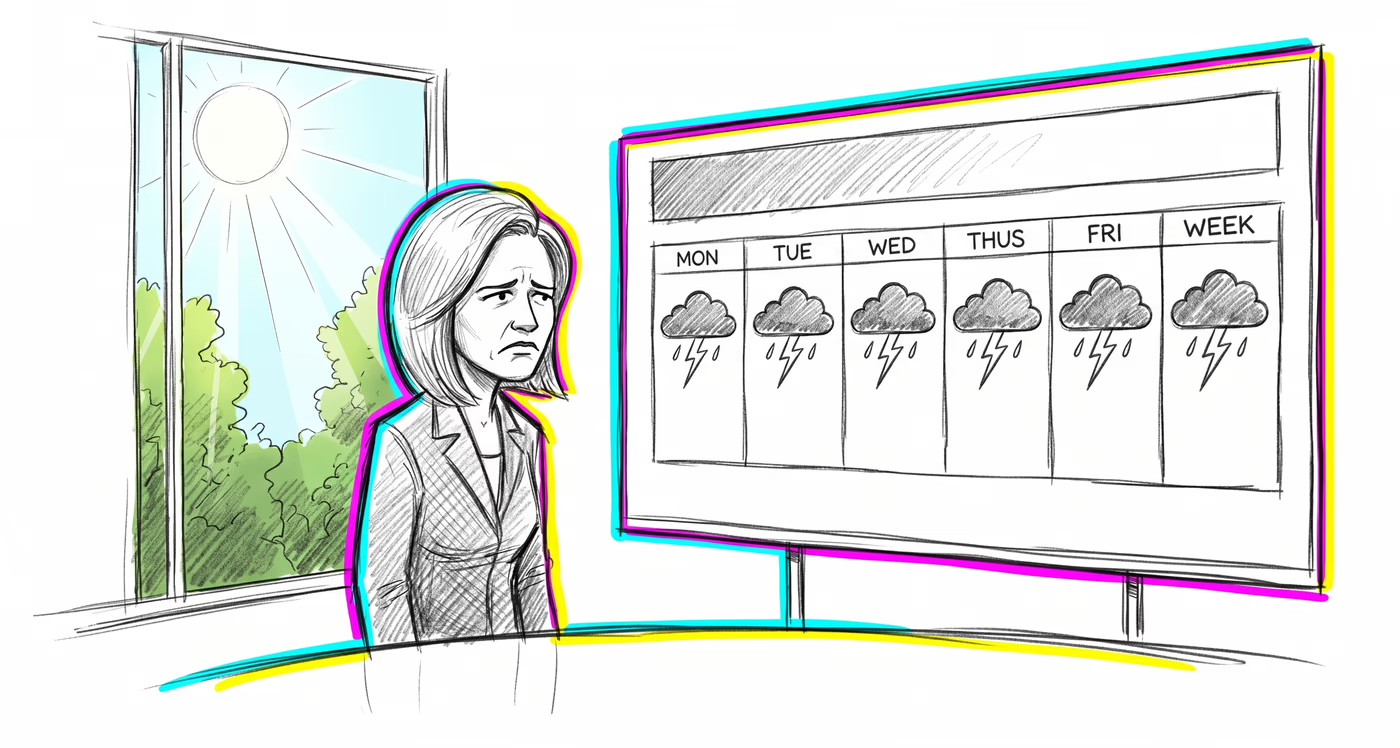
Believing society is in irreversible decline, often paired with an idealized, rose-tinted view of the past.

WHAT IT IS

The glitch, explained plainly.

It's like thinking music was 'real' and life was 'simpler' when you were a kid, while ignoring the fact that you also didn't have modern medicine, the internet, or the same civil rights back then.

Declensionism is a predisposition to view the present and future as inherently worse than a perceived 'Golden Age' of the past. It involves a selective memory process where historical hardships are filtered out, leaving only positive attributes to compare against modern complexities and failures. This bias often manifests as a collective cultural narrative that reinforces the idea that traditional values, social cohesion, or economic stability are permanently eroding.

SOUND FAMILIAR?

Where it shows up.

  1. 01 A grandfather tells his grandson that the neighborhood was a 'paradise' in 1960, ignoring the high crime rates and lack of infrastructure that actually existed then.
  2. 02 A political candidate's entire platform is built on 'returning' the country to a specific decade that was actually fraught with civil unrest.
  3. 03 A manager refuses to adopt new software because the 'old paper system' worked perfectly and people were 'more focused' back then.
  4. 04 A social media thread goes viral by comparing a grainy photo of 1950s kids playing outside to kids on iPads, claiming society has failed.
  5. 05 A writer publishes an op-ed claiming that human empathy is dead because of smartphones, citing a 'kinder' era that never truly existed.
IN DIFFERENT DOMAINS

Where it shows up at work.

The same glitch looks different depending on the terrain. Finance, medicine, a relationship, a team — same mechanism, different costume.

Finance & investing

Investors avoiding new asset classes like crypto or ESG funds because they believe the 'pure' stock market of the mid-20th century was the only 'honest' way to build wealth.

Medicine & diagnosis

The 'natural is better' movement, which suggests that ancient herbal remedies are superior to modern pharmaceuticals, ignoring the drastically lower life expectancy of the past.

Education & grading

The recurring 'Literacy Crisis' narrative where critics claim students can no longer write, despite historical data showing writing proficiency has remained stable or improved in many metrics.

Relationships

The belief that 'divorce didn't exist' in the past, ignoring the 'empty shell' marriages and lack of legal agency for women that kept families together by force.

Tech & product

Users demanding the return of skeuomorphic designs (icons that look like real objects) because they feel 'more intuitive' and 'warm' than modern flat UI.

HOW TO SPOT IT

Ask yourself…

  • Am I ignoring the specific problems and suffering that existed in the era I am currently romanticizing?
  • Is my view of the 'decline' based on objective data (like crime rates or health) or just a 'feeling' of cultural loss?
  • Am I confusing 'the world getting worse' with 'me getting older and having more responsibilities'?
HOW TO DEFEND AGAINST IT

The playbook.

  • Fact-Checking the Past: Look up actual statistics for the 'Golden Age' regarding health, crime, and poverty.
  • Identify the Fading Affect Bias: Acknowledge that your brain naturally forgets the boring or painful parts of the past.
  • Progress Tracking: List five specific modern conveniences or social advancements you would be unwilling to give up.
  • Cognitive Reframing: View change as 'evolution' rather than 'decay'.
FAMOUS CASES

In history.

  • The 'Fall of Rome' narratives written by 18th-century historians who used Rome's decline as a cautionary tale for their own 'decaying' societies.
  • The 19th-century Romantic movement, which reacted against the Industrial Revolution by idealizing a pastoral, pre-industrial Europe.
  • The recurring 'Make America Great Again' or 'Britain's Best Days' political slogans that leverage nostalgia for specific post-war eras.
WHERE IT COMES FROM
Academic origin

Concept discussed by historians like Arthur Herman (1997) and popularised in psychology by Steven Pinker (2011/2018) in the context of 'declinism'.

Evolutionary origin

Likely tied to the survival benefit of maintaining group morale and social cohesion through shared heroic myths, and a cautious 'loss aversion' toward rapid social changes that might destabilize a known-safe environment.

IN AI SYSTEMS

How the machines inherit it.

AI models can inherit declensionism if their training data includes a disproportionate amount of alarmist literature or historical revisionist texts that frame technological progress as purely destructive.

Read more on Wikipedia
FREE FIELD ZINE

10 glitches quietly running your life.

A free field-zine PDF — ten cognitive glitches named, illustrated, with a defense move for each. Plus the weekly Glitch Report on Fridays — one bias named, two spotted in the wild, one defense move. Unsubscribe any time.

EXPLORE MORE

Related glitches.

LAUNCH PRICE

Train against your blindspots.

50 cards are free to preview. Buyers unlock the rest of the deck plus the interactive training — Spot-the-Bias Quiz unlimited, Swipe Deck with spaced repetition, My Blindspots, Decision Pre-Flight, the Printable Deck + Cheat Sheets, and the Field Guide e-book. $29.50$59.


Unlock the full deck

Everything below — yours forever. Pay once, use across every device.

Half-off launch — limited to the first 100 readers. Auto-applied at checkout.
$59 $29.50
one-time payment · lifetime access
  • All interactive digital cards — search, filter, flip, shuffle on any device
  • Five training modes — Spot-the-Bias Quiz, Swipe Deck, Pre-Flight, Blindspots, Journal
  • Curated Lenses + Decision Templates + Defense Playbook
  • Printable Deck PDFs + Field Guide e-book + Cheat Sheets + Anki Export
  • Every future improvement, included
Unlock  $29.50

30-day refund · no questions asked

Unlock the full deck

Everything below — yours forever. Pay once, use across every device.

Half-off launch — limited to the first 100 readers. Auto-applied at checkout.
$59 $29.50
one-time payment · lifetime access
  • All interactive digital cards — search, filter, flip, shuffle on any device
  • Five training modes — Spot-the-Bias Quiz, Swipe Deck, Pre-Flight, Blindspots, Journal
  • Curated Lenses + Decision Templates + Defense Playbook
  • Printable Deck PDFs + Field Guide e-book + Cheat Sheets + Anki Export
  • Every future improvement, included
Unlock  $29.50

30-day refund · no questions asked