Denomination Effect

aka Bias for the Whole · Large Bill Effect

Being less willing to spend a single large bill than the same amount in smaller bills or coins.

WHAT IT IS

The glitch, explained plainly.

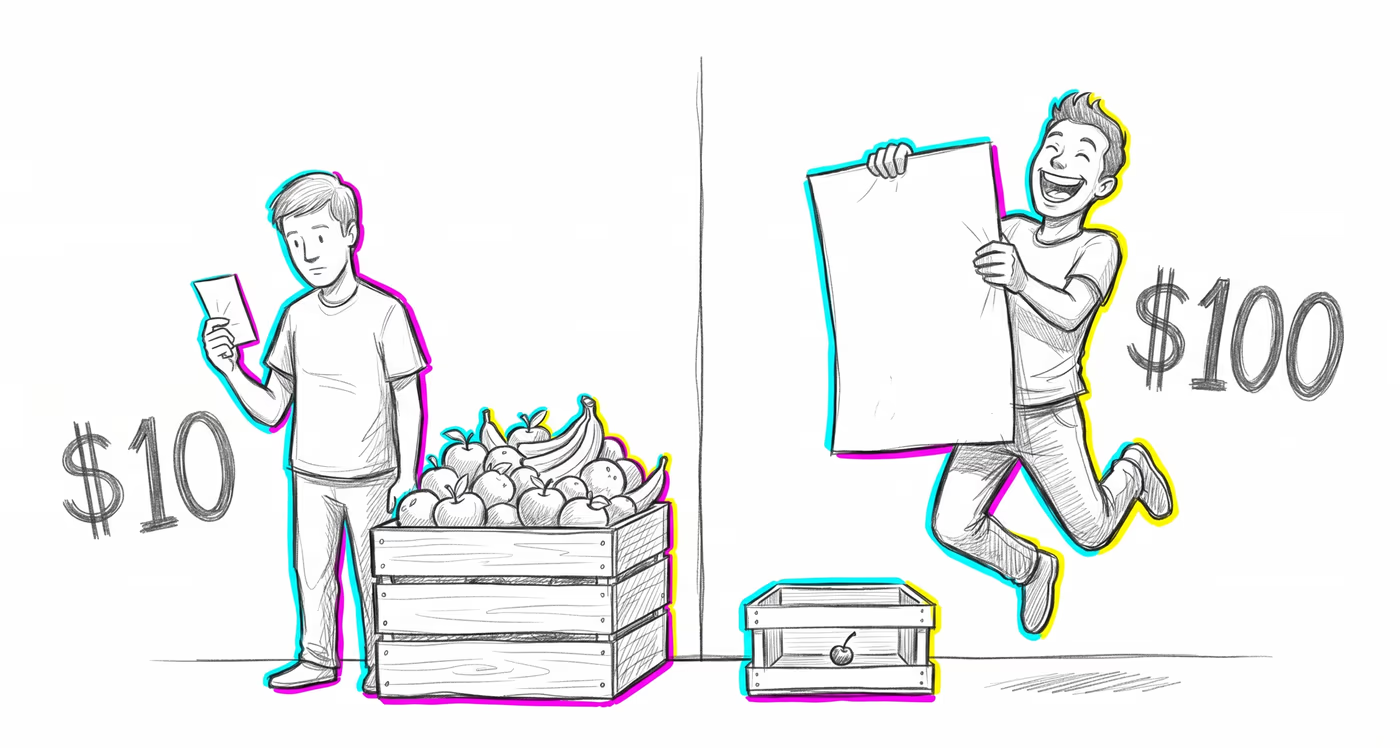
Imagine you have a big, shiny gold coin and your friend has ten small copper coins, but they're worth the exact same amount. You'd keep your gold coin safe in your pocket and not want to spend it, but your friend would happily toss their little coins into a candy machine one by one. The big coin just feels more important, even though it buys the same stuff.

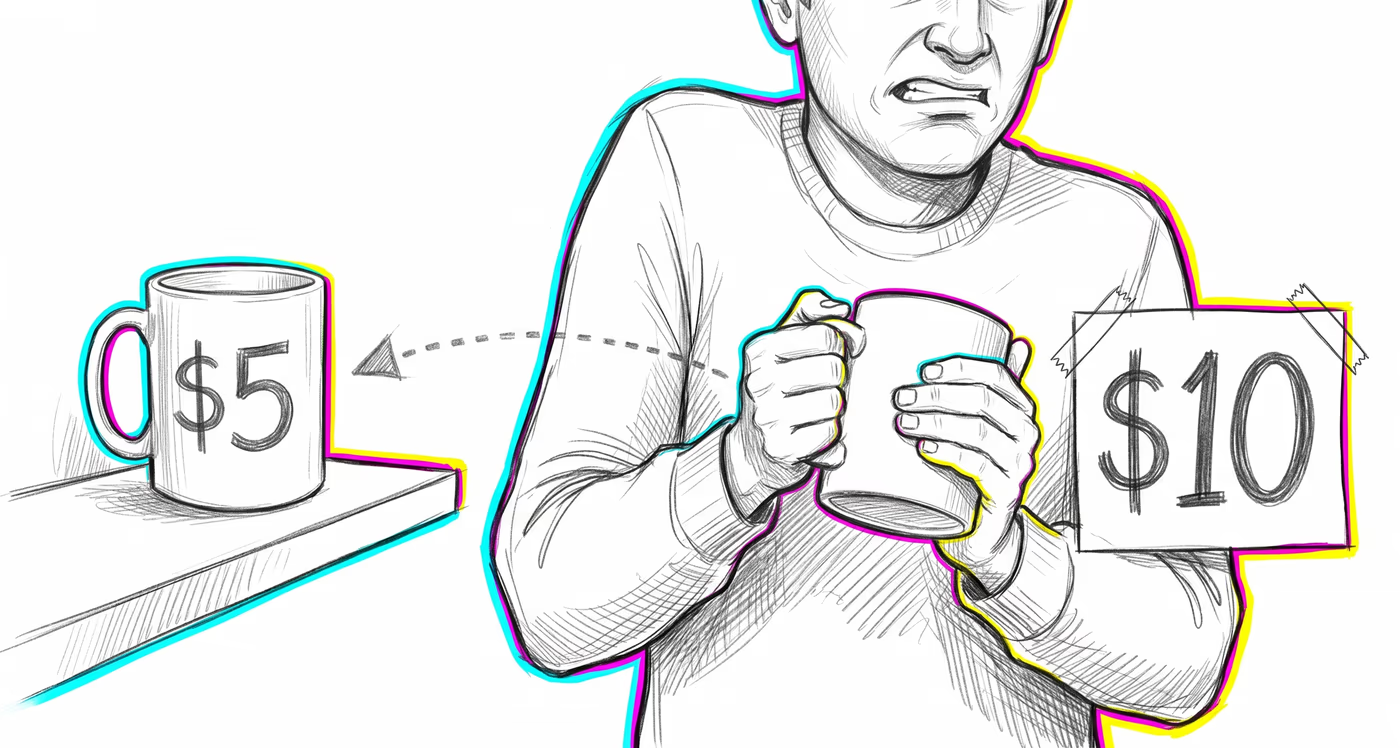
The denomination effect describes a systematic bias in which the physical form of money — specifically the size of its denominations — influences spending decisions independently of its actual monetary value. People treat a single large bill as psychologically 'weightier' and more valuable than the same total amount broken into smaller notes or coins, making them reluctant to 'break' the large bill. This reluctance stems from several reinforcing mechanisms: large denominations serve as a precommitment device for self-control, they are easier to mentally monitor and track, and breaking them triggers a heightened 'pain of paying' that smaller units do not. The effect has real consequences for consumer welfare and monetary policy, as the mere physical representation of the same amount of money can meaningfully alter saving and spending patterns.

SOUND FAMILIAR?

Where it shows up.

  1. 01 Maria receives a $100 holiday bonus in cash. She tucks it in her purse and carries it untouched for three weeks, passing up coffee runs and small treats she normally buys. When she finally breaks it to buy groceries, she spends the remaining change on snacks and magazines within two days.
  2. 02 A casino gives gamblers their winnings in stacks of $1 chips rather than a single high-value chip. Managers notice that players who receive the small chips gamble significantly longer before cashing out, compared to those who receive equivalent large chips.
  3. 03 A charity fundraiser tests two approaches: giving potential donors a single $10 bill and asking them to contribute, versus giving ten $1 bills. The $1-bill group donates nearly twice as much on average, despite receiving the same total amount.
  4. 04 An economist notices that after a country redenominates its currency — replacing 10,000 old units with 1 new unit — consumer spending temporarily drops, even though purchasing power hasn't changed. Shoppers perceive the new, smaller-numbered bills as more valuable and are reluctant to part with them.
  5. 05 A mobile game sells its virtual currency in packs: a single 1000-gem bundle or ten 100-gem packs for the same price. Players who buy the single bundle spend their gems more slowly and deliberate more before in-app purchases, while those with the ten smaller packs burn through them quickly.
IN DIFFERENT DOMAINS

Where it shows up at work.

The same glitch looks different depending on the terrain. Finance, medicine, a relationship, a team — same mechanism, different costume.

Finance & investing

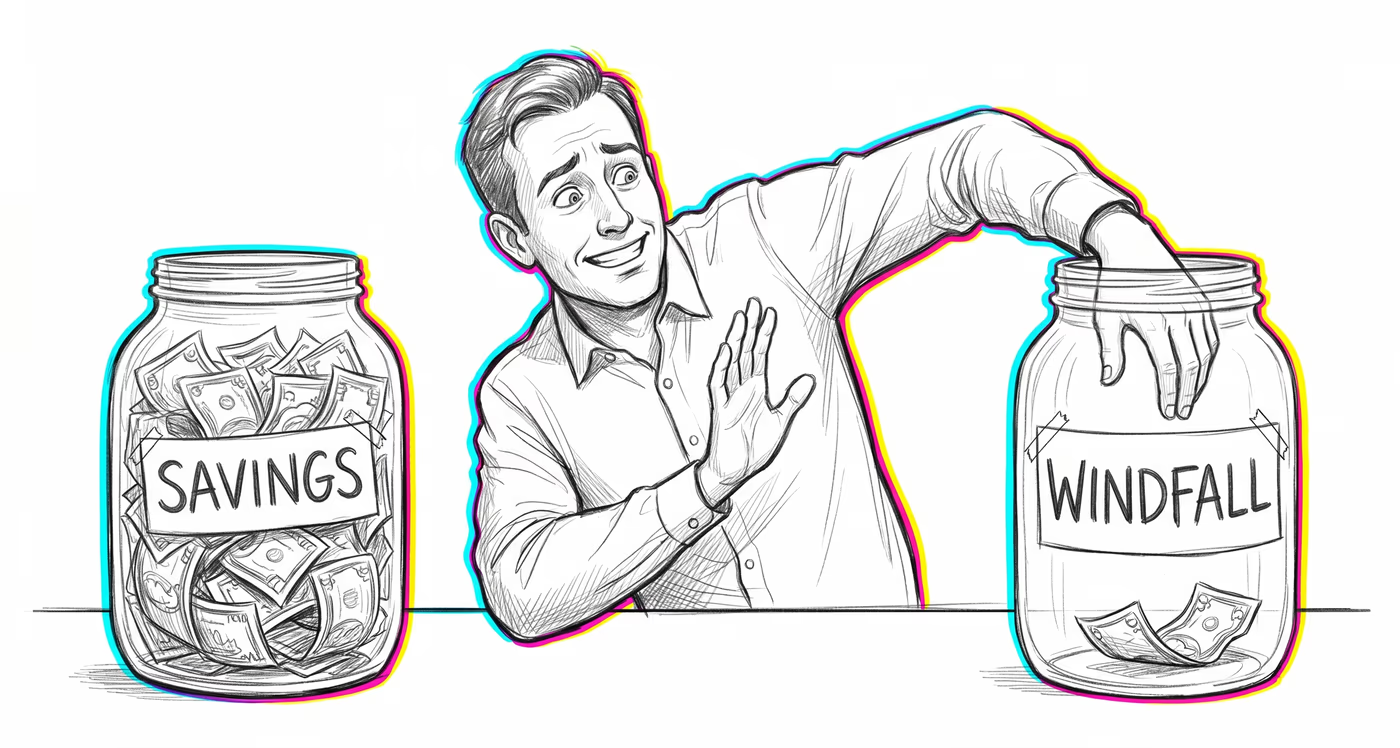
Investors may be more reluctant to liquidate a single large-value stock position than to sell off multiple smaller positions totaling the same amount, treating the large holding as psychologically more significant and harder to 'break.' Similarly, consumers spend loose change and small bills more freely, distorting household budgeting.
Relationships

People may feel more generous tipping with coins or small bills from their pocket than peeling off a large bill, leading to systematically different generosity depending on the physical form of money they happen to carry.

Tech & product

Digital platforms and games exploit this bias by selling virtual currency in small denominations (e.g., 100 coins for $1) rather than showing the real-dollar cost per item. Microtransactions feel trivial when priced in small virtual units, encouraging higher cumulative spending than if users saw the equivalent lump sum.

Politics Media

Monetary policy and currency design decisions — such as whether to introduce high-denomination bills or coins — can systematically influence national spending and saving rates. Redenomination of a currency can temporarily alter consumer behavior due to changed denomination perceptions.

HOW TO SPOT IT

Ask yourself…

  • Am I hesitating to spend this money primarily because of the physical size of the bill, not because the purchase isn't worthwhile?
  • Would I make this same purchase if I had the identical amount in smaller bills or coins instead?
  • Am I spending small change or coins more freely than I would an equivalent large bill?
HOW TO DEFEND AGAINST IT

The playbook.

  • Recognize that money is fungible: $100 in one bill has the exact same value as $100 in twenties, fives, or coins.
  • Track all spending regardless of denomination — use a budgeting app that treats every dollar identically.
  • When deciding whether to make a purchase, ask yourself whether you'd buy it if you had the money in a different physical form.
  • If you want to curb impulsive spending, intentionally carry large bills. If you want to be more willing to spend (e.g., for tipping), carry small denominations.
  • Shift to digital payments where denomination cues are absent, then evaluate whether your spending patterns change.
FAMOUS CASES

In history.

  • During the 2008 Great Recession, a Sacramento business owner observed employees switching from bills to coins in vending machines, perceiving coin spending as more frugal even when the amounts were similar.
  • Ghana's 2007 currency redenomination (removing four zeros) temporarily depressed consumer spending as people perceived the new, lower-numbered bills as more valuable.
  • The introduction of the Euro across European nations in 2002 led to shifts in spending patterns partly attributed to denomination-related cognitive illusions as consumers adjusted to unfamiliar bill sizes.
WHERE IT COMES FROM
Academic origin

Priya Raghubir and Joydeep Srivastava, 2009, 'Denomination Effect,' Journal of Consumer Research. Preceded by Mishra, Mishra, and Nayakankuppam (2006), who documented the related 'bias for the whole' in the Journal of Consumer Research.

Evolutionary origin

While there is no direct ancestral equivalent for currency denominations, the effect likely exploits an older tendency to preserve whole, intact resources over fragmented ones. In resource-scarce environments, a large intact food store (e.g., a whole animal carcass) would have been perceived as more valuable and worth protecting than scattered smaller portions, because wholeness signaled future security and reduced the cognitive cost of inventory tracking.

IN AI SYSTEMS

How the machines inherit it.

Recommendation engines and pricing algorithms that present costs in small fractional units (e.g., '$0.99/day' vs. '$365/year') exploit the same psychological mechanism. AI-driven pricing systems may inadvertently learn that breaking prices into micro-denominations increases conversion rates, perpetuating the bias at scale without explicit programming.

Read more on Wikipedia
FREE FIELD ZINE

10 glitches quietly running your life.

A free field-zine PDF — ten cognitive glitches named, illustrated, with a defense move for each. Plus the weekly Glitch Report on Fridays — one bias named, two spotted in the wild, one defense move. Unsubscribe any time.

EXPLORE MORE

Related glitches.

LAUNCH PRICE

Train against your blindspots.

50 cards are free to preview. Buyers unlock the rest of the deck plus the interactive training — Spot-the-Bias Quiz unlimited, Swipe Deck with spaced repetition, My Blindspots, Decision Pre-Flight, the Printable Deck + Cheat Sheets, and the Field Guide e-book. $29.50$59.

Unlock the full deck

Everything below — yours forever. Pay once, use across every device.

Half-off launch — limited to the first 100 readers. Auto-applied at checkout.
$59 $29.50
one-time payment · lifetime access
  • All interactive digital cards — search, filter, flip, shuffle on any device
  • Five training modes — Spot-the-Bias Quiz, Swipe Deck, Pre-Flight, Blindspots, Journal
  • Curated Lenses + Decision Templates + Defense Playbook
  • Printable Deck PDFs + Field Guide e-book + Cheat Sheets + Anki Export
  • Every future improvement, included
Unlock  $29.50

30-day refund · no questions asked

Unlock the full deck

Everything below — yours forever. Pay once, use across every device.

Half-off launch — limited to the first 100 readers. Auto-applied at checkout.
$59 $29.50
one-time payment · lifetime access
  • All interactive digital cards — search, filter, flip, shuffle on any device
  • Five training modes — Spot-the-Bias Quiz, Swipe Deck, Pre-Flight, Blindspots, Journal
  • Curated Lenses + Decision Templates + Defense Playbook
  • Printable Deck PDFs + Field Guide e-book + Cheat Sheets + Anki Export
  • Every future improvement, included
Unlock  $29.50

30-day refund · no questions asked