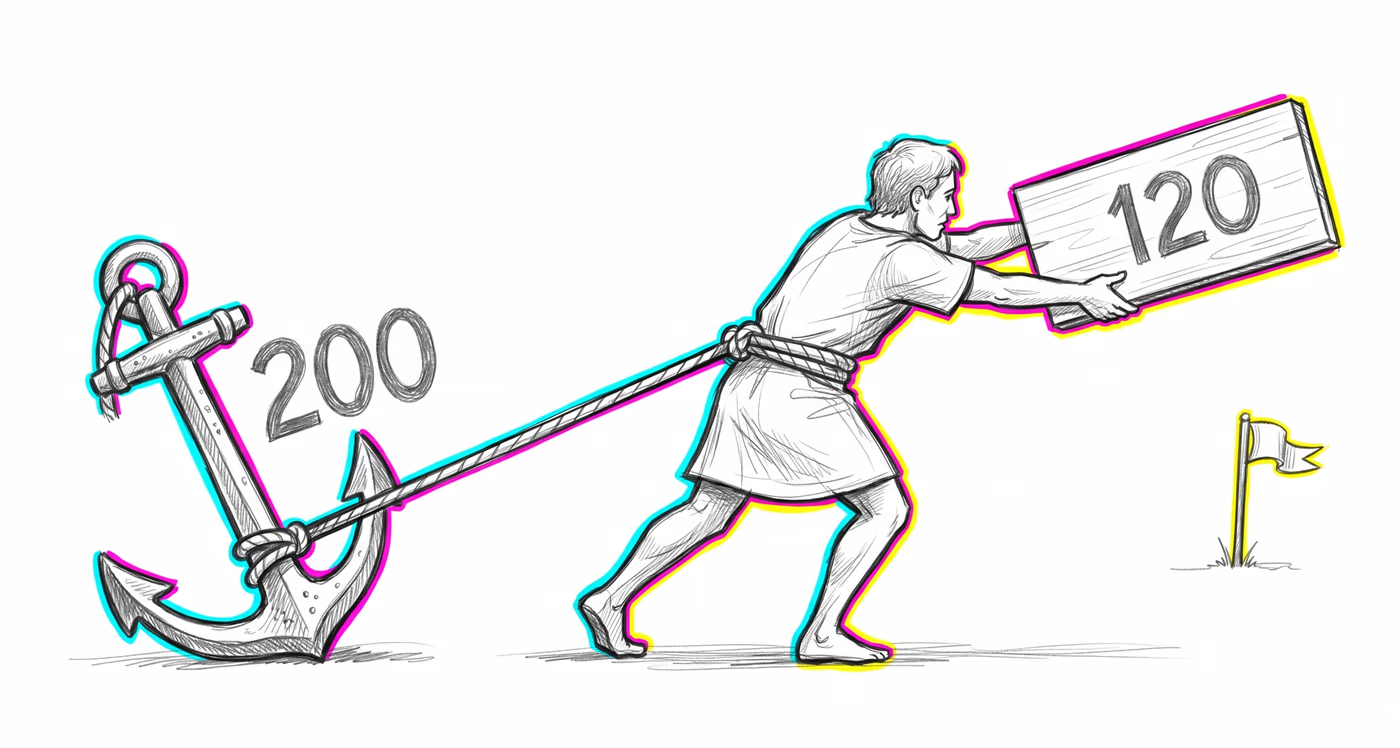
Denominator Neglect

aka Ratio Bias · Denominator Neglect Bias

Focusing on the number of successes while ignoring the total number of attempts, distorting probability estimates.

WHAT IT IS

The glitch, explained plainly.

Imagine you have two bags of candy. One bag has 1 golden candy out of 10 total. The other bag has 7 golden candies out of 100 total. You want to reach in and grab a golden one. Even though you have a better chance with the small bag (1 in 10 is better than 7 in 100), your brain says 'but look at all those golden candies in the big bag!' and wants to pick there instead. Your brain gets excited about counting the winners and forgets to count everything else.

Denominator neglect occurs when people give disproportionate attention to the absolute count of target events while failing to adequately weigh the total population or sample size from which those events are drawn. This means that a medical treatment saving 100 lives out of 700 may feel more effective than one saving 90 out of 400, even though the latter has a much higher success rate. The bias is particularly insidious in risk communication, where framing a danger as '1,286 deaths per 10,000 people' makes it seem far more threatening than '24.14 deaths per 100 people,' despite the latter representing a higher mortality rate. People often report being fully aware that the probabilities favor the smaller-number option, yet they still feel drawn to the larger absolute figure — a hallmark conflict between intuitive and analytical processing.

SOUND FAMILIAR?

Where it shows up.

  1. 01 A city council is reviewing two water safety programs. Program A caught 300 contaminant violations out of 15,000 tests. Program B caught 45 violations out of 500 tests. The council votes to expand Program A, praising its '300 catches' as evidence of superior detection capability, without calculating that B's 9% detection rate far exceeds A's 2%.
  2. 02 A parent is choosing between two daycares. Daycare A reports 12 minor injuries over the past year with 400 enrolled children. Daycare B reports 3 injuries with 30 children. The parent chooses Daycare B because 'only 3 kids got hurt,' overlooking that B's injury rate (10%) is more than triple A's (3%).
  3. 03 A pharmaceutical company presents clinical trial results showing Drug X prevented complications in 800 out of 10,000 at-risk patients, while Drug Y prevented complications in 120 out of 500 at-risk patients. A hospital formulary committee selects Drug X, citing its impressive absolute number of patients helped, even though Drug Y's 24% efficacy rate substantially outperforms Drug X's 8%.
  4. 04 An investor compares two mutual funds. Fund A generated $2 million in returns on a $50 million portfolio, while Fund B generated $400,000 on a $3 million portfolio. The investor moves money into Fund A because '$2 million in returns' sounds far more impressive, without recognizing that Fund B's 13.3% return dwarfs Fund A's 4%.
  5. 05 A public health official opposes a new vaccine after reviewing adverse event reports showing 150 serious side effects across 20 million doses administered. A colleague points out that the alternative treatment has 8 serious side effects per 5,000 treatments, but the official remains fixated on the absolute number of 150, arguing that 'we can't ignore 150 people harmed' — failing to recognize the alternative carries a risk rate thousands of times higher.
IN DIFFERENT DOMAINS

Where it shows up at work.

The same glitch looks different depending on the terrain. Finance, medicine, a relationship, a team — same mechanism, different costume.

Finance & investing

Investors are drawn to funds or stocks reporting large absolute dollar gains without normalizing for the size of the investment or portfolio, leading them to favor high-volume, low-return options over smaller, higher-yield alternatives. Revenue figures presented without reference to total market size or costs similarly distort valuation judgments.
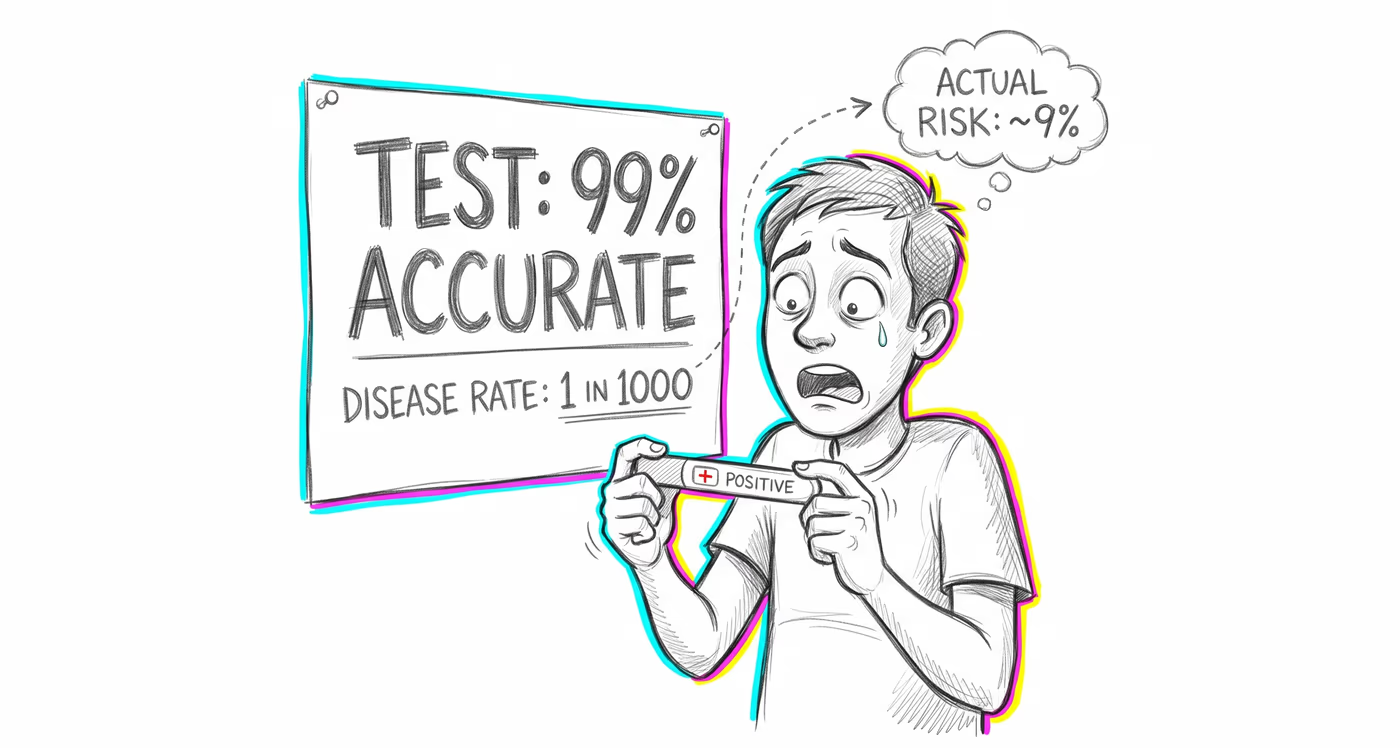

Medicine & diagnosis

Patients and clinicians misjudge treatment risks when adverse events are reported as raw counts rather than rates. A treatment with '50 reported side effects' among 2 million patients may be rejected in favor of one with '5 side effects' among 1,000 patients. Risk communication research shows that frequency formats with large denominators systematically inflate perceived danger.

Education & grading

Students and educators may evaluate school performance based on total number of high-achieving students rather than the proportion of the student body reaching benchmarks. A large school celebrating '500 honor roll students' may appear superior to a small school with '40 honor roll students,' even if the smaller school has a higher percentage of high performers.

Relationships

People judge partners or friends by the absolute count of positive or negative actions ('He forgot my birthday three times!') without normalizing against the total number of relevant interactions or years, inflating or deflating the perceived frequency of behaviors.

Tech & product

Product teams may prioritize fixing a bug reported by 200 users on a platform with 10 million users over a bug reported by 15 users on a feature used by only 100 people, despite the latter having a 15% failure rate versus 0.002%. Dashboard designs that display raw event counts without contextual denominators encourage biased prioritization.

Workplace & hiring

Hiring managers may be impressed by a candidate who 'closed 50 deals' without asking about the total pipeline size, compared to a candidate who closed 12 deals out of 15 leads. Performance reviews that report absolute output numbers without normalizing for opportunity, workload, or team size systematically favor high-volume, low-efficiency performers.

Politics Media

Media outlets exploit denominator neglect by reporting absolute figures — '10,000 crimes in City X' — without per-capita context, making larger cities appear more dangerous. Politicians frame policy statistics using whichever denominator makes their position look strongest, and audiences rarely recalculate.

HOW TO SPOT IT

Ask yourself…

  • Am I reacting to a raw count of events, or have I actually calculated the rate or percentage?
  • Do I know what the total population or sample size is behind this number?
  • Would my judgment change if the same information were presented as a percentage instead of an absolute figure?
HOW TO DEFEND AGAINST IT

The playbook.

  • Always convert absolute numbers to rates or percentages before making comparisons — force yourself to divide the numerator by the denominator.
  • Ask 'out of how many?' every time you encounter a count-based statistic in news, reports, or marketing materials.
  • Use visual aids like icon arrays or pie charts that make proportions visually salient rather than relying on raw frequency tables.
  • When comparing two options, normalize them to a common denominator (e.g., per 1,000 people) before evaluating.
  • Practice the Kahneman reframe: restate any absolute-number risk statement as a mathematical probability and see if your intuition shifts.
FAMOUS CASES

In history.

  • During the AstraZeneca COVID-19 vaccine rollout, public fear was disproportionately driven by absolute reports of rare blood clot cases (e.g., 15 cases among millions of doses), while the extremely low per-dose risk rate received less attention, contributing to vaccine hesitancy in multiple countries.
  • Media coverage of shark attacks routinely reports annual absolute numbers (e.g., '88 unprovoked attacks worldwide') without referencing the billions of ocean-swimmer hours, inflating public fear of sharks beyond all statistical warrant.
WHERE IT COMES FROM
Academic origin

The concept was developed independently by Valerie Reyna and Charles Brainerd (1991–1994) under fuzzy-trace theory, and by Seymour Epstein (1994) under cognitive-experiential self-theory (CEST). The seminal experimental demonstration was by Veronika Denes-Raj and Seymour Epstein (1994). Kimihiko Yamagishi (1997) extended it to risk perception. Daniel Kahneman popularized the term 'denominator neglect' in Thinking, Fast and Slow (2011).

Evolutionary origin

In ancestral environments, absolute frequencies were the only available data format. Encountering 8 predators in a large valley versus 1 predator in a small clearing required rapid, concrete assessment of immediate threats. Brains evolved to process raw counts of dangers and opportunities because percentage-based reasoning did not exist in pre-numerate societies. The ability to quickly register 'more threats here' provided a survival advantage even when the proportional risk was lower.

IN AI SYSTEMS

How the machines inherit it.

Machine learning models trained on imbalanced datasets can exhibit a form of denominator neglect when evaluation metrics focus on absolute counts of correct predictions rather than rates. A classifier detecting rare fraud may look impressive with thousands of true positives while hiding a high false-positive rate against a massive denominator of legitimate transactions. Additionally, LLMs summarizing statistical data may emphasize absolute numbers from training text while underreporting rates, mirroring the human bias in their outputs.

Read more on Wikipedia
FREE FIELD ZINE

10 glitches quietly running your life.

A free field-zine PDF — ten cognitive glitches named, illustrated, with a defense move for each. Plus the weekly Glitch Report on Fridays — one bias named, two spotted in the wild, one defense move. Unsubscribe any time.

EXPLORE MORE

Related glitches.

LAUNCH PRICE

Train against your blindspots.

50 cards are free to preview. Buyers unlock the rest of the deck plus the interactive training — Spot-the-Bias Quiz unlimited, Swipe Deck with spaced repetition, My Blindspots, Decision Pre-Flight, the Printable Deck + Cheat Sheets, and the Field Guide e-book. $29.50$59.

Unlock the full deck

Everything below — yours forever. Pay once, use across every device.

Half-off launch — limited to the first 100 readers. Auto-applied at checkout.
$59 $29.50
one-time payment · lifetime access
  • All interactive digital cards — search, filter, flip, shuffle on any device
  • Five training modes — Spot-the-Bias Quiz, Swipe Deck, Pre-Flight, Blindspots, Journal
  • Curated Lenses + Decision Templates + Defense Playbook
  • Printable Deck PDFs + Field Guide e-book + Cheat Sheets + Anki Export
  • Every future improvement, included
Unlock  $29.50

30-day refund · no questions asked

Unlock the full deck

Everything below — yours forever. Pay once, use across every device.

Half-off launch — limited to the first 100 readers. Auto-applied at checkout.
$59 $29.50
one-time payment · lifetime access
  • All interactive digital cards — search, filter, flip, shuffle on any device
  • Five training modes — Spot-the-Bias Quiz, Swipe Deck, Pre-Flight, Blindspots, Journal
  • Curated Lenses + Decision Templates + Defense Playbook
  • Printable Deck PDFs + Field Guide e-book + Cheat Sheets + Anki Export
  • Every future improvement, included
Unlock  $29.50

30-day refund · no questions asked