Feature-Positive Effect

aka Feature-Positive Bias · FPE

Noticing when something is present much more easily than when it's absent — nonoccurrences are nearly invisible.

WHAT IT IS

The glitch, explained plainly.

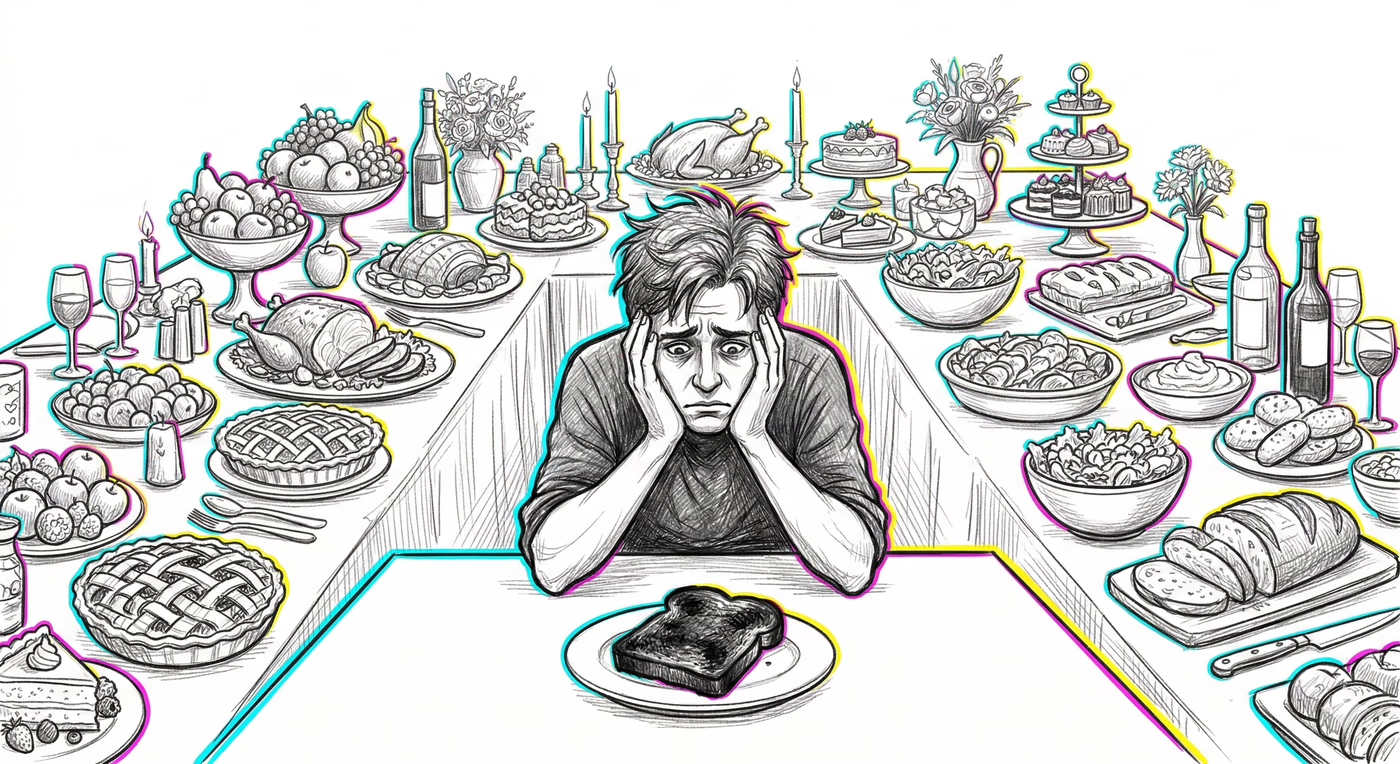
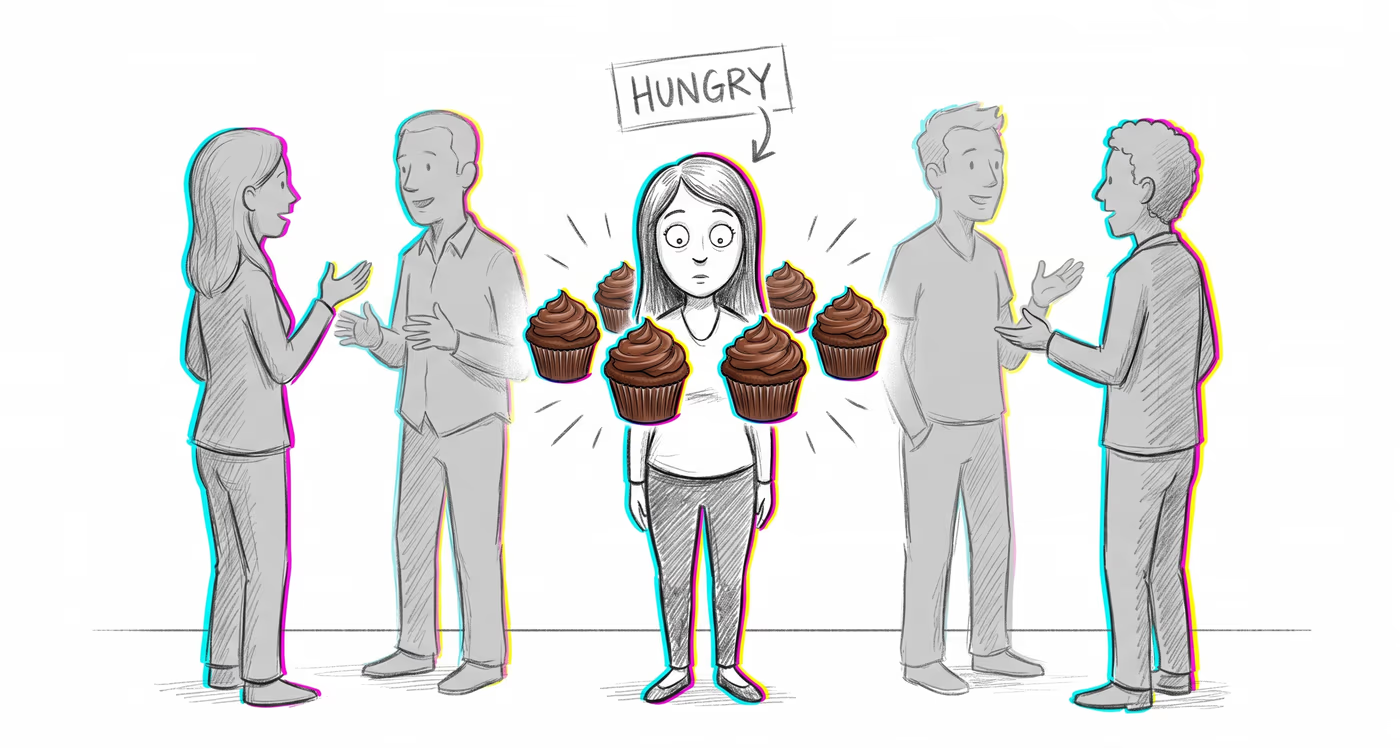
Imagine you have a box of crayons. It's really easy to notice when there's a bright red crayon in the box—you see it right away. But if someone quietly takes the red crayon out, you probably won't notice it's missing for a long time. Our brains are really good at noticing things that ARE there, but really bad at noticing when something ISN'T there.

The Feature-Positive Effect describes the asymmetry in how organisms—including humans—process information about what is present versus what is absent. People find it significantly easier to learn associations involving the presence of a cue than associations involving its absence, leading them to underweight or overlook the informational value of things that do not happen. This bias extends beyond mere attention; it distorts recall, judgment, and decision-making, because nonoccurring events are encoded more weakly in memory and perceived as less important even when they carry equivalent or greater diagnostic value. The effect has been demonstrated across species, from pigeons and monkeys to children and adults, suggesting a deeply rooted processing asymmetry rather than a learned cultural habit.

SOUND FAMILIAR?

Where it shows up.

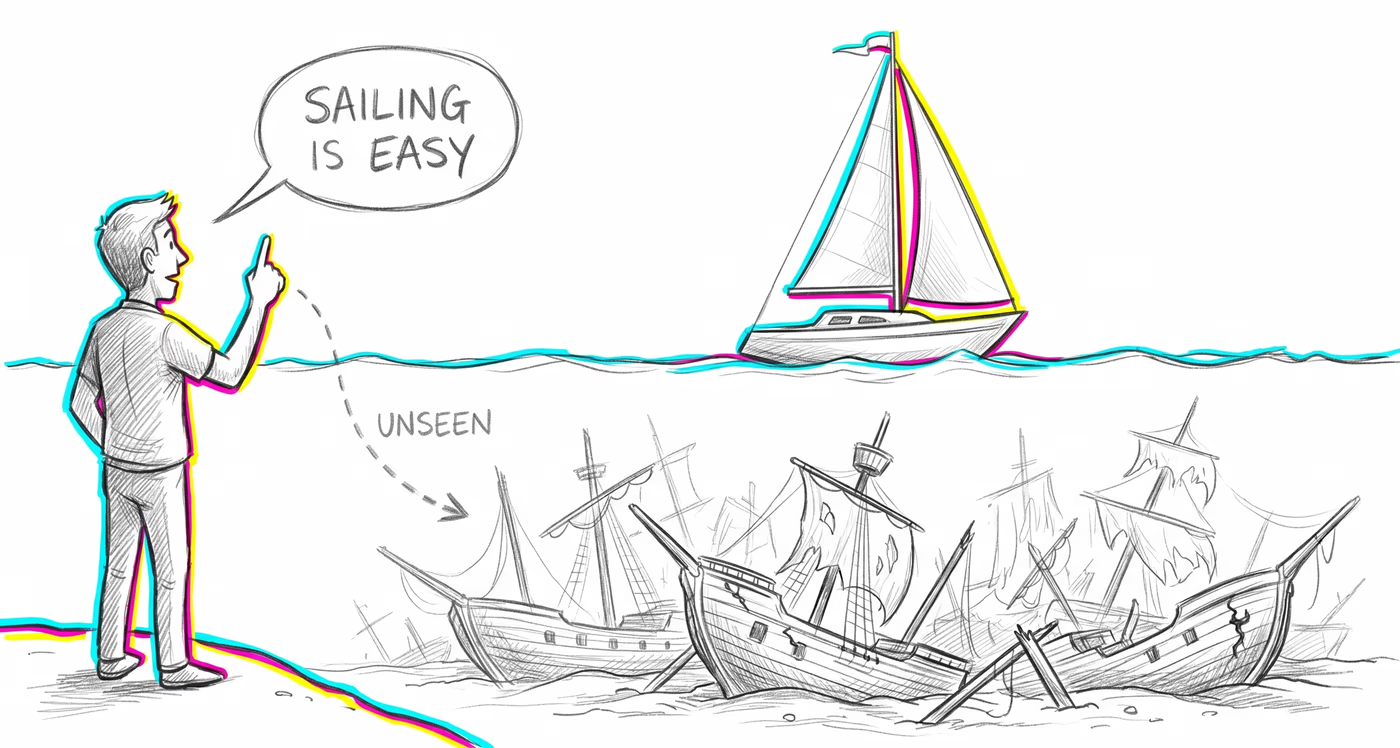
  1. 01 A city council reviews public safety data and decides to defund a program that prevents bridge collapses. Since no bridges have collapsed in 15 years, council members argue the program is unnecessary—failing to recognize that the absence of collapses is precisely the evidence that the program is working.
  2. 02 A product manager compiles user feedback and notices that 40 users complained about a buggy search feature. She prioritizes fixing it immediately, while a report showing that the checkout flow has zero error reports—meaning it works flawlessly—receives no mention in the quarterly review, and the team that built it gets no recognition.
  3. 03 A doctor evaluates two patients for a rare disease. Patient A has an unusual rash (a present symptom), and the doctor immediately investigates further. Patient B lacks three key symptoms that would normally accompany the disease, which is equally diagnostic, but the doctor doesn't factor in these absences and orders the same battery of tests for both.
  4. 04 A teacher gives students a set of number sequences and asks them to discover the hidden rule. Students quickly find the pattern 'all sequences containing a 7 are winners,' but when the rule is actually 'all sequences NOT containing a 3 are winners,' the same students take four times as long to figure it out.
  5. 05 An investor reads a company's annual report and focuses on the new product launches and revenue growth mentioned. He fails to notice that the report makes no mention of the company's previously announced sustainability initiative—an absence that signals the initiative was quietly abandoned, which later proves to be a reputational liability.
IN DIFFERENT DOMAINS

Where it shows up at work.

The same glitch looks different depending on the terrain. Finance, medicine, a relationship, a team — same mechanism, different costume.

Finance & investing

Investors tend to react strongly to the presence of positive earnings signals or visible risk indicators but fail to notice the absence of expected disclosures, dividend payments, or regulatory filings—missing information that can be equally diagnostic of a company's health.

Medicine & diagnosis

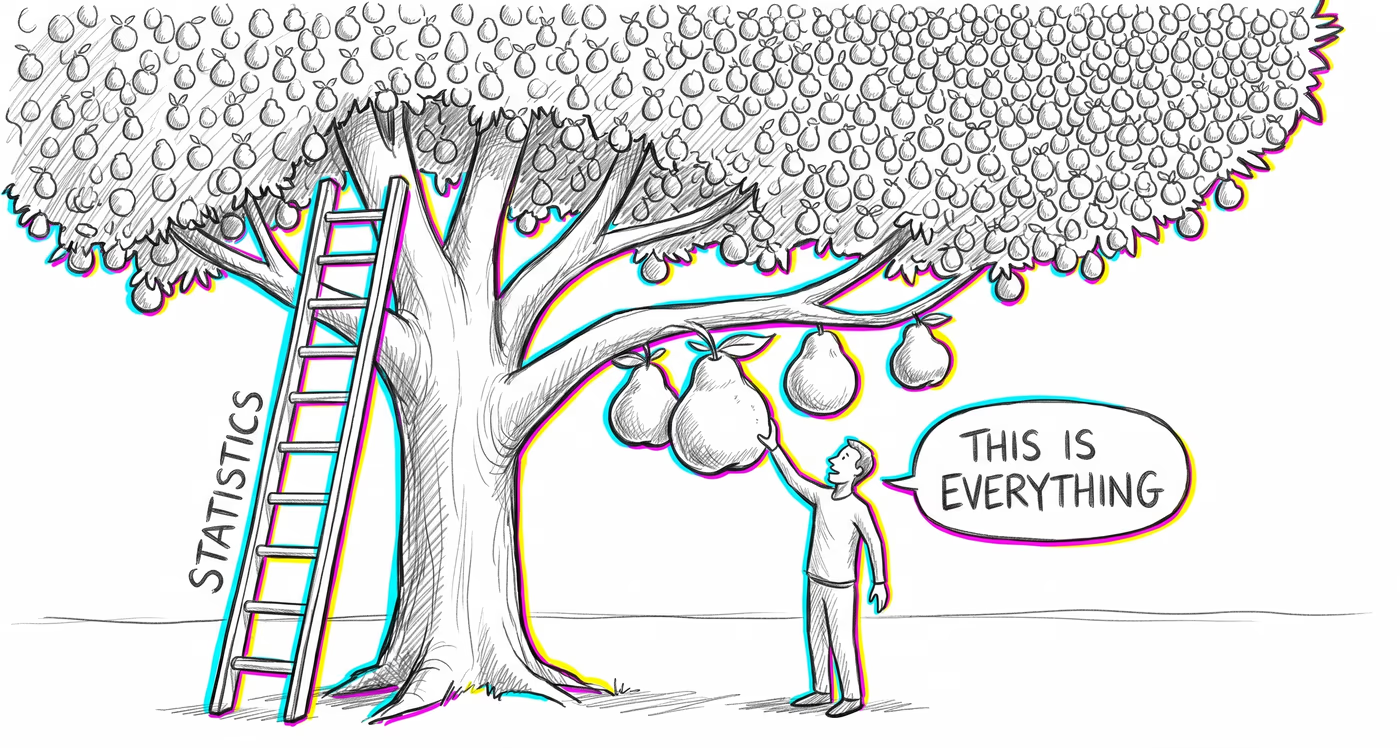
Clinicians more readily identify and act on symptoms that are present (a visible rash, an abnormal lab value) while systematically underweighting the diagnostic value of absent symptoms, even when the absence of certain findings is a strong differential diagnostic clue.

Education & grading

Teachers and students more easily learn rules defined by the presence of a feature ('words with a double letter are X') than rules defined by absence ('words without a vowel cluster are Y'), leading to systematic difficulty with concepts framed around what is missing or excluded.

Relationships

People readily notice and remember hurtful actions or comments from partners (presence) but chronically fail to appreciate the absence of conflict, criticism, or neglect—leading them to undervalue stable, low-drama relationships.

Tech & product

Product teams track and respond to bug reports and feature requests (present signals) but struggle to identify usability problems from what users are NOT doing—such as features that are never used or flows that are silently abandoned—because absence generates no salient data.

Workplace & hiring

Managers easily recognize and reward visible achievements (closed deals, shipped features) but fail to notice or credit preventive work—the security breach that didn't happen, the compliance violation that was avoided—because success through prevention produces no observable event.

Politics Media

News coverage gravitates toward events that occurred (attacks, disasters, scandals) rather than non-events (prevented attacks, avoided crises, successful deterrence), distorting public perception of risk and causing preventive policies to appear wasteful.

HOW TO SPOT IT

Ask yourself…

  • Am I making this judgment based only on what I can see, hear, or observe—and ignoring what might be conspicuously absent?
  • Would I weigh this evidence differently if the absence of something were presented to me as a visible, tangible event?
  • Am I undervaluing a preventive measure or quiet success simply because nothing bad happened?
HOW TO DEFEND AGAINST IT

The playbook.

  • Explicitly ask: 'What is NOT happening here that I would expect to see, and what does that tell me?' Force yourself to generate a list of absent features.
  • Use pre-mortem analysis: before making a decision, imagine a failure scenario and identify which absent warning signs you might be ignoring.
  • Create checklists that include both presence and absence criteria—for example, in medical diagnosis, explicitly list symptoms the patient does NOT have and consider their diagnostic value.
  • Reframe absences as presences: instead of 'no side effects,' think 'a clean bill of health after treatment'—translating missing features into positive statements.
  • When evaluating programs or policies, ask: 'What would the world look like if this program didn't exist?' to make the prevented outcomes more concrete and visible.
FAMOUS CASES

In history.

  • Public health campaigns against smoking: the greatest medical achievement of recent decades—discouraging smoking—is rarely cited because it involves the absence of disease rather than a dramatic cure.
  • Y2K bug remediation: after extensive preventive work prevented computer failures at the year 2000 rollover, the lack of catastrophe led many to dismiss the effort as unnecessary, because the prevented disaster was invisible.
  • Vaccination programs: the elimination of diseases like smallpox and near-elimination of polio are undervalued because people cannot see the diseases that no longer occur, contributing to modern vaccine hesitancy.
WHERE IT COMES FROM
Academic origin

First described by Sainsbury and Jenkins (1967) in pigeon discrimination learning experiments. Extended to adult human subjects by Newman, Wolff, and Hearst (1980) at Indiana University.

Evolutionary origin

In ancestral environments, present stimuli—a predator in view, ripe fruit on a branch, a moving shadow—demanded immediate response and carried urgent survival information. Absent stimuli (the lack of a predator, the absence of food) were less actionable in the moment. Organisms that quickly attended to present features and acted on them had a survival advantage, so neural systems evolved a processing bias toward what is here and now rather than what is not.

IN AI SYSTEMS

How the machines inherit it.

Machine learning models are typically trained on positive examples (features that are present in the data) and struggle to learn from absent features or missing data patterns. Anomaly detection systems have difficulty identifying threats defined by what is missing rather than what is present. Additionally, training datasets encode the feature-positive effect from their human annotators, who are more likely to label and flag present features than absent ones, creating systematic gaps in model knowledge about nonoccurrences.

FREE FIELD ZINE

10 glitches quietly running your life.

A free field-zine PDF — ten cognitive glitches named, illustrated, with a defense move for each. Plus the weekly Glitch Report on Fridays — one bias named, two spotted in the wild, one defense move. Unsubscribe any time.

EXPLORE MORE

Related glitches.

LAUNCH PRICE

Train against your blindspots.

50 cards are free to preview. Buyers unlock the rest of the deck plus the interactive training — Spot-the-Bias Quiz unlimited, Swipe Deck with spaced repetition, My Blindspots, Decision Pre-Flight, the Printable Deck + Cheat Sheets, and the Field Guide e-book. $29.50$59.

Unlock the full deck

Everything below — yours forever. Pay once, use across every device.

Half-off launch — limited to the first 100 readers. Auto-applied at checkout.
$59 $29.50
one-time payment · lifetime access
  • All interactive digital cards — search, filter, flip, shuffle on any device
  • Five training modes — Spot-the-Bias Quiz, Swipe Deck, Pre-Flight, Blindspots, Journal
  • Curated Lenses + Decision Templates + Defense Playbook
  • Printable Deck PDFs + Field Guide e-book + Cheat Sheets + Anki Export
  • Every future improvement, included
Unlock  $29.50

30-day refund · no questions asked

Unlock the full deck

Everything below — yours forever. Pay once, use across every device.

Half-off launch — limited to the first 100 readers. Auto-applied at checkout.
$59 $29.50
one-time payment · lifetime access
  • All interactive digital cards — search, filter, flip, shuffle on any device
  • Five training modes — Spot-the-Bias Quiz, Swipe Deck, Pre-Flight, Blindspots, Journal
  • Curated Lenses + Decision Templates + Defense Playbook
  • Printable Deck PDFs + Field Guide e-book + Cheat Sheets + Anki Export
  • Every future improvement, included
Unlock  $29.50

30-day refund · no questions asked