False Uniqueness Effect

aka False Uniqueness Bias · Illusion of Uniqueness · False Distinctiveness

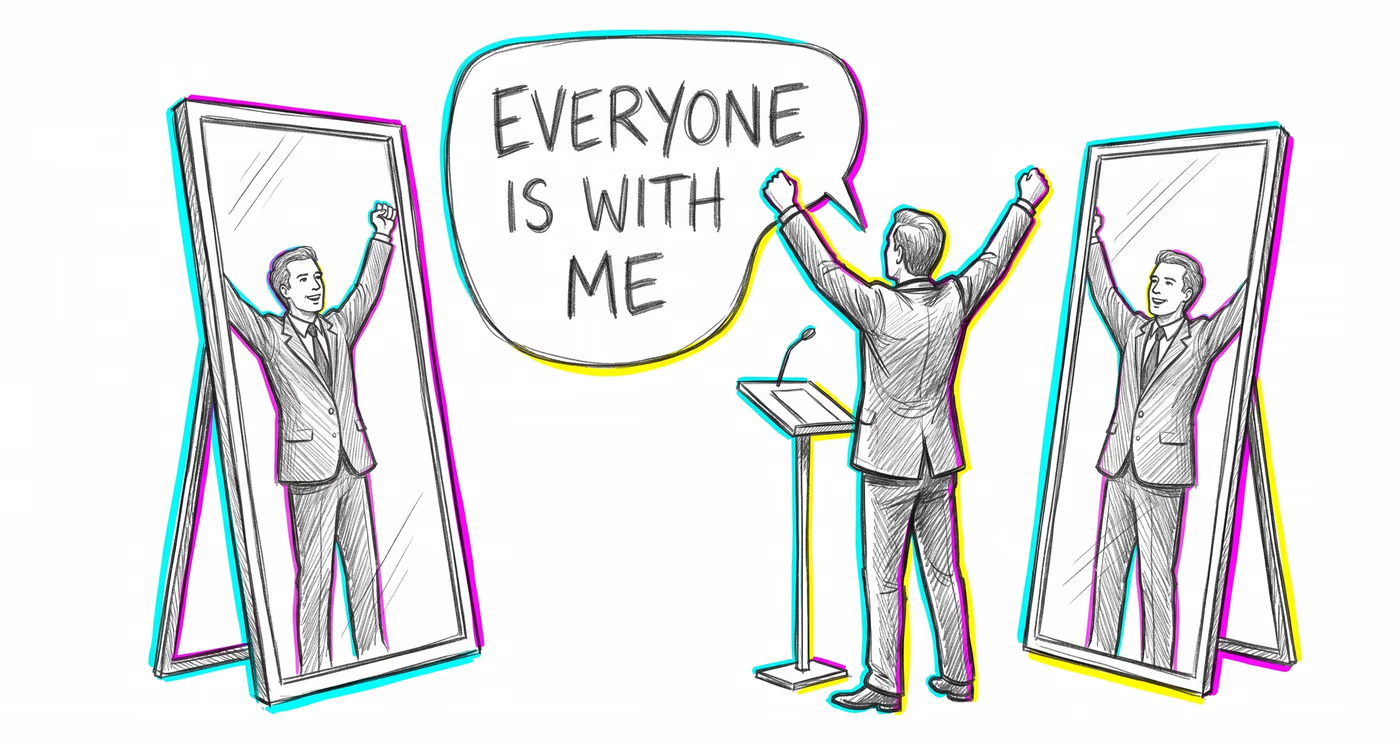
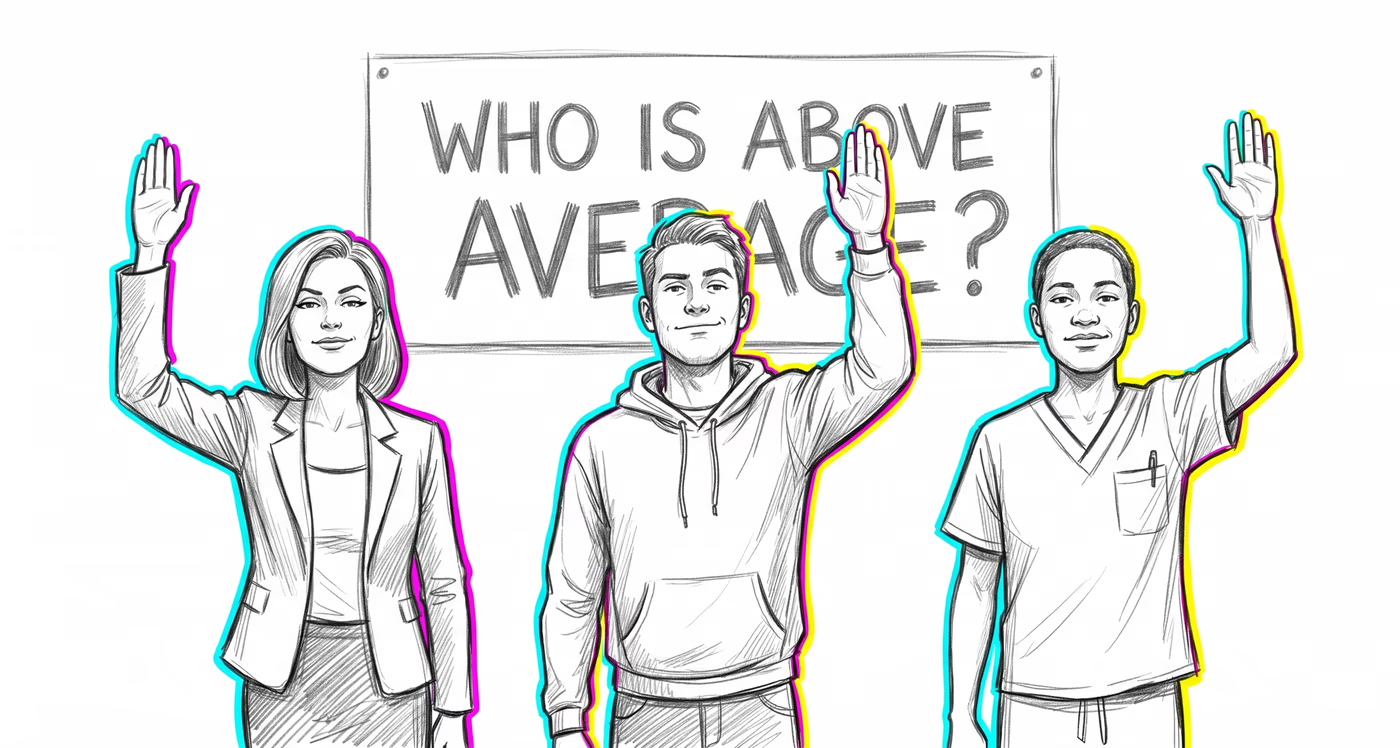
Underestimating how many others share your good qualities, believing you're more special or rare than you are.

WHAT IT IS

The glitch, explained plainly.

Imagine you eat your vegetables every day and you think, 'Wow, I'm one of the only people who actually eats healthy.' But if you asked everyone in your class, you'd find out lots of kids eat their vegetables too. You just assumed you were the special one because it made you feel good about yourself.

The false uniqueness effect occurs when individuals systematically underestimate the proportion of peers who share their positive qualities, healthy behaviors, or valued abilities, thereby perceiving themselves as more exceptional than warranted by reality. This bias is particularly pronounced for socially desirable attributes — people tend to believe their strengths, virtues, and good habits are rarer than they objectively are. The effect operates asymmetrically alongside the false consensus effect: people overestimate how common their negative traits are (to normalize them) while simultaneously underestimating how common their positive traits are (to feel special). This constructive social comparison process serves a self-enhancement function, allowing individuals to maintain elevated self-esteem by believing their best qualities set them apart from the crowd.

SOUND FAMILIAR?

Where it shows up.

  1. 01 After volunteering at a food bank on Saturday, Marcus tells his friend, 'It's sad how few people actually give back to the community.' His friend points out that the food bank is fully staffed with over 200 regular volunteers, but Marcus insists that level of commitment is rare and that most people just talk about helping without doing anything.
  2. 02 A software engineer named Priya consistently writes unit tests for her code. During a team retrospective, she suggests implementing mandatory testing standards because she assumes she's one of the few developers who bothers. When the team's repository metrics are pulled up, they show that 80% of the team already writes tests at a similar rate.
  3. 03 During a company wellness survey, David estimates that only about 15% of his coworkers exercise regularly, despite exercising five days a week himself. The actual survey results reveal that 58% of employees exercise at least four times per week. David finds the number hard to believe and wonders if people exaggerated their responses.
  4. 04 A university professor prides herself on genuinely caring about students' mental health and being approachable outside office hours. When the department proposes a peer mentoring initiative, she's skeptical it will work because she doubts other faculty share her level of concern. She declines to participate, not realizing that anonymous faculty surveys show the majority report strong student-welfare motivation.
  5. 05 An investor who maintained his portfolio positions through a major market correction feels his discipline is exceptionally rare among retail investors. He structures his financial newsletter around the premise that most people panic-sell during downturns. However, brokerage data from that period shows that the majority of long-term retail holders also stayed the course — his restraint, while admirable, was far from uncommon.
IN DIFFERENT DOMAINS

Where it shows up at work.

The same glitch looks different depending on the terrain. Finance, medicine, a relationship, a team — same mechanism, different costume.

Finance & investing

Investors who maintain disciplined strategies (e.g., consistent dollar-cost averaging, avoiding panic selling) tend to underestimate how many other investors follow similarly disciplined approaches, which can lead them to overvalue their own financial acumen and take outsized risks based on inflated confidence in their supposed edge.
Medicine & diagnosis

Patients who adhere to medication schedules or healthy lifestyle changes often underestimate how many other patients are equally compliant, which can lead to a false sense of medical exceptionalism and reluctance to participate in support groups or follow standardized treatment protocols that they perceive as designed for less disciplined patients.

Education & grading

Students who study consistently may underestimate how many classmates also prepare thoroughly, leading them to feel their effort is uniquely meritorious. Teachers who employ innovative methods may underestimate how many colleagues use similar techniques, reducing their willingness to collaborate or share best practices.

Relationships

Partners who perceive their loyalty, emotional availability, or conflict resolution skills as uniquely superior may undervalue their partner's equivalent contributions, creating resentment and imbalance. Friends may feel their supportiveness is unmatched, leading them to feel underappreciated when reciprocity isn't explicitly acknowledged.

Tech & product

Designers and developers who adopt user-centered design principles or clean coding practices often assume these values are rarer in their industry than they actually are, leading to 'not invented here' attitudes and resistance to adopting established frameworks or community standards that embody the same principles.

Workplace & hiring

Employees who believe their work ethic, punctuality, or creative contributions are uniquely strong may undervalue team members' parallel efforts, leading to frustration during performance reviews when recognition is distributed across the team rather than concentrated on them.

Politics Media

Citizens who follow news critically or fact-check claims tend to underestimate how many others in their community do the same, which can foster a sense of intellectual isolation and cynicism about public discourse that is more pessimistic than warranted by actual media literacy rates.

HOW TO SPOT IT

Ask yourself…

  • Am I assuming that fewer people share this positive quality of mine than I have actual evidence for?
  • If I surveyed 100 people in my peer group, would I be surprised by how many share this trait or behavior?
  • Am I using my sense of being 'special' in this area to dismiss others' efforts or to avoid collaborating?
HOW TO DEFEND AGAINST IT

The playbook.

  • Before assuming a trait is rare, seek concrete data: ask peers directly, consult surveys, or review actual statistics about the behavior in question.
  • Practice perspective-taking by listing three people you know who likely share the trait you consider unique — you'll often find more than three.
  • Use the 'base rate check': estimate the percentage of people who share your trait, then look up the actual number. Track how often your estimates are too low.
  • In team settings, explicitly ask colleagues about their habits and values before assuming yours are distinctive.
  • When you catch yourself feeling uniquely virtuous, reframe it: 'This is a common and admirable behavior, and I'm glad to be part of a larger group doing it.'
FAMOUS CASES

In history.

  • Public health campaigns during the early HIV/AIDS crisis struggled partly because individuals who practiced safe sex underestimated how common their behavior was, reducing their motivation to advocate for broader adoption.
  • Early COVID-19 mask compliance studies found that individuals who wore masks consistently underestimated community compliance rates, contributing to pessimism about collective public health behavior.
WHERE IT COMES FROM
Academic origin

Ryback & Shenkel introduced the 'illusion of uniqueness' concept in 1978. The term 'false uniqueness effect' was formally coined by Jerry Suls and Choi K. Wan (1987) and further elaborated by Suls, Wan, and Glenn S. Sanders (1988).

Evolutionary origin

In small ancestral groups, perceiving oneself as possessing rare and valuable skills or traits would have conferred social standing advantages. Individuals who believed their contributions were uniquely important were more likely to assert themselves in status hierarchies, attract mates, and secure resources — even if the belief was somewhat inflated. This self-enhancement motivation served as a psychological engine for confidence and initiative in competitive social environments.

IN AI SYSTEMS

How the machines inherit it.

Recommender systems can inadvertently reinforce false uniqueness by personalizing content in ways that make users feel their tastes and preferences are more niche than they are. When algorithms surface 'hidden gems' or label suggestions as tailored specifically for the user, they can amplify the perception of personal distinctiveness even when millions of others receive similar recommendations.

Read more on Wikipedia
FREE FIELD ZINE

10 glitches quietly running your life.

A free field-zine PDF — ten cognitive glitches named, illustrated, with a defense move for each. Plus the weekly Glitch Report on Fridays — one bias named, two spotted in the wild, one defense move. Unsubscribe any time.

EXPLORE MORE

Related glitches.

LAUNCH PRICE

Train against your blindspots.

50 cards are free to preview. Buyers unlock the rest of the deck plus the interactive training — Spot-the-Bias Quiz unlimited, Swipe Deck with spaced repetition, My Blindspots, Decision Pre-Flight, the Printable Deck + Cheat Sheets, and the Field Guide e-book. $29.50$59.

Unlock the full deck

Everything below — yours forever. Pay once, use across every device.

Half-off launch — limited to the first 100 readers. Auto-applied at checkout.
$59 $29.50
one-time payment · lifetime access
  • All interactive digital cards — search, filter, flip, shuffle on any device
  • Five training modes — Spot-the-Bias Quiz, Swipe Deck, Pre-Flight, Blindspots, Journal
  • Curated Lenses + Decision Templates + Defense Playbook
  • Printable Deck PDFs + Field Guide e-book + Cheat Sheets + Anki Export
  • Every future improvement, included
Unlock  $29.50

30-day refund · no questions asked

Unlock the full deck

Everything below — yours forever. Pay once, use across every device.

Half-off launch — limited to the first 100 readers. Auto-applied at checkout.
$59 $29.50
one-time payment · lifetime access
  • All interactive digital cards — search, filter, flip, shuffle on any device
  • Five training modes — Spot-the-Bias Quiz, Swipe Deck, Pre-Flight, Blindspots, Journal
  • Curated Lenses + Decision Templates + Defense Playbook
  • Printable Deck PDFs + Field Guide e-book + Cheat Sheets + Anki Export
  • Every future improvement, included
Unlock  $29.50

30-day refund · no questions asked