Survivorship Bias

aka Survivor Bias · Survival Bias · Survivorship Fallacy

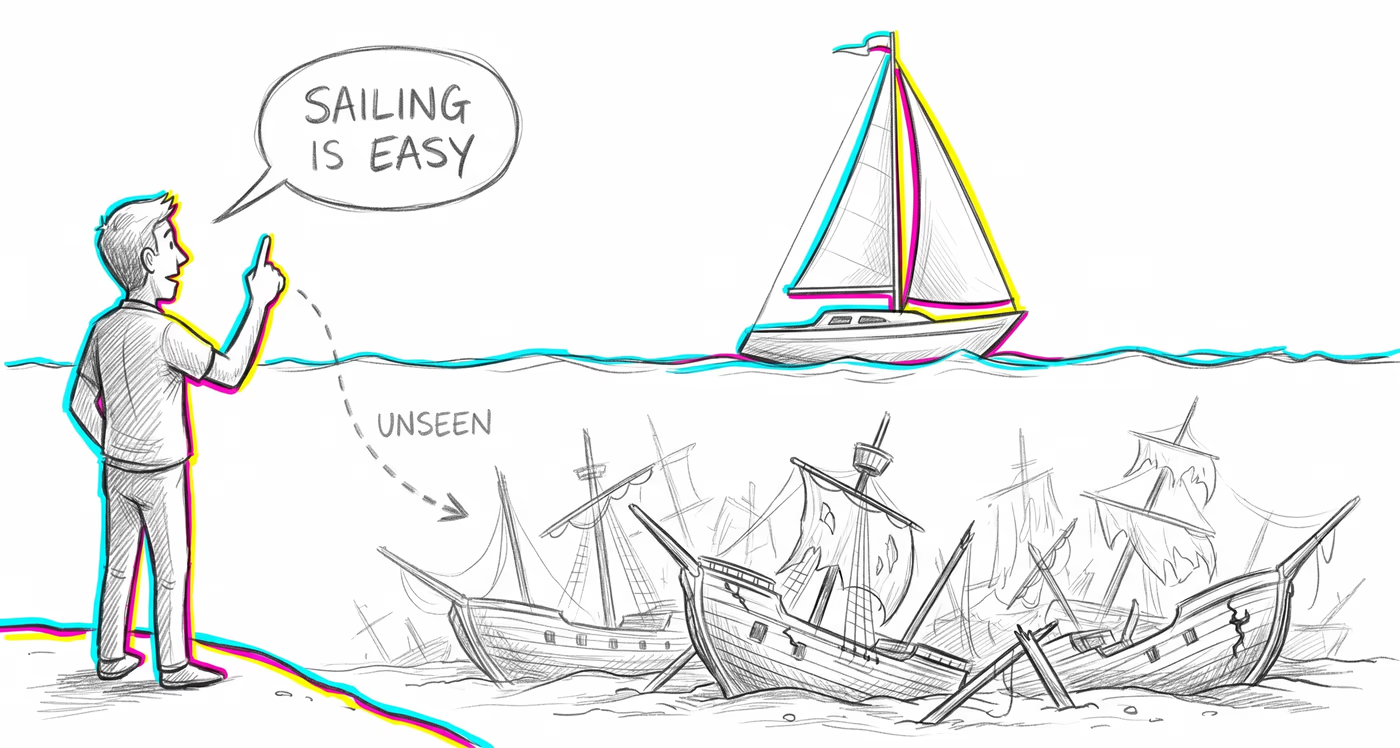
Drawing conclusions from only the successes that are visible, while ignoring all the failures that quietly disappeared.

Illustration: Survivorship Bias
WHAT IT IS

The glitch, explained plainly.

Imagine your teacher only shows you gold-star drawings from class and throws the bad ones in the trash. You'd think 'Wow, everyone in this class draws amazingly!' But that's because you never saw the ones that got thrown away. You're only seeing the winners, so you think winning is normal.

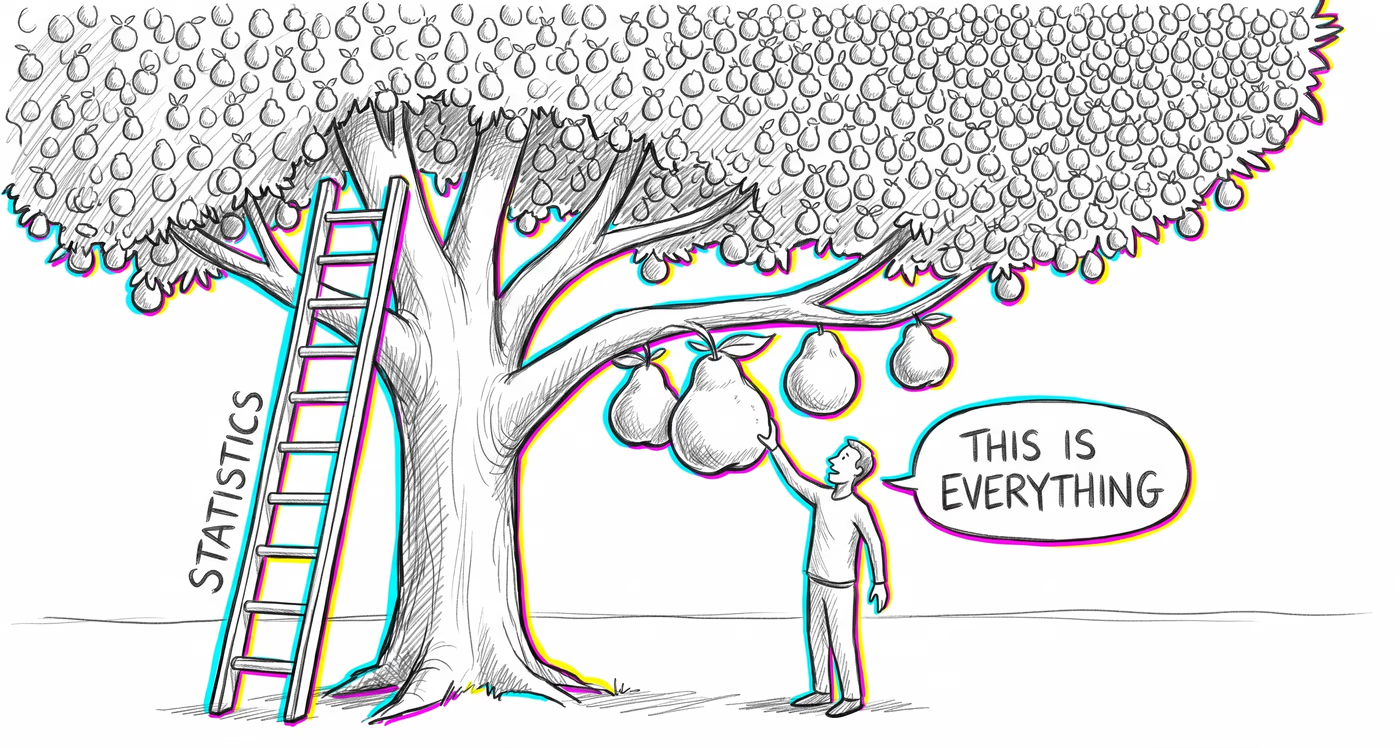
Survivorship bias occurs when we systematically focus on people, companies, strategies, or things that passed through a selection filter while overlooking those that did not, typically because the failures are no longer visible or salient. This creates a dangerously distorted picture of reality: success appears more common, strategies appear more effective, and risks appear smaller than they actually are. The bias is especially insidious because the missing data — the failures, the dropouts, the companies that went bankrupt — is invisible by definition, making the skewed sample feel complete. It leads to false conclusions about causation, inflated confidence in emulating 'winners,' and systematic underestimation of the base rate of failure.

SOUND FAMILIAR?

Where it shows up.

  1. 01 A venture capitalist gives a talk to MBA students, showcasing 10 portfolio companies that achieved billion-dollar valuations. She highlights the common traits these founders shared: risk tolerance, college dropout status, and pivoting early. The students begin copying these traits, unaware that she invested in 200 companies and 190 of them failed — many of whose founders also had those exact same traits.
  2. 02 A city historian writes a book arguing that pre-war architecture was objectively superior to modern construction, citing dozens of stunning century-old buildings still standing downtown. A structural engineer reads the book and notes that the author never investigated the hundreds of pre-war buildings that collapsed, were condemned, or were demolished for safety reasons over the past hundred years.
  3. 03 A financial analyst reports that the average mutual fund in a category returned 11% over the past 20 years, beating the market index. However, his dataset only includes funds that currently exist. Over those 20 years, dozens of underperforming funds were quietly merged into better-performing ones or shut down entirely, and their poor returns were erased from the record.
  4. 04 A pharmaceutical company publishes a study showing that patients who completed a 12-month experimental treatment showed significant improvement compared to the control group. A reviewer notices that 40% of patients in the treatment group dropped out mid-trial due to severe side effects, and their outcomes were excluded from the final analysis.
  5. 05 A leadership consultant studies CEOs of Fortune 500 companies and identifies that most wake up before 5 AM, exercise daily, and practice meditation. He concludes these habits cause executive success and publishes a bestselling book. He never investigated whether thousands of mid-level managers and failed entrepreneurs who practice the exact same habits simply never rose to prominence.
IN DIFFERENT DOMAINS

Where it shows up at work.

The same glitch looks different depending on the terrain. Finance, medicine, a relationship, a team — same mechanism, different costume.

Finance & investing

Mutual fund performance data is systematically inflated because funds that perform poorly are closed or merged into other funds, removing their returns from historical indices. Backtesting investment strategies using current index members rather than historical constituents also creates artificially strong results by excluding companies that went bankrupt.

Medicine & diagnosis

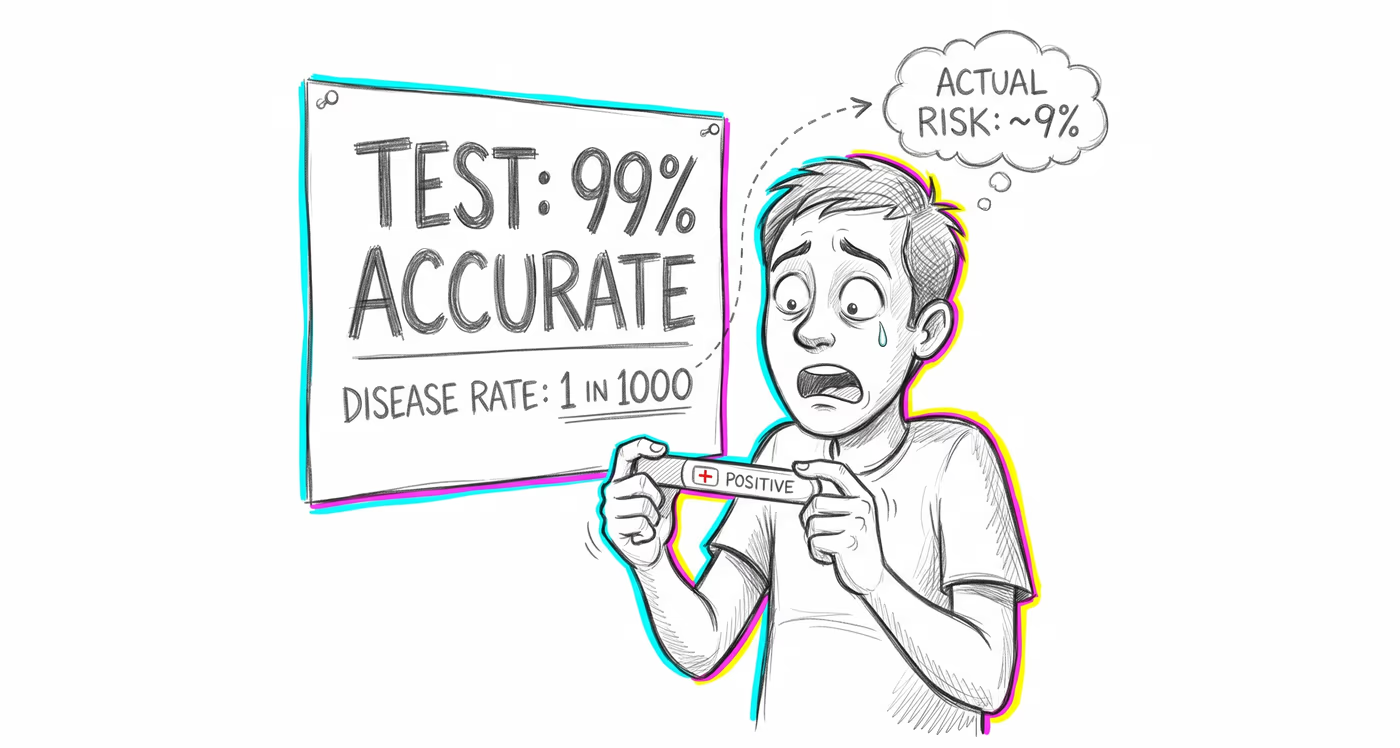
Clinical trial results can overestimate treatment effectiveness when patients who drop out due to side effects or worsening conditions are excluded from the final analysis. Epidemiological studies may show improving population health trends that actually reflect differential attrition of sicker individuals from longitudinal samples.

Education & grading

Schools and universities showcase successful alumni to demonstrate program quality, while students who dropped out, transferred, or failed are absent from promotional materials. This skews prospective students' perception of likely outcomes and graduation rates.

Relationships

People observe long-lasting marriages at anniversary celebrations and conclude that past generations had stronger relationships, not accounting for the many unhappy marriages that ended in divorce, separation, or were endured silently due to social pressure.

Tech & product

Product teams study successful apps and features to extract 'best practices,' while ignoring the vast majority of launched features and products that failed and were quietly shut down. A/B tests that only analyze users who completed a flow miss insights from users who abandoned it entirely.

Workplace & hiring

Companies study traits of their top performers to build hiring profiles, but never analyze the traits of candidates who were hired with the same profile and subsequently failed or left. Performance review systems that only benchmark against current high-performers ignore the departed employees who represent important signal about organizational problems.

Politics Media

Media disproportionately covers political movements, policies, or leaders that achieve visible success, while countless failed movements, abandoned policy proposals, and defeated candidates receive little coverage. This creates the illusion that activism and political strategy are more effective than base rates suggest.

HOW TO SPOT IT

Ask yourself…

  • Am I only looking at examples that succeeded, and have I considered what happened to the ones that failed or disappeared?
  • Is the data I'm seeing a complete picture, or has a selection process filtered out the negative outcomes before I saw it?
  • If I copied the exact strategy of these 'winners,' what is the actual base rate of success for people who tried the same thing?
HOW TO DEFEND AGAINST IT

The playbook.

  • Always ask: 'Where are the dead bodies?' — deliberately seek out the failures, dropouts, and non-survivors before drawing conclusions from visible successes.
  • Invert the question: instead of 'What do winners have in common?' ask 'Did losers also have these same traits?' If yes, the trait doesn't explain success.
  • When evaluating historical data or track records, check whether underperformers have been removed from the dataset (e.g., closed funds, delisted stocks, discontinued products).
  • Use base rate thinking: before being inspired by a success story, research the denominator — how many people attempted the same thing and what percentage actually succeeded?
  • Apply pre-mortem analysis: before committing to a strategy modeled on survivors, imagine it has failed and list all the reasons it could have gone wrong that the success stories wouldn't reveal.
FAMOUS CASES

In history.

  • Abraham Wald's WWII aircraft analysis: The Statistical Research Group at Columbia University initially planned to armor the most bullet-riddled areas of returning bombers, until Wald pointed out that the missing data — planes that didn't return — indicated those unscathed areas were actually the most vulnerable.
  • Mutual fund performance inflation: Elton, Gruber, and Blake (1996) demonstrated that survivorship bias inflated U.S. mutual fund performance by approximately 0.9% per year, as failed funds were systematically excluded from industry performance statistics.
  • The 'Academy Award longevity' study by Redelmeier and Singh, published in the Annals of Internal Medicine, claimed Oscar winners lived nearly four years longer than peers. Reanalysis correcting for survivorship bias (immortal time bias) reduced the advantage to about one year and it was no longer statistically significant.
WHERE IT COMES FROM
Academic origin

The concept gained formal prominence through Abraham Wald's work with the Statistical Research Group at Columbia University during World War II (1943). The term 'survivorship bias' was later formalized in financial economics, notably by Elton, Gruber, and Blake in their 1996 paper in the Review of Financial Studies.

Evolutionary origin

In ancestral environments, learning from observable survivors was adaptive. If a tribe member ate a berry and lived, that was useful safety data. The cost of ignoring absent counter-examples was low in small, observable groups where most outcomes were directly witnessed. The heuristic 'learn from what you can see' was efficient when populations and datasets were small and mostly visible.

IN AI SYSTEMS

How the machines inherit it.

Training datasets for machine learning models often contain survivorship bias: successful products, popular content, and visible outcomes are overrepresented while failures are absent. This causes models to overfit on attributes correlated with survival rather than true quality. In LLMs, training data skews toward published, successful, and visible text — reinforcing optimistic or conventional narratives while underrepresenting perspectives from failures, marginalized outcomes, and discontinued projects.

Read more on Wikipedia
FREE FIELD ZINE

10 glitches quietly running your life.

A free field-zine PDF — ten cognitive glitches named, illustrated, with a defense move for each. Plus the weekly Glitch Report on Fridays — one bias named, two spotted in the wild, one defense move. Unsubscribe any time.

EXPLORE MORE

Related glitches.

LAUNCH PRICE

Train against your blindspots.

50 cards are free to preview. Buyers unlock the rest of the deck plus the interactive training — Spot-the-Bias Quiz unlimited, Swipe Deck with spaced repetition, My Blindspots, Decision Pre-Flight, the Printable Deck + Cheat Sheets, and the Field Guide e-book. $29.50$59.

Unlock the full deck

Everything below — yours forever. Pay once, use across every device.

Half-off launch — limited to the first 100 readers. Auto-applied at checkout.
$59 $29.50
one-time payment · lifetime access
  • All interactive digital cards — search, filter, flip, shuffle on any device
  • Five training modes — Spot-the-Bias Quiz, Swipe Deck, Pre-Flight, Blindspots, Journal
  • Curated Lenses + Decision Templates + Defense Playbook
  • Printable Deck PDFs + Field Guide e-book + Cheat Sheets + Anki Export
  • Every future improvement, included
Unlock  $29.50

30-day refund · no questions asked

Unlock the full deck

Everything below — yours forever. Pay once, use across every device.

Half-off launch — limited to the first 100 readers. Auto-applied at checkout.
$59 $29.50
one-time payment · lifetime access
  • All interactive digital cards — search, filter, flip, shuffle on any device
  • Five training modes — Spot-the-Bias Quiz, Swipe Deck, Pre-Flight, Blindspots, Journal
  • Curated Lenses + Decision Templates + Defense Playbook
  • Printable Deck PDFs + Field Guide e-book + Cheat Sheets + Anki Export
  • Every future improvement, included
Unlock  $29.50

30-day refund · no questions asked