Form-Function Bias

aka Form Function Attribution Bias · FFAB · Appearance-Function Attribution Bias

Inferring what something can do from how it looks, rather than from its actual capabilities or specifications.

WHAT IT IS

The glitch, explained plainly.

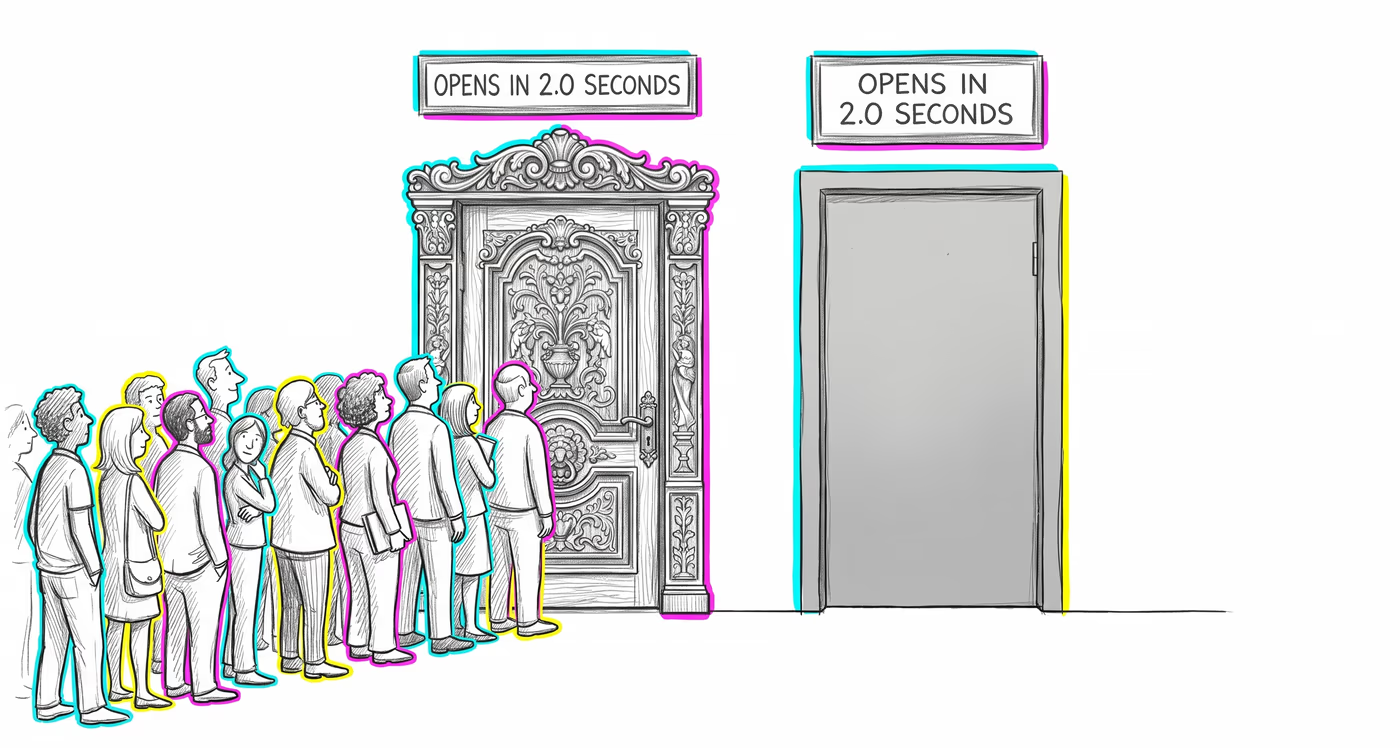
Imagine you see two lunchboxes. One looks like a fancy spaceship, and the other is a plain brown bag. You automatically think the spaceship one keeps food cold better, even though they both work the same inside. You're judging what it can do just by how it looks.

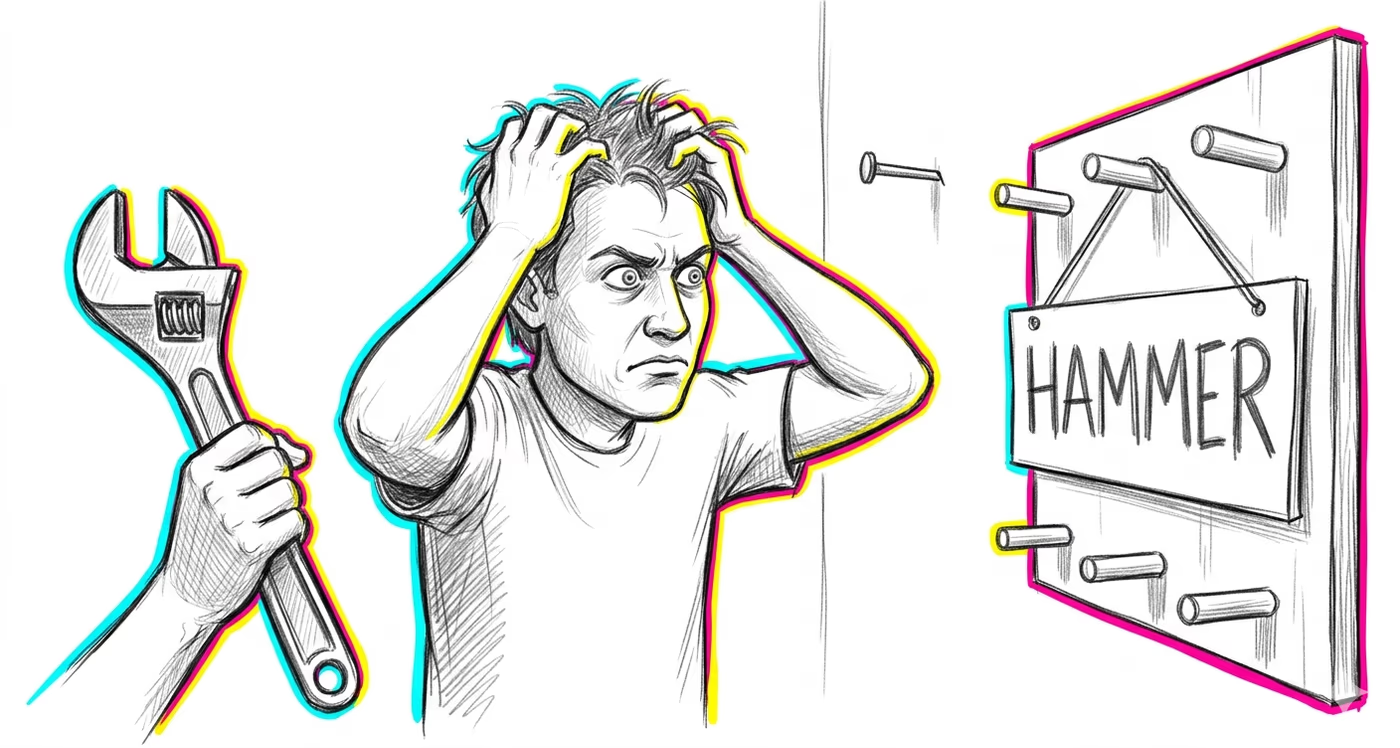
Form-Function Bias occurs when people use the physical appearance or aesthetic form of an object, agent, or system as a cognitive shortcut to judge what it can do, often miscalibrating their expectations in the process. Rather than evaluating actual capabilities through evidence or testing, individuals rely on visual cues — such as humanoid features on a robot, premium materials on a product, or a polished user interface on software — to attribute sophistication, intelligence, or reliability that may not exist. This bias is especially pronounced when interacting with unfamiliar technology, where outward design signals become the primary basis for trust and expectation formation. The mismatch between perceived and actual function can lead to disappointment when a beautiful product underperforms, or to underestimation when an ugly but capable tool is dismissed.

SOUND FAMILIAR?

Where it shows up.

  1. 01 A hospital introduces two telepresence devices for remote doctor consultations. One has a humanoid face and head mounted on a wheeled base; the other is a simple screen on a pole. Nurses consistently route complex patient cases to the humanoid device, believing it provides a 'better' consultation experience, even though both run identical software and connect to the same pool of physicians.
  2. 02 Maria is choosing between two portable chargers for her phone. One is a sleek aluminum cylinder with glowing LED indicators; the other is a plain black plastic rectangle. She picks the aluminum one, convinced it charges faster. At home, she discovers both have identical 10,000mAh capacity and the same charging speed.
  3. 03 A company deploys two chatbots for internal IT support. One uses a cartoon robot avatar with animated expressions; the other is a plain text-entry box labeled 'IT Help.' Employees report the avatar-based chatbot as 'more helpful' and 'more knowledgeable' in satisfaction surveys, despite both chatbots using the same language model and knowledge base.
  4. 04 During a robotics trade show, attendees crowd around a humanoid robot with articulated fingers and a face, asking it about philosophy and emotions. Meanwhile, a boxy industrial robot arm at the next booth — running a far more advanced AI for real-time adaptive manufacturing — is largely ignored. Attendees later describe the humanoid as 'the most advanced AI at the show.'
  5. 05 A product reviewer rates a fitness tracker with a premium stainless-steel case and sapphire glass display as having 'superior health monitoring accuracy' compared to a plastic competitor, even though both use the same optical heart rate sensor and accelerometer chipset with identical firmware.
IN DIFFERENT DOMAINS

Where it shows up at work.

The same glitch looks different depending on the terrain. Finance, medicine, a relationship, a team — same mechanism, different costume.

Finance & investing

Investors may evaluate fintech platforms based on interface polish and branding aesthetics rather than on their actual risk management algorithms or regulatory compliance, leading to over-trust in visually sophisticated but poorly audited platforms.

Medicine & diagnosis

Patients and even clinicians may place greater trust in medical devices that look sleek and modern, assuming superior diagnostic accuracy, while dismissing older or bulkier equipment that may have better validated measurement capabilities.

Education & grading

Students may judge educational software or robots as more effective learning tools when they have appealing, human-like designs, leading schools to invest in aesthetically impressive but pedagogically unproven technology.

Tech & product

Product teams may design interfaces and hardware with anthropomorphic features or premium aesthetics to inflate user expectations of capability, creating an 'expectation gap' when the technology cannot deliver on the sophistication its form suggests. Conversely, powerful but plain-looking tools may suffer low adoption.

Workplace & hiring

In hiring or vendor selection, decision-makers may favor tools, platforms, or even candidates whose presentation and packaging appear polished, assuming competence from form, while overlooking less visually impressive but functionally superior alternatives.

Politics Media

Audiences may attribute greater credibility and technological sophistication to news outlets or government digital platforms that have modern, visually polished interfaces, while dismissing equally accurate but dated-looking sources.

HOW TO SPOT IT

Ask yourself…

  • Am I assuming this thing is capable of X mainly because it looks like it should be able to do X?
  • Have I actually tested or verified the functionality, or am I relying on how it appears?
  • Would I judge this system's capabilities differently if it looked plain or unpolished?
HOW TO DEFEND AGAINST IT

The playbook.

  • Before judging a product or system, explicitly ask: 'What evidence do I have about its actual capabilities, separate from its appearance?'
  • Conduct blind or controlled comparisons where form is neutralized — compare outputs, specs, or performance data rather than visual impressions.
  • Create a 'form vs. function' checklist: list what you assume based on appearance in one column and what you've verified in another.
  • When evaluating technology, read independent benchmarks and technical reviews rather than relying on promotional visuals or first impressions.
  • Practice interacting with deliberately 'ugly' but functional tools to calibrate your intuition about the relationship between appearance and capability.
FAMOUS CASES

In history.

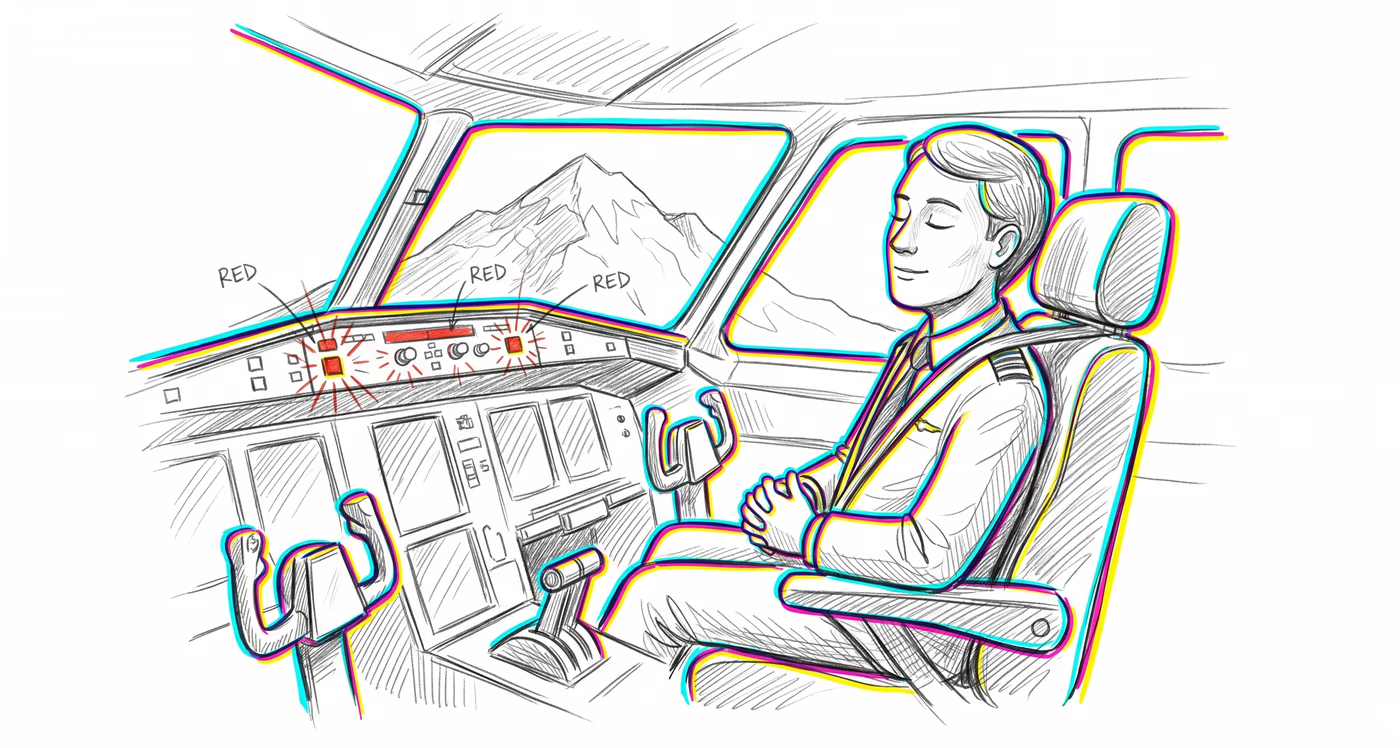
  • The Asiana Airlines Flight 214 crash (2013) has been analyzed as partly involving form-function attribution bias, where the advanced-looking cockpit automation was trusted to perform functions it was not designed to handle in that flight mode, contributing to pilot over-reliance.
  • Early consumer reactions to the Amazon Echo (2014) showed users attributing conversational intelligence and general knowledge far beyond Alexa's actual capabilities, driven by the device's always-listening, human-like voice interaction form.
WHERE IT COMES FROM
Academic origin

Kerstin S. Haring, Katsumi Watanabe, Mari Velonaki, Chad C. Tossell, and Victor Finomore formally coined the term 'Form Function Attribution Bias' (FFAB) in 2018, published in IEEE Transactions on Cognitive and Developmental Systems.

Evolutionary origin

In ancestral environments, an organism's physical form was a reliable predictor of its capabilities — a large predator with sharp teeth signals danger, a fruit's color signals ripeness, a sturdy branch signals support. The brain evolved to rapidly link visible form to likely function because waiting for behavioral evidence could be fatal. This form-to-function mapping was generally adaptive when dealing with natural objects and living creatures whose appearance reliably co-varied with their abilities.

IN AI SYSTEMS

How the machines inherit it.

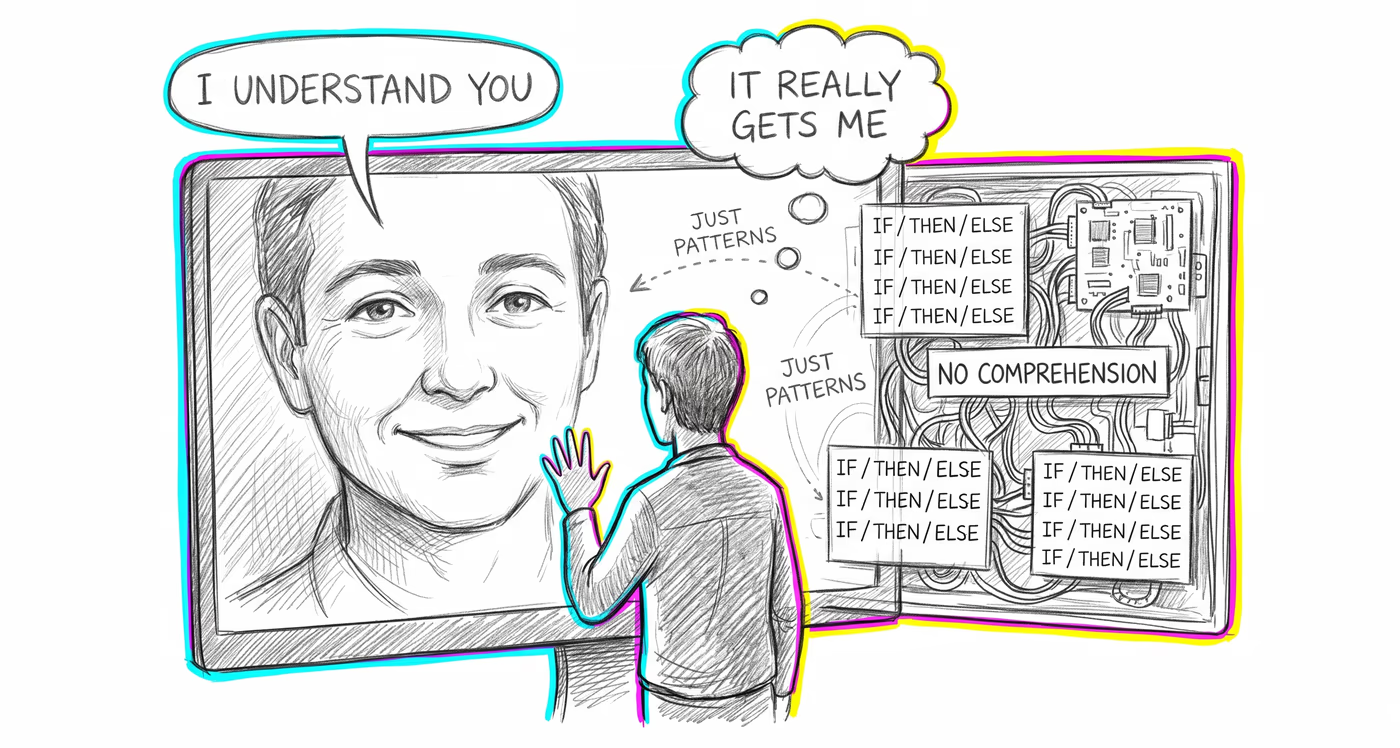
AI systems with human-like interfaces (conversational agents, humanoid robots, realistic avatars) are attributed with understanding, empathy, and general intelligence they do not possess. Users interact with anthropomorphic AI as if it has human-level reasoning simply because its form mimics human communication patterns. This leads to over-trust in AI outputs, under-scrutiny of AI errors, and difficulty calibrating expectations to actual model capabilities.

FREE FIELD ZINE

10 glitches quietly running your life.

A free field-zine PDF — ten cognitive glitches named, illustrated, with a defense move for each. Plus the weekly Glitch Report on Fridays — one bias named, two spotted in the wild, one defense move. Unsubscribe any time.

EXPLORE MORE

Related glitches.

LAUNCH PRICE

Train against your blindspots.

50 cards are free to preview. Buyers unlock the rest of the deck plus the interactive training — Spot-the-Bias Quiz unlimited, Swipe Deck with spaced repetition, My Blindspots, Decision Pre-Flight, the Printable Deck + Cheat Sheets, and the Field Guide e-book. $29.50$59.

Unlock the full deck

Everything below — yours forever. Pay once, use across every device.

Half-off launch — limited to the first 100 readers. Auto-applied at checkout.
$59 $29.50
one-time payment · lifetime access
  • All interactive digital cards — search, filter, flip, shuffle on any device
  • Five training modes — Spot-the-Bias Quiz, Swipe Deck, Pre-Flight, Blindspots, Journal
  • Curated Lenses + Decision Templates + Defense Playbook
  • Printable Deck PDFs + Field Guide e-book + Cheat Sheets + Anki Export
  • Every future improvement, included
Unlock  $29.50

30-day refund · no questions asked

Unlock the full deck

Everything below — yours forever. Pay once, use across every device.

Half-off launch — limited to the first 100 readers. Auto-applied at checkout.
$59 $29.50
one-time payment · lifetime access
  • All interactive digital cards — search, filter, flip, shuffle on any device
  • Five training modes — Spot-the-Bias Quiz, Swipe Deck, Pre-Flight, Blindspots, Journal
  • Curated Lenses + Decision Templates + Defense Playbook
  • Printable Deck PDFs + Field Guide e-book + Cheat Sheets + Anki Export
  • Every future improvement, included
Unlock  $29.50

30-day refund · no questions asked