Generation Effect

aka Self-Generation Effect

Remembering information far better when you actively produced it yourself than when you passively received it.

WHAT IT IS

The glitch, explained plainly.

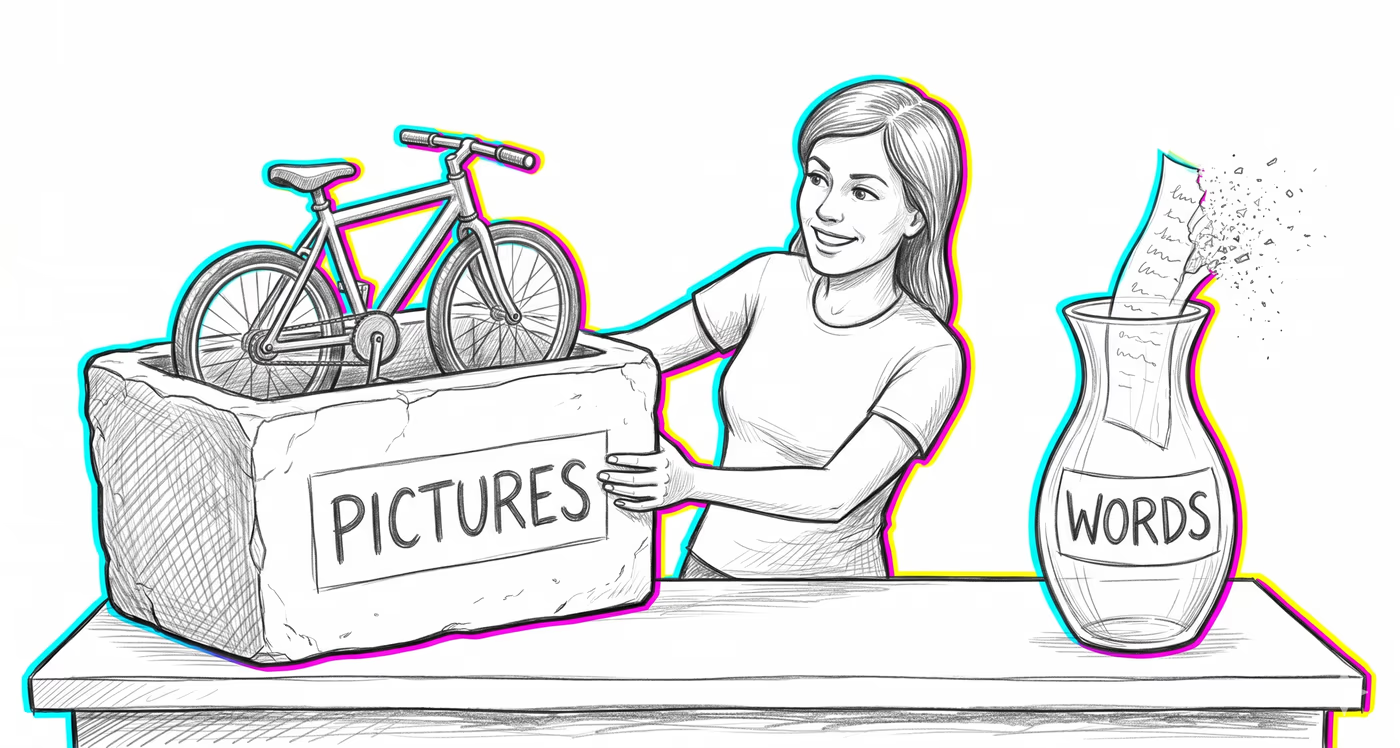
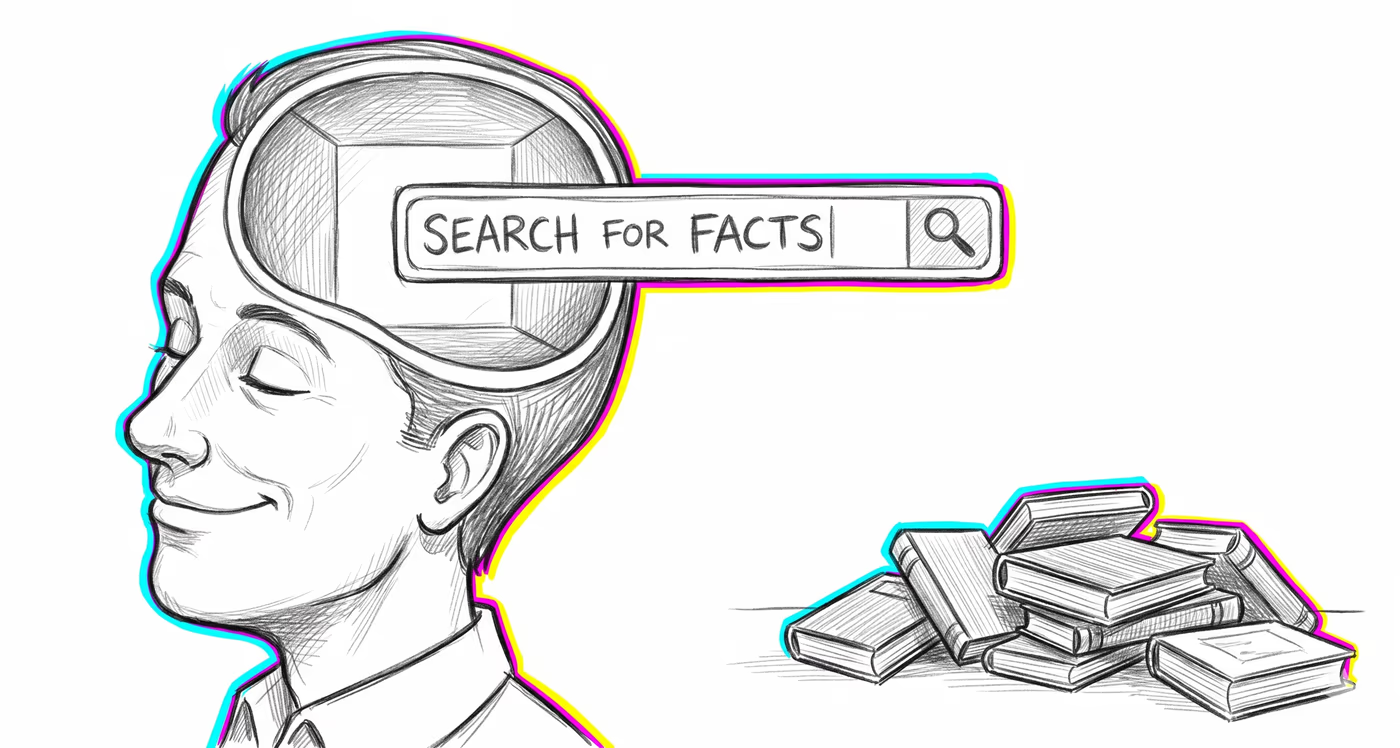
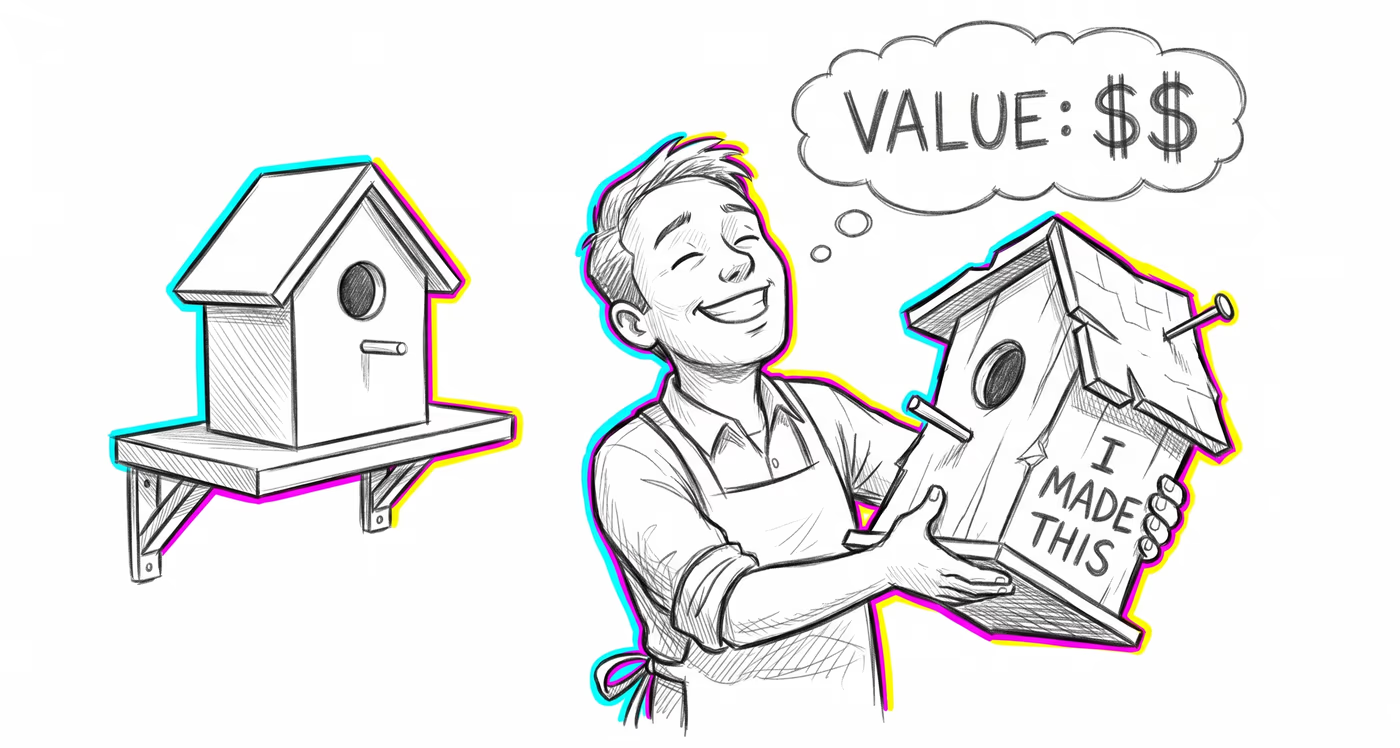
Imagine someone tells you the answer to a riddle versus you figuring it out yourself. When you work it out on your own, it sticks in your brain way better — like how you remember a song you made up better than one you just heard on the radio. Your brain glues things down harder when it has to do the work itself.

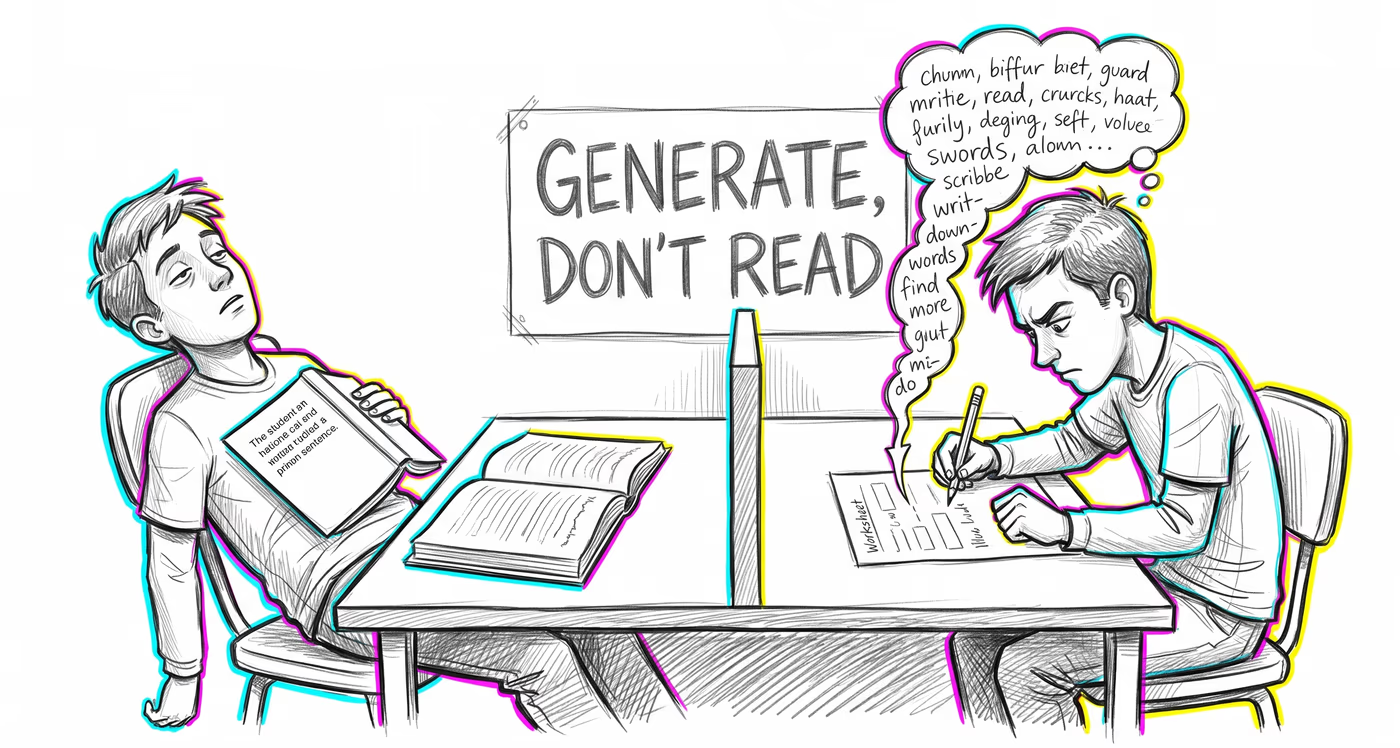
The Generation Effect describes the robust finding that when individuals produce information themselves — by completing word fragments, solving problems, paraphrasing concepts, or generating answers from partial cues — they form stronger and more durable memory traces than when they simply read or passively absorb the same information. This advantage holds across free recall, cued recall, and recognition tests, and has been demonstrated with verbal materials, arithmetic problems, pictures, and sentence completion tasks. The effect appears to be driven by deeper semantic processing, greater cognitive effort during encoding, and the creation of richer associative networks that link new information to existing knowledge in memory. Critically, the benefit is most pronounced for meaningful stimuli and within mixed-list designs where generated and read items are intermixed, allowing the contrast to enhance the distinctiveness of self-generated material.

SOUND FAMILIAR?

Where it shows up.

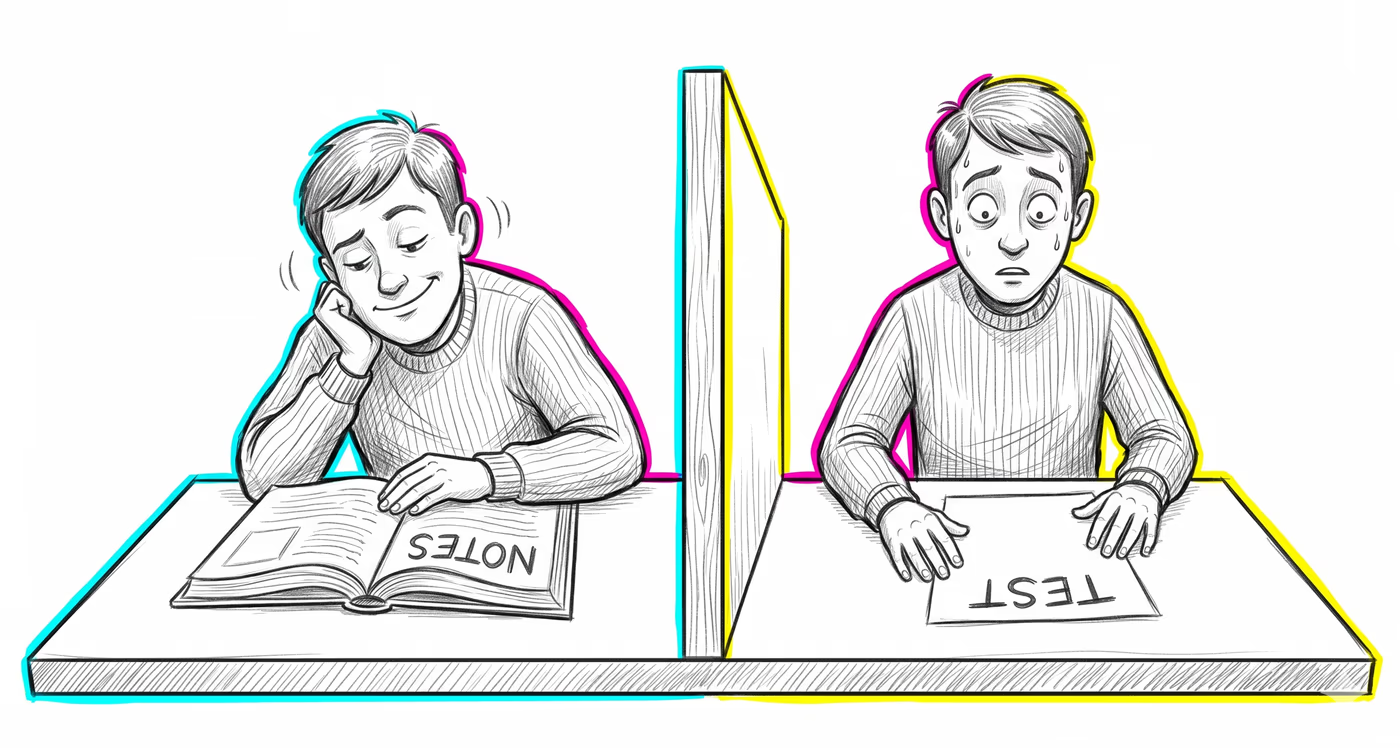
  1. 01 Maria is studying for her biology exam. She spends three hours re-reading her highlighted notes and feels confident she knows the material. Her classmate Javier spends the same time covering his notes and trying to write out the key concepts from memory, checking himself afterward. On the exam, Javier scores significantly higher despite feeling less confident during his study sessions.
  2. 02 A language teacher gives half the class vocabulary cards with the foreign word and translation printed together, while the other half receives cards with the foreign word and a blank they must fill in with the correct translation using context clues. On a test two weeks later, the fill-in-the-blank group recalls 40% more words, even though both groups studied for the same duration.
  3. 03 During a corporate training session, one group of employees watches a video explaining the new compliance procedures, while another group is given incomplete procedure outlines and must fill in the missing steps from provided reference materials. Months later, the second group follows the procedures more accurately, despite both groups rating their initial understanding equally highly.
  4. 04 A software developer remembers the exact syntax and logic of functions she wrote herself from scratch, but constantly has to look up the usage of library functions she copy-pasted from documentation, even though she has used both sets of code equally often over the past year.
  5. 05 A medical school adopts a new curriculum where students must predict a diagnosis before being shown the answer in case studies, rather than simply reading the diagnosis alongside the symptoms. Faculty initially worry this slows coverage of material, but find that students retain diagnostic patterns significantly longer, even though the act of predicting often produces incorrect initial guesses.
IN DIFFERENT DOMAINS

Where it shows up at work.

The same glitch looks different depending on the terrain. Finance, medicine, a relationship, a team — same mechanism, different costume.

Finance & investing

Investors who manually calculate risk-return metrics for their portfolios tend to remember and apply those insights more effectively than those who passively review automated reports, leading to better internalization of portfolio strategy but potentially slower decision-making.
Medicine & diagnosis

Medical students who practice generating differential diagnoses from patient symptoms before seeing the answer retain diagnostic frameworks longer than those who study symptom-diagnosis pairings through passive review, which supports case-based and problem-based learning curricula.

Education & grading

Students who complete fill-in-the-blank exercises, write summaries from memory, or generate practice test answers consistently outperform those who rely on passive strategies like re-reading and highlighting, yet most students underestimate the value of generative study techniques.

Relationships

People remember conversations and agreements better when they actively paraphrased or restated what their partner said ('So what you're saying is...') compared to silently listening, which can reduce misunderstandings about what was discussed.

Tech & product

Tutorial designs that require users to type commands or solve mini-challenges produce better skill retention than walkthroughs that simply demonstrate each step, which is why interactive onboarding flows outperform passive video tutorials.

Workplace & hiring

Employees who take notes in their own words during meetings retain action items better than those who receive pre-written meeting minutes, and training programs that include hands-on exercises produce more durable skill acquisition than lecture-only formats.

Politics Media

Citizens who actively discuss and debate political issues in their own words develop more stable and retrievable political knowledge than those who passively consume news coverage, which can influence the depth of democratic participation.

HOW TO SPOT IT

Ask yourself…

  • Am I just re-reading or passively reviewing this material, or am I actively producing it from memory?
  • Would I remember this better if I closed the book and tried to write it out from scratch first?
  • Am I confusing recognition familiarity ('this looks right') with genuine recall ability ('I can reproduce this')?
HOW TO DEFEND AGAINST IT

The playbook.

  • Replace re-reading with self-testing: cover the material and try to reproduce key points from memory before checking.
  • Use the 'blank page' method: after studying a topic, write down everything you can recall on a blank sheet without referring to notes.
  • Adopt flashcard systems that require active recall rather than passive recognition (e.g., Anki-style spaced repetition with answer generation).
  • When learning new procedures, try to perform them from memory with minimal guidance rather than following step-by-step instructions.
  • Teach the material to someone else in your own words — the act of generating an explanation forces deeper encoding.
WHERE IT COMES FROM
Academic origin

Norman J. Slamecka and Peter Graf, 1978. Published in the Journal of Experimental Psychology: Human Learning and Memory.

Evolutionary origin

In ancestral environments, information acquired through active problem-solving — such as figuring out which plants were edible through trial-and-error or navigating new terrain — had higher survival relevance than passively observed information. Brains that prioritized self-discovered knowledge created stronger memory traces for the most actionable and personally relevant information.

IN AI SYSTEMS

How the machines inherit it.

Language models trained primarily on passively ingested text do not benefit from the generation effect the way humans do. However, training approaches that use self-supervised prediction tasks — where the model must generate the next token rather than simply encoding input — mirror the generation principle. In educational AI, systems that prompt users to generate answers before revealing them leverage this effect, while purely presentational AI tutors may inadvertently undermine retention by making information too easy to passively consume.

Read more on Wikipedia
FREE FIELD ZINE

10 glitches quietly running your life.

A free field-zine PDF — ten cognitive glitches named, illustrated, with a defense move for each. Plus the weekly Glitch Report on Fridays — one bias named, two spotted in the wild, one defense move. Unsubscribe any time.

EXPLORE MORE

Related glitches.

LAUNCH PRICE

Train against your blindspots.

50 cards are free to preview. Buyers unlock the rest of the deck plus the interactive training — Spot-the-Bias Quiz unlimited, Swipe Deck with spaced repetition, My Blindspots, Decision Pre-Flight, the Printable Deck + Cheat Sheets, and the Field Guide e-book. $29.50$59.

Unlock the full deck

Everything below — yours forever. Pay once, use across every device.

Half-off launch — limited to the first 100 readers. Auto-applied at checkout.
$59 $29.50
one-time payment · lifetime access
  • All interactive digital cards — search, filter, flip, shuffle on any device
  • Five training modes — Spot-the-Bias Quiz, Swipe Deck, Pre-Flight, Blindspots, Journal
  • Curated Lenses + Decision Templates + Defense Playbook
  • Printable Deck PDFs + Field Guide e-book + Cheat Sheets + Anki Export
  • Every future improvement, included
Unlock  $29.50

30-day refund · no questions asked

Unlock the full deck

Everything below — yours forever. Pay once, use across every device.

Half-off launch — limited to the first 100 readers. Auto-applied at checkout.
$59 $29.50
one-time payment · lifetime access
  • All interactive digital cards — search, filter, flip, shuffle on any device
  • Five training modes — Spot-the-Bias Quiz, Swipe Deck, Pre-Flight, Blindspots, Journal
  • Curated Lenses + Decision Templates + Defense Playbook
  • Printable Deck PDFs + Field Guide e-book + Cheat Sheets + Anki Export
  • Every future improvement, included
Unlock  $29.50

30-day refund · no questions asked