Forgetting Curve

aka Ebbinghaus Forgetting Curve · Curve of Forgetting · Memory Decay Curve

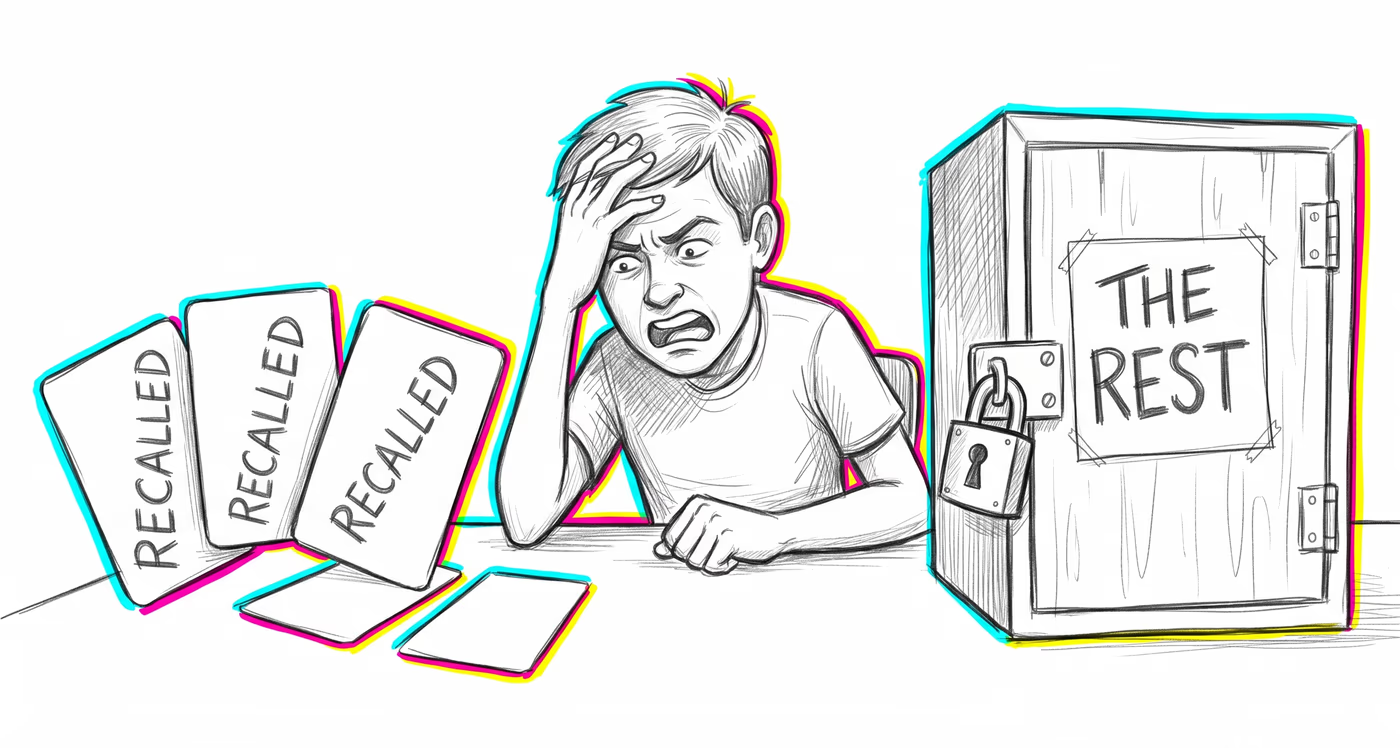
Newly learned information decaying rapidly — most of it lost within hours unless actively reviewed or reinforced.

WHAT IT IS

The glitch, explained plainly.

Imagine you build a sandcastle on the beach. Right after you finish, the waves start washing it away really fast. After a few waves, only the biggest parts are left, and they wash away much more slowly. Your memory works the same way—new stuff disappears super quickly at first, but if you keep rebuilding the sandcastle (reviewing what you learned), the waves can't knock it down as easily.

The Forgetting Curve describes a predictable, negatively accelerated decline in memory retention following initial learning. Without any deliberate review, humans typically lose roughly half of newly acquired information within the first hour, and retention continues to drop—though at a decelerating rate—over subsequent days and weeks. The steepness of the curve is modulated by factors such as the meaningfulness of the material, the depth of initial encoding, emotional significance, and stress or sleep quality. Crucially, each act of spaced retrieval or review 'resets' and flattens the curve, making subsequent forgetting slower and extending the interval before the next review is needed.

SOUND FAMILIAR?

Where it shows up.

  1. 01 Maria attends a three-hour compliance training at work and scores 95% on the post-session quiz. Two weeks later, her manager asks her to apply a specific regulation she learned, and she realizes she can recall almost nothing from the training—not because it was confusing, but because she never reviewed the material after that single session.
  2. 02 A medical student crams an entire pharmacology chapter the night before an exam and performs well. Six weeks later during clinical rotations, she cannot recall the drug interactions she once knew perfectly, while her classmate who reviewed the same material across four separate study sessions over two weeks remembers them clearly.
  3. 03 A software engineer reads the documentation for a new API framework and understands it thoroughly on Monday. By Friday, when he finally starts implementing it, he finds himself re-reading the same documentation almost from scratch—not because the material was difficult, but simply because five days passed without any retrieval of that information.
  4. 04 A sales team receives product training featuring 40 new feature updates. The trainer is excellent and engagement is high. Three weeks later, the team's customer-facing conversations reference only 3-4 of the 40 features, and management blames the trainer's quality rather than recognizing that a single exposure with no follow-up review made forgetting inevitable.
  5. 05 A corporate executive reads a 50-page strategy report during a flight and feels deeply informed. At the board meeting two weeks later, she confidently cites only two or three key points, unknowingly misremembering a critical statistic. She attributes her confidence to having 'studied' the report, not recognizing that her one-time reading without any subsequent review made significant memory loss a near-certainty.
IN DIFFERENT DOMAINS

Where it shows up at work.

The same glitch looks different depending on the terrain. Finance, medicine, a relationship, a team — same mechanism, different costume.

Finance & investing

Investors who attend a financial literacy seminar retain the core strategies for only a few days without follow-up materials, leading them to revert to prior habits and repeat avoidable mistakes in portfolio management.

Medicine & diagnosis

Clinicians who learn updated treatment protocols in a single continuing-education session frequently revert to outdated practices within weeks, as the new guidelines decay from memory without structured reinforcement or spaced review.

Education & grading

Students who cram material in a single intensive study session perform well on immediate tests but show dramatically lower retention on cumulative exams weeks later, compared with students who distribute the same study time across multiple sessions.

Relationships

Partners remember the emotional tone of a conversation but progressively lose the specific details and commitments discussed, leading to disagreements about what was actually agreed upon days or weeks earlier.

Tech & product

Users who complete an onboarding tutorial for a complex application forget most feature instructions within days if the product does not incorporate progressive disclosure, contextual tooltips, or spaced re-engagement prompts.

Workplace & hiring

Employees who attend a one-time orientation or training workshop lose the majority of procedural knowledge within weeks, resulting in repeated errors and the false perception that the training itself was ineffective.

Politics Media

Voters who absorb detailed policy positions during a debate forget the specifics within days, retaining only vague impressions or emotional reactions—making them more susceptible to simplified slogans and repeated messaging.

HOW TO SPOT IT

Ask yourself…

  • When was the last time I actually reviewed this information—am I assuming I still know it just because I learned it once?
  • Am I about to rely on knowledge from a single exposure that happened days or weeks ago without any intervening review?
  • Could my confidence in remembering this material be based on recognition familiarity rather than genuine recall ability?
HOW TO DEFEND AGAINST IT

The playbook.

  • Implement spaced repetition: review new material at increasing intervals (1 day, 3 days, 1 week, 2 weeks, 1 month) to progressively flatten the curve.
  • Use active recall instead of passive re-reading: close the book and try to reproduce the information from memory before checking.
  • Apply the 'teach-back' method: explain what you learned to someone else within 24 hours of initial exposure.
  • Create retrieval cues: connect new information to vivid images, personal experiences, or existing knowledge frameworks to strengthen encoding.
  • Build review into workflows: schedule brief refresher sessions after any important training, meeting, or learning event rather than assuming one exposure is sufficient.
FAMOUS CASES

In history.

  • NASA's post-Challenger investigations revealed that critical safety lessons from earlier incidents had been effectively 'forgotten' organizationally because they were documented once but never systematically revisited or drilled.
  • Studies of medical error consistently find that clinicians revert to outdated practices within weeks of single-session protocol updates, contributing to preventable adverse events.
WHERE IT COMES FROM
Academic origin

Hermann Ebbinghaus, 1885. Published in 'Über das Gedächtnis' (Memory: A Contribution to Experimental Psychology), based on self-experimentation conducted between 1880 and 1885 at the University of Berlin.

Evolutionary origin

In ancestral environments, retaining every sensory detail would overwhelm limited cognitive resources. Rapid forgetting of irrelevant, non-repeated information served as an efficient filtering mechanism, ensuring that only information encountered repeatedly—and therefore likely survival-relevant—was consolidated into long-term memory. Repeated encounters with a predator's location or a food source naturally produced the spaced repetitions needed to overcome the curve.

IN AI SYSTEMS

How the machines inherit it.

Machine learning models do not 'forget' stored data the way humans do, but the concept manifests in continual learning scenarios as 'catastrophic forgetting,' where neural networks trained on new data lose performance on previously learned tasks. This parallels the human forgetting curve and requires analogous strategies like replay buffers and elastic weight consolidation—computational equivalents of spaced repetition.

FREE FIELD ZINE

10 glitches quietly running your life.

A free field-zine PDF — ten cognitive glitches named, illustrated, with a defense move for each. Plus the weekly Glitch Report on Fridays — one bias named, two spotted in the wild, one defense move. Unsubscribe any time.

EXPLORE MORE

Related glitches.

LAUNCH PRICE

Train against your blindspots.

50 cards are free to preview. Buyers unlock the rest of the deck plus the interactive training — Spot-the-Bias Quiz unlimited, Swipe Deck with spaced repetition, My Blindspots, Decision Pre-Flight, the Printable Deck + Cheat Sheets, and the Field Guide e-book. $29.50$59.

Unlock the full deck

Everything below — yours forever. Pay once, use across every device.

Half-off launch — limited to the first 100 readers. Auto-applied at checkout.
$59 $29.50
one-time payment · lifetime access
  • All interactive digital cards — search, filter, flip, shuffle on any device
  • Five training modes — Spot-the-Bias Quiz, Swipe Deck, Pre-Flight, Blindspots, Journal
  • Curated Lenses + Decision Templates + Defense Playbook
  • Printable Deck PDFs + Field Guide e-book + Cheat Sheets + Anki Export
  • Every future improvement, included
Unlock  $29.50

30-day refund · no questions asked

Unlock the full deck

Everything below — yours forever. Pay once, use across every device.

Half-off launch — limited to the first 100 readers. Auto-applied at checkout.
$59 $29.50
one-time payment · lifetime access
  • All interactive digital cards — search, filter, flip, shuffle on any device
  • Five training modes — Spot-the-Bias Quiz, Swipe Deck, Pre-Flight, Blindspots, Journal
  • Curated Lenses + Decision Templates + Defense Playbook
  • Printable Deck PDFs + Field Guide e-book + Cheat Sheets + Anki Export
  • Every future improvement, included
Unlock  $29.50

30-day refund · no questions asked