Picture Superiority Effect

aka Pictorial Superiority Effect · PSE

Remembering images significantly better than words, even when both convey the same information.

WHAT IT IS

The glitch, explained plainly.

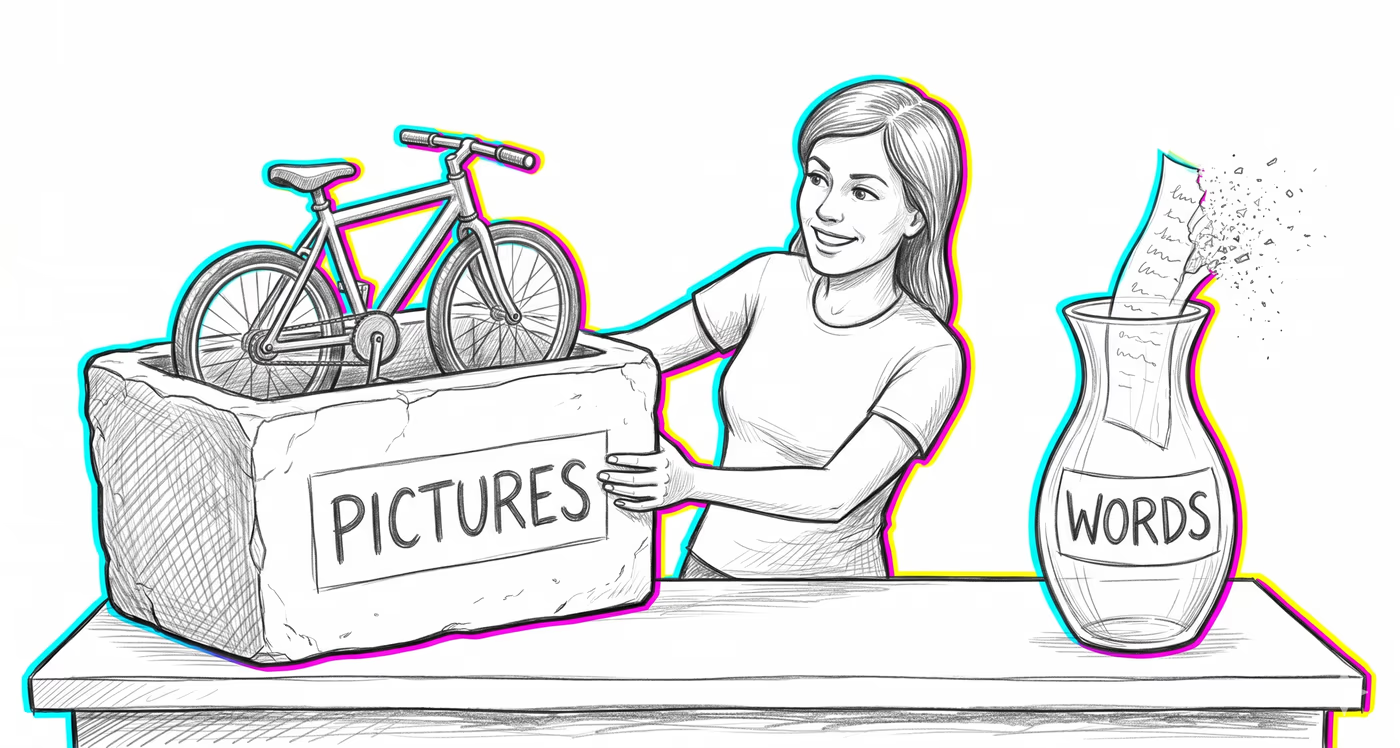
Imagine your brain has two filing cabinets — one for words and one for pictures. When you see a word like 'dog,' your brain only puts it in the word cabinet. But when you see a picture of a dog, your brain puts a copy in BOTH cabinets — the picture one and the word one. So later, when you're trying to remember, you have two places to look instead of one, which makes it way easier to find.

The Picture Superiority Effect describes the robust finding that when people are exposed to both pictures and words, they consistently remember the pictures with far greater accuracy and for much longer durations. This advantage holds across free recall, cued recall, and recognition memory tasks, and persists even when test items are presented as words rather than images. The effect is strongest for concrete, easily visualized items and diminishes when pictures are highly similar to one another or when information is processed at deep semantic levels. Importantly, the effect is not merely about preference — it reflects a fundamental asymmetry in how the brain encodes and retrieves visual versus verbal information, with images benefiting from richer, more distinctive memory traces.

SOUND FAMILIAR?

Where it shows up.

  1. 01 A marketing team creates two versions of a product brochure: one with detailed text descriptions and one with large product photographs accompanied by minimal captions. In follow-up surveys a week later, customers who received the photo-heavy version recall significantly more product details than those who read the text version.
  2. 02 A medical student studies anatomy using a textbook with labeled diagrams on one chapter and pure text descriptions on another. When tested three weeks later, she scores much higher on the diagram-based material, even though she spent equal time on both sections and the text contained more detailed information.
  3. 03 A nonprofit organization sends two fundraising emails: one with a compelling photograph of a child receiving clean water and a short caption, and another with a detailed written story about the same child. The photo email generates three times the donations, and donors later recall the campaign with much greater detail, even though the text email contained richer factual information.
  4. 04 A project manager presents quarterly results using a slide deck full of charts and graphs. Afterward, team members accurately recall the data trends. At the next meeting, she presents equally important information as bullet-pointed text slides, and the team struggles to remember key figures just days later — despite the text slides containing more precise numbers.
  5. 05 A jury deliberates after a trial where the prosecution showed graphic crime-scene photographs and the defense relied on detailed written forensic reports. Despite the defense's reports containing contradictory evidence, jurors overwhelmingly recall the prosecution's visual evidence and weigh it more heavily in their verdict, not because of emotional shock but because the images created more durable and retrievable memory traces.
IN DIFFERENT DOMAINS

Where it shows up at work.

The same glitch looks different depending on the terrain. Finance, medicine, a relationship, a team — same mechanism, different costume.

Finance & investing

Investors tend to remember and be more influenced by charts and visual trend lines than by the numerical data tables that underlie them. A dramatic downward-sloping graph can trigger stronger sell impulses than reading the same percentage decline in a text report, even when the text provides crucial context like timeframe and base rate.
Medicine & diagnosis

Patients retain health instructions significantly better when accompanied by diagrams or pictorial guides rather than text-only handouts. Physicians using visual aids in patient education see higher adherence rates, while text-heavy discharge instructions are frequently forgotten or misremembered.

Education & grading

Textbooks and lectures that incorporate diagrams, illustrations, and visual representations consistently produce better student retention than text-only materials. Students who study with visual aids perform better on recall tests, leading educators to design curricula that pair images with text rather than relying on reading alone.

Relationships

People remember faces and visual moments from social encounters (what someone wore, where they sat, their facial expression) far more reliably than what was said in conversation, leading to mismatches where one person recalls the emotional 'scene' vividly while forgetting the specific words that were spoken.

Tech & product

Product designers leverage this effect by using icons, visual progress indicators, and image-based navigation rather than text labels, knowing users will more easily learn and remember interface elements presented visually. Onboarding flows with illustrated tutorials outperform text-based instruction manuals in user retention.

Workplace & hiring

Presentations relying on data visualizations and diagrams are recalled more accurately by attendees than those using text-heavy bullet points. Meeting outcomes communicated with visual summaries or infographics are retained better than email recaps, influencing which information actually drives subsequent decisions.

Politics Media

News stories accompanied by striking photographs or video footage are remembered far longer and shape public opinion more durably than text-only reporting on the same events. Political campaigns exploit this by investing heavily in visual imagery, knowing that a single iconic photograph can outweigh thousands of words of policy text in voter recall.

HOW TO SPOT IT

Ask yourself…

  • Am I forming my opinion based primarily on a vivid image I saw rather than on the written facts that accompanied it?
  • Would I remember this information differently if it had been presented as text instead of as a picture or diagram?
  • Am I neglecting important textual details or caveats because the visual component was more memorable?
HOW TO DEFEND AGAINST IT

The playbook.

  • When encountering mixed visual-text information, deliberately re-read the text component separately and summarize it in your own words before forming an opinion.
  • Ask yourself: 'What does the text say that the image doesn't show?' to surface information that may be lost to picture superiority.
  • When making important decisions, request data in multiple formats (tables, text summaries, and charts) and cross-reference them rather than relying on whichever format is most memorable.
  • Practice the 'text-first' rule for high-stakes decisions: read the written evidence before looking at any accompanying images or visualizations.
  • Use spaced repetition with verbal/textual encoding to strengthen memory for information that was originally encountered visually.
FAMOUS CASES

In history.

  • The Vietnam War photograph 'Napalm Girl' (1972) shaped public opinion far more powerfully than hundreds of written reports about civilian casualties, demonstrating how a single image dominated collective memory and policy discourse.
  • Graphic cigarette package warnings with images have been shown across multiple countries to be significantly more effective at discouraging smoking than text-only health warnings, leading to global regulatory shifts toward pictorial warnings.
WHERE IT COMES FROM
Academic origin

Allan Paivio and Kalman Csapo formalized the effect in 1973 through their seminal paper 'Picture superiority in free recall: Imagery or dual coding?' published in Cognitive Psychology. Paivio's dual-coding theory (originally proposed in 1971) provided the primary theoretical framework. Earlier foundational work includes Shepard (1967) and Standing, Conezio & Haber (1970).

Evolutionary origin

Visual processing evolved over hundreds of millions of years as a primary survival mechanism — recognizing predators, food sources, shelter, and social threats required rapid and durable visual memory long before written language existed. Reading and writing are extremely recent inventions (roughly 5,000 years old), meaning the brain has had virtually no evolutionary time to develop equally robust encoding systems for text. The visual memory system is deeply wired because organisms that could quickly remember and recognize visual patterns survived and reproduced more successfully.

IN AI SYSTEMS

How the machines inherit it.

Machine learning models trained on multimodal data (text + images) can inherit and amplify picture superiority by weighting visual features more heavily in retrieval and classification tasks. Image-based search and recommendation systems may surface visually striking but less informative content over text-rich but more accurate alternatives. LLMs generating content may also overemphasize visual descriptions when summarizing mixed-media sources, reproducing the human tendency to privilege imagery over text.

Read more on Wikipedia
FREE FIELD ZINE

10 glitches quietly running your life.

A free field-zine PDF — ten cognitive glitches named, illustrated, with a defense move for each. Plus the weekly Glitch Report on Fridays — one bias named, two spotted in the wild, one defense move. Unsubscribe any time.

EXPLORE MORE

Related glitches.

LAUNCH PRICE

Train against your blindspots.

50 cards are free to preview. Buyers unlock the rest of the deck plus the interactive training — Spot-the-Bias Quiz unlimited, Swipe Deck with spaced repetition, My Blindspots, Decision Pre-Flight, the Printable Deck + Cheat Sheets, and the Field Guide e-book. $29.50$59.

Unlock the full deck

Everything below — yours forever. Pay once, use across every device.

Half-off launch — limited to the first 100 readers. Auto-applied at checkout.
$59 $29.50
one-time payment · lifetime access
  • All interactive digital cards — search, filter, flip, shuffle on any device
  • Five training modes — Spot-the-Bias Quiz, Swipe Deck, Pre-Flight, Blindspots, Journal
  • Curated Lenses + Decision Templates + Defense Playbook
  • Printable Deck PDFs + Field Guide e-book + Cheat Sheets + Anki Export
  • Every future improvement, included
Unlock  $29.50

30-day refund · no questions asked

Unlock the full deck

Everything below — yours forever. Pay once, use across every device.

Half-off launch — limited to the first 100 readers. Auto-applied at checkout.
$59 $29.50
one-time payment · lifetime access
  • All interactive digital cards — search, filter, flip, shuffle on any device
  • Five training modes — Spot-the-Bias Quiz, Swipe Deck, Pre-Flight, Blindspots, Journal
  • Curated Lenses + Decision Templates + Defense Playbook
  • Printable Deck PDFs + Field Guide e-book + Cheat Sheets + Anki Export
  • Every future improvement, included
Unlock  $29.50

30-day refund · no questions asked