Gambler’s Fallacy

aka Monte Carlo Fallacy · Fallacy of the Maturity of Chances · Negative Recency Bias

Believing that a streak of random outcomes makes the opposite outcome more likely next time, even when each event is independent.

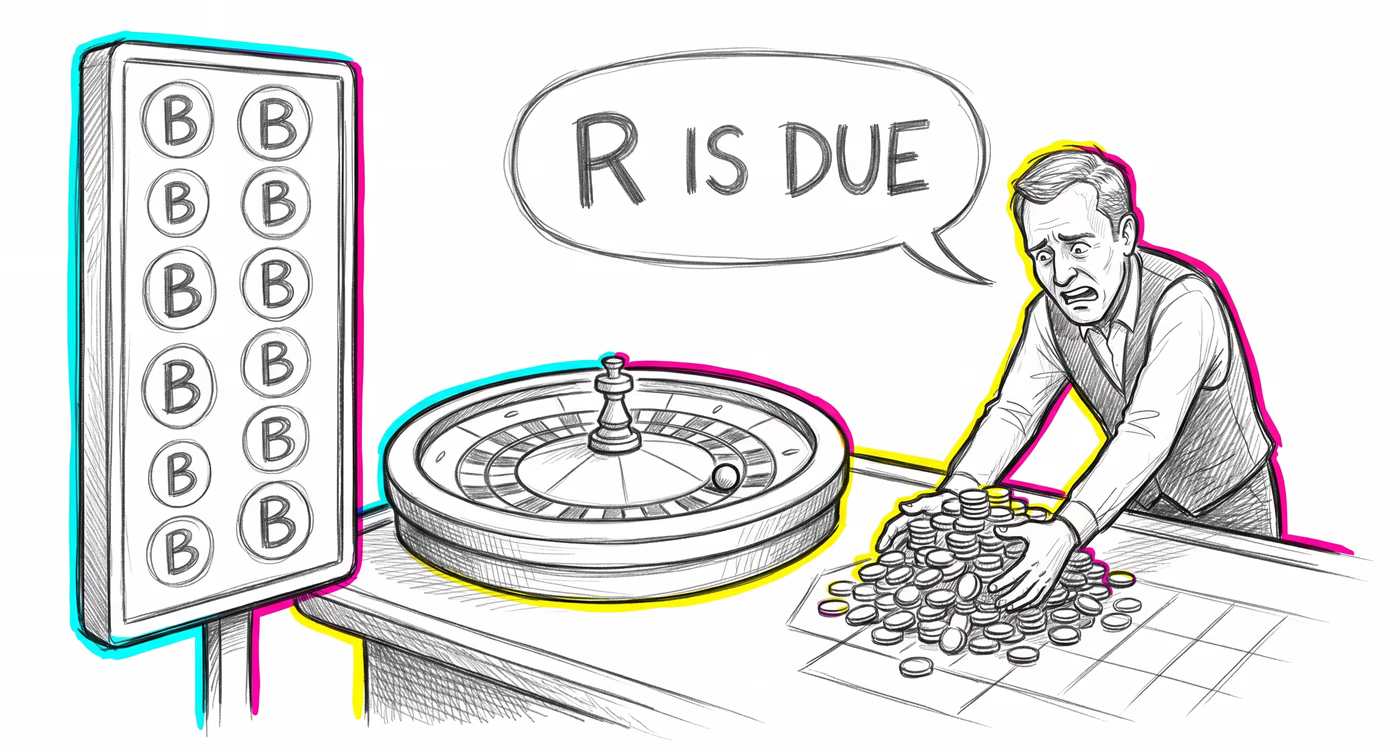
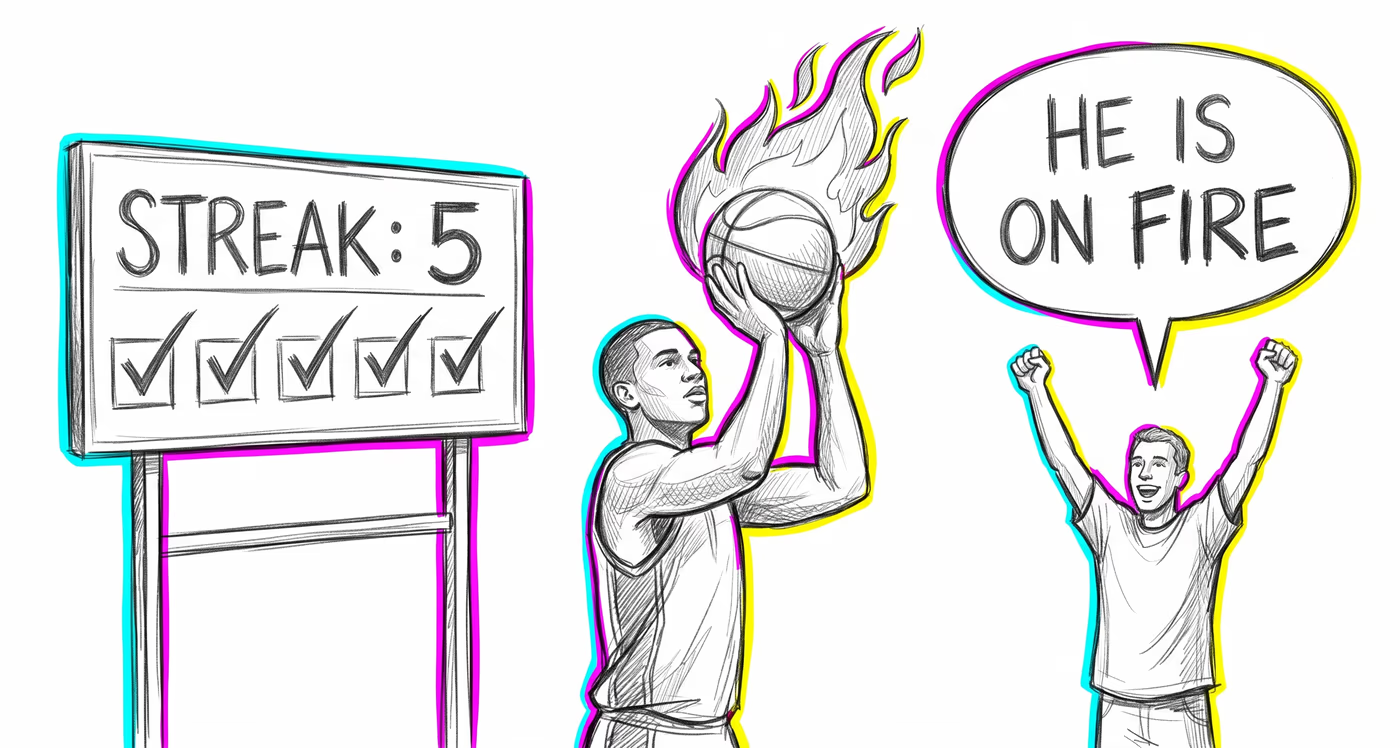
Illustration: Gambler’s Fallacy
WHAT IT IS

The glitch, explained plainly.

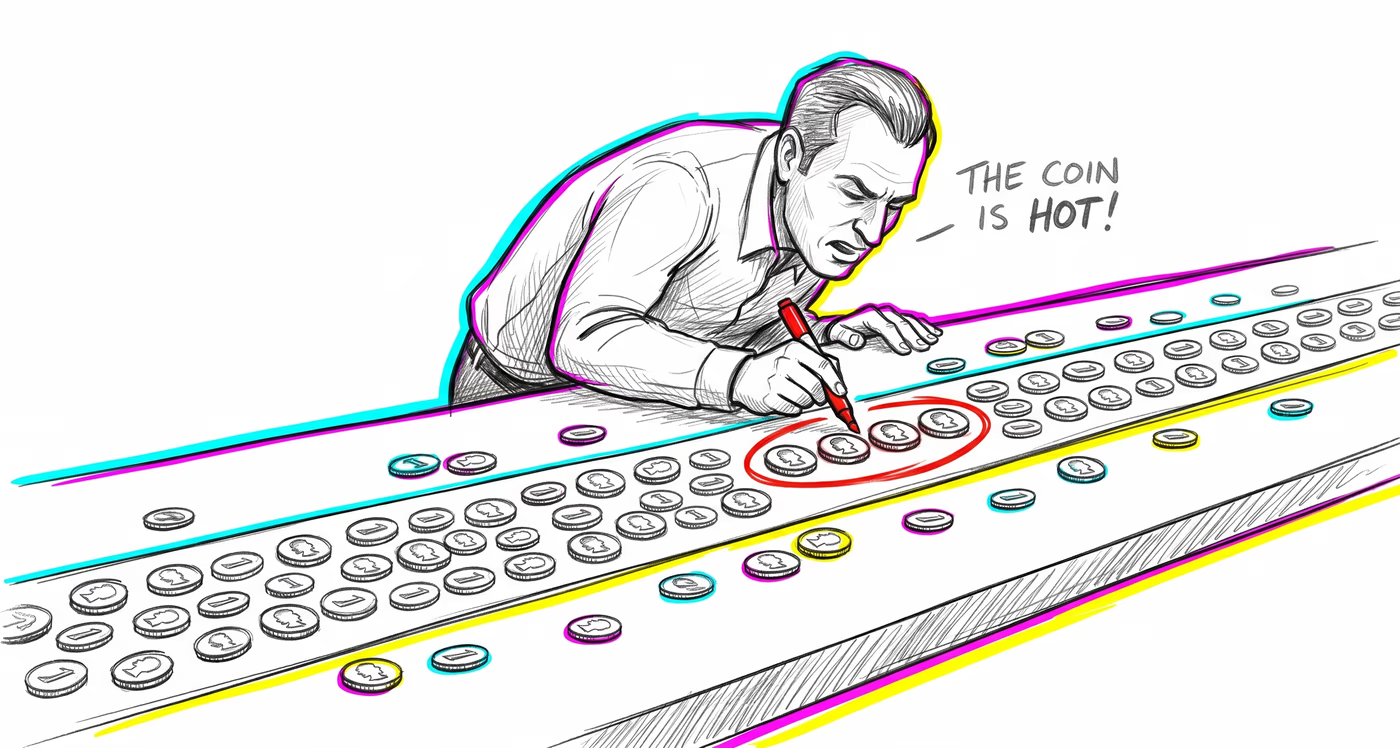
Imagine you're flipping a coin and it lands on heads five times in a row. Your tummy tells you 'tails HAS to come next!' But the coin doesn't know what happened before — it's always 50/50, every single time. It's like expecting that because you picked three red gummy bears in a row from a mixed bag, the next one must be green. The bag doesn't keep score.

The Gambler’s Fallacy leads people to believe that random processes possess a self-correcting mechanism, as if a coin 'remembers' its previous flips and adjusts accordingly. After observing a streak of identical outcomes in a genuinely random sequence, individuals predict that the opposite outcome is now 'due,' despite each event being statistically independent. This error extends far beyond casinos — it influences judges making sequential rulings, investors reacting to market streaks, and parents predicting the sex of their next child. The fallacy is driven by the intuition that even short sequences should mirror the long-run distribution, a belief Tversky and Kahneman termed the 'law of small numbers.'

SOUND FAMILIAR?

Where it shows up.

  1. 01 A roulette player at a casino watches the ball land on red seven times consecutively. She places her entire remaining bankroll on black, telling her friend, 'Black is massively overdue — the odds of eight reds in a row are astronomical.' She loses when the ball lands on red again.
  2. 02 A quality control manager at a factory notices that the last 12 items off the assembly line all passed inspection. He tells his team to relax their scrutiny because 'statistically, a defective unit has to show up soon, so we'll catch it naturally.' He reduces the inspection sampling rate.
  3. 03 An asylum court judge who has granted refugee status in each of her last four cases feels increasingly uneasy about approving the fifth, even though the applicant's documentation is strong. She denies the application, later rationalizing that her approval rate was 'getting too high' and needed to balance out.
  4. 04 A venture capitalist has invested in five startups in a row that all failed. When evaluating a sixth opportunity with mediocre fundamentals, she invests anyway, reasoning that 'the law of averages means I'm due for a hit — I can't possibly pick six losers in a row.'
  5. 05 A basketball coach notices that his team's free throw shooter has missed three consecutive shots during a close game. Rather than keeping the team's best shooter in, he substitutes another player, arguing that the current shooter's probability of making the next shot has somehow decreased because of the recent misses — even though the shots are independent events and the substitute has a lower career free throw percentage.
IN DIFFERENT DOMAINS

Where it shows up at work.

The same glitch looks different depending on the terrain. Finance, medicine, a relationship, a team — same mechanism, different costume.

Finance & investing

Investors sell assets after a series of consecutive gains, expecting an inevitable downturn, or hold losing positions expecting a rebound — treating independent market movements as if they must self-correct over short periods, often leading to premature exits from profitable positions or excessive exposure to declining ones.
Medicine & diagnosis

Clinicians who have diagnosed several patients in a row with the same rare condition may unconsciously lower their suspicion for that diagnosis in the next patient, assuming the streak is unlikely to continue, potentially causing a missed diagnosis when the condition is genuinely present.

Education & grading

Teachers grading a series of exams may unconsciously expect a poor paper after grading several strong ones in sequence, rating borderline work more harshly than they would have if it had appeared after a run of weak submissions.

Relationships

After a string of failed relationships, a person may rush into the next one with excessive optimism, believing they are 'due' for a successful relationship purely based on the length of their unsuccessful streak, rather than evaluating compatibility on its own merits.

Tech & product

A/B testing teams may prematurely halt experiments after seeing a streak of one variant winning consecutive user cohorts, assuming the trend must reverse, rather than waiting for statistically significant sample sizes before drawing conclusions.

Workplace & hiring

Hiring managers who have selected several strong candidates in a row may become irrationally skeptical of the next equally qualified applicant, feeling that their streak of good picks is 'too lucky' and due for a miss, leading them to reject strong talent.

Politics Media

Pundits predict that a political party that has won several consecutive elections is 'due for a loss' regardless of current polling data, candidate quality, or policy environment, treating election outcomes as if they were independent coin flips that must revert to the mean.

HOW TO SPOT IT

Ask yourself…

  • Am I predicting this outcome partly because the opposite has happened several times recently?
  • Am I treating this event as if it 'knows' what happened before — as if the universe keeps a running tally?
  • Would I make the same prediction if I had no knowledge of the recent streak?
HOW TO DEFEND AGAINST IT

The playbook.

  • Apply the independence test: Ask 'Does this event have any physical mechanism to know or respond to what happened before?' If the answer is no, treat each event as fresh.
  • Reframe the streak: Instead of thinking 'five heads in a row means tails is due,' remind yourself that the probability of the sixth flip is still exactly 50/50, independent of all prior flips.
  • Distinguish between the law of large numbers and the law of small numbers: Long-run averages converge to expected values over thousands of trials, not within the handful you are observing.
  • Introduce a decision delay: Before acting on a streak-based prediction, pause and write down the actual statistical probability of the next event, ignoring the recent sequence.
  • Use a pre-commitment strategy: Decide your actions (bet size, investment allocation, judgment criteria) before observing the sequence, removing the temptation to adjust based on streaks.
FAMOUS CASES

In history.

  • Monte Carlo Casino, August 18, 1913: Roulette ball landed on black 26 times in a row, and gamblers lost millions of francs betting on red, believing it was overdue.
  • Chen, Moskowitz & Shue (2016) documented that US asylum judges were up to 3.3 percentage points more likely to deny a current case after approving the previous one, with an estimated 2% of decisions reversed purely due to sequential bias.
  • The same study found Indian loan officers were up to 23% less likely to approve a loan application if they had approved the prior one, independent of application quality.
  • Major League Baseball umpires were found to be approximately 5% less likely to call a strike if the two previous pitches were called strikes, demonstrating the fallacy in high-stakes professional judgment.
WHERE IT COMES FROM
Academic origin

The concept was discussed informally for centuries in relation to gambling, but was formally analyzed by Amos Tversky and Daniel Kahneman in their 1971 paper 'Belief in the Law of Small Numbers' and further elaborated in their landmark 1974 paper 'Judgment under Uncertainty: Heuristics and Biases.' The earliest experimental documentation of the negative recency effect was by Murray Jarvik in 1951.

Evolutionary origin

In ancestral environments, most event sequences were genuinely non-independent — resource depletion, predator movement patterns, seasonal cycles, and social reciprocity all exhibited real negative autocorrelation. A berry bush picked clean yesterday is less likely to yield fruit today. Brains that expected 'correction' after streaks were often correct in natural ecologies, making this heuristic adaptive for survival in a world where most experienced sequences were not truly random.

IN AI SYSTEMS

How the machines inherit it.

Machine learning models trained on sequential prediction tasks can inherit gambler's-fallacy-like patterns if training data reflects human decisions that exhibit negative autocorrelation. Recommendation algorithms may over-diversify suggestions after repeated similar user choices, assuming the user wants variety rather than recognizing genuine preference stability. Additionally, if AI systems are trained on human-labeled sequential data (e.g., loan approvals, medical diagnoses), the models can learn and replicate the human tendency toward negatively autocorrelated decisions.

Read more on Wikipedia
FREE FIELD ZINE

10 glitches quietly running your life.

A free field-zine PDF — ten cognitive glitches named, illustrated, with a defense move for each. Plus the weekly Glitch Report on Fridays — one bias named, two spotted in the wild, one defense move. Unsubscribe any time.

EXPLORE MORE

Related glitches.

LAUNCH PRICE

Train against your blindspots.

50 cards are free to preview. Buyers unlock the rest of the deck plus the interactive training — Spot-the-Bias Quiz unlimited, Swipe Deck with spaced repetition, My Blindspots, Decision Pre-Flight, the Printable Deck + Cheat Sheets, and the Field Guide e-book. $29.50$59.

Unlock the full deck

Everything below — yours forever. Pay once, use across every device.

Half-off launch — limited to the first 100 readers. Auto-applied at checkout.
$59 $29.50
one-time payment · lifetime access
  • All interactive digital cards — search, filter, flip, shuffle on any device
  • Five training modes — Spot-the-Bias Quiz, Swipe Deck, Pre-Flight, Blindspots, Journal
  • Curated Lenses + Decision Templates + Defense Playbook
  • Printable Deck PDFs + Field Guide e-book + Cheat Sheets + Anki Export
  • Every future improvement, included
Unlock  $29.50

30-day refund · no questions asked

Unlock the full deck

Everything below — yours forever. Pay once, use across every device.

Half-off launch — limited to the first 100 readers. Auto-applied at checkout.
$59 $29.50
one-time payment · lifetime access
  • All interactive digital cards — search, filter, flip, shuffle on any device
  • Five training modes — Spot-the-Bias Quiz, Swipe Deck, Pre-Flight, Blindspots, Journal
  • Curated Lenses + Decision Templates + Defense Playbook
  • Printable Deck PDFs + Field Guide e-book + Cheat Sheets + Anki Export
  • Every future improvement, included
Unlock  $29.50

30-day refund · no questions asked