Google-Assisted Illusion

aka Internet-Induced Knowledge Illusion · Search-Induced Overconfidence · Knowledge Misattribution Effect

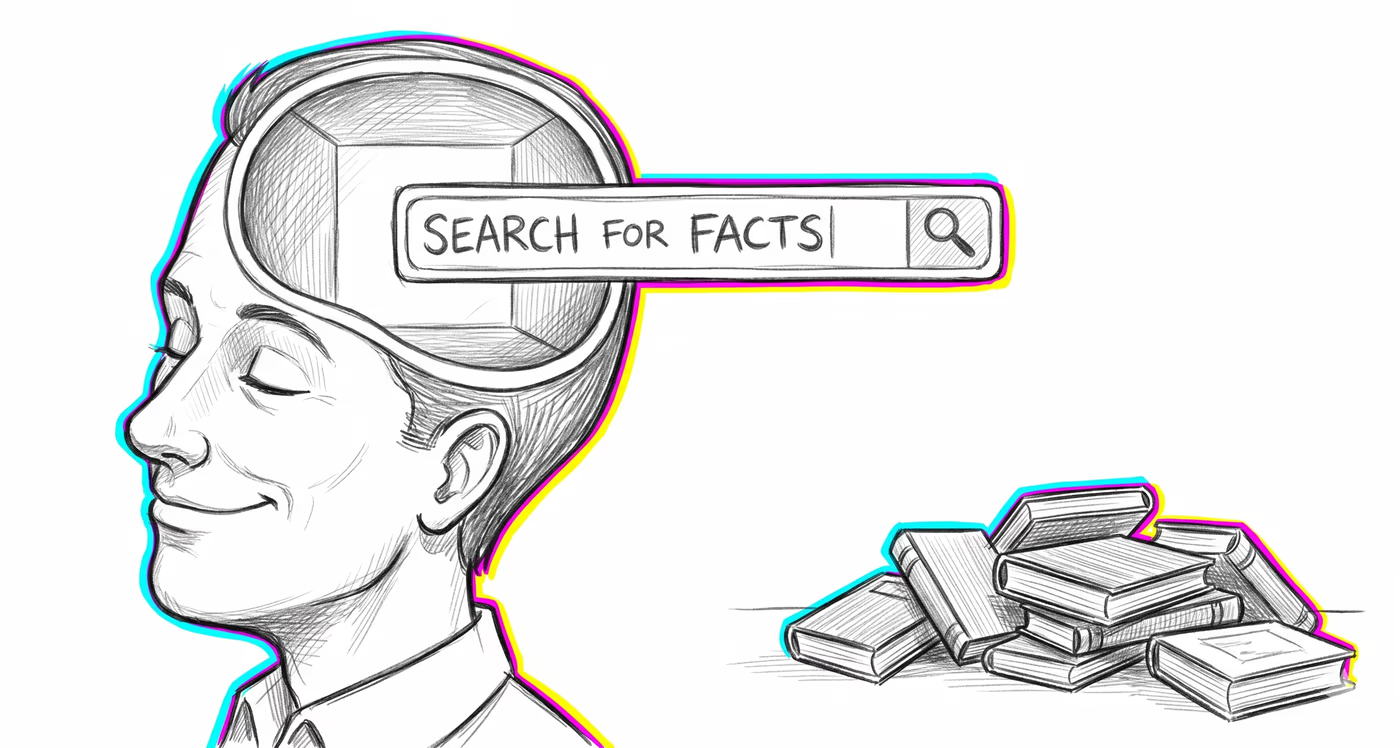
Mistaking knowledge found through an internet search for personal knowledge, inflating confidence in your own understanding.

WHAT IT IS

The glitch, explained plainly.

Imagine you have a super-smart friend who whispers every answer in your ear during a quiz. After a while, you start thinking YOU are the genius — you forget your friend was helping at all. That's what Google does to your brain: it gives you answers so fast and smoothly that you start believing the answers were already in your head.

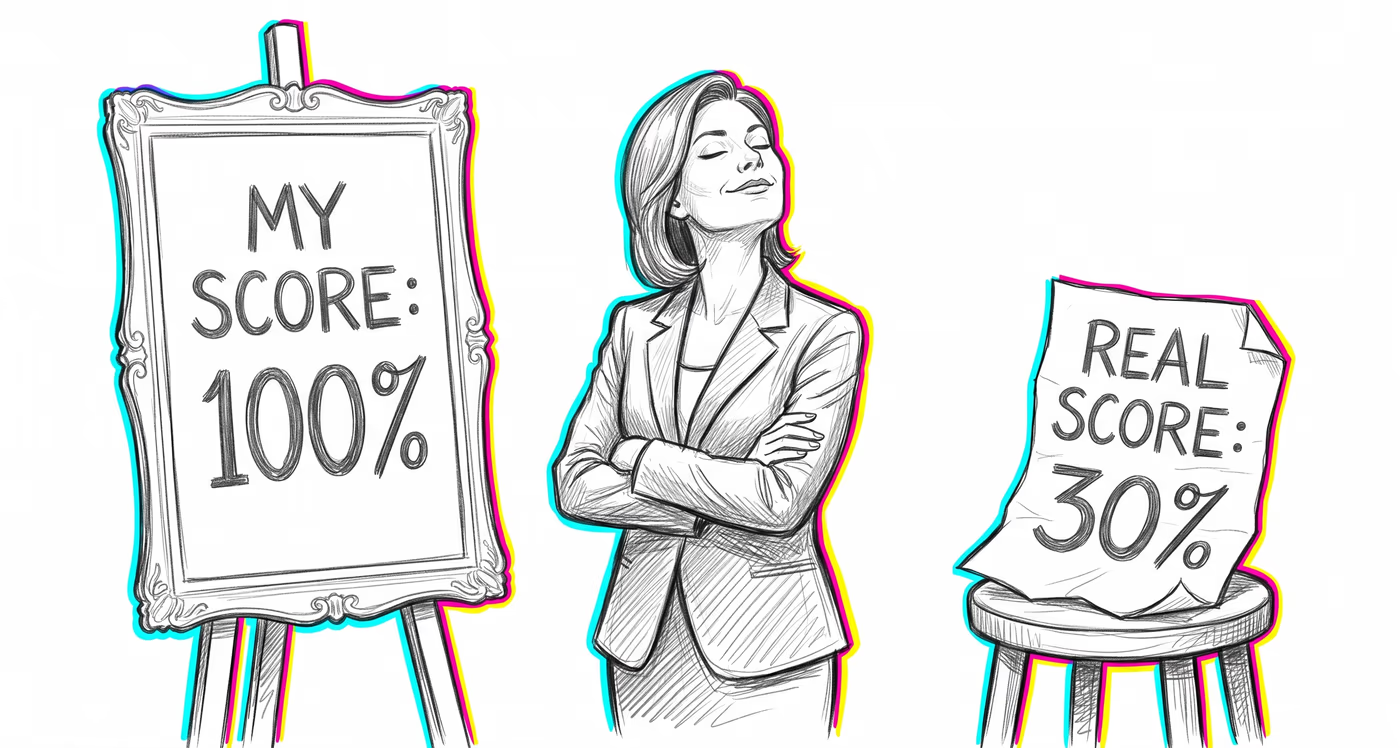
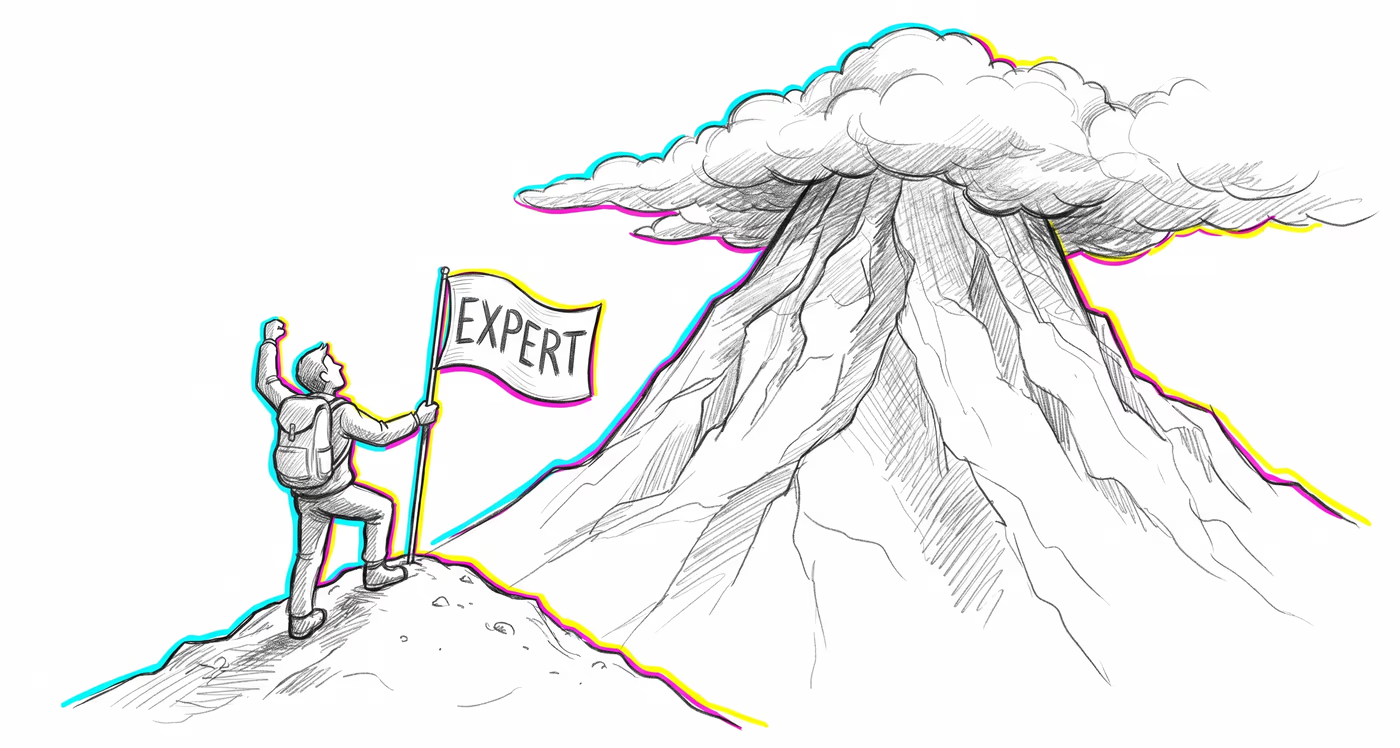
The Google-Assisted Illusion describes how the act of searching for information online blurs the boundary between externally accessed knowledge and internally held understanding, leading people to overestimate their own cognitive abilities. Unlike simply having access to information, the seamless and rapid nature of internet search causes people to conflate the search engine's knowledge with their own, even inflating confidence about topics they never searched for. Remarkably, this illusion persists even when searches yield no useful results — the mere experience of being in 'search mode' is enough to boost perceived self-knowledge. This effect extends beyond factual recall: people who use Google also rate their own brains as more active and predict they will perform better on future tests taken without internet access.

SOUND FAMILIAR?

Where it shows up.

  1. 01 After spending 20 minutes Googling climate change data for a social media argument, Priya walks away from her laptop feeling highly confident about her climate science knowledge. At dinner, when a friend asks about ocean acidification — a topic Priya never actually searched — she rates herself as very knowledgeable and proceeds to give an improvised explanation.
  2. 02 Marcus uses Google to look up how cryptocurrency mining works before a team meeting. During the meeting, when his manager asks who feels qualified to evaluate a blockchain vendor proposal, Marcus volunteers confidently, genuinely believing he has strong foundational understanding — despite having only skimmed two search results 30 minutes ago.
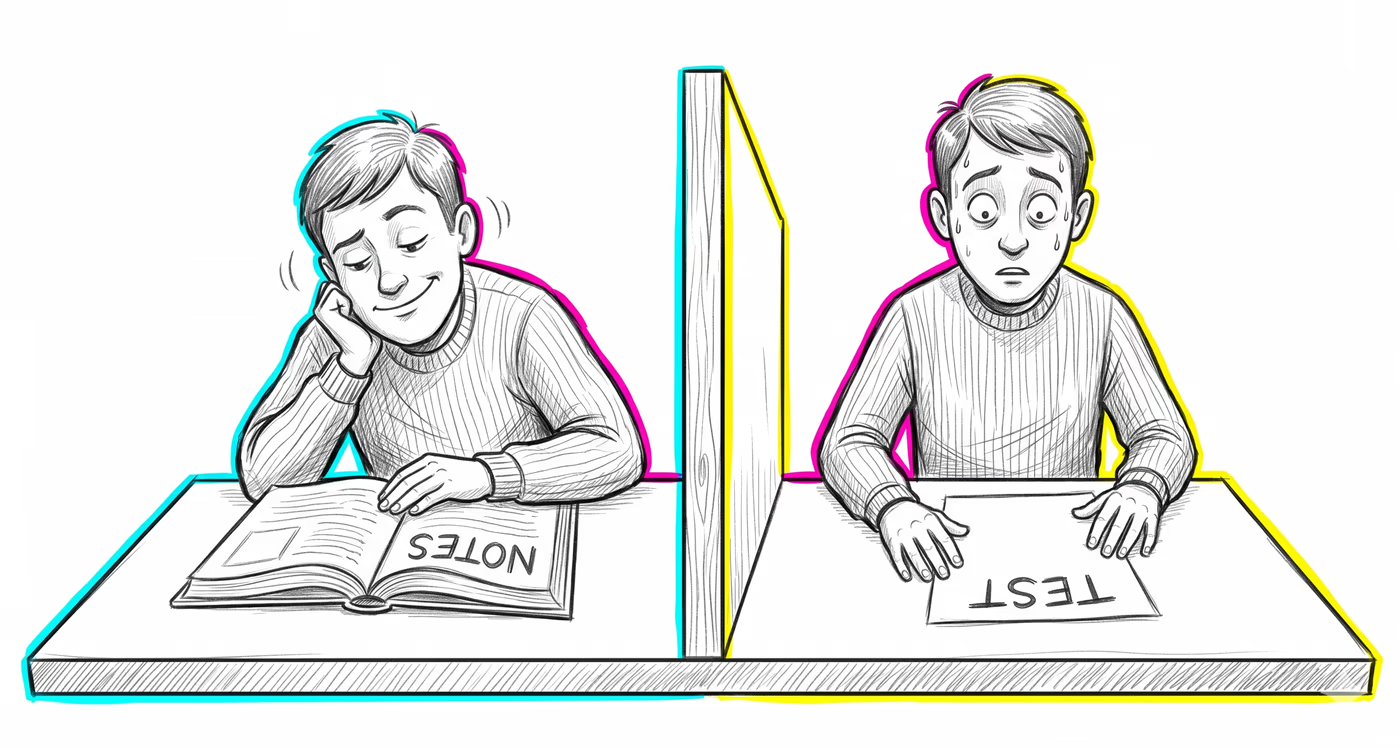
  3. 03 A medical student searches online for the mechanism of a rare drug interaction before a pharmacology exam. During the exam — taken without internet access — she is surprised at how little she can actually recall and writes far less than she predicted, having confused the ease of finding the answer online with having learned it.
  4. 04 David reads several Google results about geopolitical tensions in Southeast Asia while preparing talking points for a podcast. When the conversation shifts to an unrelated region he didn't research at all, David speaks with the same level of confidence, sincerely believing his general understanding has improved across the board from his earlier searches.
  5. 05 A product manager uses search engines extensively while writing a market analysis report. When her VP asks in a hallway conversation how well she personally understands the competitive landscape without her notes, she rates her own knowledge as an 8 out of 10. Three days later, asked the same questions cold, she struggles to recall even basic competitive differentiators — the search-assisted fluency had made her feel the knowledge was hers.
IN DIFFERENT DOMAINS

Where it shows up at work.

The same glitch looks different depending on the terrain. Finance, medicine, a relationship, a team — same mechanism, different costume.

Finance & investing

Retail investors who research stocks via search engines develop inflated confidence in their financial acumen, leading them to make riskier trades and dismiss professional advice because they believe their internet-sourced knowledge is equivalent to genuine expertise.
Medicine & diagnosis

Patients who extensively Google their symptoms arrive at clinical visits overconfident in their self-diagnoses, resist physician recommendations, and may delay appropriate treatment because the ease of finding medical information online makes them feel medically knowledgeable.

Education & grading

Students who rely heavily on search engines for homework and study materials overestimate how much they have actually learned, underinvest in effortful encoding strategies like retrieval practice, and perform worse on closed-book exams than they predict.

Relationships

Partners who Google relationship advice or communication strategies feel they have deeply internalized the guidance, then become frustrated when they cannot execute the strategies in real-time conflict because the knowledge was never truly their own.

Tech & product

Search engine interfaces that return answers instantly and seamlessly reinforce this illusion by design — the frictionless experience prevents users from recognizing the boundary between their knowledge and the platform's. Product teams may underestimate how much users confuse access with understanding when building knowledge-dependent features.

Workplace & hiring

Employees who Google answers during meetings or presentations project unwarranted confidence in their expertise, which can lead to poor delegation decisions when managers mistake search-assisted fluency for genuine domain competence.

Politics Media

Voters who search for political information online develop inflated confidence in their policy understanding, becoming more entrenched in their existing views and less open to expert analysis, because they mistake the ease of finding supporting information for genuine comprehension.

HOW TO SPOT IT

Ask yourself…

  • Am I feeling confident about a topic primarily because I recently looked it up, rather than because I've studied or practiced it?
  • Could I explain this concept clearly to someone without any access to the internet right now?
  • Am I confusing the ease of finding information with actually understanding or remembering it?
HOW TO DEFEND AGAINST IT

The playbook.

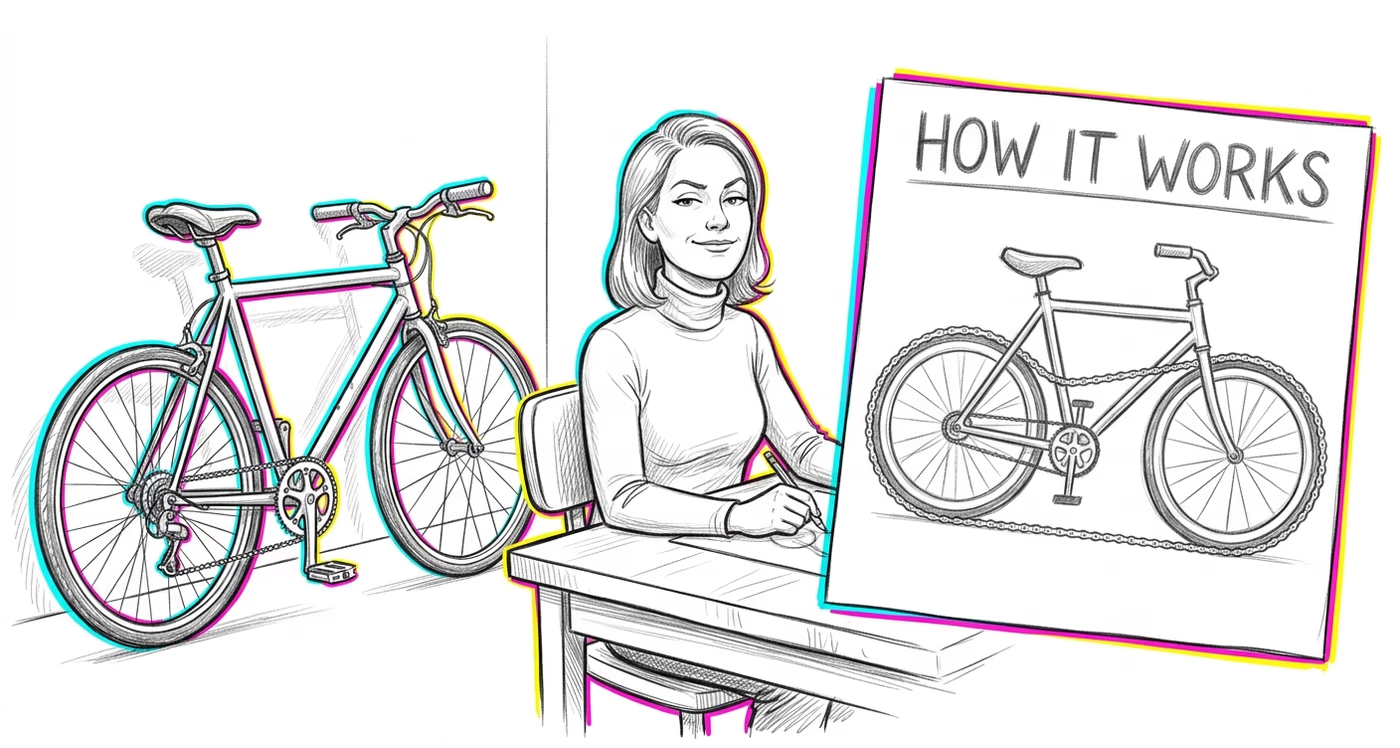
  • After searching for something, close the browser and try to explain the concept aloud or in writing from memory — the gap between what you thought you knew and what you can actually articulate reveals the illusion.
  • Before claiming knowledge on a topic, ask yourself: 'Could I pass a quiz on this right now, without my phone?' If the answer is no, recalibrate your confidence.
  • Use the 'slow search' principle: deliberately introduce friction into your information retrieval (close the laptop, try to recall first) to prevent seamless merging of external and internal knowledge.
  • Practice retrieval-based learning instead of passive browsing — test yourself on what you've read rather than simply re-reading or re-searching.
  • When making important decisions (medical, financial, political), explicitly label which pieces of your reasoning came from search results versus genuine prior knowledge.
FAMOUS CASES

In history.

  • The rise of 'Dr. Google' culture in healthcare, where patients increasingly challenge clinical diagnoses based on internet searches, has been widely documented as a pattern driven by inflated self-assessed medical knowledge.
  • During the COVID-19 pandemic, widespread internet searching about virology and epidemiology led many individuals to express overconfident opinions about viral transmission, vaccine mechanisms, and treatment protocols, contributing to misinformation spread.
WHERE IT COMES FROM
Academic origin

Matthew Fisher, Mariel K. Goddu, and Frank C. Keil at Yale University first demonstrated the core phenomenon in 2015. Adrian F. Ward at the University of Texas at Austin significantly extended the research in 2021 with eight additional experiments published in PNAS.

Evolutionary origin

Humans evolved to share cognitive labor within social groups through transactive memory systems, where individuals specialize in different knowledge domains and rely on others for complementary information. This social memory-sharing was adaptive for survival in complex environments. The brain's tendency to blur boundaries between self-knowledge and group-knowledge was functional in small tribal settings where all knowledge sources were known and trusted.

IN AI SYSTEMS

How the machines inherit it.

AI chatbots and large language models may amplify this illusion even further. When users interact with conversational AI that provides instant, fluent, authoritative-sounding answers, the conversational format makes it even easier to conflate the AI's outputs with one's own understanding. Early research suggests that using anthropomorphic digital agents (as opposed to a bare search engine) may moderate the effect, but the seamless integration of AI-generated responses into human thought processes risks deepening knowledge misattribution at scale.

FREE FIELD ZINE

10 glitches quietly running your life.

A free field-zine PDF — ten cognitive glitches named, illustrated, with a defense move for each. Plus the weekly Glitch Report on Fridays — one bias named, two spotted in the wild, one defense move. Unsubscribe any time.

EXPLORE MORE

Related glitches.

LAUNCH PRICE

Train against your blindspots.

50 cards are free to preview. Buyers unlock the rest of the deck plus the interactive training — Spot-the-Bias Quiz unlimited, Swipe Deck with spaced repetition, My Blindspots, Decision Pre-Flight, the Printable Deck + Cheat Sheets, and the Field Guide e-book. $29.50$59.

Unlock the full deck

Everything below — yours forever. Pay once, use across every device.

Half-off launch — limited to the first 100 readers. Auto-applied at checkout.
$59 $29.50
one-time payment · lifetime access
  • All interactive digital cards — search, filter, flip, shuffle on any device
  • Five training modes — Spot-the-Bias Quiz, Swipe Deck, Pre-Flight, Blindspots, Journal
  • Curated Lenses + Decision Templates + Defense Playbook
  • Printable Deck PDFs + Field Guide e-book + Cheat Sheets + Anki Export
  • Every future improvement, included
Unlock  $29.50

30-day refund · no questions asked

Unlock the full deck

Everything below — yours forever. Pay once, use across every device.

Half-off launch — limited to the first 100 readers. Auto-applied at checkout.
$59 $29.50
one-time payment · lifetime access
  • All interactive digital cards — search, filter, flip, shuffle on any device
  • Five training modes — Spot-the-Bias Quiz, Swipe Deck, Pre-Flight, Blindspots, Journal
  • Curated Lenses + Decision Templates + Defense Playbook
  • Printable Deck PDFs + Field Guide e-book + Cheat Sheets + Anki Export
  • Every future improvement, included
Unlock  $29.50

30-day refund · no questions asked