Group Attribution Error

aka Group Correspondence Bias

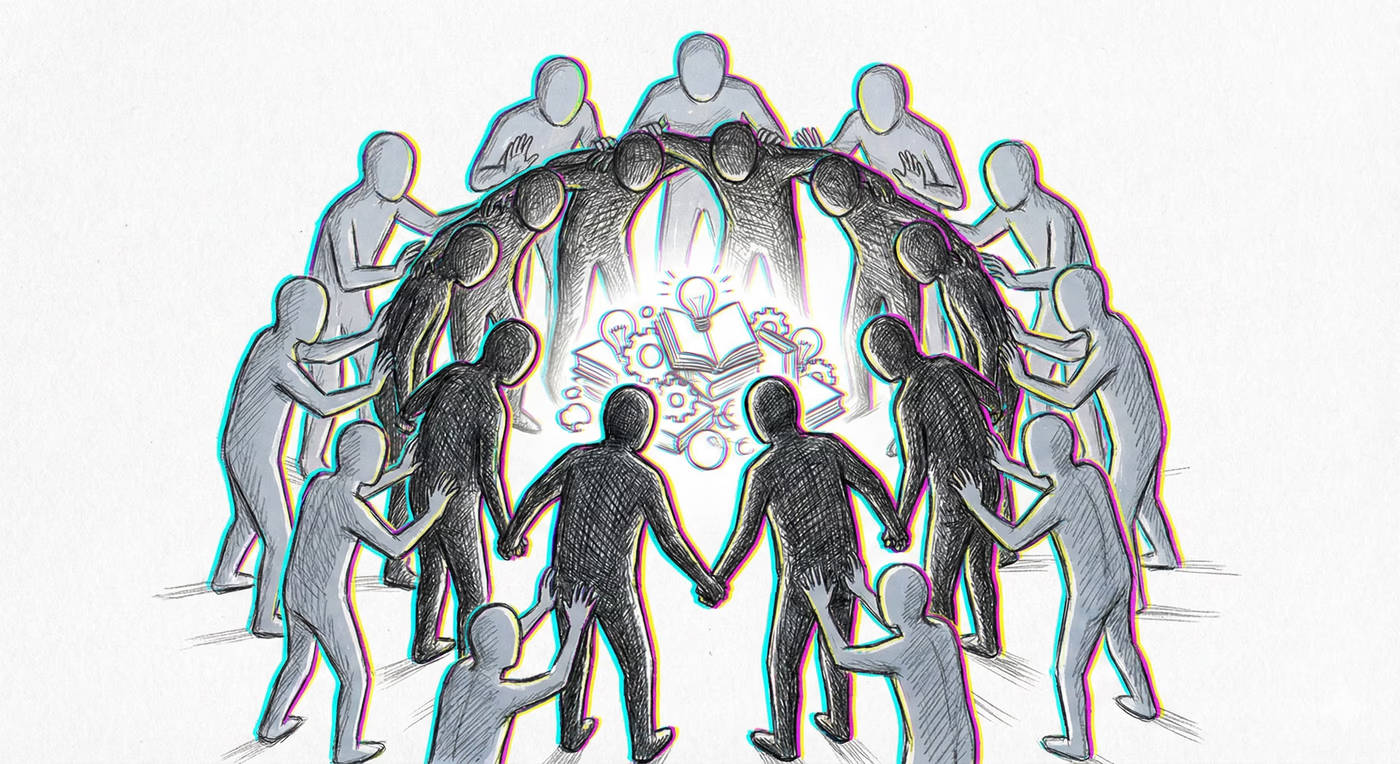
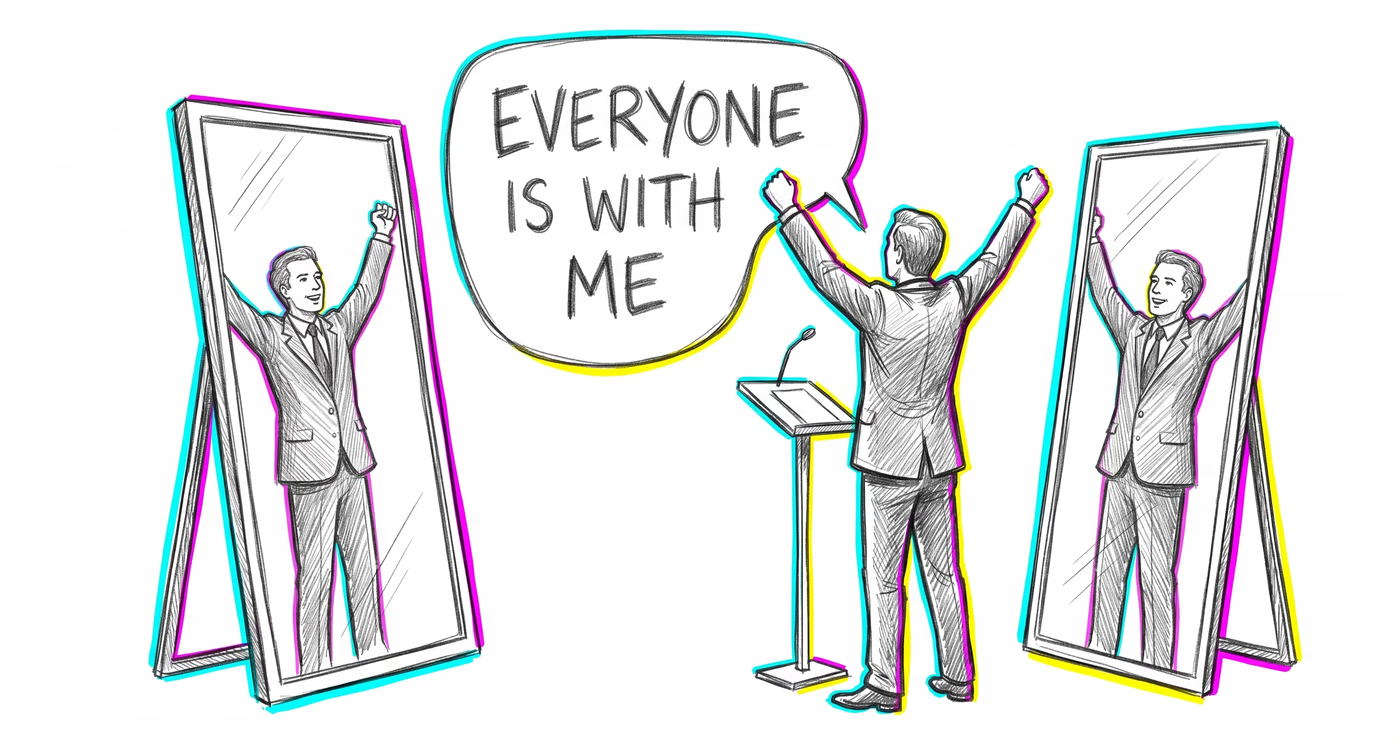
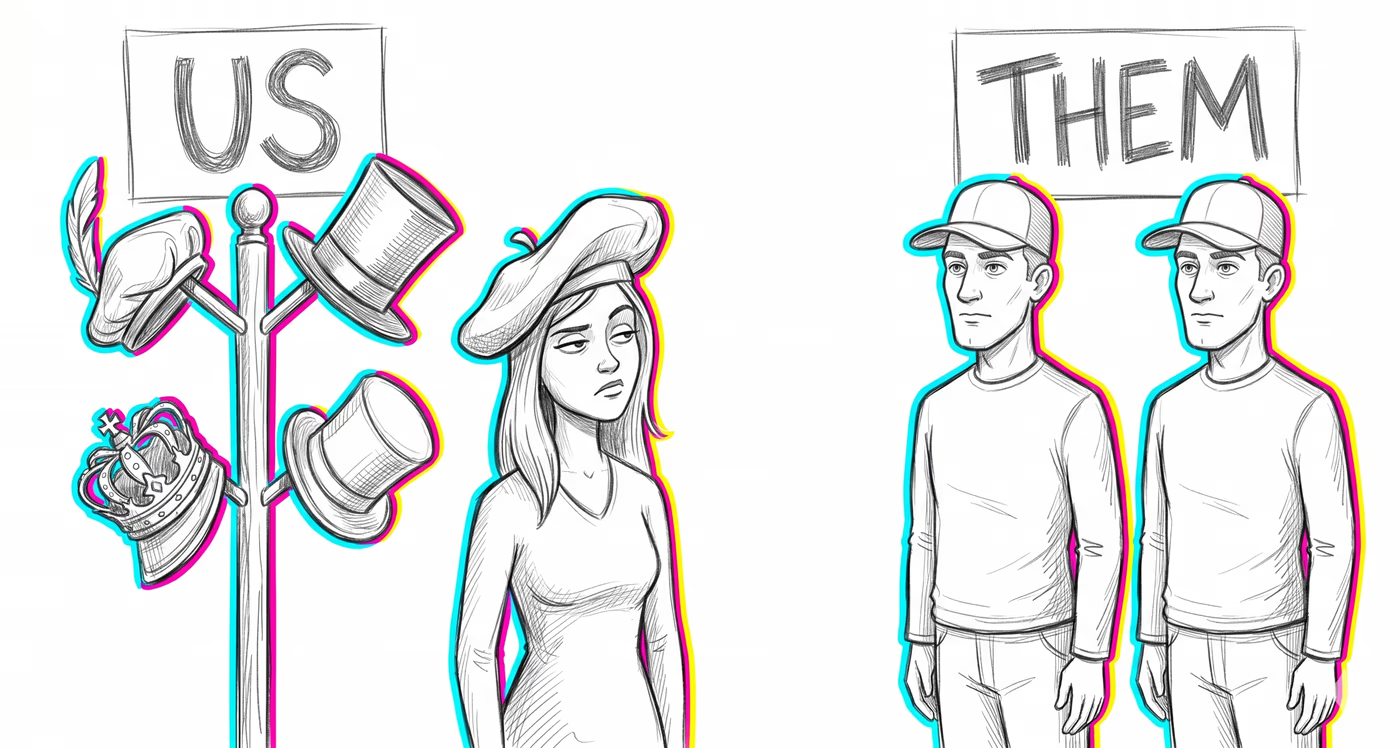
Assuming that one member's traits represent the whole group, or that a group decision reflects every individual's view.

WHAT IT IS

The glitch, explained plainly.

Imagine you meet one kid from another school who is really loud. Then you think, 'All kids from that school must be loud!' Or imagine a class votes to skip recess and you think every single kid wanted to skip, even though maybe only half of them did and the others just lost the vote. That's the group attribution error—treating one person or one decision as if it speaks for everybody in the group.

The Group Attribution Error operates in two distinct forms. First, people observe the behavior or traits of one group member and generalize those characteristics to the entire group, even when told the individual is atypical. Second, people assume that a group's collective decision—such as a vote or policy outcome—reflects the private attitudes of every member of that group, ignoring the decision rules, dissent, or structural constraints that shaped the outcome. The error intensifies when the target group is perceived as an outgroup, adversarial, or homogeneous, and it tends to disappear when people evaluate their own groups, where they more readily appreciate internal diversity and situational pressures.

SOUND FAMILIAR?

Where it shows up.

  1. 01 Maria watches a documentary featuring a single welfare recipient who has been collecting benefits for 15 years. Despite a caption noting this person is statistically atypical, Maria concludes that most welfare recipients are long-term dependents and argues against expanding the program.
  2. 02 A city council votes 5-4 to approve a controversial development project. When residents of a neighboring town hear the news, they conclude that the people of that city must be pro-development and unconcerned about the environment, ignoring how narrow the margin was and that the vote was a council decision, not a public referendum.
  3. 03 After watching a jury deliver a guilty verdict, Tom assumes all twelve jurors personally believed the defendant was guilty. He doesn't consider that the decision rule required unanimity and that some jurors may have acquiesced under deliberation pressure rather than holding a strong personal conviction.
  4. 04 A manager notices that a product team in the Tokyo office missed a deadline. She tells her colleagues, 'That whole office just doesn't take urgency seriously,' even though the delay was caused by a single vendor dependency outside the team's control, and individual team members had been working overtime.
  5. 05 A political analyst reads that a country's parliament passed a restrictive immigration law. He writes an op-ed arguing the nation's citizens hold deeply xenophobic attitudes, without examining that the law passed through a coalition compromise, was opposed by nearly half the parliament, and was shaped by a parliamentary procedure that amplified the ruling coalition's influence.
IN DIFFERENT DOMAINS

Where it shows up at work.

The same glitch looks different depending on the terrain. Finance, medicine, a relationship, a team — same mechanism, different costume.

Finance & investing

Investors may judge an entire company's workforce as incompetent or brilliant based on the actions of a single executive, leading to disproportionate stock reactions to individual scandals or successes that do not reflect the organization's overall capability.
Medicine & diagnosis

A clinician encountering one non-compliant patient from a particular demographic group may begin to assume patients from that background are generally non-compliant, adjusting communication or treatment intensity based on group membership rather than individual assessment.

Education & grading

A teacher who has a disruptive student from a particular neighborhood or school may develop lower expectations for all students transferring from that area, assuming the group shares the individual's behavioral tendencies.

Relationships

After a bad experience with one person from a friend's social circle, someone may conclude the entire group is untrustworthy and avoid future gatherings, attributing one individual's behavior to the whole friend group.

Tech & product

Product teams may generalize feedback from a single vocal user segment to all users, assuming that one subgroup's complaints or preferences reflect the entire user base's attitudes, leading to misguided feature prioritization.

Workplace & hiring

When a department delivers poor quarterly results, leadership may assume every team member underperformed, overlooking that the outcome was driven by structural issues, a few underperformers, or misaligned incentives rather than uniform low effort.

Politics Media

Media coverage of a protest often presents participants as sharing identical views, leading audiences to attribute the most extreme positions voiced by a few to every person who attended, collapsing a diverse coalition into a monolithic caricature.

HOW TO SPOT IT

Ask yourself…

  • Am I forming an opinion about this entire group based on the behavior of just one or a few members?
  • Am I assuming that a group's decision or outcome reflects what every individual in that group personally believes?
  • Would I make the same generalization if this were my own group, or would I recognize the internal diversity?
HOW TO DEFEND AGAINST IT

The playbook.

  • Before generalizing, ask: 'How was this group decision actually made? What were the decision rules, margins, and constraints?'
  • Actively seek out dissenting voices within the group to counter the illusion of unanimity.
  • Replace group-level judgments with individual-level questions: 'What do I actually know about this specific person?'
  • Increase direct, meaningful contact with diverse members of groups you tend to stereotype.
  • When consuming news about group decisions, look for vote margins, internal debates, and structural factors before drawing conclusions about members' attitudes.
FAMOUS CASES

In history.

  • Post-9/11 generalization of the actions of a small group of terrorists to broader Muslim communities, fueling widespread discrimination despite the vast diversity of opinion within those communities.
  • During the Japanese American internment in WWII, the U.S. government attributed the threat posed by a foreign nation's military to all Japanese-descent individuals living in America, treating the group as monolithic.
WHERE IT COMES FROM
Academic origin

Scott T. Allison and David M. Messick, 1985. Formalized in their paper 'The Group Attribution Error' published in the Journal of Experimental Social Psychology. Earlier related work on generalizing from atypical cases was done by Hamill, Nisbett, and Wilson in 1980.

Evolutionary origin

In ancestral environments, rapidly categorizing other tribal groups as uniformly friendly or hostile based on limited encounters with individual members would have been a survival-relevant heuristic. Treating an outgroup as monolithic allowed faster threat assessment when inter-tribal encounters were rare and the cost of misreading a hostile group was potentially fatal.

IN AI SYSTEMS

How the machines inherit it.

Machine learning models trained on group-level labeled data can inherit group attribution errors by learning to associate individual predictions with aggregate group characteristics. For example, a hiring algorithm trained on department-level performance scores may penalize all applicants from a low-performing department, ignoring individual variation. LLMs can reproduce stereotypical group attributions found in training data, generating text that treats groups as homogeneous agents.

Read more on Wikipedia
FREE FIELD ZINE

10 glitches quietly running your life.

A free field-zine PDF — ten cognitive glitches named, illustrated, with a defense move for each. Plus the weekly Glitch Report on Fridays — one bias named, two spotted in the wild, one defense move. Unsubscribe any time.

EXPLORE MORE

Related glitches.

LAUNCH PRICE

Train against your blindspots.

50 cards are free to preview. Buyers unlock the rest of the deck plus the interactive training — Spot-the-Bias Quiz unlimited, Swipe Deck with spaced repetition, My Blindspots, Decision Pre-Flight, the Printable Deck + Cheat Sheets, and the Field Guide e-book. $29.50$59.

Unlock the full deck

Everything below — yours forever. Pay once, use across every device.

Half-off launch — limited to the first 100 readers. Auto-applied at checkout.
$59 $29.50
one-time payment · lifetime access
  • All interactive digital cards — search, filter, flip, shuffle on any device
  • Five training modes — Spot-the-Bias Quiz, Swipe Deck, Pre-Flight, Blindspots, Journal
  • Curated Lenses + Decision Templates + Defense Playbook
  • Printable Deck PDFs + Field Guide e-book + Cheat Sheets + Anki Export
  • Every future improvement, included
Unlock  $29.50

30-day refund · no questions asked

Unlock the full deck

Everything below — yours forever. Pay once, use across every device.

Half-off launch — limited to the first 100 readers. Auto-applied at checkout.
$59 $29.50
one-time payment · lifetime access
  • All interactive digital cards — search, filter, flip, shuffle on any device
  • Five training modes — Spot-the-Bias Quiz, Swipe Deck, Pre-Flight, Blindspots, Journal
  • Curated Lenses + Decision Templates + Defense Playbook
  • Printable Deck PDFs + Field Guide e-book + Cheat Sheets + Anki Export
  • Every future improvement, included
Unlock  $29.50

30-day refund · no questions asked