Dunning-Kruger Effect

aka Dunning-Kruger Bias · Unskilled and Unaware Effect · Illusion of Superiority

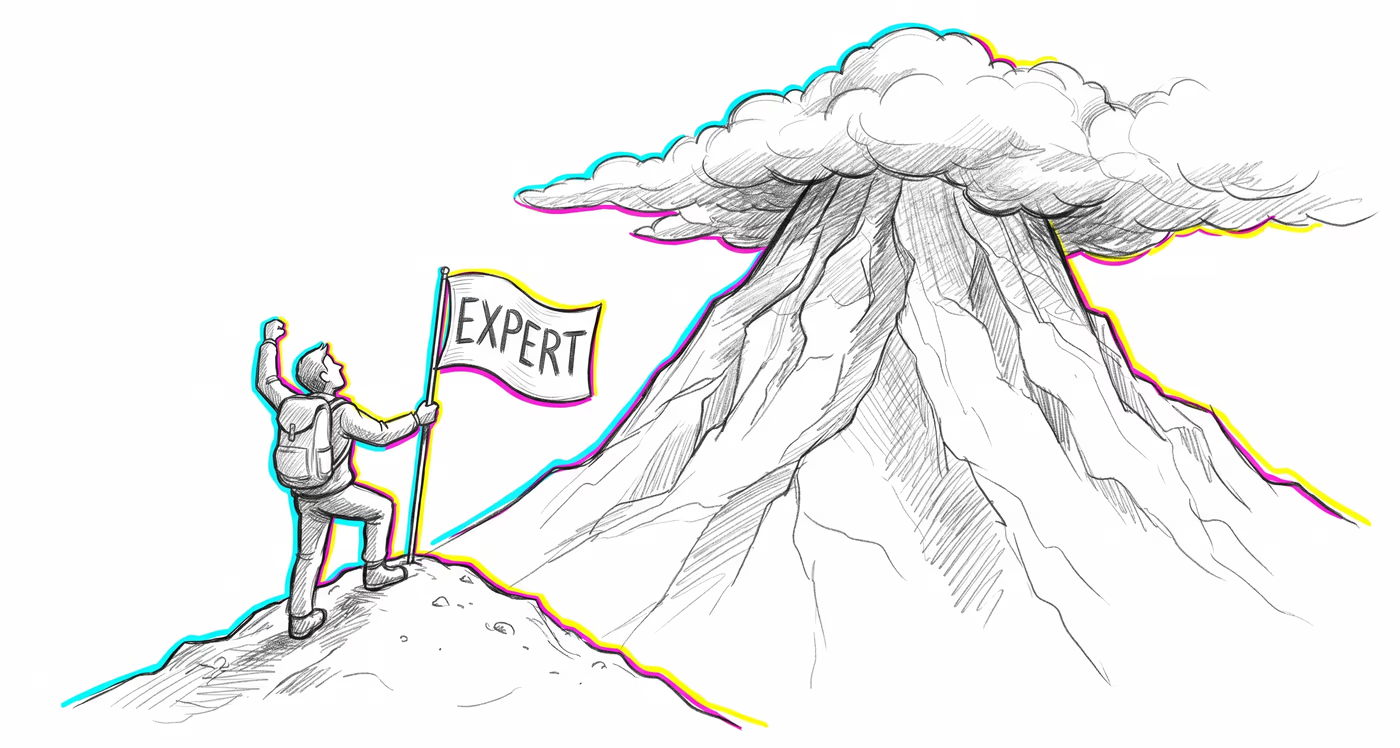
People with low competence in a domain significantly overestimating their own ability, because they lack the skill to see the gap.

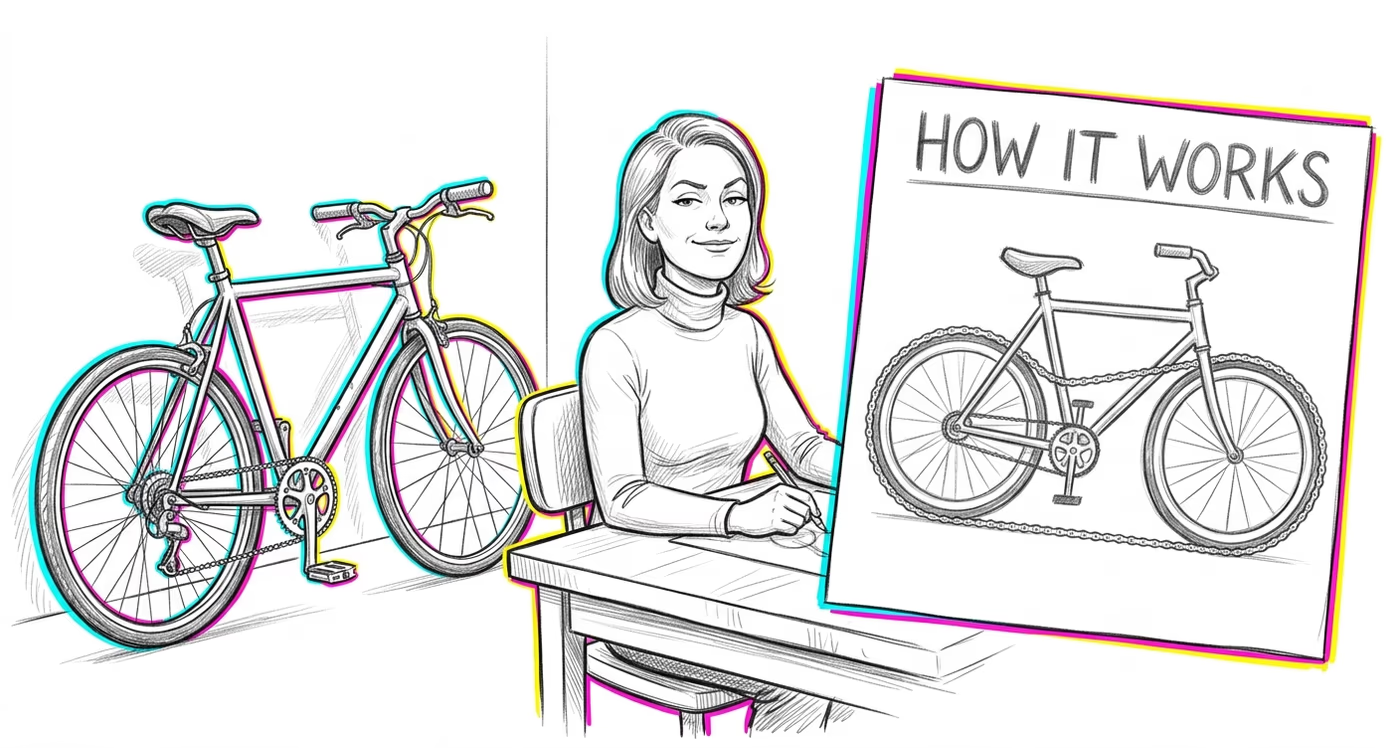
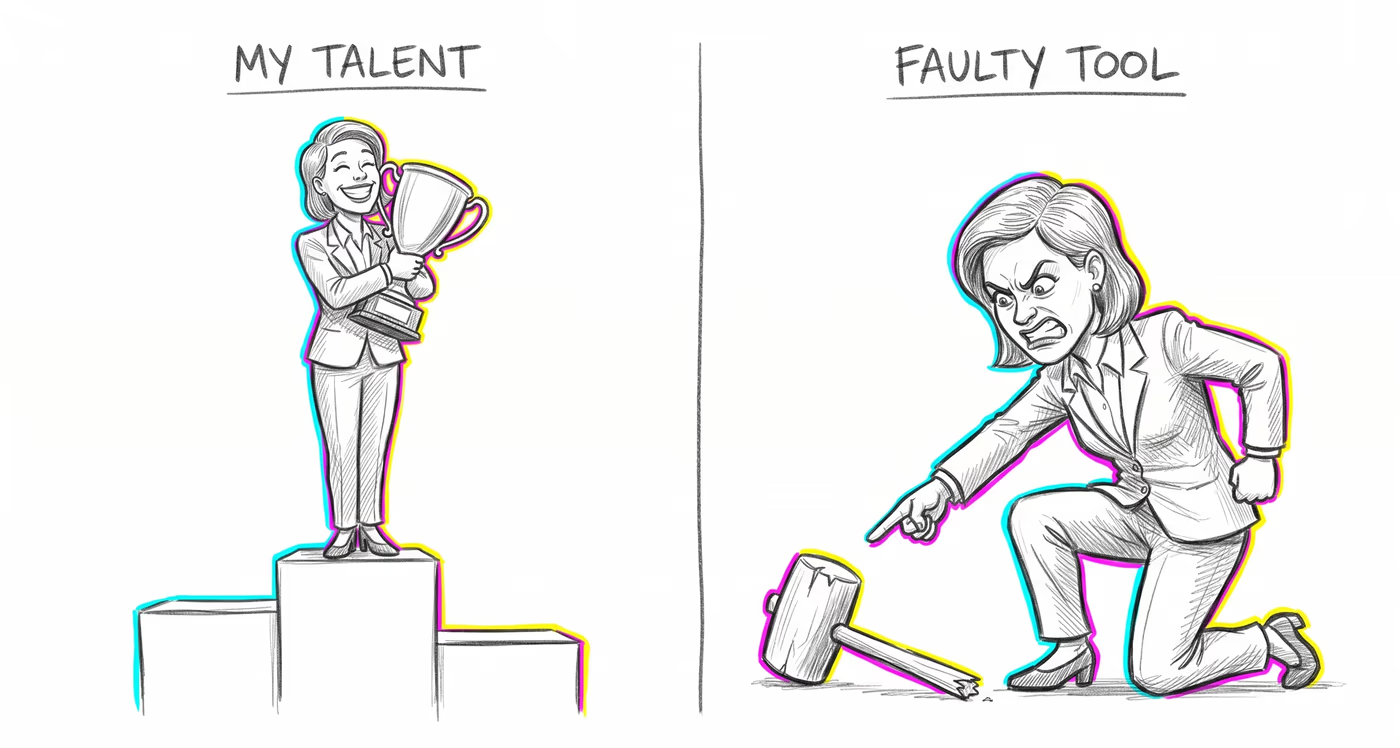
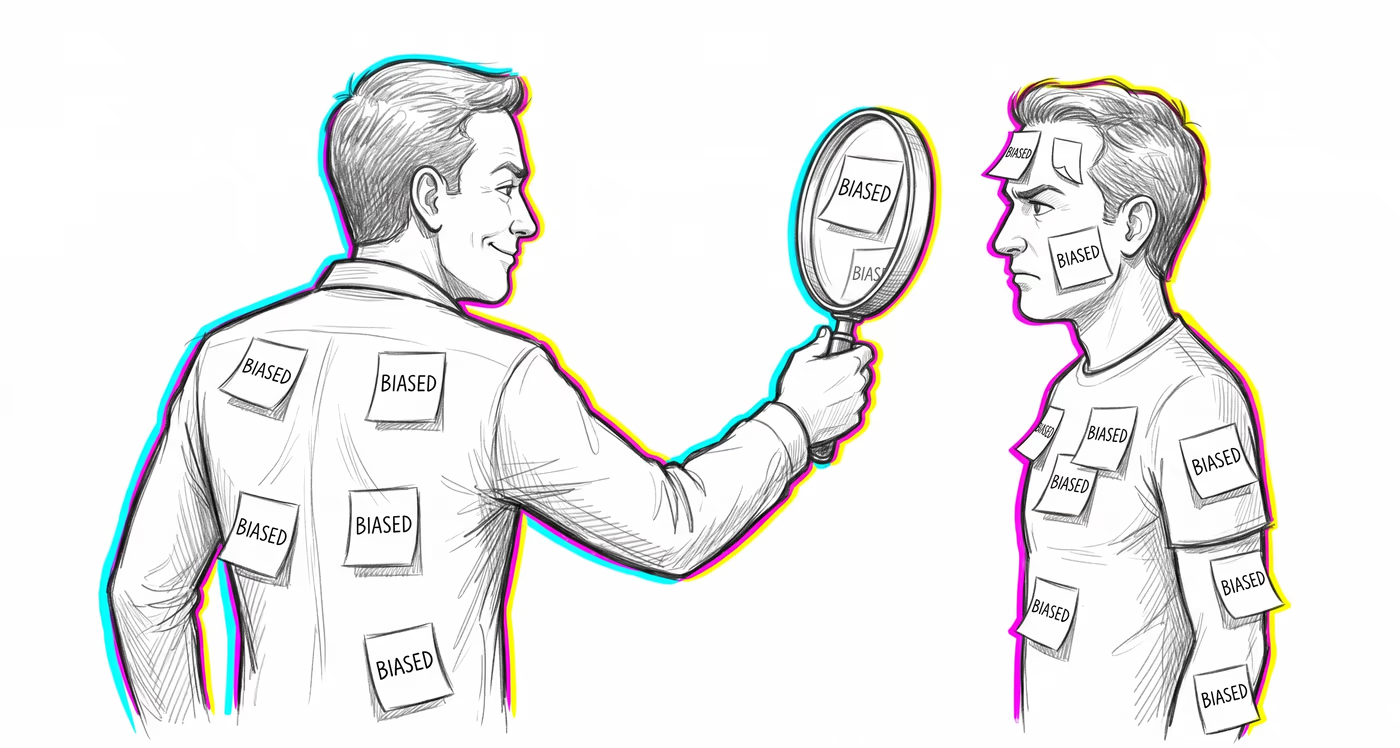
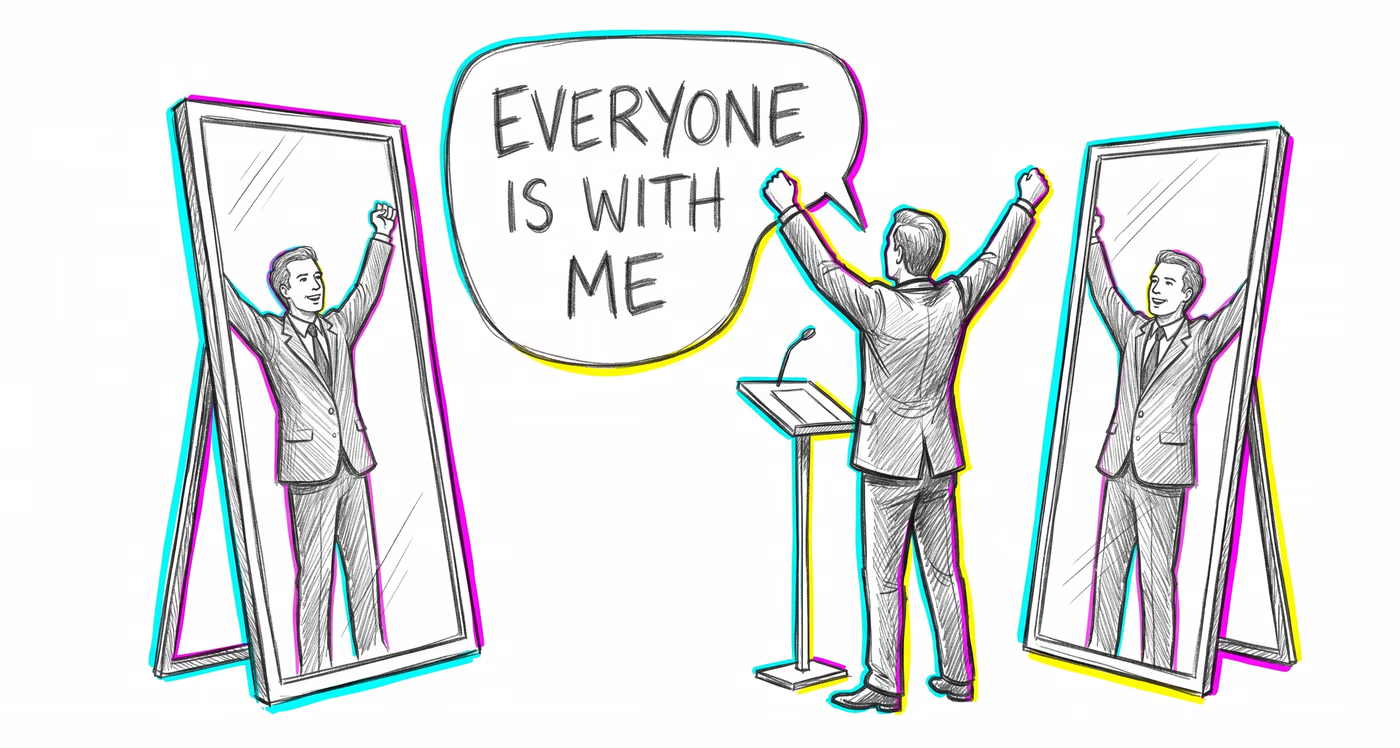
Illustration: Dunning-Kruger Effect
WHAT IT IS

The glitch, explained plainly.

Imagine you just learned three chords on guitar and you think you sound amazing because you don't know enough about music to hear what a real guitarist sounds like. Meanwhile, the actual expert guitarist thinks they're only okay because they compare themselves to even better players. You need skill to recognize skill — so when you don't have it, you can't even tell what you're missing.

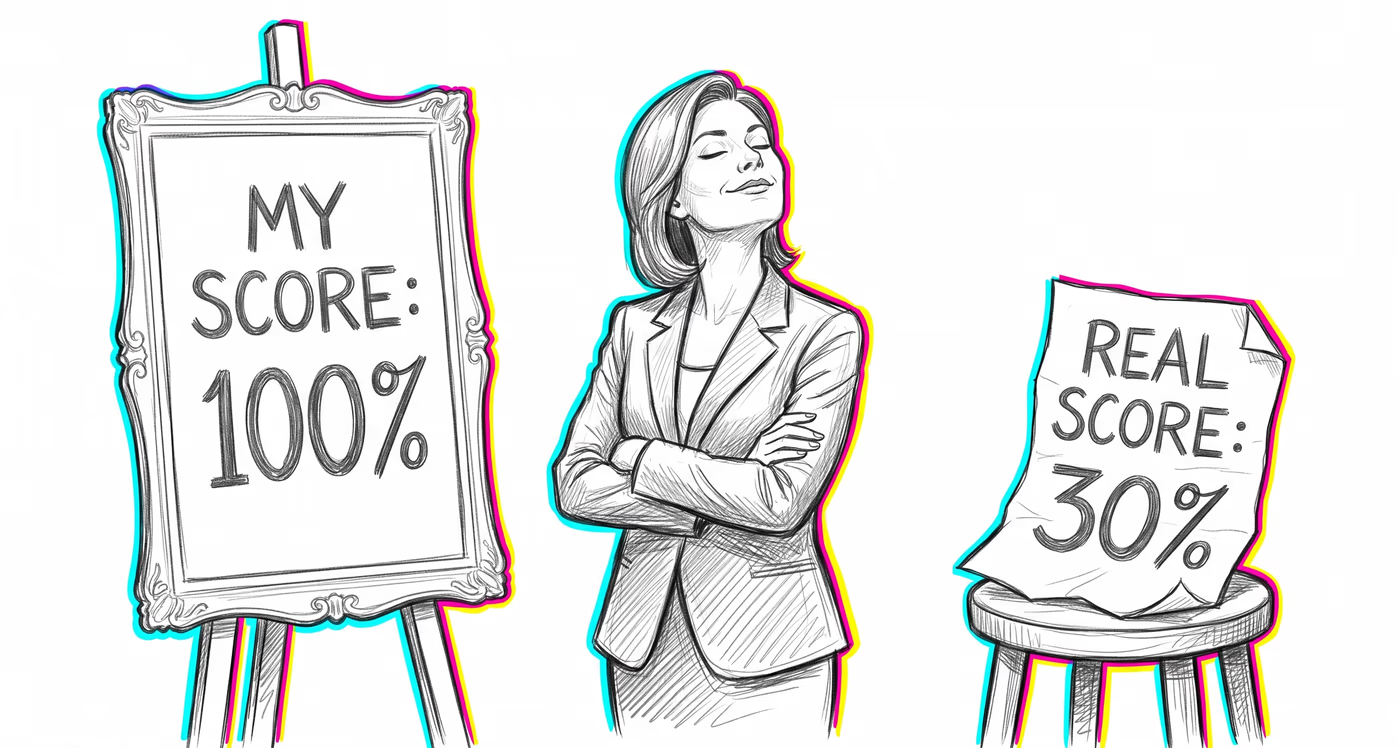
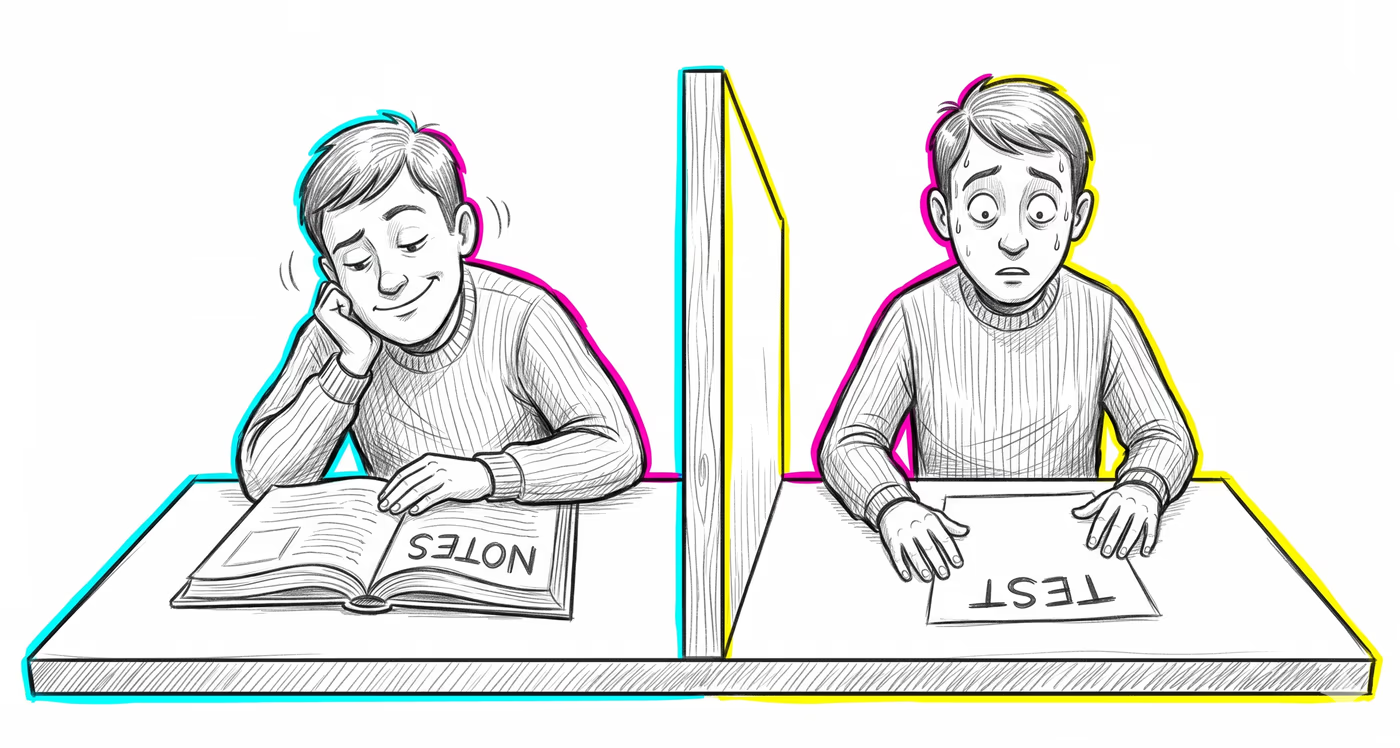
The Dunning-Kruger effect describes a metacognitive failure in which individuals who perform poorly on a task lack the very skills needed to recognize how poorly they have performed, creating a 'dual burden' of incompetence and unawareness. This leads bottom-quartile performers to place themselves well above the median in self-assessments, while top-quartile performers slightly underestimate their relative standing because they assume the task was equally easy for everyone. The effect is domain-specific rather than a statement about general intelligence: a person can be well-calibrated in one area yet dramatically overconfident in another where they lack expertise. Notably, when low performers are trained and become more competent, their self-assessments become more accurate, as they finally acquire the metacognitive tools to recognize quality work.

SOUND FAMILIAR?

Where it shows up.

  1. 01 A junior employee gives a presentation riddled with errors but walks away saying 'I nailed it,' while the senior colleague who delivered a polished talk worries she could have done better.
  2. 02 After reading one Wikipedia article on quantum physics, a person confidently argues with a physics professor at a dinner party, insisting their understanding is correct.
  3. 03 A medical student fresh from their first clinical rotation starts second-guessing the attending physician's diagnoses, feeling certain their textbook knowledge is sufficient.
  4. 04 Someone who has played chess casually for a month challenges a rated tournament player, genuinely expecting to win because they don't understand the depth of strategy they're missing.
  5. 05 A manager with no data science background reviews an analyst's statistical model and declares it flawed, proposing a 'simpler approach' that ignores fundamental assumptions the analyst carefully accounted for.
IN DIFFERENT DOMAINS

Where it shows up at work.

The same glitch looks different depending on the terrain. Finance, medicine, a relationship, a team — same mechanism, different costume.

Finance & investing

Novice investors who experienced a bull market early in their investing careers often dramatically overestimate their stock-picking ability, attributing market-wide gains to personal skill and taking on excessive risk in subsequent trades.
Medicine & diagnosis

Patients who research symptoms online may become convinced they understand their condition better than their physician, rejecting diagnostic recommendations and pursuing alternative treatments based on superficial understanding.

Education & grading

Students who perform in the bottom quartile on exams consistently predict they scored well above the class average, while top-performing students underestimate how far ahead of their peers they actually are.

Relationships

Someone with poor emotional intelligence may believe they are an excellent communicator and listener, failing to notice that their partners and friends consistently feel unheard and frustrated.

Tech & product

A project manager with minimal technical background overrides engineering estimates, insisting a feature can be shipped in half the time because they underestimate the complexity of the underlying systems architecture.

HOW TO SPOT IT

Ask yourself…

  • Am I feeling certain about this despite having only recently learned about it or having limited experience?
  • Would I be able to explain exactly why an expert's approach differs from mine, or am I dismissing their complexity as unnecessary?
  • When was the last time I received critical feedback in this domain, and did I take it seriously or brush it off?
HOW TO DEFEND AGAINST IT

The playbook.

  • Actively seek falsifying feedback: ask a trusted expert 'What am I getting wrong here?' rather than 'Am I doing well?'
  • Practice calibration exercises: before checking answers, write down your confidence level and track accuracy over time to build realistic self-assessment habits.
  • Adopt the 'pre-mortem' technique: before committing to a decision, ask yourself 'If this goes badly, what would the reason be?' to surface blind spots.
  • Use the 'teach-back' method: try to explain the topic in detail to someone knowledgeable — gaps in your understanding will become immediately apparent.
  • Expose yourself to mastery: watch or study true experts performing the task to recalibrate your sense of what 'good' looks like in that domain.
FAMOUS CASES

In history.

  • McArthur Wheeler robbed two banks in 1995 with lemon juice on his face, believing it would make him invisible to security cameras — a case that partly inspired Dunning and Kruger's research.
  • The 2008 financial crisis involved many executives and traders who overestimated their understanding of complex mortgage-backed securities and risk models, contributing to catastrophic miscalculations.
  • Public health crises have been exacerbated by individuals with no medical training confidently spreading misinformation about vaccines and treatments, illustrating the effect at a societal scale.
WHERE IT COMES FROM
Academic origin

Justin Kruger and David Dunning, Cornell University, 1999. Published as 'Unskilled and Unaware of It: How Difficulties in Recognizing One's Own Incompetence Lead to Inflated Self-Assessments' in the Journal of Personality and Social Psychology, 77(6), 1121-1134.

Evolutionary origin

In ancestral environments, overconfidence served as a social signaling mechanism that could confer status, attract mates, and deter competitors without the cost of actual physical confrontation. Individuals who projected confidence — even unwarranted confidence — were more likely to gain leadership roles, resources, and reproductive opportunities in small tribal groups where objective performance metrics were rarely available.

IN AI SYSTEMS

How the machines inherit it.

LLMs exhibit a Dunning-Kruger-like pattern: they generate confident, fluent text even on topics where their training data is sparse or contradictory, producing plausible-sounding but incorrect information (hallucinations) without any self-awareness of their limitations. Research has also shown that AI tools amplify the effect in users — people using ChatGPT to complete tasks consistently overestimate their own performance, with AI-literate users paradoxically showing the greatest overconfidence. Additionally, LLMs tested on coding tasks in rare programming languages show stronger miscalibration between reported confidence and actual accuracy, mirroring the human pattern.

Read more on Wikipedia
FREE FIELD ZINE

10 glitches quietly running your life.

A free field-zine PDF — ten cognitive glitches named, illustrated, with a defense move for each. Plus the weekly Glitch Report on Fridays — one bias named, two spotted in the wild, one defense move. Unsubscribe any time.

EXPLORE MORE

Related glitches.

LAUNCH PRICE

Train against your blindspots.

50 cards are free to preview. Buyers unlock the rest of the deck plus the interactive training — Spot-the-Bias Quiz unlimited, Swipe Deck with spaced repetition, My Blindspots, Decision Pre-Flight, the Printable Deck + Cheat Sheets, and the Field Guide e-book. $29.50$59.

Unlock the full deck

Everything below — yours forever. Pay once, use across every device.

Half-off launch — limited to the first 100 readers. Auto-applied at checkout.
$59 $29.50
one-time payment · lifetime access
  • All interactive digital cards — search, filter, flip, shuffle on any device
  • Five training modes — Spot-the-Bias Quiz, Swipe Deck, Pre-Flight, Blindspots, Journal
  • Curated Lenses + Decision Templates + Defense Playbook
  • Printable Deck PDFs + Field Guide e-book + Cheat Sheets + Anki Export
  • Every future improvement, included
Unlock  $29.50

30-day refund · no questions asked

Unlock the full deck

Everything below — yours forever. Pay once, use across every device.

Half-off launch — limited to the first 100 readers. Auto-applied at checkout.
$59 $29.50
one-time payment · lifetime access
  • All interactive digital cards — search, filter, flip, shuffle on any device
  • Five training modes — Spot-the-Bias Quiz, Swipe Deck, Pre-Flight, Blindspots, Journal
  • Curated Lenses + Decision Templates + Defense Playbook
  • Printable Deck PDFs + Field Guide e-book + Cheat Sheets + Anki Export
  • Every future improvement, included
Unlock  $29.50

30-day refund · no questions asked