Illusion of Explanatory Depth

aka IOED

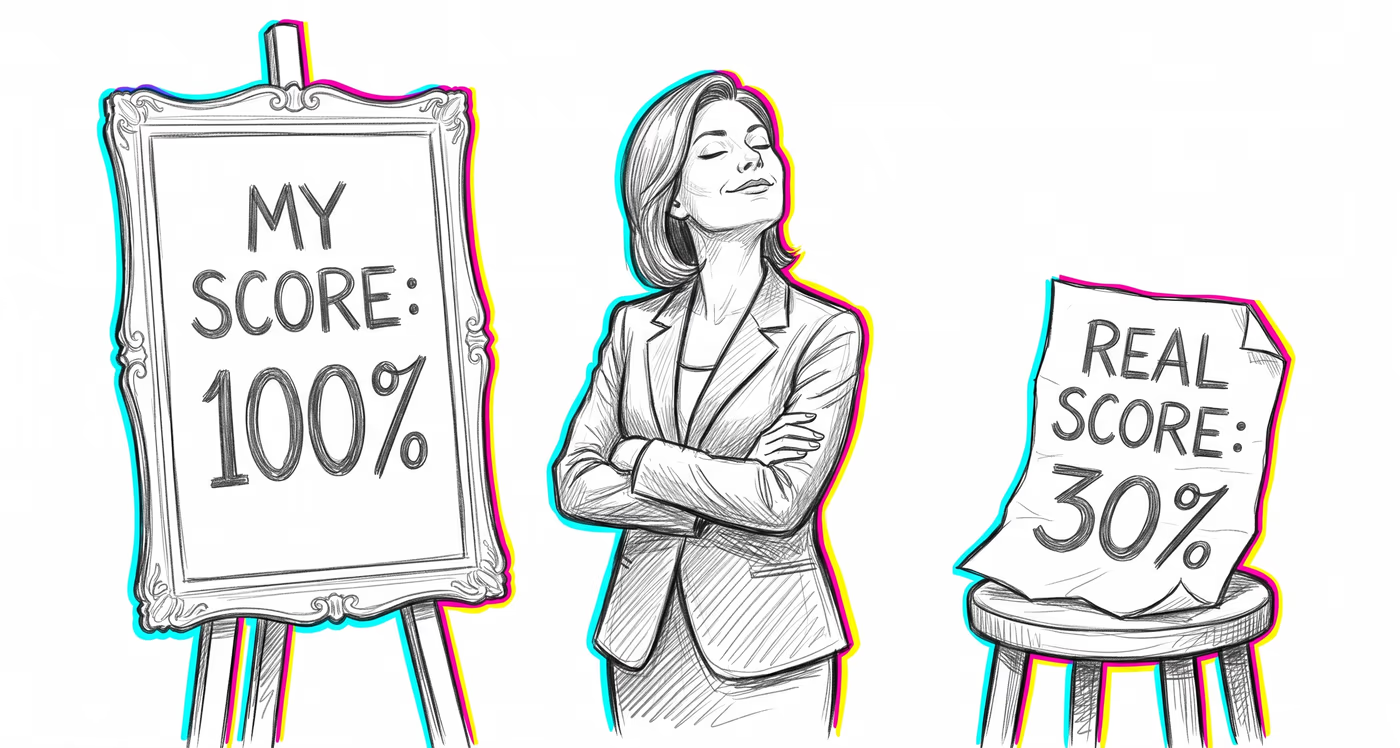
Believing you understand how complex things work far more deeply than you do — a gap only exposed when asked to explain in detail.

WHAT IT IS

The glitch, explained plainly.

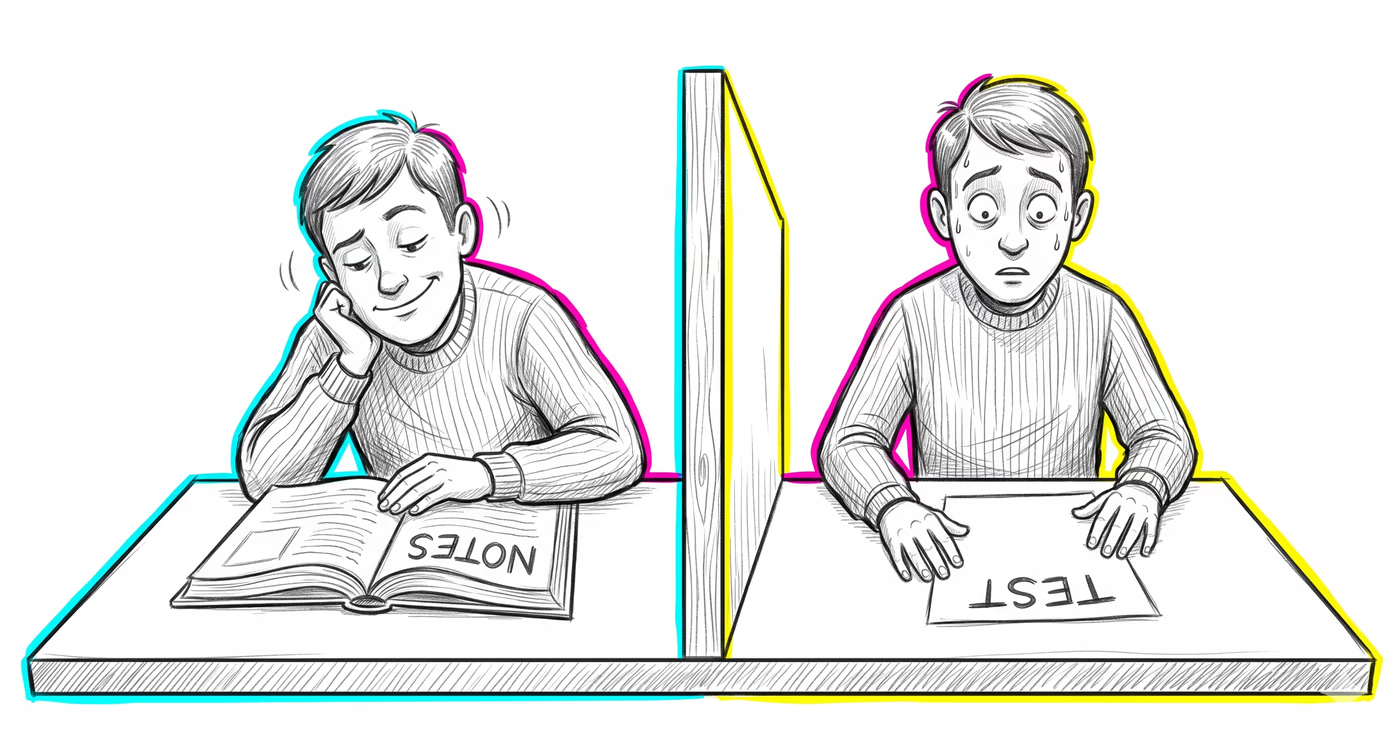
Imagine you see a magic trick every day and you think, 'Oh yeah, I totally know how that works.' But then someone says, 'Okay, explain the trick step by step.' Suddenly, you realize you have no idea how the magician actually does it — you just thought you knew because you'd seen it so many times.

The Illusion of Explanatory Depth describes the systematic tendency to overestimate the precision, coherence, and depth of one's own understanding of how things work — from everyday devices like zippers and toilets to complex policies like healthcare systems. Unlike general overconfidence, this illusion is specific to explanatory or causal knowledge, where multilayered mechanisms create many hidden gaps that people fail to notice until they attempt to articulate them. When asked to generate a step-by-step mechanistic explanation, people consistently revise their self-assessed understanding sharply downward, revealing that what felt like thorough knowledge was in fact a shallow, skeletal representation. The effect is strongest for objects and systems with visible parts, where familiarity with the surface appearance is easily confused with understanding of the underlying causal architecture.

SOUND FAMILIAR?

Where it shows up.

  1. 01 A manager at a staff meeting confidently insists the team's new software feature is straightforward, saying 'I understand exactly how the recommendation algorithm works.' When the CTO asks her to walk through the filtering logic step by step on the whiteboard, she gets through two sentences before trailing off, visibly surprised by how little she can articulate.
  2. 02 During a dinner debate, Carlos passionately argues in favor of a single-payer healthcare system, claiming it's simple and obviously superior. His friend calmly asks, 'Walk me through exactly how the reimbursement pipeline works from patient visit to government payment.' Carlos starts to answer but quickly realizes he has no idea about the actual administrative mechanisms, and his confidence in his own position noticeably deflates.
  3. 03 A science teacher rates herself a 6 out of 7 on understanding how earthquakes occur. When asked by a student to explain the specific mechanism by which tectonic stress accumulates and releases seismic waves, she finds she can only offer the general idea of 'plates colliding' and lacks any understanding of the fault dynamics or wave propagation involved.
  4. 04 An investor reads several articles about blockchain and feels he has a solid grasp of the technology. At a networking event, someone asks him to explain how the consensus mechanism validates transactions without a central authority. He discovers his understanding doesn't extend beyond 'it's a distributed ledger,' and realizes his investment confidence was built on a feeling of comprehension rather than actual knowledge.
  5. 05 A product designer reviews a competitor's app and tells her team, 'I completely understand their personalization engine — it's just basic machine learning.' When the engineering lead asks her to specify what features are likely being extracted, how the model might weight recency versus frequency, and what loss function is probably optimized, she recognizes that her sense of understanding was constructed entirely from high-level analogies rather than genuine technical knowledge.
IN DIFFERENT DOMAINS

Where it shows up at work.

The same glitch looks different depending on the terrain. Finance, medicine, a relationship, a team — same mechanism, different costume.

Finance & investing

Investors frequently overestimate their understanding of complex financial instruments like derivatives, CDOs, or cryptocurrency protocols. They feel knowledgeable because they can name the products and describe their purpose at a high level, but lack the mechanistic understanding of pricing, risk exposure, or settlement processes needed for sound decision-making.

Medicine & diagnosis

Patients often believe they understand their medical conditions or treatments deeply because they can describe symptoms and name medications, but they lack causal understanding of how the drug interacts with their physiology. Clinicians themselves may overestimate their grasp of the mechanisms underlying diseases outside their specialty, relying on surface-level textbook summaries.


Education & grading

Students routinely rate their understanding of material as high after reading a textbook or watching a lecture, confusing recognition of concepts with genuine explanatory knowledge. Teachers may overestimate how well students understand material because the students can correctly repeat terminology without being able to explain the underlying processes.

Relationships

People feel they deeply understand their partner's emotional motivations or family dynamics, but when pressed to explain specifically why their partner reacts a certain way in conflict situations, they find their 'understanding' was a vague narrative rather than a genuine causal model.

Tech & product

Designers and product managers frequently claim to understand how a system's back-end architecture works because they interact with its front-end daily. This false confidence leads to unrealistic feature requests, underestimated complexity in sprint planning, and resistance to engineering pushback on technical feasibility.

Workplace & hiring

Managers overestimate their understanding of operational workflows they oversee, assuming that familiarity with outcomes equates to knowledge of the step-by-step processes. This leads to poorly scoped projects, underestimated timelines, and misinformed restructuring decisions.

Politics Media

Voters and commentators hold extreme positions on complex policies — tax reform, immigration systems, trade agreements — while lacking mechanistic understanding of how those policies actually produce outcomes. Media coverage reinforces this by emphasizing positions and values rather than causal explanations, allowing the illusion to persist unchallenged.

HOW TO SPOT IT

Ask yourself…

  • Could I actually write out, step by step, how this thing works without looking anything up?
  • Am I confusing my ability to recognize or describe something with my ability to explain its internal mechanism?
  • If someone asked me a 'how exactly' follow-up question right now, would I have a real answer or just a vague gesture?
HOW TO DEFEND AGAINST IT

The playbook.

  • Practice the 'explain it to a child' test: Before claiming understanding, try to write a step-by-step causal explanation. If you stall, you've found a gap.
  • Use the Feynman Technique: Write down the concept as if teaching someone who knows nothing. Where you stumble or handwave, you lack real understanding.
  • Ask yourself mechanistic 'how' questions rather than 'what' questions. 'What does it do?' is easy; 'How does it achieve that?' reveals depth.
  • Deliberately seek out detailed technical explanations of things you assume you understand and notice where your model diverges from reality.
  • In group discussions, when someone claims to understand a complex topic, gently ask 'Can you walk us through exactly how that process works?' — apply this to yourself first.
FAMOUS CASES

In history.

  • The 2008 financial crisis revealed that many financial professionals, regulators, and investors had a dramatically shallow understanding of how collateralized debt obligations and credit default swaps actually worked, despite confidently trading in and regulating these instruments for years.
  • Public debates over the Affordable Care Act showed that both supporters and opponents held extreme positions while having little mechanistic understanding of how the insurance marketplace, subsidies, and coverage mandates actually functioned.
WHERE IT COMES FROM
Academic origin

Leonid Rozenblit and Frank Keil, 2002, Yale University. Published in Cognitive Science as 'The misunderstood limits of folk science: an illusion of explanatory depth.'

Evolutionary origin

In ancestral environments, most practical tasks required only shallow functional knowledge — knowing that a sharp rock cuts, or that fire cooks food — rather than deep mechanistic understanding of underlying physics. Maintaining a confident sense of understanding promoted decisive action and resource use without the paralyzing cost of admitting ignorance. Additionally, our ancestors often operated within communities where knowledge was distributed across individuals, making it adaptive to feel one had access to expertise even when the detailed knowledge resided with others.

IN AI SYSTEMS

How the machines inherit it.

LLMs can amplify the IOED by producing fluent, confident-sounding explanations that give users an even stronger false sense that they (or the AI) deeply understand a topic. Users may read an AI-generated summary and mistake its coherent narrative for genuine depth, reducing their motivation to seek true mechanistic understanding. Additionally, AI systems trained on surface-level internet text may themselves encode shallow causal models, generating plausible but mechanistically wrong explanations that are difficult for non-experts to detect.

Read more on Wikipedia
FREE FIELD ZINE

10 glitches quietly running your life.

A free field-zine PDF — ten cognitive glitches named, illustrated, with a defense move for each. Plus the weekly Glitch Report on Fridays — one bias named, two spotted in the wild, one defense move. Unsubscribe any time.

EXPLORE MORE

Related glitches.

LAUNCH PRICE

Train against your blindspots.

50 cards are free to preview. Buyers unlock the rest of the deck plus the interactive training — Spot-the-Bias Quiz unlimited, Swipe Deck with spaced repetition, My Blindspots, Decision Pre-Flight, the Printable Deck + Cheat Sheets, and the Field Guide e-book. $29.50$59.

Unlock the full deck

Everything below — yours forever. Pay once, use across every device.

Half-off launch — limited to the first 100 readers. Auto-applied at checkout.
$59 $29.50
one-time payment · lifetime access
  • All interactive digital cards — search, filter, flip, shuffle on any device
  • Five training modes — Spot-the-Bias Quiz, Swipe Deck, Pre-Flight, Blindspots, Journal
  • Curated Lenses + Decision Templates + Defense Playbook
  • Printable Deck PDFs + Field Guide e-book + Cheat Sheets + Anki Export
  • Every future improvement, included
Unlock  $29.50

30-day refund · no questions asked

Unlock the full deck

Everything below — yours forever. Pay once, use across every device.

Half-off launch — limited to the first 100 readers. Auto-applied at checkout.
$59 $29.50
one-time payment · lifetime access
  • All interactive digital cards — search, filter, flip, shuffle on any device
  • Five training modes — Spot-the-Bias Quiz, Swipe Deck, Pre-Flight, Blindspots, Journal
  • Curated Lenses + Decision Templates + Defense Playbook
  • Printable Deck PDFs + Field Guide e-book + Cheat Sheets + Anki Export
  • Every future improvement, included
Unlock  $29.50

30-day refund · no questions asked