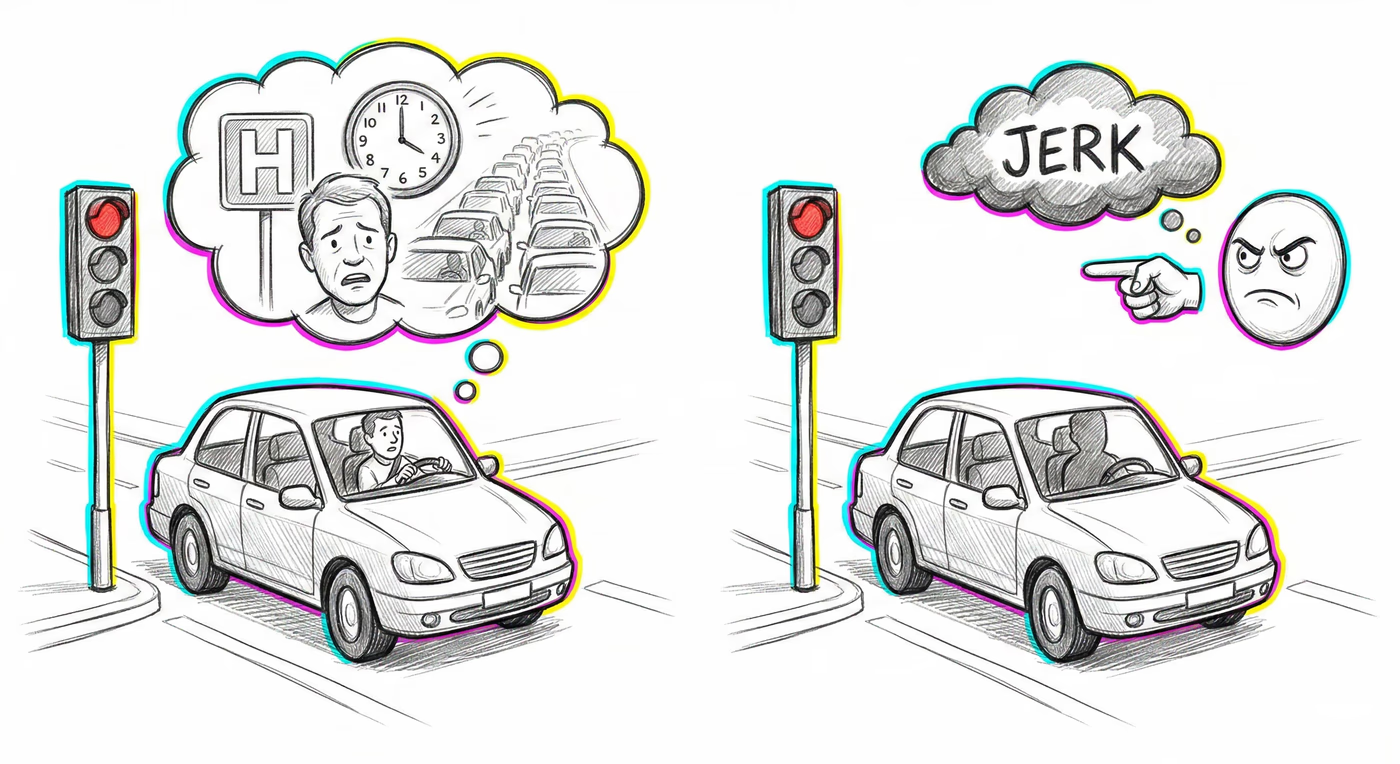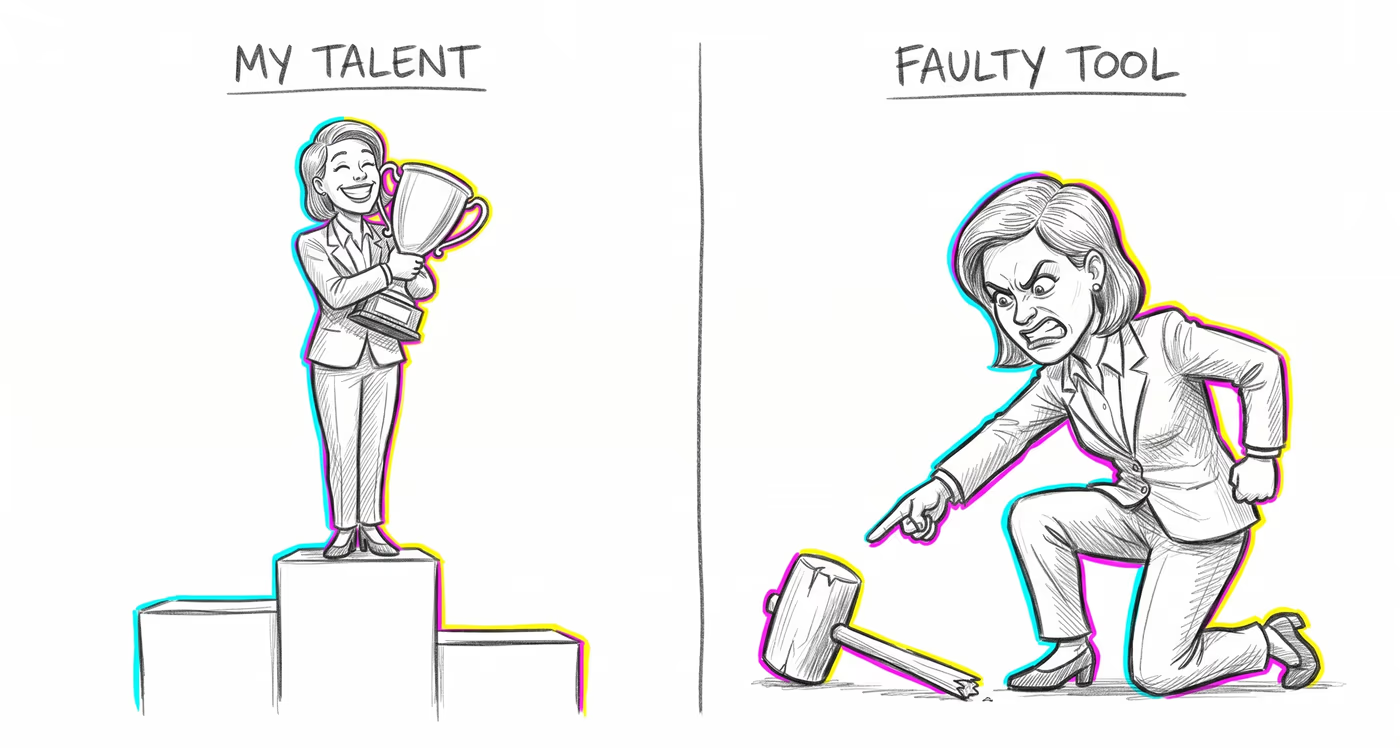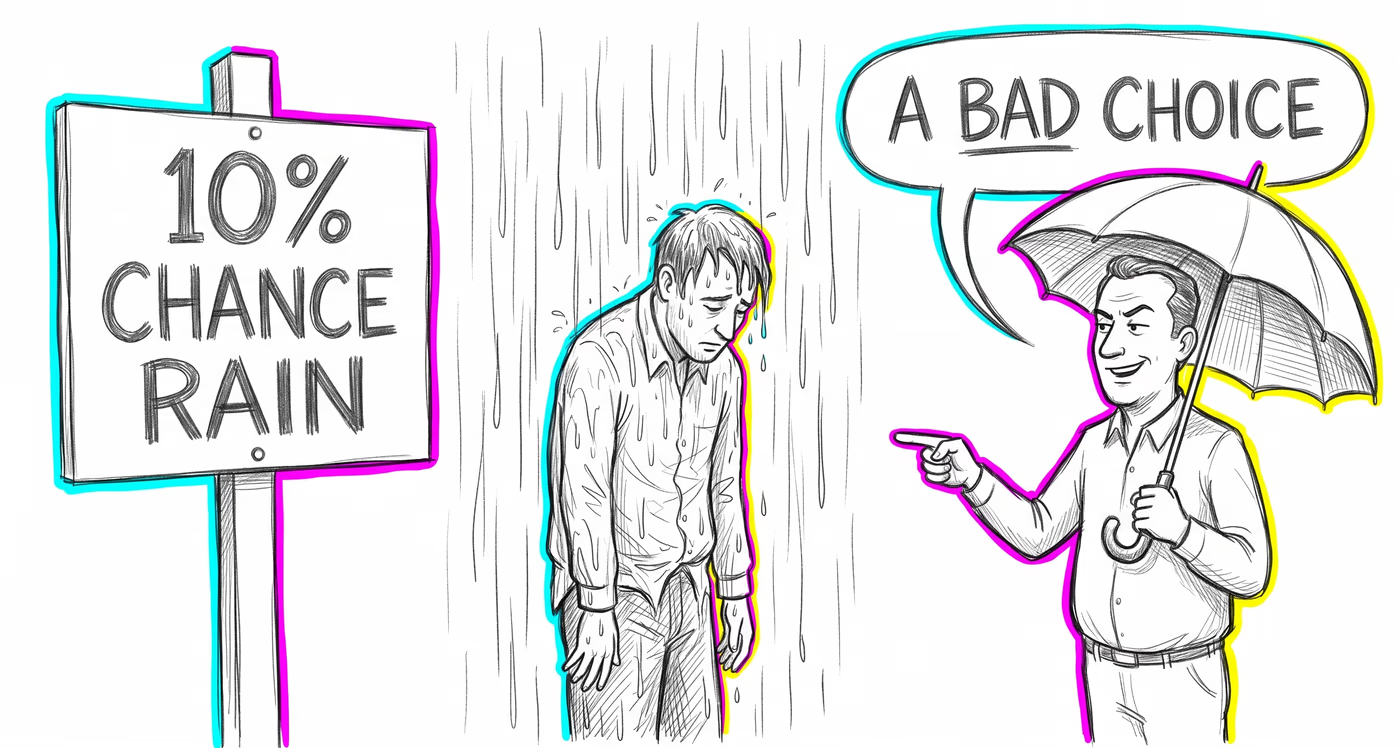
Outcome Bias

aka Outcome Effect

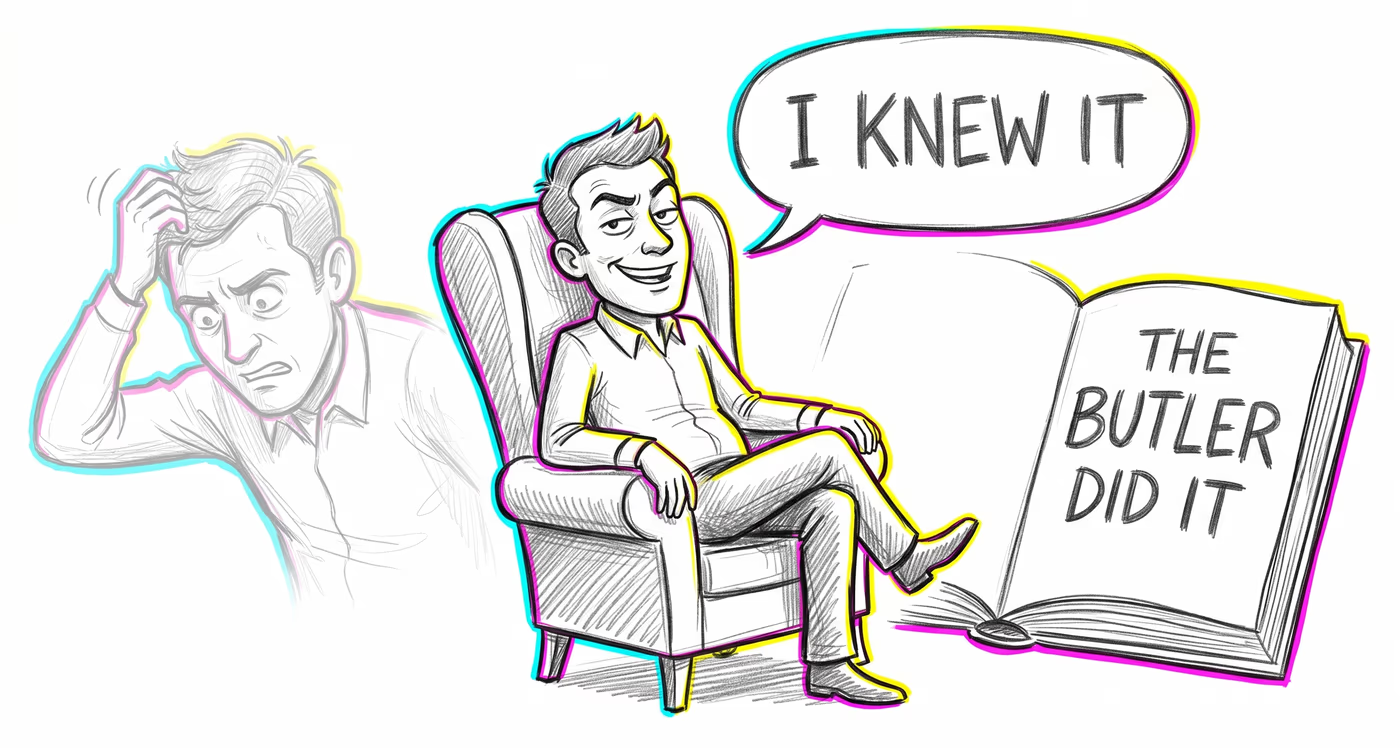
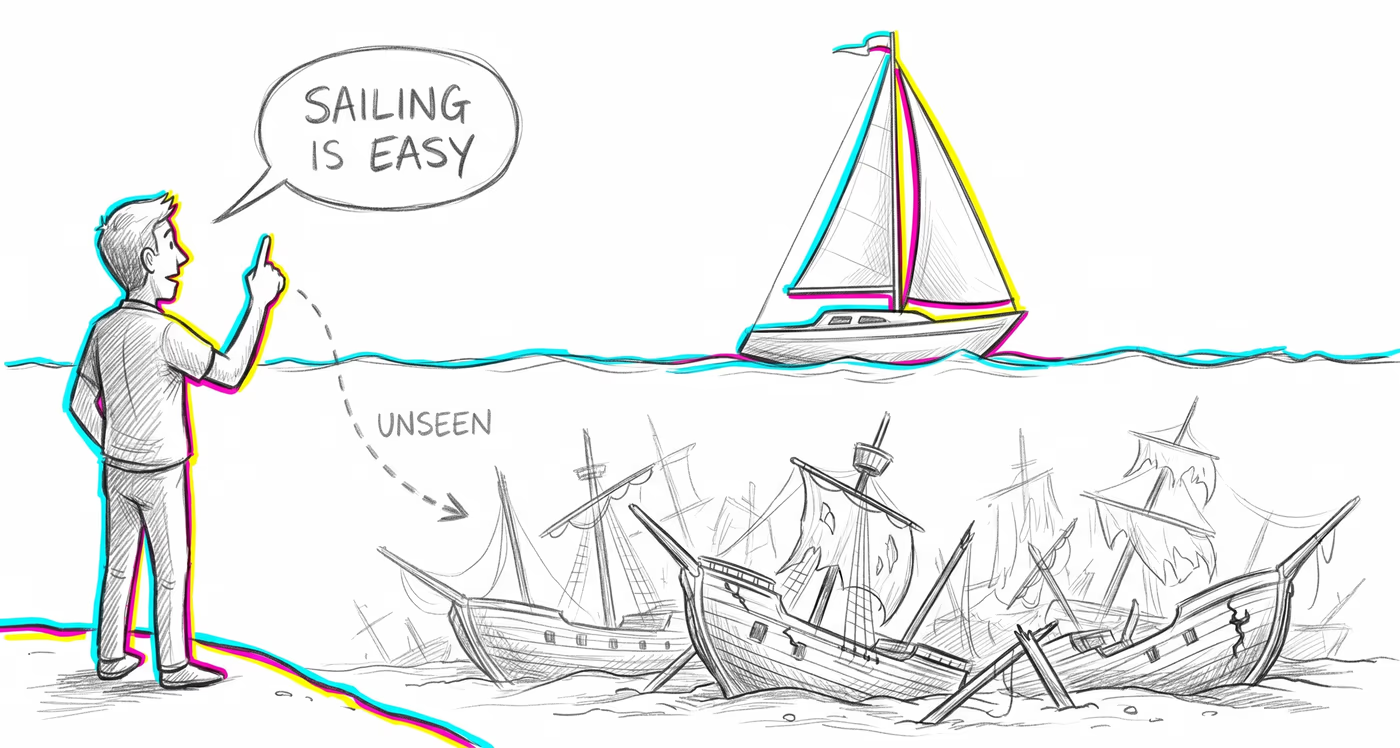
Judging a decision's quality by how it turned out rather than by whether the reasoning was sound at the time.

WHAT IT IS

The glitch, explained plainly.

Imagine you and your friend both studied the same amount for a test. Your friend guessed on the last question and got lucky — got it right. You guessed too but got it wrong. Now everyone says your friend is smarter and you made a bad choice, even though you both did the exact same thing. That's outcome bias: judging the choice by what happened after, not by whether it was a smart choice to begin with.

Outcome bias leads people to conflate the quality of a decision with the quality of its result, even when the result was largely determined by chance or factors beyond the decision-maker's control. A surgeon who made a statistically sound call to operate will be praised if the patient lives and condemned if the patient dies, despite the decision process being identical in both cases. This bias persists even when evaluators are explicitly told they have all the same information the decision-maker had and even when they acknowledge that outcomes should not influence their ratings. The effect is particularly insidious because it punishes well-reasoned risk-taking that happens to fail and rewards reckless choices that happen to succeed, thereby distorting the feedback loops people rely on to improve their judgment over time.

SOUND FAMILIAR?

Where it shows up.

  1. 01 A hospital administrator reviews two surgeons' records. Dr. Chen performed a risky but evidence-based procedure on a patient with a 70% survival rate; the patient died. Dr. Patel performed the same procedure on a similar patient; that patient survived. The administrator rates Dr. Patel's clinical judgment as significantly superior to Dr. Chen's and recommends Dr. Chen for remedial training.
  2. 02 A venture capital partner chose not to invest in a startup after a thorough analysis showed weak unit economics and no path to profitability. Two years later, the startup is acquired for $500 million after an unexpected market shift. The partner's colleagues now cite this as evidence of her poor deal-sourcing instincts, and she begins doubting her own analytical framework.
  3. 03 After a football match, commentators praise the coach's 'brilliant tactical mind' for substituting an attacker in the 80th minute, because the substitute scored a deflected goal in the 89th. They contrast this with the opposing coach, who made a similar substitution but whose player missed a clear chance, calling it a 'puzzling decision.'
  4. 04 A cybersecurity analyst decides to delay a routine server patch by 48 hours to avoid disrupting a critical deployment. No breach occurs during that window, and her manager praises the 'balanced' prioritization. A colleague at another company made the same delay decision with the same information, but a zero-day exploit hit during the gap. That colleague was fired for negligence.
  5. 05 A product manager launches an A/B test and chooses variant B based on a statistically insignificant result that looked directionally promising. Variant B happens to perform 15% better in the full rollout. In the quarterly review, the PM is praised for 'data-driven instincts,' and the team adopts the practice of acting on directionally promising but non-significant results going forward.
IN DIFFERENT DOMAINS

Where it shows up at work.

The same glitch looks different depending on the terrain. Finance, medicine, a relationship, a team — same mechanism, different costume.

Finance & investing

Investors and fund managers are routinely evaluated based on portfolio returns rather than the soundness of their investment theses. A trader who made a highly leveraged, undiversified bet that happened to pay off is celebrated as skilled, while a disciplined risk manager whose diversified portfolio underperformed due to a black swan event is penalized — leading to systematic reward of reckless strategies and punishment of prudent ones.
Medicine & diagnosis

Physicians and surgeons are frequently judged by patient outcomes rather than by whether their clinical reasoning was appropriate given the available evidence. A surgeon who opts for a procedure with an 80% success rate is evaluated differently depending on whether the patient lives or dies, despite the decision being identical. This can lead to defensive medicine, where doctors avoid risky-but-appropriate interventions to protect their reputation.

Education & grading

Teachers and instructors are often evaluated by student test scores or graduation rates rather than the quality of their pedagogical methods. An unconventional teaching approach that happens to produce high scores is deemed effective, while a well-designed curriculum that yields average scores in a particularly challenging cohort is deemed failing — discouraging pedagogical innovation.

Relationships

People judge their partner's past decisions based on how things turned out rather than the reasoning at the time. A partner who encouraged a career change that didn't work out is blamed for 'bad advice,' while identical encouragement that preceded a windfall is remembered as wise support — creating an unfair scorecard in the relationship.

Tech & product

Product teams that ship features which happen to gain traction are celebrated as visionary, while teams whose well-researched features flop due to market timing or external factors are restructured. This leads organizations to mythologize luck as strategy and to over-index on copying past successes rather than building robust decision processes.

Workplace & hiring

Performance reviews heavily weight measurable outcomes like sales numbers or project completion over the quality of the employee's process, collaboration, and decision-making under uncertainty. Employees who benefited from favorable market conditions or inherited strong pipelines receive promotions, while those who managed difficult situations skillfully but with less visible results are overlooked.

Politics Media

Political leaders are judged almost entirely by outcomes that are often beyond their control. A president whose term coincides with economic growth driven by global trends is rated as competent, while one who governs during an inherited recession is deemed incompetent. Media reinforces this by constructing post-hoc narratives that treat outcomes as direct evidence of leadership quality.

HOW TO SPOT IT

Ask yourself…

  • Am I evaluating this person's decision based on what I now know happened, or based on what they reasonably knew at the time?
  • If the outcome had been different but the decision process identical, would I still rate this decision the same way?
  • Am I attributing this result to the decision-maker's skill when it could equally be explained by luck or factors outside their control?
HOW TO DEFEND AGAINST IT

The playbook.

  • Before evaluating any decision, write down what a reasonable person would have concluded given only the information available at the time of the decision — ignore all outcome data.
  • Use pre-mortems: before a decision is made, imagine both good and bad outcomes and evaluate the decision logic independently of each hypothetical result.
  • Ask the counterfactual inversion question: 'If the exact same process had produced the opposite outcome, would I change my evaluation of the process?' If yes, you are likely being influenced by outcome bias.
  • Institutionalize process-based evaluations: in performance reviews, explicitly score the quality of reasoning, information-gathering, and risk assessment separately from the results achieved.
  • Study base rates: familiarize yourself with the typical variance in outcomes for the domain, so you can distinguish skill from luck (e.g., understanding that even optimal medical decisions have failure rates).
FAMOUS CASES

In history.

  • The post-mortem criticism of NASA's decision-making after the Challenger disaster, where the same risk-tolerance that had been accepted in many prior successful launches was suddenly deemed reckless only after the tragic outcome.
  • Evaluations of military commanders throughout history — generals who took similar calculated risks are remembered as geniuses (when they won) or reckless fools (when they lost), regardless of whether the strategic reasoning was sound.
  • The 2008 financial crisis led to the vilification of some risk managers who had made decisions consistent with prevailing models, while those who happened to short the housing market were celebrated as prescient, even when some acted on hunches rather than rigorous analysis.
WHERE IT COMES FROM
Academic origin

Jonathan Baron and John C. Hershey, 1988. Formalized in their paper 'Outcome Bias in Decision Evaluation' published in the Journal of Personality and Social Psychology (Vol. 54, pp. 569–579).

Evolutionary origin

In ancestral environments, outcomes were often the only reliable feedback signal. If eating a berry made you sick, avoiding that berry was adaptive regardless of the underlying probability. Environments were stable enough that outcome-based learning ('that worked, do it again; that failed, avoid it') was a fast, low-cost heuristic that generally tracked real causal patterns. The brain did not evolve to handle domains where outcomes are dominated by randomness or delayed feedback.

IN AI SYSTEMS

How the machines inherit it.

Machine learning models trained on outcome data rather than decision-process quality can systematically learn to reward lucky strategies. Recommendation systems and reinforcement learning agents may over-fit to positive outcomes caused by random environmental factors rather than genuinely superior actions. In hiring algorithms, training on 'successful employee' outcomes can encode outcome bias by attributing success to the hiring decision rather than to post-hire environmental factors like team composition or market conditions.

Read more on Wikipedia
FREE FIELD ZINE

10 glitches quietly running your life.

A free field-zine PDF — ten cognitive glitches named, illustrated, with a defense move for each. Plus the weekly Glitch Report on Fridays — one bias named, two spotted in the wild, one defense move. Unsubscribe any time.

EXPLORE MORE

Related glitches.

LAUNCH PRICE

Train against your blindspots.

50 cards are free to preview. Buyers unlock the rest of the deck plus the interactive training — Spot-the-Bias Quiz unlimited, Swipe Deck with spaced repetition, My Blindspots, Decision Pre-Flight, the Printable Deck + Cheat Sheets, and the Field Guide e-book. $29.50$59.

Unlock the full deck

Everything below — yours forever. Pay once, use across every device.

Half-off launch — limited to the first 100 readers. Auto-applied at checkout.
$59 $29.50
one-time payment · lifetime access
  • All interactive digital cards — search, filter, flip, shuffle on any device
  • Five training modes — Spot-the-Bias Quiz, Swipe Deck, Pre-Flight, Blindspots, Journal
  • Curated Lenses + Decision Templates + Defense Playbook
  • Printable Deck PDFs + Field Guide e-book + Cheat Sheets + Anki Export
  • Every future improvement, included
Unlock  $29.50

30-day refund · no questions asked

Unlock the full deck

Everything below — yours forever. Pay once, use across every device.

Half-off launch — limited to the first 100 readers. Auto-applied at checkout.
$59 $29.50
one-time payment · lifetime access
  • All interactive digital cards — search, filter, flip, shuffle on any device
  • Five training modes — Spot-the-Bias Quiz, Swipe Deck, Pre-Flight, Blindspots, Journal
  • Curated Lenses + Decision Templates + Defense Playbook
  • Printable Deck PDFs + Field Guide e-book + Cheat Sheets + Anki Export
  • Every future improvement, included
Unlock  $29.50

30-day refund · no questions asked