Hot-Hand Fallacy

aka Hot Hand Phenomenon · Hot Hand Belief · Streak Shooting Belief

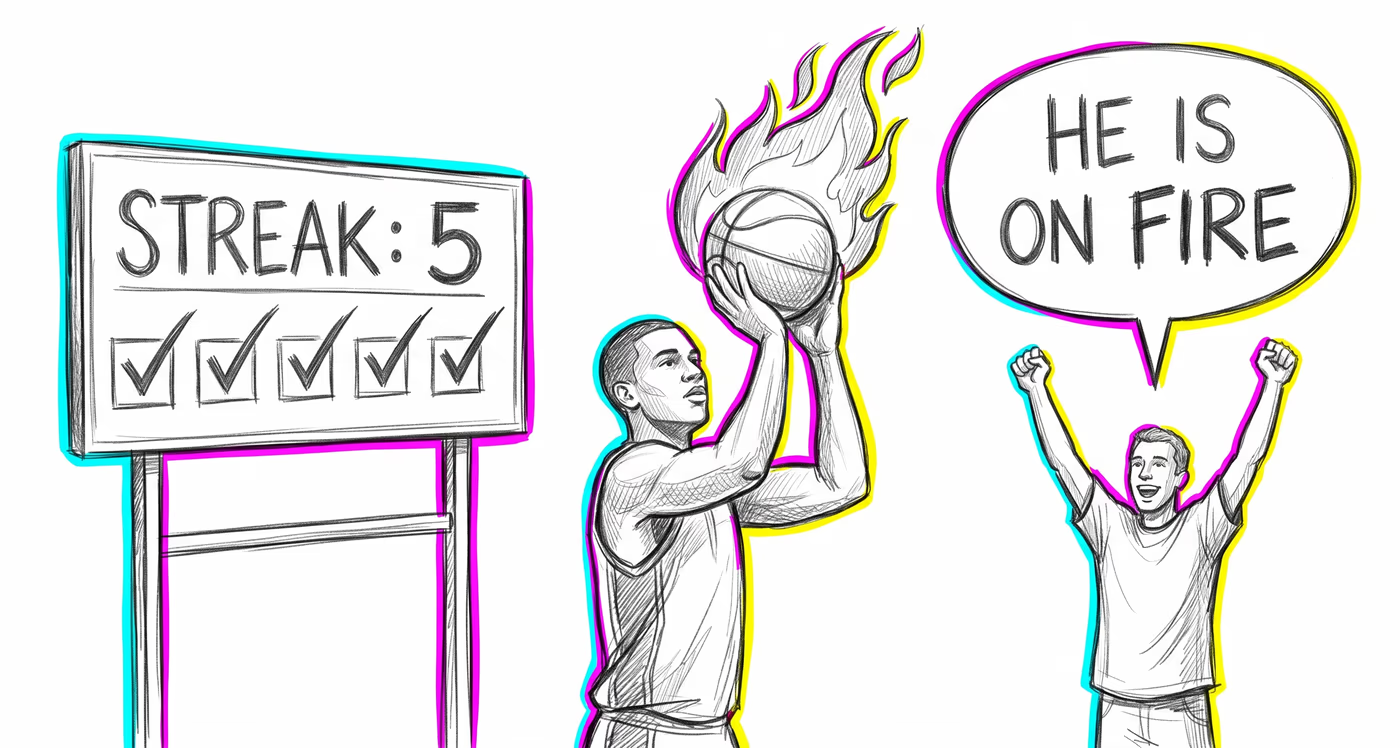
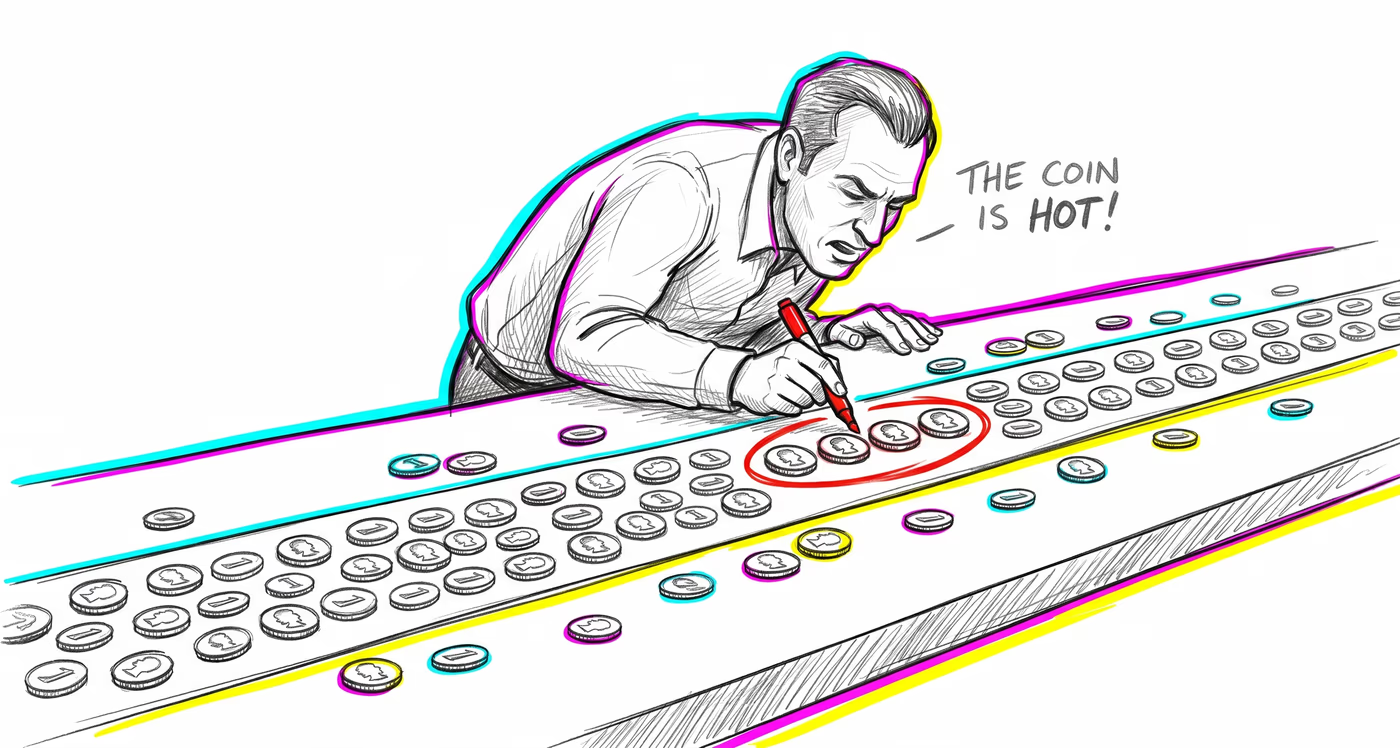
Believing a person on a winning streak is more likely to keep succeeding, even when each outcome is statistically independent.

WHAT IT IS

The glitch, explained plainly.

Imagine you're flipping a coin and you get heads five times in a row. Your brain screams 'heads again!' because it feels like the coin is 'on a roll.' But the coin doesn't remember what it did before — each flip is brand new. We do the same thing when we watch someone score a few baskets in a row: we feel certain they'll keep scoring, even though each shot is its own little event.

The Hot-Hand Fallacy describes the widespread belief that recent success in a sequential task signals an elevated probability of continued success — that a person is 'on fire' or 'in the zone.' This belief leads observers and performers alike to overweight short streaks of positive outcomes, treating them as evidence of a temporary shift in underlying ability rather than as natural clustering within a random process. The fallacy is deeply rooted in the human tendency to perceive meaningful patterns in sequences that are actually consistent with chance variation. Notably, recent statistical research by Miller and Sanjurjo (2018) has challenged the original conclusion that the hot hand is purely illusory, revealing methodological flaws in the seminal 1985 study; however, the cognitive tendency to overinterpret streaks and extrapolate them beyond what evidence warrants remains a well-documented bias.

SOUND FAMILIAR?

Where it shows up.

  1. 01 A venture capitalist reviews a fund manager's track record and sees four consecutive quarters of above-market returns. Despite knowing that most fund outperformance regresses to the mean, she decides to allocate 40% of her portfolio to this manager, reasoning that his recent streak demonstrates a sustained edge over other managers.
  2. 02 During a trivia night, Marcus answers seven questions correctly in a row. His teammates start deferring all remaining questions to him, even on topics outside his expertise, telling the other members to 'let Marcus handle it — he's on fire tonight.'
  3. 03 A sales director notices that a new hire closed deals with five consecutive prospects. She reassigns the team's most valuable lead to the new hire over a veteran salesperson, reasoning that the newcomer is 'in the zone' right now and most likely to convert it.
  4. 04 A data scientist builds a stock-picking algorithm that outperforms the S&P 500 for eight consecutive months during a specific market regime. Rather than attributing the streak partly to favorable conditions, the team increases their leverage and concentrates bets, arguing the model has 'proven itself' over a meaningful run.
  5. 05 A surgeon who has had successful outcomes in her last six complex procedures volunteers to take on a case that would normally be referred to a more specialized colleague, feeling that her current streak reflects a heightened state of precision that she should capitalize on before it fades.
IN DIFFERENT DOMAINS

Where it shows up at work.

The same glitch looks different depending on the terrain. Finance, medicine, a relationship, a team — same mechanism, different costume.

Finance & investing

Investors chase recently outperforming mutual funds or stocks, pouring money into assets with short-term winning streaks under the assumption that recent returns predict continued outperformance, leading to overconcentration and vulnerability to mean reversion.
Medicine & diagnosis

Clinicians who have recently made several correct diagnoses in ambiguous cases may develop inflated confidence in their next snap judgment, reducing the thoroughness of differential diagnosis and increasing the risk of error on complex cases.

Education & grading

A student who scores well on three consecutive practice tests may reduce study effort for the final exam, interpreting the streak as evidence of mastery rather than as a product of favorable question sampling.

Relationships

After a string of successful first dates, a person becomes overconfident in their romantic judgment and rushes into commitment with a new partner, ignoring early warning signs they would normally heed.

Tech & product

Product teams that ship three successful features in a row may skip user research for the next release, assuming the team is 'in a groove' and that their intuition alone will continue to produce winning designs.

Workplace & hiring

Managers promote or assign high-visibility projects to employees based on a recent streak of wins, rather than evaluating the employee's overall competency profile and the specific demands of the new role.

Politics Media

Political pundits who correctly predicted several election outcomes gain outsized credibility and audience share, with audiences treating their next forecast as near-certain despite the fundamentally unpredictable nature of elections.

HOW TO SPOT IT

Ask yourself…

  • Am I predicting this outcome will be positive mainly because the last few outcomes were positive?
  • Would I make the same prediction if I only saw this person's long-term average performance instead of their recent streak?
  • Am I confusing a naturally occurring cluster of successes with evidence that something fundamental has changed?
HOW TO DEFEND AGAINST IT

The playbook.

  • Before acting on a streak, look up the long-term base rate for the outcome in question and compare it to recent performance.
  • Ask yourself: 'If I hadn't seen the last few results, what would I predict?' Use that as your anchor.
  • Implement a mandatory cooling-off period before making decisions based on recent streaks — delay by 24 hours.
  • Use pre-commitment strategies: decide your criteria for action before observing the sequence, and stick to them regardless of streaks.
  • Seek out disconfirming data — actively look for times the same person or system had a streak that ended abruptly.
FAMOUS CASES

In history.

  • The widespread belief among NBA fans and coaches in streak shooting, directly studied and challenged by Gilovich, Vallone, and Tversky's landmark 1985 paper using Philadelphia 76ers shooting data.
  • Investors piling into tech stocks during the late-1990s dot-com bubble, extrapolating recent extraordinary returns as evidence the market would keep climbing.
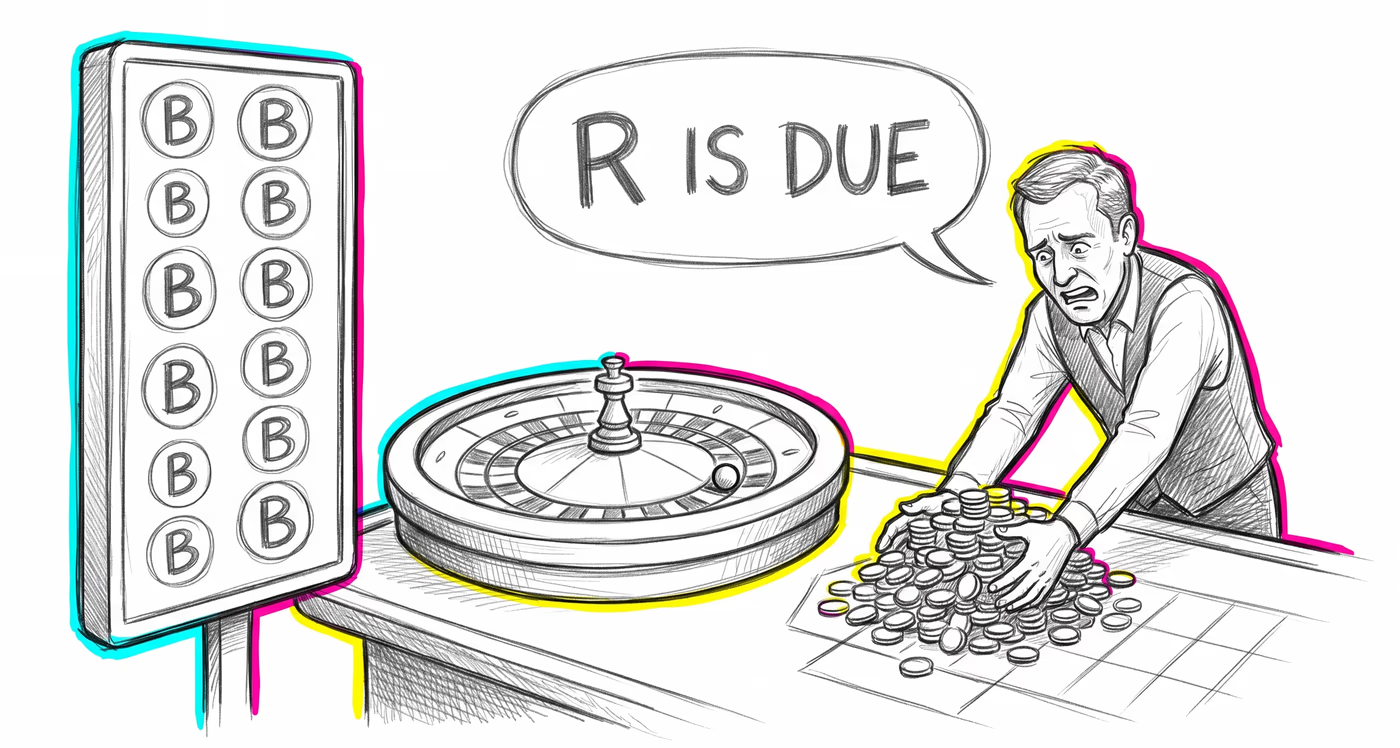
  • Casino gamblers in Croson and Sundali's (2005) study who systematically increased their bets after winning streaks at roulette, treating random outcomes as momentum-driven.
WHERE IT COMES FROM
Academic origin

Thomas Gilovich, Robert Vallone, and Amos Tversky, 1985. Formalized in their paper 'The Hot Hand in Basketball: On the Misperception of Random Sequences,' published in Cognitive Psychology.

Evolutionary origin

In ancestral environments, detecting genuine patterns in sequential events was critical for survival — noticing that a predator returned to the same watering hole, or that a fruiting tree produced reliably, conferred adaptive advantages. Brains evolved to be aggressive pattern detectors, erring on the side of seeing causal streaks rather than dismissing potentially meaningful sequences as noise. The cost of missing a real pattern (being eaten) far outweighed the cost of falsely detecting one (wasted vigilance).

IN AI SYSTEMS

How the machines inherit it.

Machine learning models trained on sequential data can exhibit hot-hand-like behavior if they overfit to recent streaks in training data, treating short-run patterns as durable signals. Recommendation algorithms may also amplify the bias by surfacing recently trending content or products as if their streak of popularity will persist, creating feedback loops that reinforce extrapolation from small samples.

Read more on Wikipedia
FREE FIELD ZINE

10 glitches quietly running your life.

A free field-zine PDF — ten cognitive glitches named, illustrated, with a defense move for each. Plus the weekly Glitch Report on Fridays — one bias named, two spotted in the wild, one defense move. Unsubscribe any time.

EXPLORE MORE

Related glitches.

LAUNCH PRICE

Train against your blindspots.

50 cards are free to preview. Buyers unlock the rest of the deck plus the interactive training — Spot-the-Bias Quiz unlimited, Swipe Deck with spaced repetition, My Blindspots, Decision Pre-Flight, the Printable Deck + Cheat Sheets, and the Field Guide e-book. $29.50$59.

Unlock the full deck

Everything below — yours forever. Pay once, use across every device.

Half-off launch — limited to the first 100 readers. Auto-applied at checkout.
$59 $29.50
one-time payment · lifetime access
  • All interactive digital cards — search, filter, flip, shuffle on any device
  • Five training modes — Spot-the-Bias Quiz, Swipe Deck, Pre-Flight, Blindspots, Journal
  • Curated Lenses + Decision Templates + Defense Playbook
  • Printable Deck PDFs + Field Guide e-book + Cheat Sheets + Anki Export
  • Every future improvement, included
Unlock  $29.50

30-day refund · no questions asked

Unlock the full deck

Everything below — yours forever. Pay once, use across every device.

Half-off launch — limited to the first 100 readers. Auto-applied at checkout.
$59 $29.50
one-time payment · lifetime access
  • All interactive digital cards — search, filter, flip, shuffle on any device
  • Five training modes — Spot-the-Bias Quiz, Swipe Deck, Pre-Flight, Blindspots, Journal
  • Curated Lenses + Decision Templates + Defense Playbook
  • Printable Deck PDFs + Field Guide e-book + Cheat Sheets + Anki Export
  • Every future improvement, included
Unlock  $29.50

30-day refund · no questions asked