Illusion of External Agency

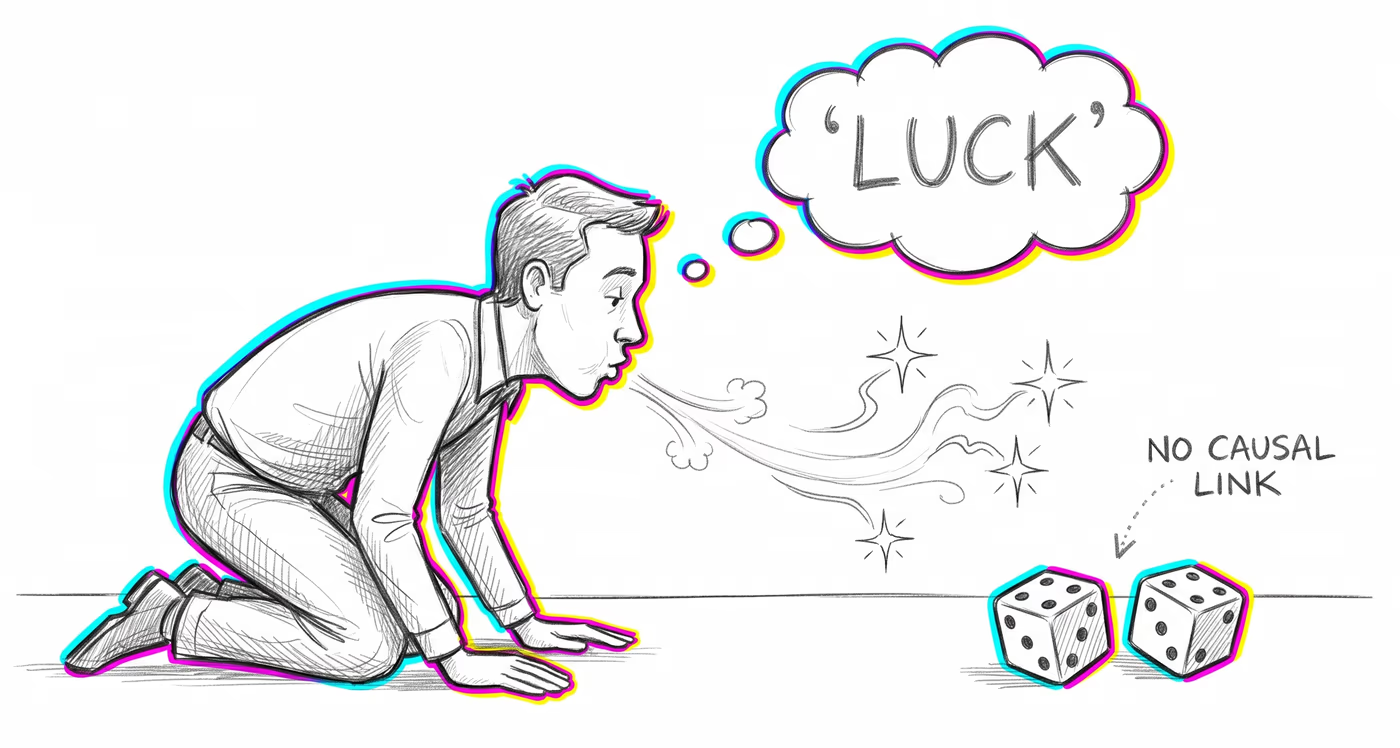
Crediting an outside force for positive outcomes that actually resulted from your own psychological adaptation.

WHAT IT IS

The glitch, explained plainly.

Imagine you wanted the red toy but got the blue one instead. After a while, your brain secretly convinces you that the blue one is actually awesome. But since you don't notice your brain doing this trick, you think someone — maybe your mom or a guardian angel — somehow knew you'd love the blue one and gave it to you on purpose.

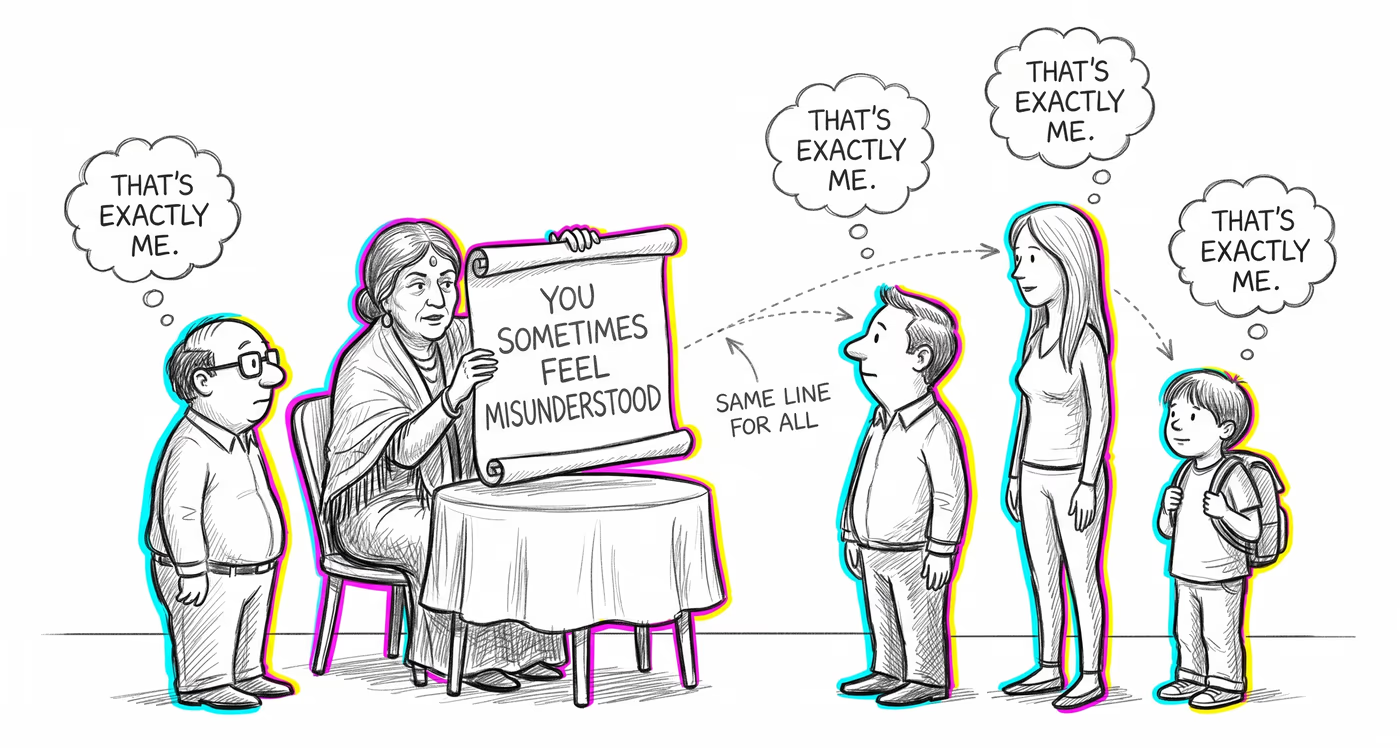
The Illusion of External Agency describes a systematic misattribution that occurs when people unconsciously generate their own satisfaction with outcomes — through rationalization, cognitive dissonance reduction, and psychological adaptation — but fail to recognize this internal process. Because they are unaware of their own psychological immune system at work, they perceive the resulting contentment as evidence that some external force (a wise advisor, fate, a benevolent institution, or even a higher power) arranged for the best possible outcome. This bias is strongest when outcomes are irreversible, because irreversibility triggers more vigorous internal rationalization. The result is an inflated belief in the power, insight, and goodwill of external agents who had little or no actual causal role.

SOUND FAMILIAR?

Where it shows up.

  1. 01 Maria didn't get into her first-choice graduate program and enrolled in her backup school instead. After a semester, she feels genuinely happy and keeps telling friends that the admissions committee at the backup school must have seen something special in her application that she couldn't see herself — a perfect match they somehow detected.
  2. 02 After a corporate restructuring randomly reassigned Jake to a new department, he quickly grew content with his new role. He now regularly praises the HR director's 'brilliant foresight' in placing him where he'd thrive, despite the reassignment being done by an automated system with no knowledge of his preferences.
  3. 03 A patient is randomly assigned to a therapist through an insurance system. Over weeks, the patient feels better and insists the intake coordinator must have carefully matched them based on deep psychological profiling, when the assignment was purely based on scheduling availability.
  4. 04 An investor's financial advisor recommended a diversified portfolio. After the market dipped and recovered, the investor ended up roughly where they started but felt satisfied. The investor tells colleagues the advisor has an uncanny ability to 'read the market,' attributing their own emotional adaptation to the advisor's skill.
  5. 05 A music streaming service randomly selects a playlist for Priya. She initially dislikes several songs but over repeated listens finds herself enjoying most of them. She writes a glowing review about the algorithm's ability to understand her 'true musical identity,' not realizing her own familiarity-driven preference shift is the real source of her satisfaction.
IN DIFFERENT DOMAINS

Where it shows up at work.

The same glitch looks different depending on the terrain. Finance, medicine, a relationship, a team — same mechanism, different costume.

Finance & investing

Investors who end up in a financial product by default or limited choice often rationalize satisfaction with the returns and then attribute that satisfaction to their advisor's wisdom or the fund manager's skill, reinforcing loyalty to intermediaries who had minimal actual impact on outcomes.

Medicine & diagnosis

Patients assigned to treatments through clinical protocols may unconsciously rationalize their recovery and then credit their physician with unusual insight or care quality, inflating perceptions of practitioner competence and potentially reducing engagement with objective outcome evaluation.

Education & grading

Students who are placed in courses or sections through administrative processes often come to believe their advisor or school deliberately matched them to the ideal learning environment, attributing self-generated academic satisfaction to institutional wisdom.

Relationships

People in arranged or semi-arranged partnerships (including dating app matches) who grow content over time may attribute their satisfaction to the matchmaker's or algorithm's deep understanding of compatibility, rather than recognizing their own psychological adaptation to the relationship.

Tech & product

Users who receive algorithmic recommendations and gradually warm to them tend to credit the system with exceptional personalization ability, inflating trust in recommendation engines beyond their actual predictive accuracy and increasing platform dependency.

Workplace & hiring

Employees assigned to teams or projects through organizational processes often attribute their eventual job satisfaction to management's people-reading skills, reinforcing hierarchical trust and sometimes preventing scrutiny of arbitrary or flawed assignment processes.

Politics Media

Citizens who adapt to political outcomes they did not vote for may come to believe that the electoral process or governing party somehow produced the best result, lending unearned legitimacy to leadership and dampening critical civic engagement.

HOW TO SPOT IT

Ask yourself…

  • Am I giving someone or something credit for an outcome that I may have simply grown to accept on my own?
  • Would I feel this satisfied if I could still reverse this outcome, or is my contentment partly because the decision is final?
  • Is there concrete evidence that this external agent actually had the insight or influence I'm attributing to them?
HOW TO DEFEND AGAINST IT

The playbook.

  • Before crediting an external agent, ask: 'How would I feel about this outcome if it were still reversible?' — irreversibility is the trigger for your psychological immune system.
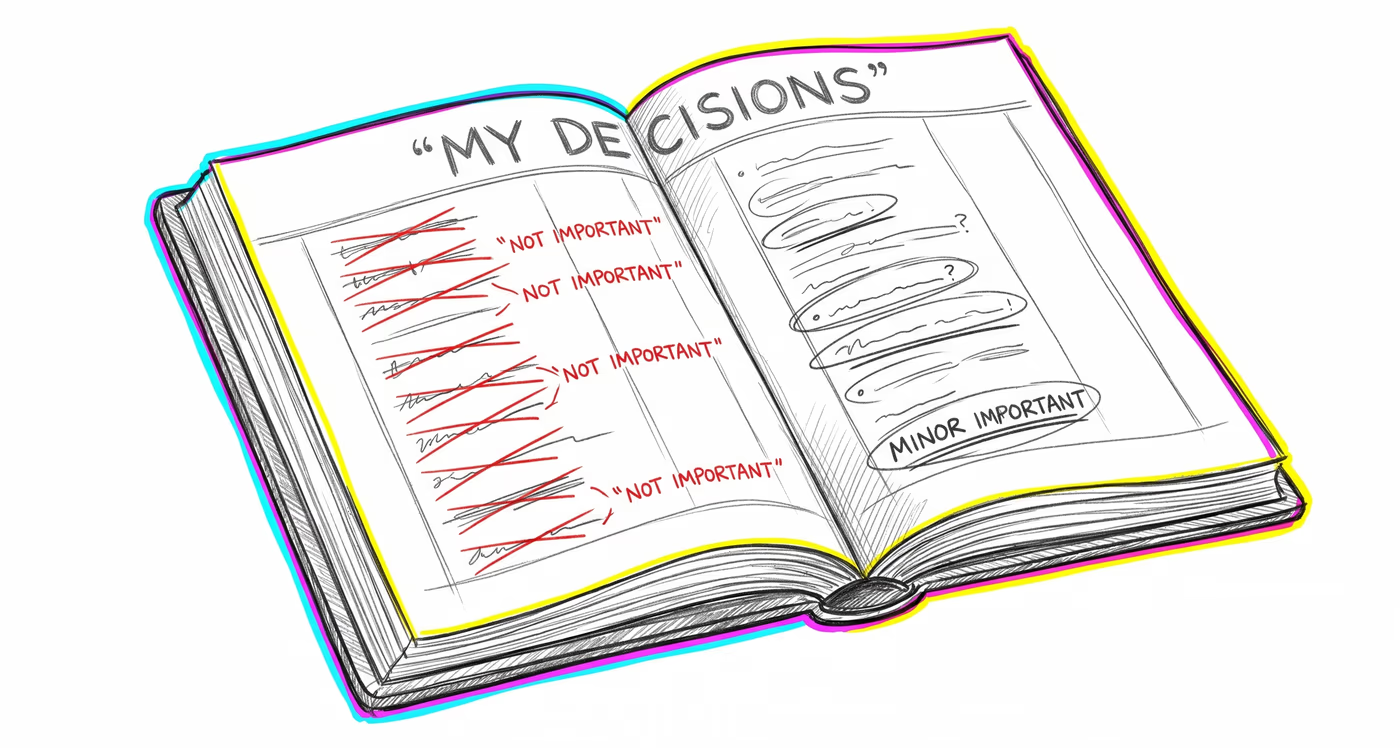
  • Keep a decision journal that records your initial reaction to outcomes and tracks how satisfaction changes over time, making your own adaptation process visible.
  • Apply the 'random assignment test': if the outcome had been assigned entirely at random, would you still eventually feel okay about it? If yes, the satisfaction may be self-generated.
  • Seek disconfirming evidence about the external agent's actual track record — do they consistently produce genuinely better outcomes, or do most people just grow satisfied regardless?
  • Practice the habit of distinguishing between 'this turned out well' and 'this was well-chosen' — the former may be your adaptation, the latter requires actual causal evidence.
WHERE IT COMES FROM
Academic origin

Daniel T. Gilbert, Ryan P. Brown, Elizabeth C. Pinel, and Timothy D. Wilson, 2000, published in the Journal of Personality and Social Psychology (Vol. 79, No. 5, pp. 690–700).

Evolutionary origin

Attributing important outcomes to powerful external agents likely strengthened social cohesion and cooperative bonds in ancestral groups. By perceiving leaders, elders, or spiritual forces as wise and benevolent, individuals reinforced group hierarchies and trust networks that enhanced collective survival. The underlying psychological immune system itself evolved to prevent prolonged rumination over irreversible losses, enabling faster behavioral recovery.

IN AI SYSTEMS

How the machines inherit it.

Recommendation systems and AI assistants benefit from this bias: when users adapt to AI-selected outcomes (music, products, content), they misattribute their self-generated satisfaction to the algorithm's intelligence, inflating perceived AI competence. This creates a feedback loop where user satisfaction ratings reflect psychological adaptation rather than genuine algorithmic accuracy, distorting training signals and evaluation metrics.

FREE FIELD ZINE

10 glitches quietly running your life.

A free field-zine PDF — ten cognitive glitches named, illustrated, with a defense move for each. Plus the weekly Glitch Report on Fridays — one bias named, two spotted in the wild, one defense move. Unsubscribe any time.

EXPLORE MORE

Related glitches.

LAUNCH PRICE

Train against your blindspots.

50 cards are free to preview. Buyers unlock the rest of the deck plus the interactive training — Spot-the-Bias Quiz unlimited, Swipe Deck with spaced repetition, My Blindspots, Decision Pre-Flight, the Printable Deck + Cheat Sheets, and the Field Guide e-book. $29.50$59.

Unlock the full deck

Everything below — yours forever. Pay once, use across every device.

Half-off launch — limited to the first 100 readers. Auto-applied at checkout.
$59 $29.50
one-time payment · lifetime access
  • All interactive digital cards — search, filter, flip, shuffle on any device
  • Five training modes — Spot-the-Bias Quiz, Swipe Deck, Pre-Flight, Blindspots, Journal
  • Curated Lenses + Decision Templates + Defense Playbook
  • Printable Deck PDFs + Field Guide e-book + Cheat Sheets + Anki Export
  • Every future improvement, included
Unlock  $29.50

30-day refund · no questions asked

Unlock the full deck

Everything below — yours forever. Pay once, use across every device.

Half-off launch — limited to the first 100 readers. Auto-applied at checkout.
$59 $29.50
one-time payment · lifetime access
  • All interactive digital cards — search, filter, flip, shuffle on any device
  • Five training modes — Spot-the-Bias Quiz, Swipe Deck, Pre-Flight, Blindspots, Journal
  • Curated Lenses + Decision Templates + Defense Playbook
  • Printable Deck PDFs + Field Guide e-book + Cheat Sheets + Anki Export
  • Every future improvement, included
Unlock  $29.50

30-day refund · no questions asked