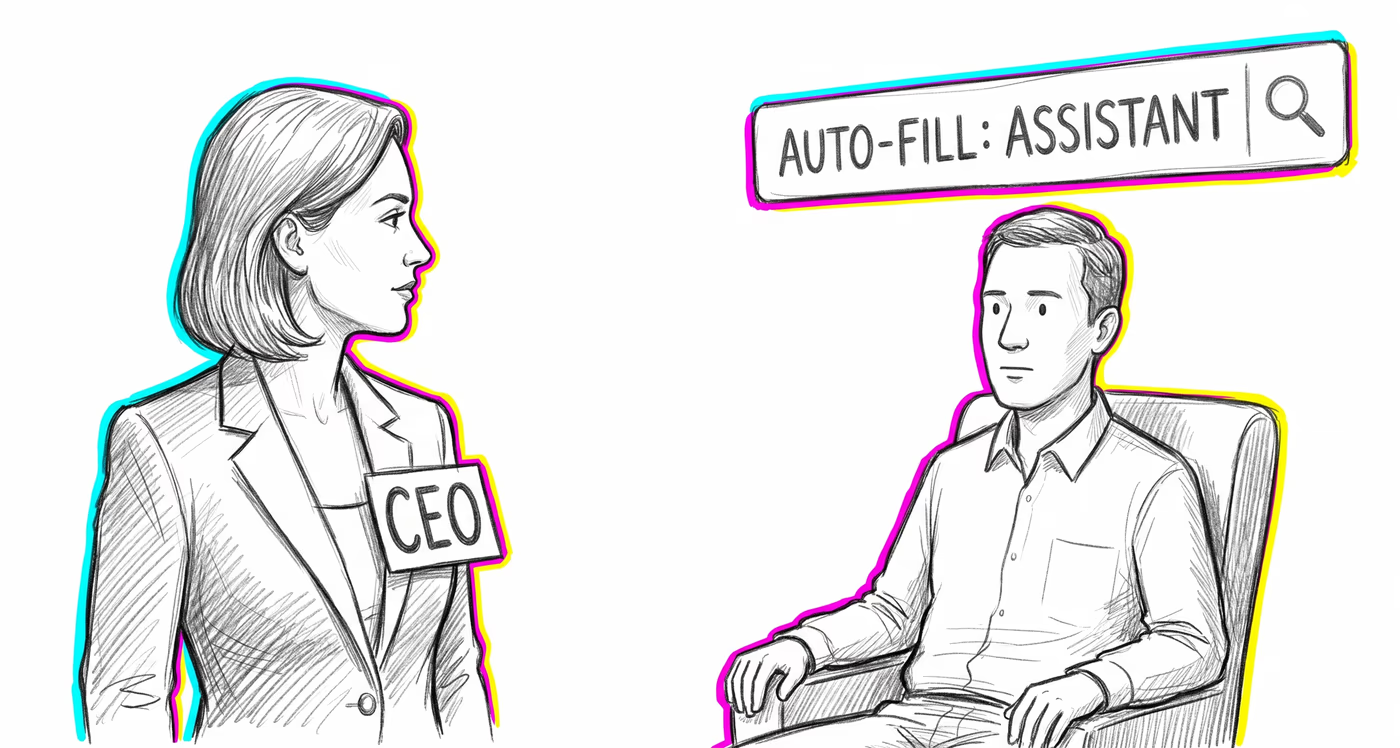
Implicit Stereotyping

aka Implicit Bias · Unconscious Bias · Implicit Social Cognition

Automatically and unconsciously attributing traits to someone based on their group membership, without awareness or intent.

WHAT IT IS

The glitch, explained plainly.

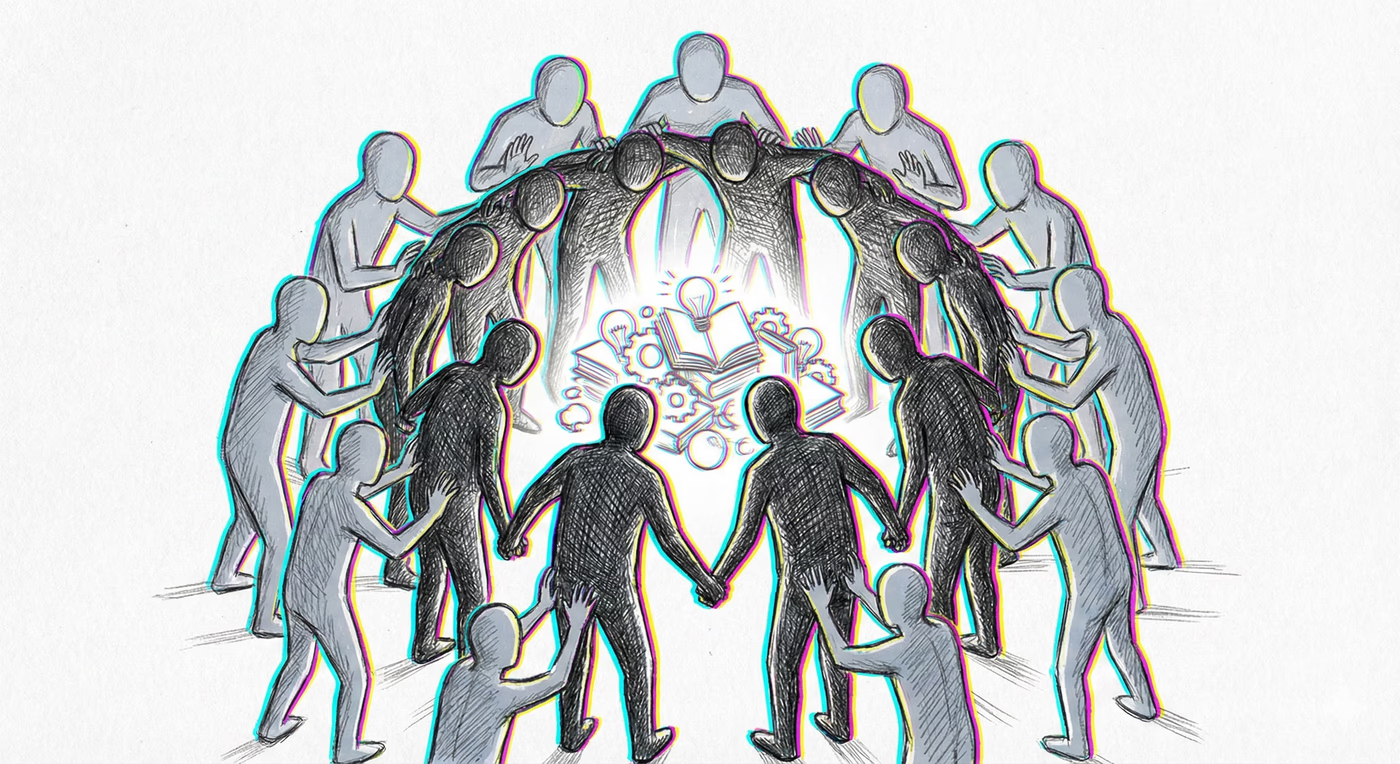
Imagine your brain has a giant filing cabinet that someone else filled up with labels before you were even old enough to choose what goes inside. When you meet someone, your brain grabs the file for their 'group' before you even have a chance to think. You might not agree with what's on the label at all, but your brain already read it and started acting on it before you could stop it.

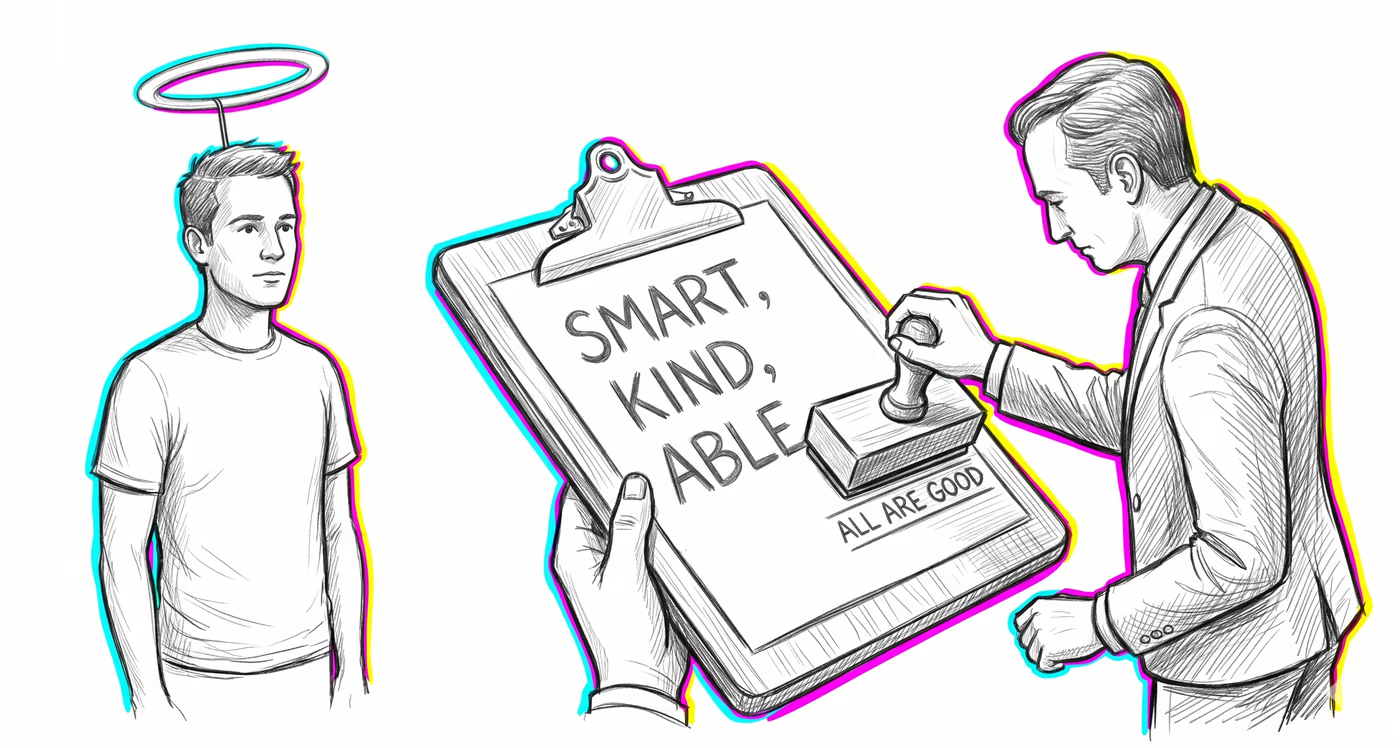
Implicit stereotyping occurs when learned associations between social categories (such as race, gender, age, or profession) and particular attributes automatically influence a person's judgments, decisions, and behaviors—even when those associations directly contradict their consciously held beliefs. Unlike explicit prejudice, implicit stereotypes operate below the threshold of awareness; a person may genuinely endorse egalitarian values while simultaneously exhibiting measurably biased behavior in reaction-time tasks or real-world decisions. These associations are absorbed through repeated cultural exposure—media, language patterns, social norms—and become deeply encoded in memory, functioning as default mental shortcuts that activate whenever a social category is encountered. The gap between what people believe they believe and how they actually behave is the hallmark signature of this phenomenon.

SOUND FAMILIAR?

Where it shows up.

  1. 01 A hiring manager reviews two identical resumes. One has the name 'James Sullivan' and the other 'Jamal Washington.' Without realizing it, the manager rates James's resume as more polished and professional, and invites only James for an interview. When asked, the manager insists they evaluate all candidates purely on qualifications.
  2. 02 A teacher unconsciously calls on boys more often during math class and girls more often during reading, despite believing strongly in gender equality. When shown video footage of her own teaching, she is shocked and insists she treats all students the same.
  3. 03 A venture capitalist listens to two founders pitch identical business plans. The male founder's assertiveness is perceived as 'confident leadership,' while the female founder's identical delivery is perceived as 'aggressive.' The VC funds the male founder and genuinely cannot identify why she preferred his pitch.
  4. 04 A doctor quickly decides a middle-aged Black patient's chest pain is likely muscular strain and recommends rest, while ordering a full cardiac workup for a white patient with the same symptoms and risk profile. The doctor has no conscious racial prejudice and scores highly on cultural competency assessments.
  5. 05 During a team brainstorming session, a project lead consistently attributes creative ideas to the native English speakers who proposed them, but unconsciously re-attributes the same quality ideas from non-native speakers to 'group consensus' in the meeting notes. He genuinely believes he is documenting contributions accurately.
IN DIFFERENT DOMAINS

Where it shows up at work.

The same glitch looks different depending on the terrain. Finance, medicine, a relationship, a team — same mechanism, different costume.

Finance & investing

Loan officers and credit reviewers may unconsciously apply stricter scrutiny to applications from minority borrowers or women entrepreneurs, resulting in higher rejection rates or less favorable terms for equally qualified applicants, even when standardized criteria are followed.
Medicine & diagnosis

Physicians may unconsciously undertreate pain in Black patients relative to white patients presenting identical symptoms, or may be slower to refer women for cardiac evaluation, reflecting implicit associations between demographic categories and perceived pain tolerance or symptom seriousness.

Education & grading

Teachers may unconsciously provide more encouragement, eye contact, and challenging questions to students from dominant social groups, while offering lower expectations and less feedback to students from marginalized groups, thereby creating self-fulfilling prophecies in academic achievement.

Relationships

People may unconsciously evaluate potential romantic partners from certain racial or ethnic backgrounds more harshly on ambiguous traits like 'trustworthiness' or 'intelligence,' or may apply different standards when interpreting the same behavior (e.g., assertiveness vs. aggression) based on a partner's gender.

Tech & product

Product teams may unconsciously design interfaces, default avatars, voice assistants, and stock imagery that center one demographic as the 'default user,' while overlooking accessibility and representation for others, thereby encoding cultural stereotypes into the user experience.

Workplace & hiring

Performance reviews frequently show implicit stereotyping patterns: identical behaviors are described with different language depending on the employee's gender or race (e.g., 'takes charge' vs. 'is bossy'), and promotion decisions may systematically favor candidates who match the implicit prototype of 'leader' held by evaluators.

Politics Media

News coverage implicitly applies different frames to identical events based on the race or religion of the actors involved—describing some groups' violence as 'terrorism' and others' as 'mental illness,' or associating certain communities with crime through disproportionate coverage that reinforces viewers' implicit associations.

HOW TO SPOT IT

Ask yourself…

  • Would I form the exact same impression of this person if they belonged to a different social group?
  • Am I reacting to this specific individual's behavior, or am I pattern-matching against a cultural template?
  • If I feel surprised by someone's competence or role, what assumption was I holding that made this surprising?
HOW TO DEFEND AGAINST IT

The playbook.

  • Take the Implicit Association Test (IAT) at Project Implicit to identify specific implicit biases, then use that awareness as a starting point, not an endpoint.
  • Implement structured decision-making: use standardized rubrics, blind evaluations (redacting names, photos, demographic markers), and checklists to reduce reliance on automatic judgments.
  • Practice individuation: before forming an impression, deliberately focus on unique personal attributes rather than group membership.
  • Increase exposure to counter-stereotypical exemplars through diverse media, social networks, and professional environments.
  • Build in 'slow-down' points before consequential decisions—pausing disrupts the automatic-to-action pipeline.
FAMOUS CASES

In history.

  • The Bertrand & Mullainathan (2004) resume audit study demonstrated that resumes with white-sounding names received 50% more callbacks than identical resumes with African-American-sounding names across Boston and Chicago employers.
  • Studies of the U.S. criminal justice system have found that implicit racial stereotypes influence prosecutorial charging decisions, jury deliberations, and sentencing outcomes, with Black defendants receiving harsher treatment than white defendants for comparable offenses.
  • Research on physicians' thrombolysis decisions found that doctors' implicit racial bias predicted whether they recommended clot-busting treatment for Black vs. white heart attack patients, even among doctors who explicitly endorsed equal treatment.
WHERE IT COMES FROM
Academic origin

Anthony Greenwald and Mahzarin Banaji formalized the concept in their landmark 1995 paper 'Implicit Social Cognition: Attitudes, Self-Esteem, and Stereotypes' published in Psychological Review. Patricia Devine's 1989 work on the automatic and controlled components of stereotypes was a key precursor.

Evolutionary origin

Rapid social categorization was adaptive for ancestral humans who needed to quickly distinguish between in-group allies and potential out-group threats. The ability to instantly classify individuals based on observable features (appearance, accent, behavior) and apply prior group-level knowledge enabled faster threat assessment and cooperation decisions in environments where hesitation could be fatal.

IN AI SYSTEMS

How the machines inherit it.

Large language models and machine learning systems absorb implicit stereotypes from their training data, reproducing and amplifying cultural associations—such as linking male names to career-related terms and female names to domestic terms. Word embeddings (like Word2Vec) have been shown to encode gender and racial stereotypes that mirror IAT results in humans. AI hiring tools, facial recognition systems, and content recommendation algorithms can systematically disadvantage underrepresented groups by operationalizing these embedded biases at scale.

Read more on Wikipedia
FREE FIELD ZINE

10 glitches quietly running your life.

A free field-zine PDF — ten cognitive glitches named, illustrated, with a defense move for each. Plus the weekly Glitch Report on Fridays — one bias named, two spotted in the wild, one defense move. Unsubscribe any time.

EXPLORE MORE

Related glitches.

LAUNCH PRICE

Train against your blindspots.

50 cards are free to preview. Buyers unlock the rest of the deck plus the interactive training — Spot-the-Bias Quiz unlimited, Swipe Deck with spaced repetition, My Blindspots, Decision Pre-Flight, the Printable Deck + Cheat Sheets, and the Field Guide e-book. $29.50$59.

Unlock the full deck

Everything below — yours forever. Pay once, use across every device.

Half-off launch — limited to the first 100 readers. Auto-applied at checkout.
$59 $29.50
one-time payment · lifetime access
  • All interactive digital cards — search, filter, flip, shuffle on any device
  • Five training modes — Spot-the-Bias Quiz, Swipe Deck, Pre-Flight, Blindspots, Journal
  • Curated Lenses + Decision Templates + Defense Playbook
  • Printable Deck PDFs + Field Guide e-book + Cheat Sheets + Anki Export
  • Every future improvement, included
Unlock  $29.50

30-day refund · no questions asked

Unlock the full deck

Everything below — yours forever. Pay once, use across every device.

Half-off launch — limited to the first 100 readers. Auto-applied at checkout.
$59 $29.50
one-time payment · lifetime access
  • All interactive digital cards — search, filter, flip, shuffle on any device
  • Five training modes — Spot-the-Bias Quiz, Swipe Deck, Pre-Flight, Blindspots, Journal
  • Curated Lenses + Decision Templates + Defense Playbook
  • Printable Deck PDFs + Field Guide e-book + Cheat Sheets + Anki Export
  • Every future improvement, included
Unlock  $29.50

30-day refund · no questions asked