Less-is-Better Effect

aka Less-is-More Effect

Preferring an objectively worse option when seen alone because it looks better on easy-to-judge qualities — a preference that reverses in direct comparison.

WHAT IT IS

The glitch, explained plainly.

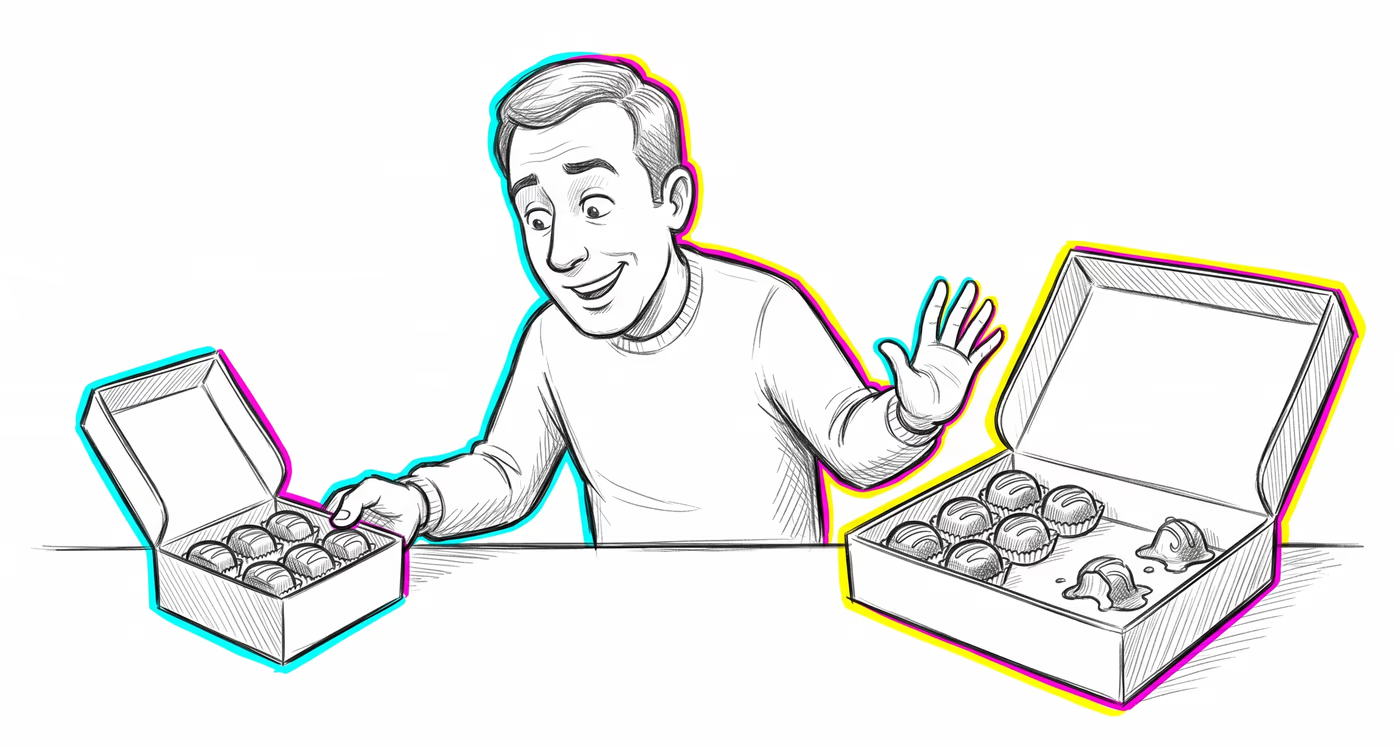
Imagine you have a tiny box perfectly packed with 10 beautiful crayons, and a bigger box with those same 10 crayons plus 5 broken ones rattling around. If you only see one box at a time, the small perfect box feels way better — even though the big box literally has everything the small one has plus more. Your brain focuses on what's easy to notice: 'ooh, they're all perfect!' instead of counting them up.

The less-is-better effect describes a systematic preference reversal that occurs when people evaluate options one at a time rather than comparing them directly. When judging an option in isolation, people disproportionately weight attributes that are easy to evaluate — such as whether a container looks full, whether items appear pristine, or how an item ranks within its product category — while neglecting attributes that are harder to assess without a comparison baseline, such as absolute quantity or objective monetary value. This leads to paradoxical outcomes where a smaller, neater, or category-topping option is valued more highly than an objectively superior but less impressive-looking alternative. Crucially, the effect vanishes under joint evaluation, when side-by-side comparison makes the hard-to-evaluate attributes (like total quantity or price) salient and easy to process.

SOUND FAMILIAR?

Where it shows up.

  1. 01 A nonprofit director is preparing two versions of their annual impact report. Version A highlights 12 highly successful case studies. Version B includes those same 12 case studies plus 8 additional ones where results were mixed. She chooses to send Version A to donors, believing they will perceive the organization as more effective, even though Version B documents more total impact.
  2. 02 A hiring manager reviews two candidates' portfolios separately on different days. Candidate X shows 5 outstanding design projects. Candidate Y shows those same 5 outstanding projects plus 3 decent but unremarkable ones. The manager rates Candidate X more favorably despite Candidate Y having strictly more demonstrated work.
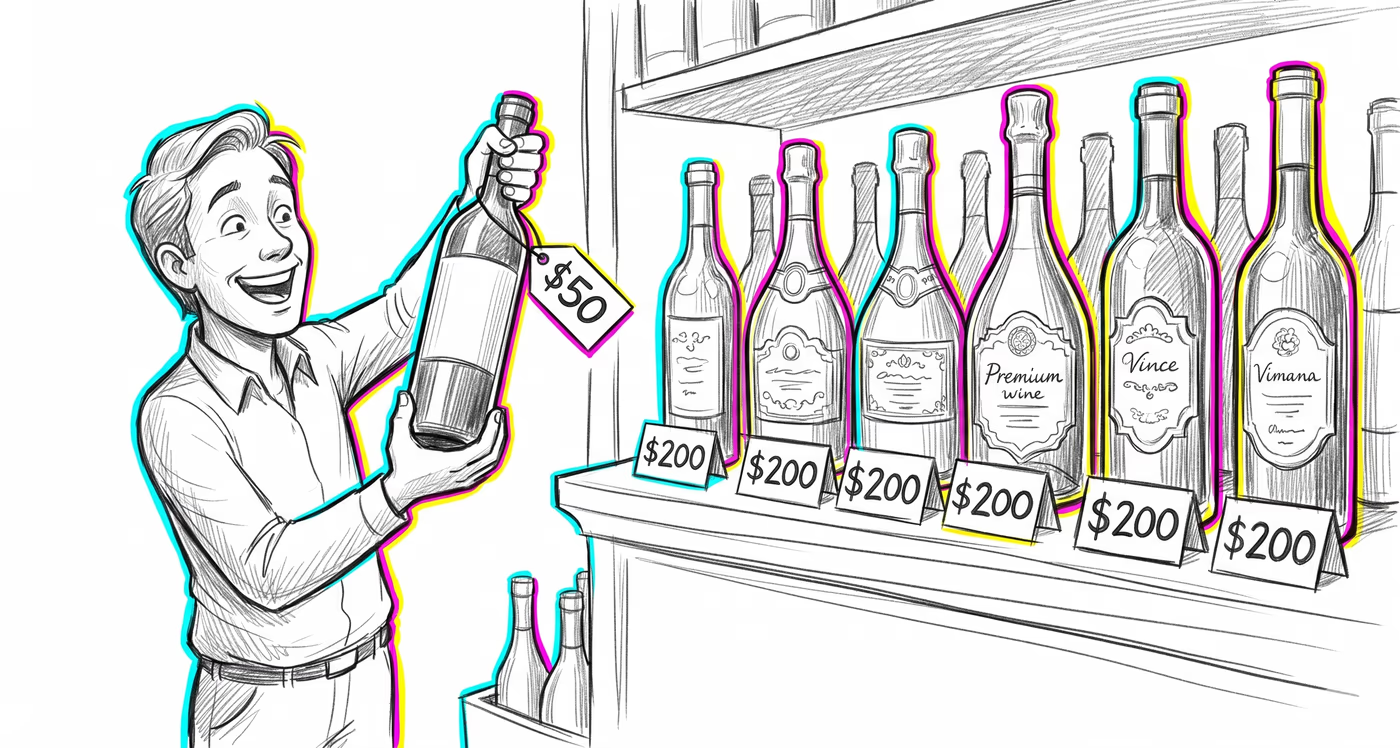
  3. 03 A wine shop owner sells a gift set of 4 premium wines for $120. He considers adding 2 mid-range wines to create a 6-bottle set for $140, but testing shows that customers shopping for individual gifts actually rate the 4-bottle set as more generous and are willing to pay more per bottle for it, because the set feels consistently luxurious.
  4. 04 A software engineer has built a demo with 6 polished features. Her colleague suggests adding 3 more partially-finished features to show broader capability. At the client presentation, the engineer insists on showing only the 6 polished ones, arguing that the incomplete features would make the entire product feel less impressive — even though more total functionality would be demonstrated.
  5. 05 A professor publishes a paper with 4 rigorous, well-controlled experiments. A reviewer suggests she could strengthen the paper by including a 5th study that has weaker methodology but directionally supportive results. She declines, suspecting that journal editors evaluating the manuscript on its own will perceive the overall evidential quality as diluted by the weaker study, even though it adds information.
IN DIFFERENT DOMAINS

Where it shows up at work.

The same glitch looks different depending on the terrain. Finance, medicine, a relationship, a team — same mechanism, different costume.

Finance & investing

Investors may perceive a fund with 8 consecutive winning quarters as more attractive than a fund with those same 8 winning quarters plus 2 break-even quarters, even though the latter fund has a longer and objectively equal-or-better track record. Separately evaluated, the imperfect record dilutes the perception of consistent excellence.

Medicine & diagnosis

Patients evaluating treatment options in isolation may prefer a drug that lists 3 clear benefits over one that lists those same 3 benefits plus 2 minor, ambiguous effects — perceiving the shorter profile as more reliably effective even when the comprehensive option is medically equivalent or superior.

Education & grading

A student's transcript with 5 A-grades can be perceived as more impressive than one showing those 5 A-grades plus 3 B-grades, even though the latter represents more coursework completed. Admissions officers reviewing applications individually may unconsciously penalize the higher-volume transcript for diluting the impression of excellence.

Relationships

A partner who gives three thoughtful, perfectly chosen gifts may be perceived as more generous than one who gives those same three gifts plus two hastily wrapped extras, because the additional lower-effort items dilute the overall impression of care and intentionality.

Tech & product

Product teams that ship a focused app with 5 well-designed features often receive higher user satisfaction ratings than teams that ship those same 5 features bundled with 3 additional half-baked ones. Users evaluate the overall experience by its average quality rather than total capability.

Workplace & hiring

An employee presenting a pitch deck with 8 strong slides is often rated higher than one presenting those 8 slides plus 4 filler slides, because decision-makers judge the presentation's quality by its average impression rather than its total informational content.

Politics Media

A political candidate's messaging built around 3 strong policy proposals can poll better than the same 3 proposals padded with 2 vague, less developed positions, because voters evaluating the platform as a whole average the quality downward rather than crediting the additional scope.

HOW TO SPOT IT

Ask yourself…

  • Am I evaluating this option in isolation, and would my preference change if I compared it directly to the alternative?
  • Am I focusing on how polished or complete this feels rather than its total objective value?
  • Would I feel differently about this if I could see a side-by-side comparison of everything I'm actually getting?
HOW TO DEFEND AGAINST IT

The playbook.

  • Force joint evaluation: Before deciding, place all options side by side and compare total value, not just qualitative impressions.
  • Quantify before you judge: Write down the objective metrics (total items, total cost, total benefit) before forming an impression.
  • Ask the subtraction test: If I removed the weaker elements from the larger option, would I now prefer the remaining items? If yes, recognize you're averaging quality rather than summing value.
  • Separate the signal from the container: Evaluate the content independently of its presentation — a half-empty large cup still holds more ice cream.
  • Use a cooling-off period: When evaluating something presented alone, delay your judgment until you can research or compare alternatives.
FAMOUS CASES

In history.

  • Research on Olympic medal satisfaction found that bronze medalists were happier than silver medalists, reflecting a less-is-better dynamic: bronze winners compared downward (almost no medal) while silver winners compared upward (almost gold), illustrating how isolated evaluation against the nearest reference point distorts satisfaction.
  • A field experiment by John List (2002) showed that baseball card collectors bid more for a set of 10 mint-condition cards than for those same 10 cards plus 3 in poor condition, even though the larger set had a higher total catalog value.
WHERE IT COMES FROM
Academic origin

Christopher K. Hsee, 1998. Formalized in his paper 'Less is Better: When Low-Value Options Are Valued More Highly than High-Value Options,' published in the Journal of Behavioral Decision Making. Built on his earlier evaluability hypothesis work (1996).

Evolutionary origin

In ancestral environments, quick assessments of resource quality over quantity often yielded better survival outcomes — a smaller cache of ripe, uncontaminated food was safer and more nutritious than a larger pile containing spoiled items. Attending to easily observable quality signals (freshness, completeness, purity) was a reliable heuristic when formal counting or weighing was impractical.

IN AI SYSTEMS

How the machines inherit it.

Recommendation algorithms trained on user satisfaction ratings may learn to suggest smaller, curated sets over larger, mixed-quality bundles because user feedback data reflects the less-is-better bias in separate evaluation contexts. This can lead models to systematically under-recommend comprehensive options in favor of artificially narrow ones, reducing the total value delivered to users.

Read more on Wikipedia
FREE FIELD ZINE

10 glitches quietly running your life.

A free field-zine PDF — ten cognitive glitches named, illustrated, with a defense move for each. Plus the weekly Glitch Report on Fridays — one bias named, two spotted in the wild, one defense move. Unsubscribe any time.

EXPLORE MORE

Related glitches.

LAUNCH PRICE

Train against your blindspots.

50 cards are free to preview. Buyers unlock the rest of the deck plus the interactive training — Spot-the-Bias Quiz unlimited, Swipe Deck with spaced repetition, My Blindspots, Decision Pre-Flight, the Printable Deck + Cheat Sheets, and the Field Guide e-book. $29.50$59.

Unlock the full deck

Everything below — yours forever. Pay once, use across every device.

Half-off launch — limited to the first 100 readers. Auto-applied at checkout.
$59 $29.50
one-time payment · lifetime access
  • All interactive digital cards — search, filter, flip, shuffle on any device
  • Five training modes — Spot-the-Bias Quiz, Swipe Deck, Pre-Flight, Blindspots, Journal
  • Curated Lenses + Decision Templates + Defense Playbook
  • Printable Deck PDFs + Field Guide e-book + Cheat Sheets + Anki Export
  • Every future improvement, included
Unlock  $29.50

30-day refund · no questions asked

Unlock the full deck

Everything below — yours forever. Pay once, use across every device.

Half-off launch — limited to the first 100 readers. Auto-applied at checkout.
$59 $29.50
one-time payment · lifetime access
  • All interactive digital cards — search, filter, flip, shuffle on any device
  • Five training modes — Spot-the-Bias Quiz, Swipe Deck, Pre-Flight, Blindspots, Journal
  • Curated Lenses + Decision Templates + Defense Playbook
  • Printable Deck PDFs + Field Guide e-book + Cheat Sheets + Anki Export
  • Every future improvement, included
Unlock  $29.50

30-day refund · no questions asked