Peak-End Rule

aka Peak-End Effect · Peak-End Heuristic

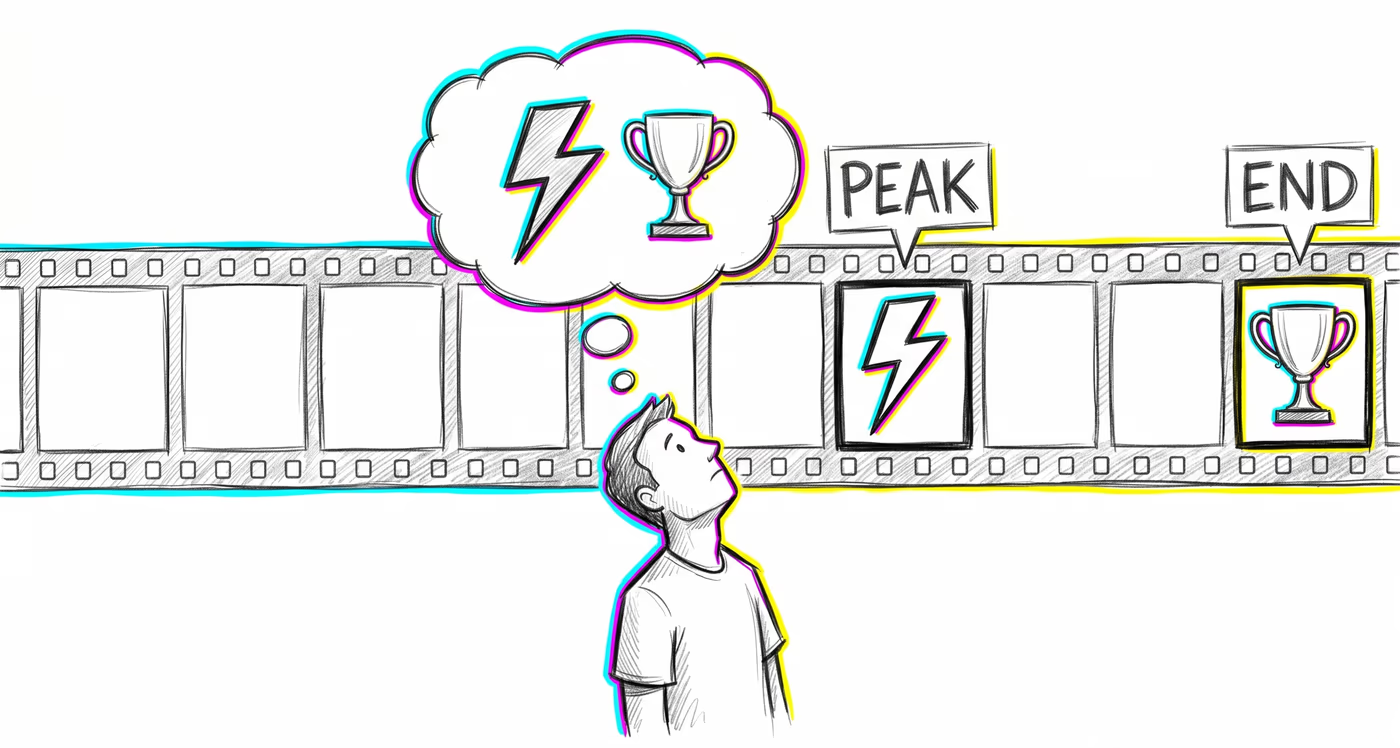
Judging an experience mainly by how it felt at its most intense moment and at the very end, not the overall average.

WHAT IT IS

The glitch, explained plainly.

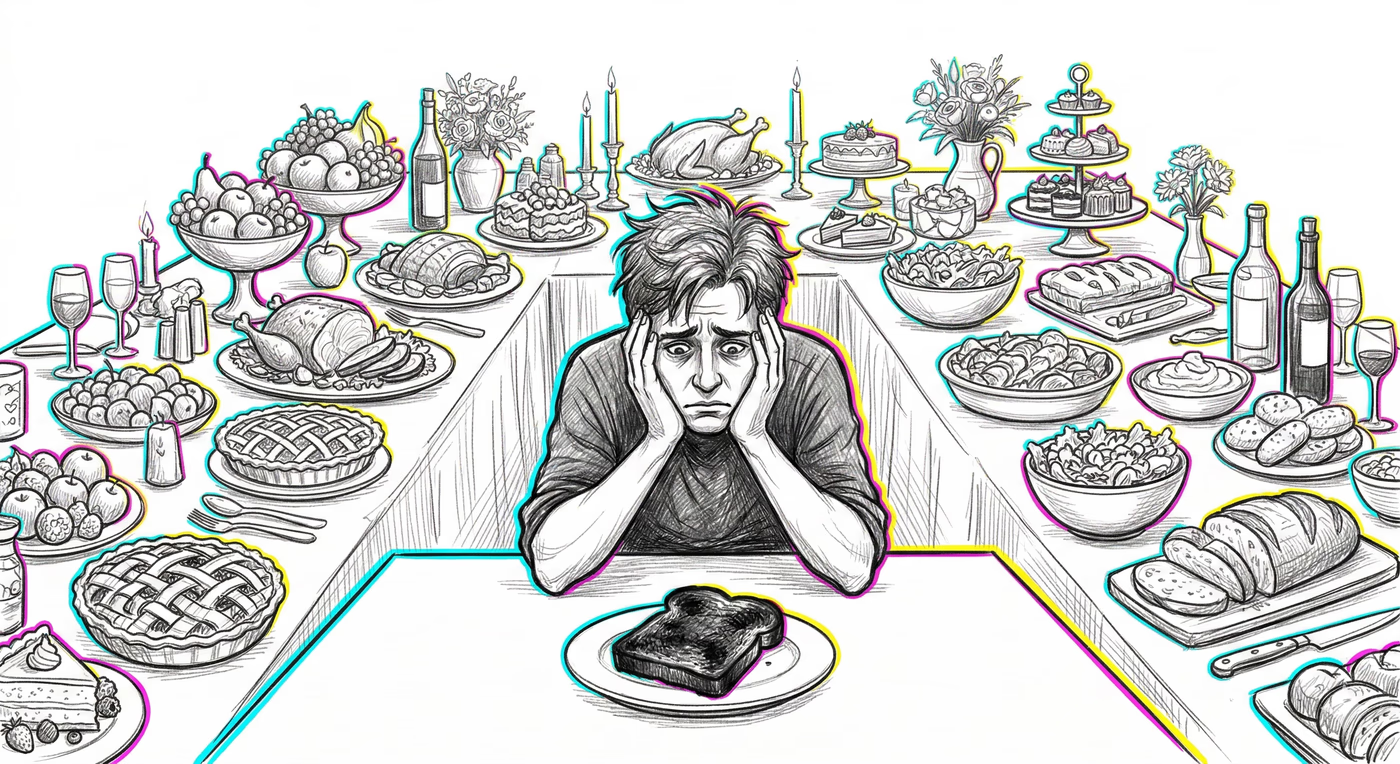
Imagine you go to a birthday party. You played boring games for two hours, but then there was an amazing magic show, and at the very end, you got the biggest slice of cake. When someone asks you about the party, you say it was awesome — because your brain only really saved the magic show and the cake, and forgot the boring parts in between.

The Peak-End Rule describes how retrospective evaluations of experiences are disproportionately shaped by two specific moments: the point of greatest emotional intensity (whether positive or negative) and the final moments before the experience concludes. The overall duration of the experience has remarkably little influence on how it is remembered, a related phenomenon known as duration neglect. This means that a long, moderately pleasant experience can be remembered less favorably than a shorter one that contained a vivid high point and a satisfying ending. The bias operates across both painful and pleasurable experiences, distorting memories of medical procedures, vacations, customer interactions, and everyday events in ways that often diverge significantly from what moment-by-moment reports would predict.

SOUND FAMILIAR?

Where it shows up.

  1. 01 A theme park designer is reviewing guest satisfaction data. Park A has consistently moderate rides and ends with a gentle exit. Park B has mostly average attractions but includes one record-breaking roller coaster in the middle and a spectacular fireworks show as the closing event. Despite Park A having higher average enjoyment ratings across all attractions, visitors rate Park B's overall experience significantly higher.
  2. 02 A hospital administrator notices that patients who underwent a slightly longer version of an uncomfortable screening procedure — where the final minute was made deliberately less painful — report more positive memories and are significantly more likely to return for follow-up screenings than patients who had the standard, shorter procedure.
  3. 03 Maria attends two three-day conferences in the same month. The first had consistently good sessions throughout but ended with a flat closing keynote. The second had mostly mediocre panels but featured one electrifying debate and a rousing finale. When her boss asks which was more valuable, Maria enthusiastically recommends the second, even though her own session-by-session notes show the first averaged higher ratings.
  4. 04 A software company redesigns its cancellation flow. Instead of improving the overall product experience, they invest heavily in making the final confirmation screen warm and personal, with a heartfelt message and a one-click option to return. Post-cancellation surveys show dramatically improved brand perception compared to the old flow, despite no changes to the product itself.
  5. 05 A financial advisor reflects on two investment periods of equal length. In the first, his portfolio delivered steady 7% annual returns. In the second, returns were volatile — mostly flat with one month of spectacular gains — but ended with a strong final quarter. He finds himself far more enthusiastic about the second period's strategy and wants to replicate it, even though his spreadsheet shows the first period yielded higher total returns.
IN DIFFERENT DOMAINS

Where it shows up at work.

The same glitch looks different depending on the terrain. Finance, medicine, a relationship, a team — same mechanism, different costume.

Finance & investing

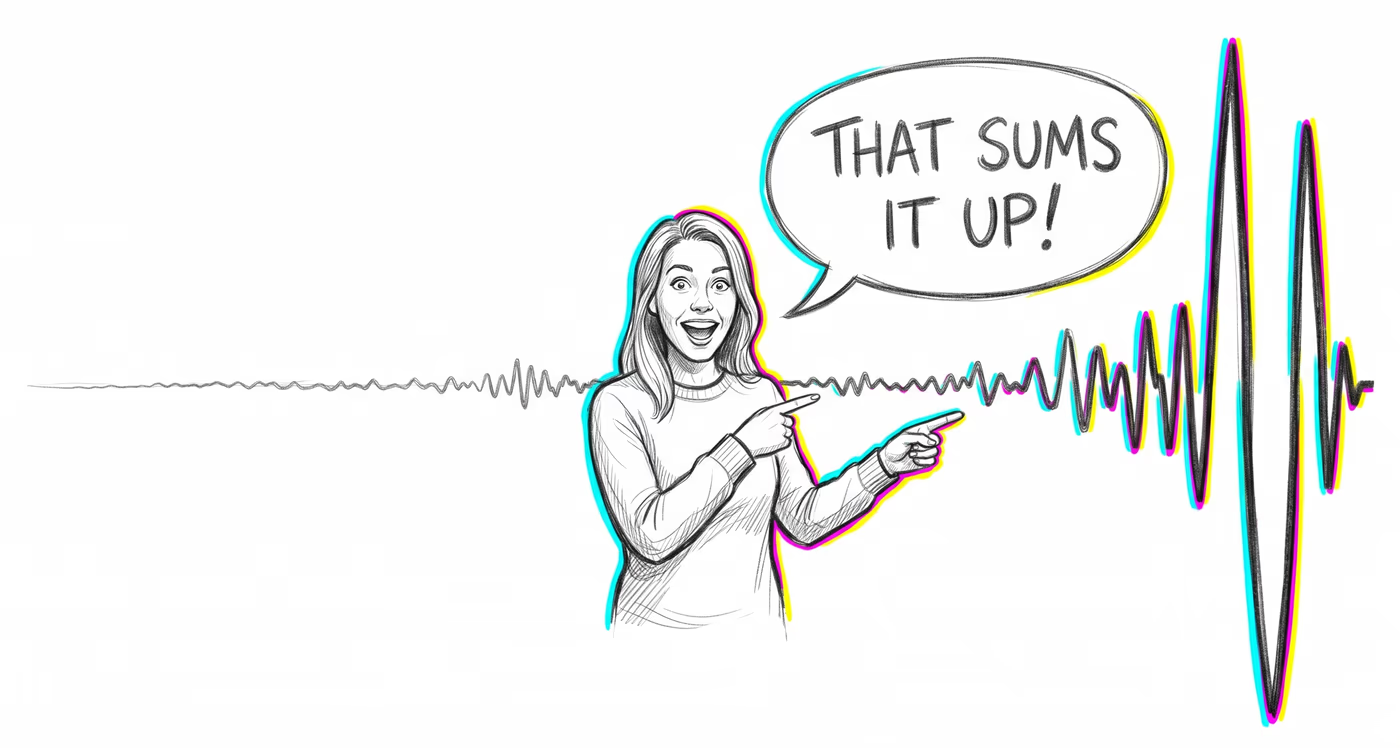
Investors tend to evaluate the quality of a trading period based on the most extreme gain or loss and the portfolio's final position, rather than on cumulative returns. This leads to preferring volatile strategies that ended well over steadier approaches with higher total yield, and it distorts reference pricing — consumers anchor on the highest price seen and the most recent price rather than the average.
Medicine & diagnosis

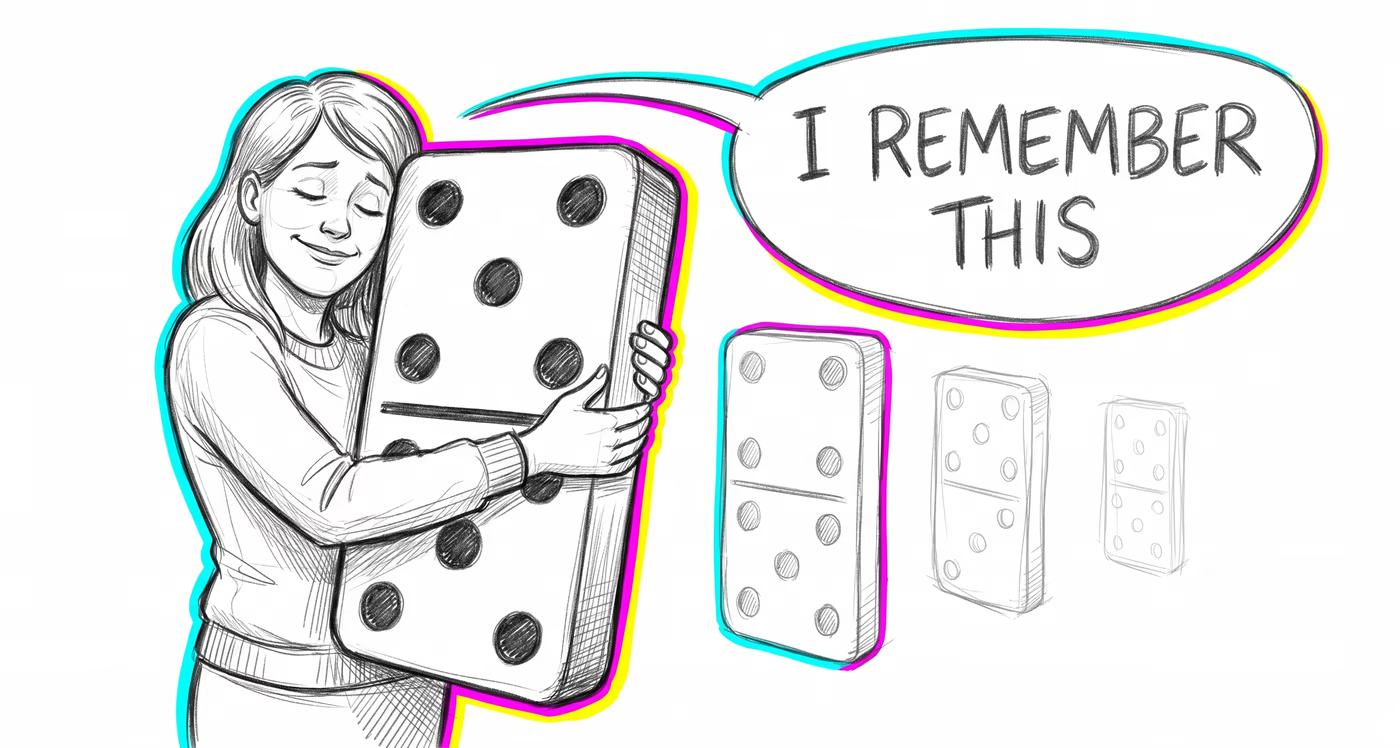
Patients' willingness to return for preventive screenings such as colonoscopies is strongly influenced by how painful the worst moment was and how the procedure ended, rather than total duration of discomfort. This has led to clinical strategies where practitioners deliberately taper pain at the end of procedures to improve patient recall and compliance with future screenings.

Education & grading

Students' retrospective evaluations of a course are disproportionately shaped by the most emotionally charged moment (a particularly exciting or frustrating class) and the final session. A course with mostly mediocre lectures but a powerful final project presentation may be rated higher than a consistently good course with a flat ending, distorting teaching evaluations.

Relationships

People's overall assessment of a relationship, a date, or a shared experience is heavily colored by the most emotionally intense interaction and how things ended. A long relationship with years of steady contentment but a bitter breakup is often remembered primarily as painful, while a brief but passionate fling that ended on a sweet note is recalled fondly.

Tech & product

Product designers exploit this bias by investing disproportionately in 'wow moments' and the offboarding or checkout experience. A smooth, delightful final confirmation screen (like Mailchimp's celebratory animation after sending a campaign) can dramatically improve user satisfaction scores even if earlier workflow steps were frustrating.

Workplace & hiring

Employees' annual satisfaction is often driven by the most emotionally intense event of the year (a major win or a painful conflict) and the tone of their year-end review, rather than the day-to-day quality of their work life. Managers who deliver negative feedback early and end reviews on a constructive note tend to leave employees with more positive retrospective evaluations.

Politics Media

Voters' memories of a political term or campaign are dominated by the most dramatic event (a scandal, a crisis response) and the candidate's final impression before the election. A presidency with steady governance but a chaotic final month may be remembered far more negatively than performance data would suggest.

HOW TO SPOT IT

Ask yourself…

  • Am I judging this entire experience based on one standout moment and how it ended, rather than considering the full duration?
  • If I wrote down how I felt at every stage, would my average rating actually match my current overall impression?
  • Am I about to make a future decision (repeat, recommend, avoid) based on a memory that ignores how long the experience lasted?
HOW TO DEFEND AGAINST IT

The playbook.

  • Keep a real-time journal or log of experiences (e.g., rate each day of a vacation, each session of a course) so you can compare moment-by-moment data against your retrospective impression.
  • Before making a repeat-or-avoid decision, explicitly ask: 'What was the average quality of this experience, and how long did it last?' rather than relying on gut recall.
  • When evaluating others' experiences (employee reviews, patient feedback), collect longitudinal data points rather than relying on single retrospective surveys.
  • Design important experiences with awareness: if you must deliver bad news or discomfort, try to end on a constructive or positive note — but also recognize when you're being manipulated by the same tactic.
  • Use the 'pre-mortem' technique: before an experience ends, pause and assess how you've felt throughout, not just in the current moment.
FAMOUS CASES

In history.

  • Kahneman and Redelmeier's colonoscopy studies (1996, 2003) demonstrated that patients who underwent a slightly prolonged but less painful ending remembered the procedure more positively and were more likely to return for follow-ups, directly influencing clinical practice discussions.
  • Disney theme parks have been cited as a deliberate application of the Peak-End Rule, engineering dramatic ride peaks and memorable park-closing spectacles (fireworks, parades) to maximize positive retrospective evaluations despite long wait times throughout the day.
WHERE IT COMES FROM
Academic origin

Barbara Fredrickson and Daniel Kahneman, 1993. Formalized in the paper 'Duration Neglect in Retrospective Evaluations of Affective Episodes' (Journal of Personality and Social Psychology, 1993) and the landmark experiment 'When More Pain Is Preferred to Less: Adding a Better End' (Psychological Science, 1993) by Kahneman, Fredrickson, Schreiber, and Redelmeier.

Evolutionary origin

In ancestral environments, the most emotionally intense moment of an encounter — such as the peak danger during a predator attack or the peak reward during a successful hunt — carried the most survival-relevant information about whether to repeat or avoid that situation. The ending of an event similarly signaled the final outcome (escape or capture, fed or still hungry). Encoding these two data points was far more computationally efficient than tracking every moment, allowing rapid future decision-making about threats and opportunities.

IN AI SYSTEMS

How the machines inherit it.

Recommendation systems and sentiment analysis models that weigh all moments of user interaction equally may fail to predict user satisfaction, because humans evaluate experiences via peak and end moments. AI systems trained on retrospective user ratings inherit the bias — they learn to optimize for peak intensity and endings rather than consistent quality, potentially leading to manipulative design patterns that game user memory rather than improving overall experience.

Read more on Wikipedia
FREE FIELD ZINE

10 glitches quietly running your life.

A free field-zine PDF — ten cognitive glitches named, illustrated, with a defense move for each. Plus the weekly Glitch Report on Fridays — one bias named, two spotted in the wild, one defense move. Unsubscribe any time.

EXPLORE MORE

Related glitches.

LAUNCH PRICE

Train against your blindspots.

50 cards are free to preview. Buyers unlock the rest of the deck plus the interactive training — Spot-the-Bias Quiz unlimited, Swipe Deck with spaced repetition, My Blindspots, Decision Pre-Flight, the Printable Deck + Cheat Sheets, and the Field Guide e-book. $29.50$59.

Unlock the full deck

Everything below — yours forever. Pay once, use across every device.

Half-off launch — limited to the first 100 readers. Auto-applied at checkout.
$59 $29.50
one-time payment · lifetime access
  • All interactive digital cards — search, filter, flip, shuffle on any device
  • Five training modes — Spot-the-Bias Quiz, Swipe Deck, Pre-Flight, Blindspots, Journal
  • Curated Lenses + Decision Templates + Defense Playbook
  • Printable Deck PDFs + Field Guide e-book + Cheat Sheets + Anki Export
  • Every future improvement, included
Unlock  $29.50

30-day refund · no questions asked

Unlock the full deck

Everything below — yours forever. Pay once, use across every device.

Half-off launch — limited to the first 100 readers. Auto-applied at checkout.
$59 $29.50
one-time payment · lifetime access
  • All interactive digital cards — search, filter, flip, shuffle on any device
  • Five training modes — Spot-the-Bias Quiz, Swipe Deck, Pre-Flight, Blindspots, Journal
  • Curated Lenses + Decision Templates + Defense Playbook
  • Printable Deck PDFs + Field Guide e-book + Cheat Sheets + Anki Export
  • Every future improvement, included
Unlock  $29.50

30-day refund · no questions asked